
Key Takeaways
- AI-generated PRs have a 32.7% acceptance rate vs. 84.4% for manual PRs, which creates large review backlogs for microservices teams.
- Microservices code reviews struggle with cross-service dependencies, API consistency, security vulnerabilities, and cascading CI failures.
- Gitar leads with automated bug fixing that analyzes CI logs, generates validated fixes, and commits them directly to PRs with full context.
- Competitors like CodeRabbit, Greptile, and Cursor Bugbot offer suggestions but lack true CI-validated auto-fixes and cross-repo analysis.
- Teams recover 20–40% productivity with Gitar’s healing engine; start your 14-day Gitar Team Plan trial for guaranteed green builds.
Why Microservices Code Reviews Break Down in 2026
AI-powered code generation increases microservices complexity and magnifies existing review bottlenecks. Development teams lose 20–40% productivity to inefficient code review workflows, which equals 4+ full-time equivalents sidelined for a 30-developer team. Teams of 25–35 developers specifically lose 174 hours per week to knowledge silos in reviews.
The core issues in microservices code review include cross-service dependency validation. A change to an authentication service can silently break downstream APIs without system-wide analysis. Most AI tools like GitHub Copilot fail at microservices breaking change prediction because they lack system-wide dependency understanding and treat code in isolation like a “smart intern seeing one document”.
Performance regressions across service boundaries, security gaps in API contracts, and CI pipeline failures that require distributed system context remain unsolved by suggestion-only tools. These tools comment on diffs but do not carry responsibility for getting builds back to green.
Teams need AI code review tools for microservices that move beyond suggestions and deliver automated bug fixing with full architectural context and CI validation.
Leading AI Code Review Tools for Microservices with Auto-Fix
Modern microservices teams evaluate tools on automated bug fixing depth, cross-repository analysis, and 2026-ready CI integrations. The tools below represent the top options for these requirements.
1. Gitar
Gitar’s healing engine focuses on end-to-end automated bug fixing for microservices. It uses hierarchical memory that maintains context per-line, per-PR, per-repo, and per-organization. Unlike competitors that only suggest fixes, Gitar automatically analyzes CI failure logs, generates validated fixes, and commits them directly to PRs.
Install Gitar now to get guaranteed green builds with full CI integration across GitHub Actions, GitLab CI, CircleCI, and Buildkite. The platform treats CI failures as tickets to resolve, not just as signals to comment on.
2. CodeRabbit
CodeRabbit supports GitHub, GitLab, Bitbucket, and Azure DevOps with 40+ linters and SAST checks and offers one-click fixes in PRs. It relies on surface-level diff-based analysis and shows medium false positive rates. Automated bug fixing remains limited, so engineers must manually implement most suggested changes.
3. Greptile
Greptile provides deep full codebase analysis for maximum bug detection, with the highest catch rate but also the highest false positives, and supports GitHub and GitLab at $30 per user each month. It offers strong microservices context but does not implement fixes automatically and does not validate changes against CI.
4. Cursor Bugbot
Cursor Bugbot is an AI agent for automated code review that integrates with GitHub and runs on every pull request, scanning for logic bugs, security vulnerabilities, and edge cases. Bugbot offers one-click fixes with “Fix in Cursor” and “Fix in Web” buttons. These fixes are not validated against CI pipelines before implementation, which shifts risk back to the team.
5. DeepSource
DeepSource maintains low false positive rates through refined algorithms for issues including security and performance. It still lacks full automation for microservices-specific fixes and cross-repository dependency analysis, so it behaves more like a precise static analysis layer than a healing engine.
Gitar vs. Other Tools: Auto-Fix and Microservices Coverage
| Tool | Auto-Fix CI Failures | Cross-Repo Microservices Analysis | Integrations | Pricing/Green Build Guarantee |
|---|---|---|---|---|
| Gitar | Yes | Yes | GitHub, GitLab, CircleCI, Buildkite, Jira, Slack | 14-day free trial/Yes |
| CodeRabbit | No | Limited | GitHub, GitLab, Bitbucket, Azure DevOps | $15-30/seat/No |
| Greptile | No | Partial | GitHub, GitLab | $30/seat/No |
| Cursor Bugbot | Limited | No | GitHub, Cursor IDE | Bundled/No |
| DeepSource | No | No | GitHub, GitLab, Bitbucket | $24+/month/No |
Gitar’s healing engine stands apart by analyzing failure logs, generating fixes with full codebase context, validating them against CI, and automatically committing working solutions. This workflow removes the manual implementation step that slows teams using suggestion-only tools.

How to Roll Out Gitar Auto-Fix for Microservices PRs
Teams can implement AI code review for microservices GitHub or GitLab workflows in a few focused steps. The process keeps control with maintainers while shifting repetitive fixes to Gitar.
1. Install GitHub or GitLab App
Add the Gitar app to your repositories through the GitHub Marketplace or GitLab integration page. Installation takes under 30 seconds and includes automatic webhook configuration.
2. Activate the 14-Day Team Plan Trial
Start your free trial at https://gitar.ai/. The trial unlocks automated bug fixing, custom rules, and all integrations for your entire team.
3. Configure Natural Language Rules
Create repository-specific rules using natural language in .gitar/rules/*.md files. Example: “PRs changing authentication or encryption code require security team review and add security-review label.” For full setup guidance, visit https://docs.gitar.ai/.
4. Enable Auto-Fix CI Integration
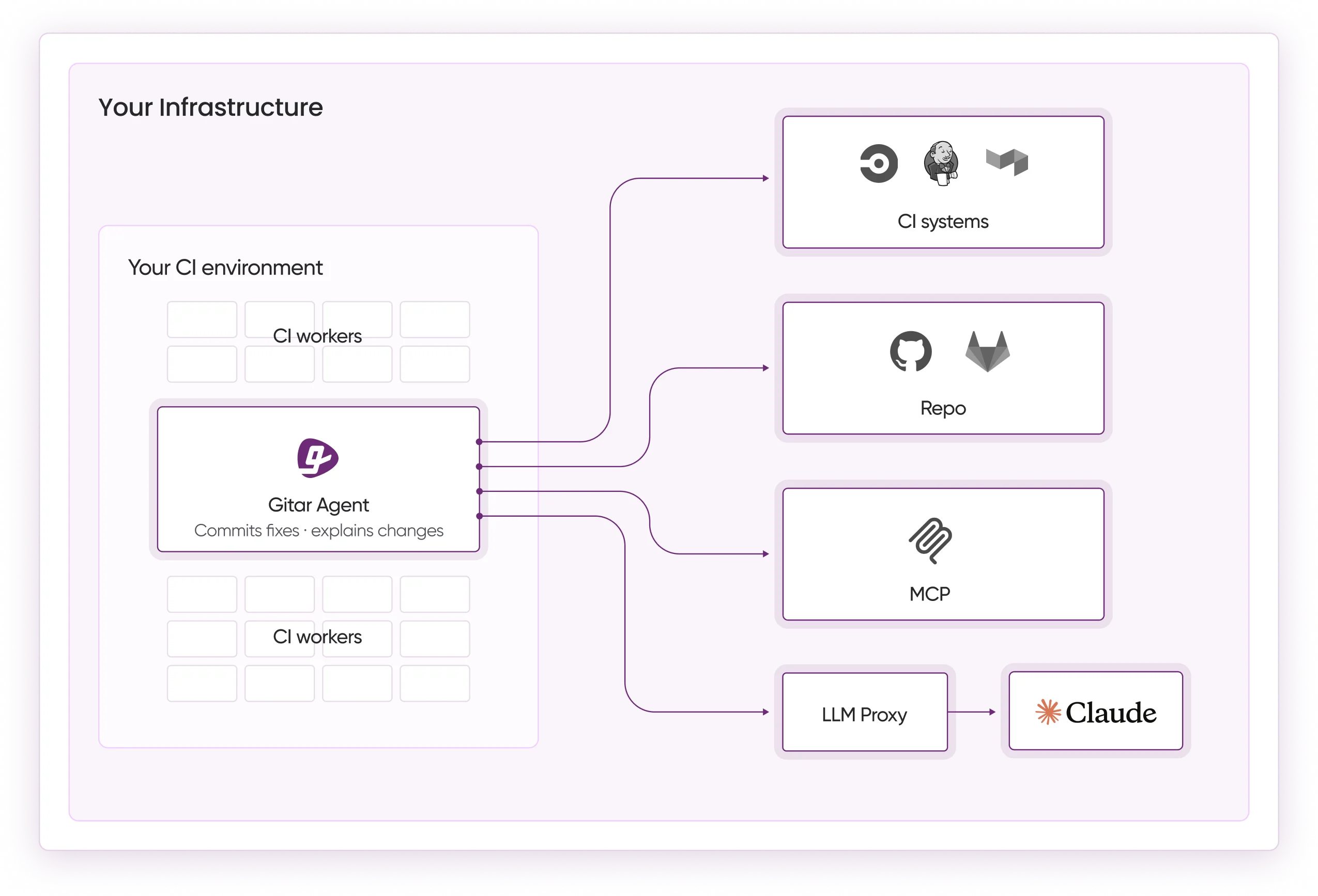
Configure Gitar to automatically analyze and fix CI failures across your microservices. The healing engine integrates with GitHub Actions, GitLab CI, CircleCI, and Buildkite to automate CI workflows tied to code review.
5. Run a Test PR Analysis
Submit a PR and let Gitar analyze it with full codebase context. Gitar identifies issues and implements fixes that keep services compatible and CI green.
6. Connect Jira and Slack
Integrate Gitar with your existing workflow tools for better context sharing. Gitar pulls product context from Jira tickets and sends consolidated notifications through Slack.
7. Track Results in the Analytics Dashboard
Use the Gitar analytics interface to monitor CI failure patterns, fix success rates, and team velocity improvements. These metrics help you tune rules and auto-fix scope.
Real-World ROI and Rollout Best Practices
2025–2026 industry benchmarks show ROI from production-ready AI agents reaching 1.7x to 10x within 6–18 months. IT Ops and AIOps benchmarks report 30–50% faster mean time to resolution, shrinking incidents from hours to minutes. For a 20-developer team, productivity losses from inefficient code review workflows can reach $1M annually.
Teams see the best results when they start with suggestion mode to build trust, then gradually enable auto-commit for specific failure types such as lint errors and deterministic test failures. They also configure cross-service dependency validation rules so Gitar checks related services when a core API changes.
Engineering leaders should define clear escalation paths for complex architectural changes and keep visibility into automated fixes through consolidated dashboard comments instead of noisy notifications. This approach keeps humans in control while Gitar handles repetitive CI breakages.
Common concerns about automated commits ease when teams use Gitar’s configurable aggression levels and full CI validation. Gitar respects specific SDK versions, multi-dependency builds, and third-party security scans before committing fixes.
Frequently Asked Questions
Does Gitar fix bugs across multiple microservices repositories?
Gitar’s hierarchical memory system maintains context per-line, per-PR, per-repo, and per-organization, which enables comprehensive codebase analysis. Gitar automatically analyzes CI failures and review feedback, then implements fixes with full context across related repositories.
How does Gitar integrate with GitHub for microservices CI workflows?
Gitar installs as a GitHub App with automatic webhook configuration. It integrates directly with GitHub Actions, analyzes CI failure logs in real time, and automatically commits fixes that are validated against your full CI environment. The platform also supports GitLab CI, CircleCI, and Buildkite for broad coverage.
What is included in the 14-day Team Plan trial?
The trial includes full access to automated bug fixing, custom repository rules, cross-repo analysis, CI failure resolution, and integrations with Jira, Slack, and Linear. The trial has no seat limits, so your entire team can experience the healing engine’s capabilities.
Which tool works best for microservices in 2026?
Gitar ranks first for microservices because its healing engine fixes code instead of only suggesting changes. Competing tools often charge $15–30 per seat for suggestion-only workflows, while Gitar provides automated bug fixing with CI validation and cross-repository context that distributed systems require.
Can Gitar handle complex CI environments with custom configurations?
Gitar handles complex CI environments by emulating your full setup, including specific SDK versions, multi-dependency builds, and third-party security scans. The Enterprise tier runs the agent inside your own CI pipeline with access to your secrets and caches, which ensures that fixes work in production environments, not just in isolation.
Conclusion: Ship Microservices Faster with CI-Validated Auto-Fix
AI code review tools for microservices with automated bug fixing in 2026 must move beyond suggestion engines and deliver real, CI-validated solutions. Gitar’s healing engine leads this shift by resolving CI failures automatically, implementing review feedback, and maintaining cross-repository context that distributed systems demand.
While competitors charge premium prices for basic commentary, Gitar offers a comprehensive 14-day trial so you can measure actual productivity gains. Start your free trial at https://gitar.ai/ and experience AI code review for microservices with automated bug fixing that delivers green builds and faster software delivery.