
Key Takeaways
- AI-generated code has shifted the main bottleneck in software delivery from writing code to verifying and reviewing it at scale.
- Manual CI troubleshooting and traditional code reviews consume significant engineering time, increase context switching, and slow distributed teams.
- AI-powered “healing engines” that apply and validate fixes autonomously differ fundamentally from suggestion-only tools that still depend on manual effort.
- Careful rollout, clear controls, and strong verification systems help teams adopt AI agents while maintaining trust, compliance, and code quality.
- Gitar provides autonomous CI and code review fixes so teams can reduce bottlenecks and ship reliably faster; install Gitar here.
The Evolving Code Review Bottleneck in 2026
AI-generated code overwhelms traditional review
AI assistants now generate a large share of production code. Many senior developers report that most of what they ship is AI-generated. This shift increases pull request size and complexity, often into tens of thousands of lines.
Human-centric review flows, optimized for small incremental changes, struggle with this volume. Teams increasingly need to review changes as higher-level units tied to intent and impact instead of line-by-line diffs. Code review bottleneck elimination tools must match the scale and speed of AI-assisted development rather than only flagging style or minor logic issues.
Manual CI and review are expensive
Manual investigation of CI failures and repeated review cycles create major hidden costs. A 20-developer team that spends one hour per engineer per day on CI and review issues, at a loaded cost of $200 per hour, loses roughly $1 million per year in productivity.
Many organizations face an “engineering productivity paradox” where more AI-generated code adds technical debt and verification toil instead of net gains. Suggestion-only tools help identify problems but leave the work of actual fixes and validation to developers.
Context switching and distributed teams feel the pain
Developers rarely submit a pull request and forget about it. CI failures and review comments pull them out of their current task, and each interruption adds context-switching overhead. A 30-minute fix can turn into an hour when ramp-up time is included.
Distributed teams face additional delays. A developer in California waiting for a reviewer in Bangalore can see simple changes dragged across multiple days. AI review tools can provide around-the-clock first-pass feedback, but suggestion-only tools still require manual implementation across time zones, which limits the benefit.
How Gitar Uses AI Agents To Remove Review Bottlenecks
From suggestions to autonomous fixes
Gitar operates as a “healing engine” for CI and pull requests. Instead of only commenting on problems, Gitar applies fixes, runs the full CI workflow, and updates the pull request with passing results before developers return to it.
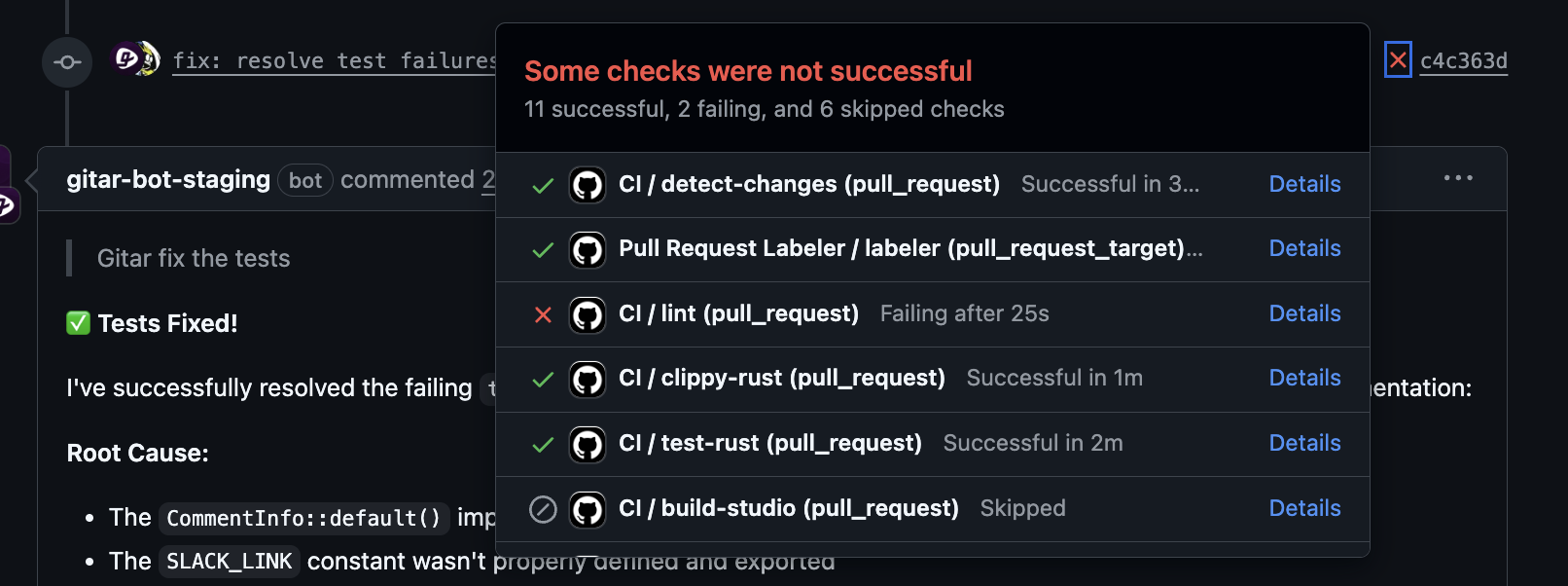
When a CI check fails due to linting errors, tests, or build issues, Gitar parses logs, identifies root causes, edits code, and commits changes back to the branch. This approach replaces the manual detect-diagnose-fix cycle that often interrupts deep work.
Install Gitar to start converting CI failures into automatic fixes.
Self-healing CI pipelines across common failures
Gitar addresses frequent CI problems such as formatting violations, snapshot updates, broken assertions, dependency issues, and simple script errors. The system treats these as routine, automatable tasks that should not require developer intervention in most cases.
Configurable modes help teams build trust. Conservative mode posts fixes as suggestions for one-click approval. Aggressive mode commits directly while keeping rollback options. Teams can start cautiously and move toward higher autonomy as confidence grows.
Applying review feedback automatically
Gitar also supports human-centric review. Reviewers can request an AI review summary, ask for strategy feedback, or leave concrete instructions for Gitar to implement.
For example, a reviewer can comment, “remove this feature from the PR and keep it focused on logging.” Gitar updates the code, pushes a commit, and explains the changes. A reviewer in India can leave instructions at the end of their day, and a developer in the US can start work with the requested changes already applied.

Running inside your real CI environment
Enterprise CI pipelines involve specific JDK versions, multiple SDKs, security scanners, and snapshot tests. Generic AI tools often miss these details.
Gitar addresses this through environment replication that mirrors real workflows, including tools such as SonarQube and Snyk, and custom build steps. This level of integration helps keep autonomous changes audit-ready and explainable for DevOps and compliance teams.
Adopting AI Agents in Your SDLC
Build vs buy for CI and review automation
Internal AI agent projects must handle concurrent pipelines, out-of-order events, complex state management, and wave-based CI execution. These requirements extend far beyond calling a model API.
Teams that develop their own agents need to invest in orchestration, memory, error handling, and long-term maintenance. Many organizations choose dedicated tools like Gitar so that internal engineering effort can focus on product features instead of building and running agent infrastructure.
Configuring automation to build trust
Trust is often the main barrier to autonomous fixes. One recent survey reported that 96% of developers do not fully trust the functional accuracy of AI-generated code.
Gitar supports a gradual path. Teams can start with suggestion-only mode, observe dozens of successful fixes, and then enable direct commits for specific repositories or failure types. Rollback options, approval workflows, and detailed logs help satisfy governance and risk requirements.
Rolling out in structured phases
A practical rollout often follows three stages. First, teams install the GitHub App on selected repositories, connect CI systems, and run in suggestion-only mode. Second, developers experience their first automatic fixes and expand usage to more repositories. Third, senior engineers begin using Gitar for targeted refactors and higher-automation modes, backed by clear rules and audit trails.
Quantifying ROI From Bottleneck Elimination
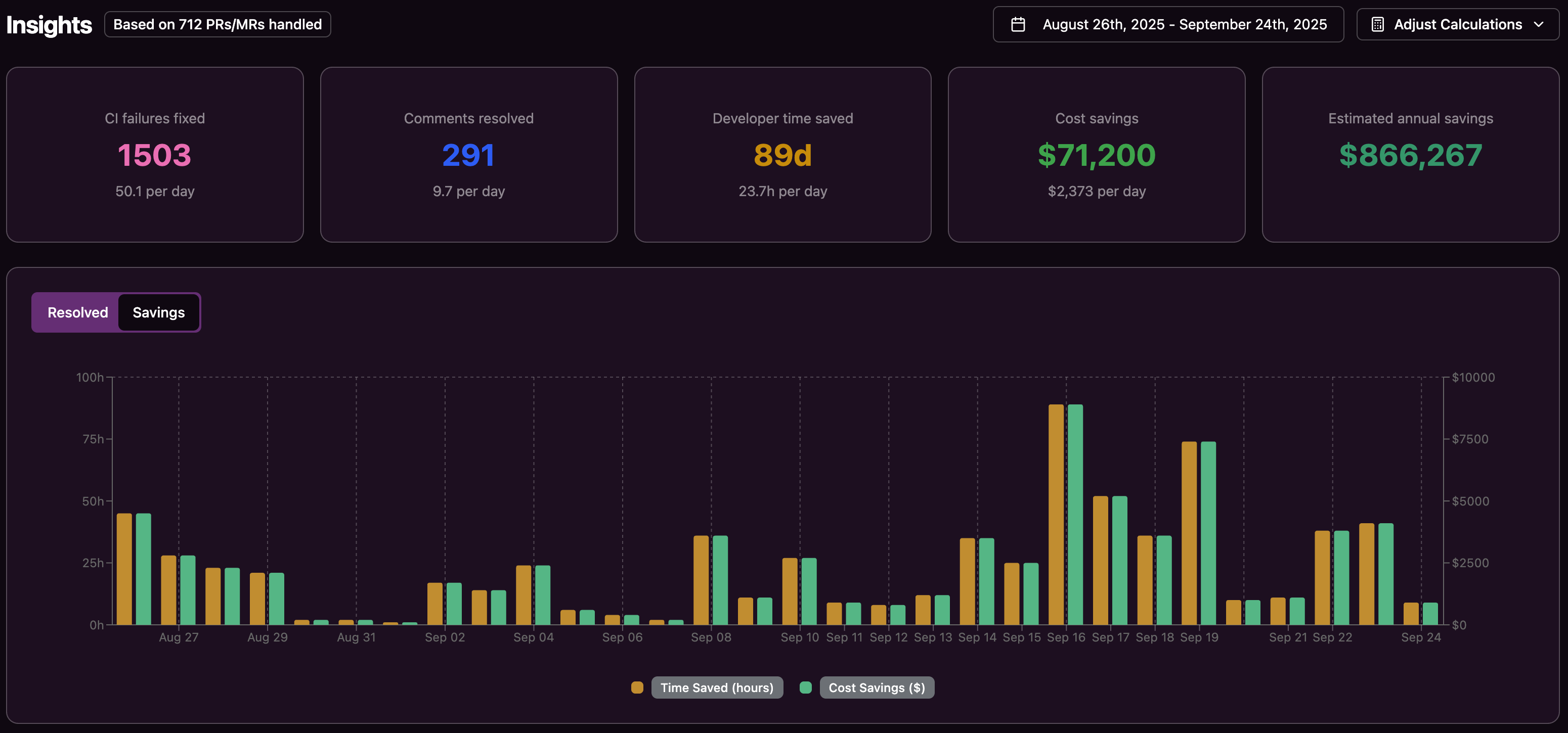
Return on investment starts with simple math. A 20-developer team that saves even 30 minutes per day per engineer on CI and review work recovers about 2,500 hours per year. At $200 per hour, that equals $500,000 in regained capacity.
Indirect benefits also matter. These include lower context-switching overhead, fewer “hero” debugging efforts late in the release cycle, and higher consistency of fixes across repositories. Teams often see improved morale as engineers spend more time on design and feature work and less on repetitive CI hygiene.
How Gitar Compares to Other Code Review Tools
Suggestion engines vs healing engines
Most AI review tools act as assistants that comment on pull requests or integrate into IDEs. These suggestion engines help developers spot issues, but still rely on manual fixes and testing.
Healing engines like Gitar focus on autonomous resolution and validation. They apply changes, run the full CI pipeline, and present passing results for review.
|
Tool Type |
Automation Level |
Validation Method |
Developer Effort |
|
Suggestion Engines |
Advisory |
Manual testing |
Apply and verify fixes |
|
Healing Engines |
Autonomous |
Full CI pipeline |
Review and approve |
|
Manual Processes |
None |
Developer testing |
End-to-end workflow |
On-demand AI tools such as Claude and IDE-based assistants like GitHub Copilot serve earlier stages of the lifecycle. They help generate and edit code before or during pull request creation. Gitar focuses on the post-commit phase, where CI failures and review changes often block merges.
Risks To Watch When Adding AI to Code Review
Avoid amplifying weak processes
Poor verification and governance can cause AI tools to amplify existing process weaknesses. Weak test suites, missing quality gates, and unclear ownership often lead to more defects rather than fewer.
Strong automated tests, static analysis, and clear review policies provide the guardrails that autonomous agents need. Gitar works best when it operates within robust verification systems rather than as a replacement for them.
Balance speed with verification
Effective AI-based workflows emphasize tests, analysis, security scanning, and review policies when human review becomes lighter. Skipping these steps often pushes problems into production.
Teams can apply a “vibe, then verify” mindset. AI helps move fast during implementation, while CI, quality gates, and selective human review maintain standards.
Plan for documentation and change management
Missing or unclear documentation is a measurable bottleneck for reviewers. AI agents working without sufficient context may introduce changes that are technically correct but misaligned with domain rules or product decisions.
Clear documentation, escalation paths, and training around where AI is appropriate help teams integrate tools like Gitar into existing practices without undermining ownership or accountability.
Frequently Asked Questions
How do AI agents improve flow state and reduce context switching?
AI agents such as Gitar keep developers focused on their current task while CI runs in the background. When linting, tests, or builds fail, Gitar investigates, applies fixes, and pushes commits without waiting for the original author to return.
This reduces the number of times engineers must stop feature work to chase CI issues. Fewer interruptions mean shorter ramp-up times and more sustained progress on complex tasks.
How can AI agents help with large AI-generated pull requests?
Large PRs are difficult to review line by line. Gitar handles mechanical issues automatically and helps summarize and prioritize changes so that reviewers can concentrate on design, risk, and business logic.
For distributed teams, Gitar can process comments and apply requested changes between time zones, so reviewers and authors start their day with updated, passing pull requests instead of long backlogs of manual fixes.
What happens when Gitar cannot safely fix a problem?
Gitar escalates issues that require human judgment. When it encounters errors that fall outside configured rules or confidence thresholds, it documents what it attempted, surfaces diagnostic details, and asks for a human decision.
Teams can treat these cases as feedback to refine rules or improve tests. Over time, this loop expands the range of issues that Gitar can handle while keeping humans in control of high-impact decisions.
Conclusion: Moving Toward Autonomous, Verified Delivery
Modern practices increasingly shift from “code review” to “change review,” focusing on intent, risk, and architectural fit. AI-generated code volume makes this shift necessary, and manual-only processes rarely keep up.
Healing engines like Gitar help teams reduce bottlenecks by automating routine CI fixes and review changes while preserving verification and auditability. Organizations that adopt these tools with clear controls, strong tests, and structured rollout plans can reclaim substantial engineering capacity in 2026.
Teams that want to reduce CI toil and review delays can start now. Install Gitar to introduce autonomous CI and review fixes into your workflow and align developer time more closely with design and product outcomes.