
Key Takeaways for Faster, Safer AI Code Reviews
- AI coding tools generate code 3-5x faster, but PR review times have surged 91%, creating serious bottlenecks for engineering teams.
- AI-generated code has 75% more logic issues and 1.7x more problems than human code, so teams need rigorous human oversight.
- Nine core practices, including incremental PRs under 400 lines, test-driven development, and natural language rules, keep AI reviews scalable.
- Gitar’s autonomous healing engine auto-fixes CI failures, applies review feedback, and keeps builds green, unlike suggestion-only tools.
- Teams using Gitar cut CI and review time from 1 hour to 15 minutes per developer daily; try Gitar free to scale reviews without adding headcount.
The Solution: Gitar’s Autonomous Healing Engine for CI and Reviews
Gitar turns code review from a suggestion engine into an autonomous healing platform. Competing tools charge $15-30 per developer for comments that still require manual fixes. Gitar actually fixes your code, resolves CI failures, addresses review feedback, and keeps builds green with minimal manual effort.
The platform offers a 14-day free Team Plan trial that highlights the difference between suggestion engines and healing engines:
| Capability | CodeRabbit/Greptile | Gitar |
|---|---|---|
| PR Summaries | Yes | Yes (concise, single comment) |
| Inline Suggestions | Yes | Yes + auto-apply |
| CI Auto-Fix | No | Yes (green build guarantee) |
| Natural Language Rules | No | Yes (docs.gitar.ai) |
Engineering teams at Tigris report that Gitar’s PR summaries are “more concise than Greptile/Bugbot.” Collate’s engineering lead calls the “unrelated PR failure detection” feature a major time saver because it separates infrastructure flakiness from real code bugs.
Install Gitar now, automatically fix broken builds, and start shipping higher quality software faster (try it free).
9 AI Code Review Best Practices for Modern Engineering Teams
1. Keep Human-in-the-Loop Oversight on AI-Generated Code
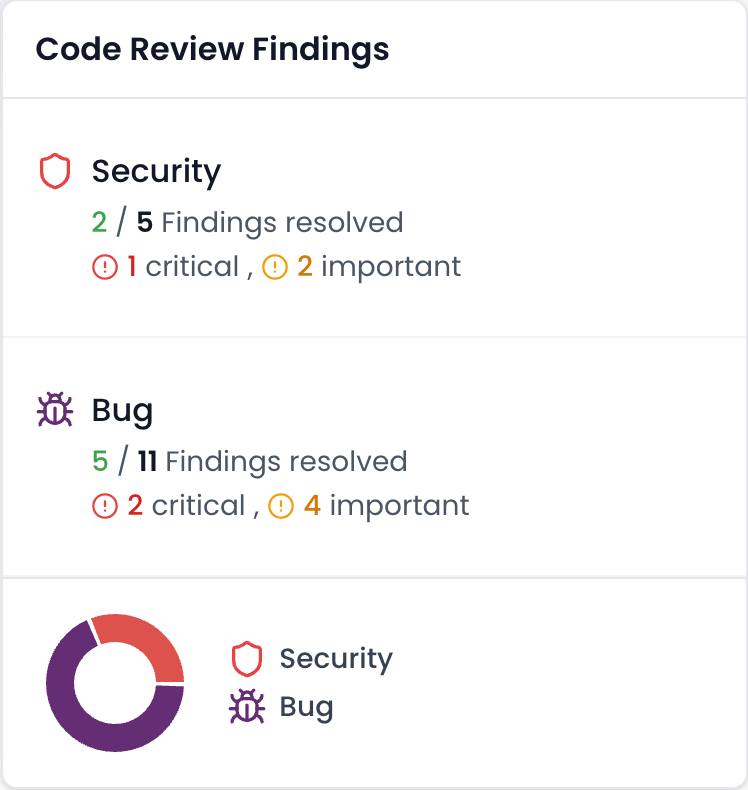
Treat AI-generated code like output from a junior developer who needs senior review. AI-coauthored PRs have about 1.7x more issues than human PRs, so human oversight protects code quality.
Use a checklist for every AI-heavy PR. Verify business logic, inspect edge cases, and review security impact. Gitar automates initial triage, flags low-risk changes for faster review, and routes high-risk modifications to senior engineers.
2. Enforce Small PRs and Test-Driven Development for AI Work
Keep every PR under 400 lines of code to protect review quality and reduce cognitive load. AI speeds up code creation, but smaller PRs still make debugging and review much easier.
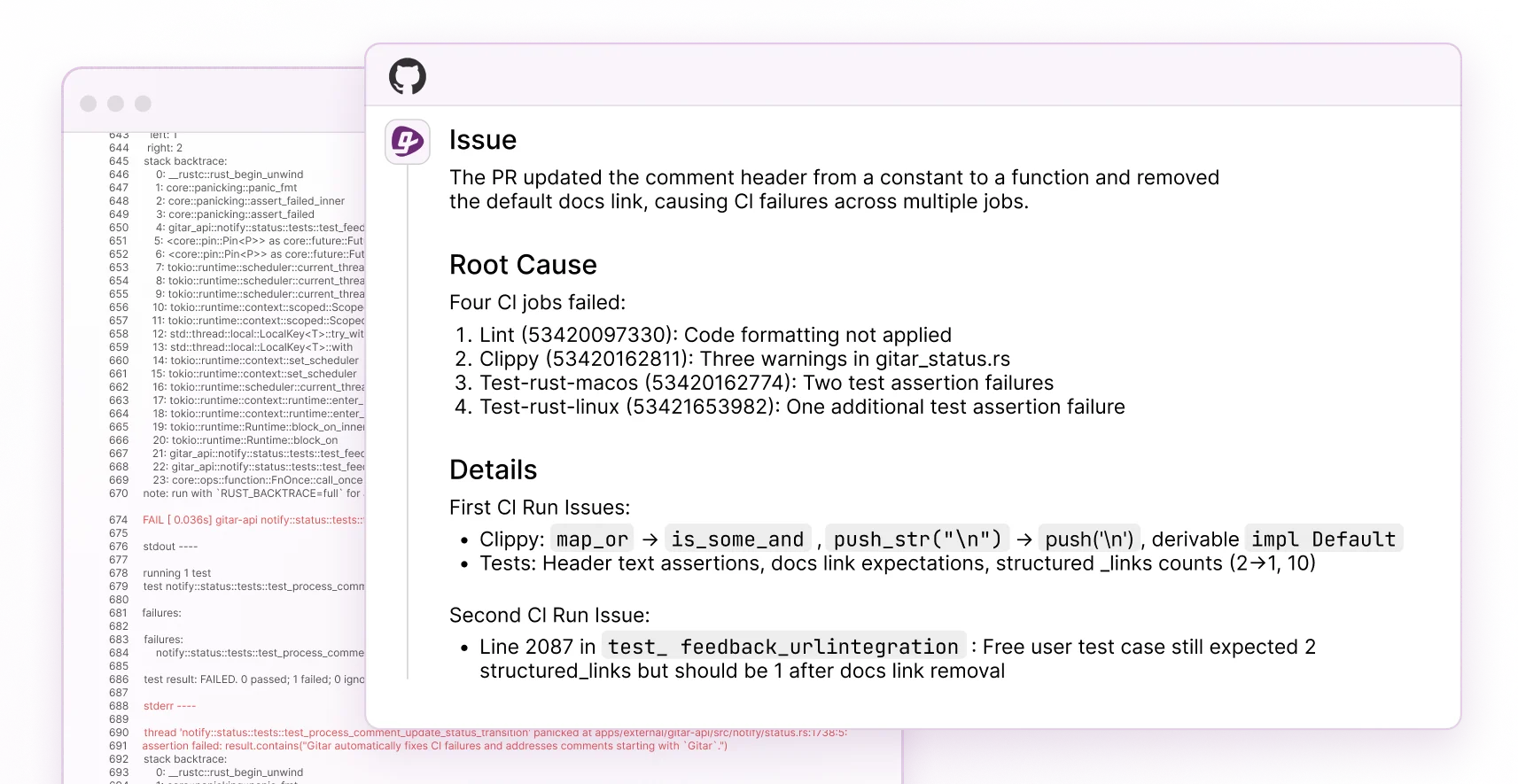
Use tests as the ground truth for AI-generated behavior. When CI tests fail, Gitar analyzes failure logs, proposes fixes, and validates them against your test suite before committing changes.
3. Standardize Prompts for Consistent AI Output
Create team-wide prompt guidelines that include architecture details, coding conventions, and security requirements. Consistent prompts produce more predictable AI output and reduce review time.
Document common patterns and anti-patterns in your codebase. Share prompts that reliably generate code aligned with your standards and architectural choices.
4. Use AI for Triage and Reserve Senior Review for High-Risk Changes
Review security-relevant behavior, data flows, and access enforcement explicitly, especially when AI writes the code. Automate detection of security-sensitive changes and route them to the right reviewers.
Gitar’s risk assessment flags changes to authentication, encryption, and data access patterns. Critical updates receive deep human review, while routine changes move through the pipeline quickly.
5. Add CI Auto-Fixes to Heal Failures Automatically
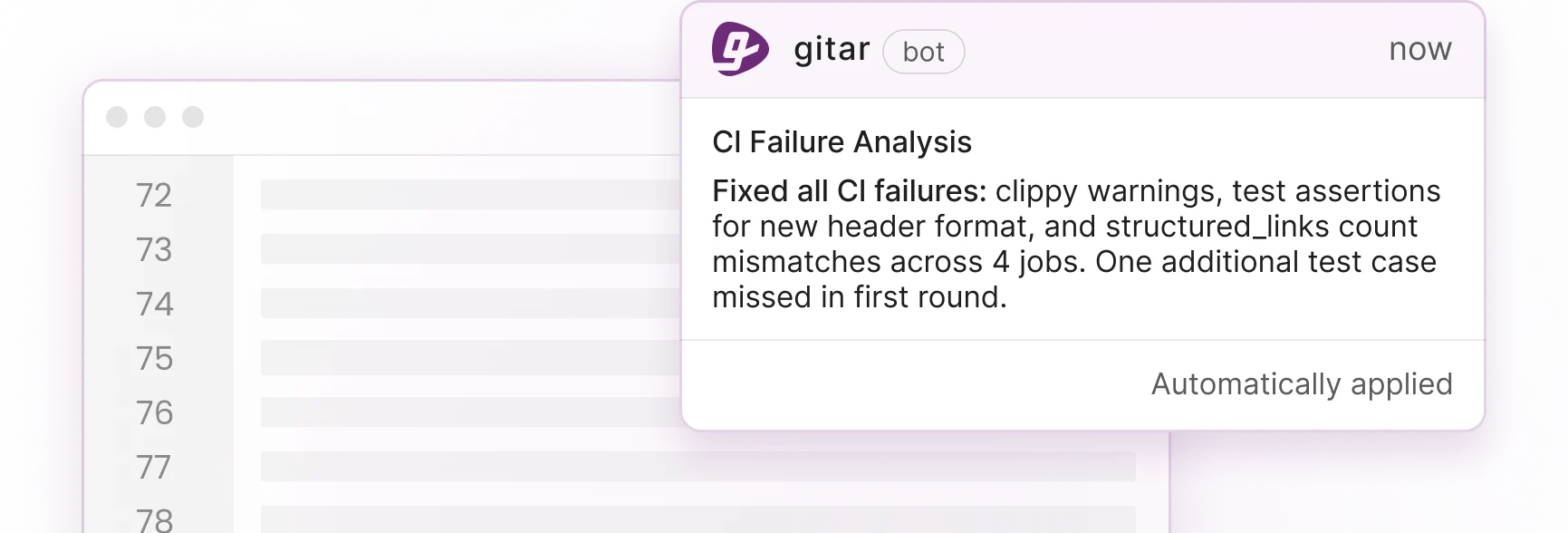
CI failures often cause context switching and slow feature delivery. Autonomous healing analyzes failure logs, generates fixes, and commits them with minimal human input.
Gitar’s healing engine repairs lint errors, test failures, build breaks, and dependency issues without manual work. The system runs your full CI pipeline before committing, so fixes actually resolve the root problem.
6. Track Review Quality and Velocity with Clear Metrics
Track PR cycle time, which has increased by 91% for teams using AI coding tools. Monitor revert rates, time-to-merge, and defects per thousand lines of code to measure review health.
Capture baseline metrics before adding AI review tools, then measure changes in throughput and quality. AI-assisted review can reduce review time by 62% without hurting quality when teams apply it correctly.
7. Automate Workflows with Natural Language Repository Rules
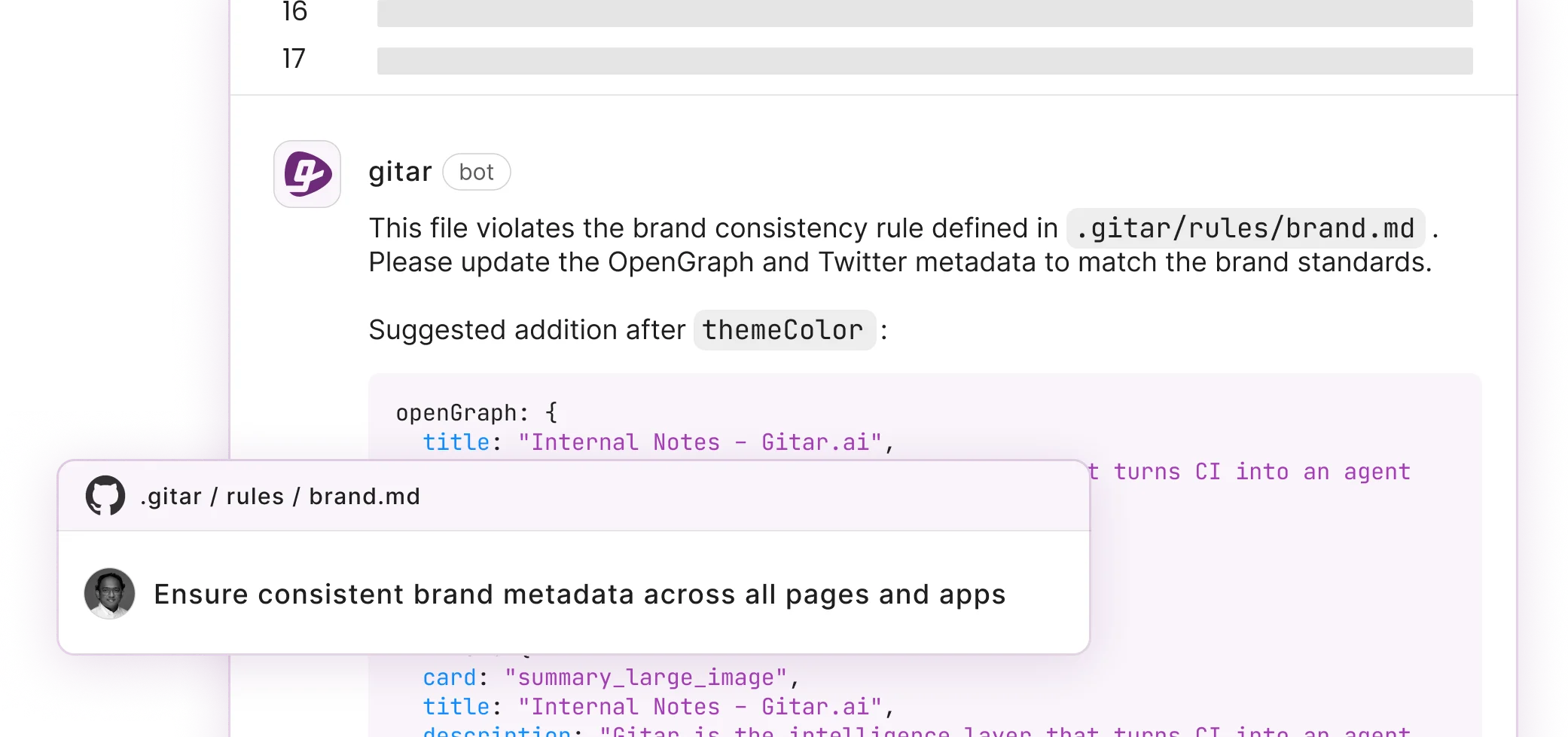
Replace complex YAML configurations with natural language rules that respond to PR events. Gitar’s repository rules let teams define workflows in plain English instead of dense syntax.
Example: “When PRs modify authentication code, assign security team and add security-review label.” This approach lowers the barrier to CI workflow automation and lets non-DevOps teammates improve processes.
8. Set Team Guidelines for AI Usage and Code Ownership
Define ownership so the developer who prompts the AI remains responsible for the generated code. Address code duplication, which has increased 4x with AI adoption.
Document approved AI tools, recommended usage patterns, and review rules. Clarify when AI assistance works well and when complex or security-critical work should stay manual.
9. Use Deep Analytics and Integrations to Improve the Pipeline
Connect code review tools with project management platforms like Jira and communication tools like Slack to keep context visible. Gitar pulls product context from these integrations to understand the business purpose behind code changes.
Use analytics to spot patterns in CI failures, review delays, and code quality trends. These insights support continuous improvement and help teams increase productivity in AI-assisted development.
Proven ROI: Results Before and After Gitar
Teams that adopt autonomous code review see major gains in productivity and cost savings:
| Metric | Before Gitar | After Gitar |
|---|---|---|
| Time on CI/Reviews | 1 hour/day/developer | 15 minutes/day/developer |
| PR Cycle Time | 91% increase from baseline | 85% reduction from peak |
| Annual Cost (20-dev team) | $1M in lost productivity | $250K total cost |
These gains come from removing manual CI failure resolution, cutting context switching, and automating routine review tasks that previously consumed large blocks of developer time.
Gitar Implementation Playbook for Your Team
Successful Gitar rollouts follow a phased approach that builds trust while showing clear value.
Phase 1: Installation and Trial – Install the GitHub App or GitLab integration and start your 14-day Team Plan trial. Gitar immediately begins posting dashboard comments on PRs.
Phase 2: Trust Building – Start in suggestion mode and review every fix. Watch Gitar resolve lint errors, test failures, and build breaks while keeping feedback in a single comment thread.
Phase 3: Automation – Enable auto-commit for trusted fixes such as formatting and simple test failures. Add repository rules for workflow automation and connect Jira and Slack integrations.
Phase 4: Platform Expansion – Use the analytics dashboard to study CI failure patterns, design custom workflows with natural language rules, and explore Enterprise deployment for maximum security and context.
Install Gitar now, automatically fix broken builds, and start shipping higher quality software faster (try it free).
Frequently Asked Questions About Gitar
How Gitar Differs from CodeRabbit and Other AI Review Tools
CodeRabbit and similar tools act as suggestion engines that analyze code and leave comments for developers to implement. Gitar operates as a healing engine that fixes the code directly. When CI fails because of a lint error or test failure, Gitar reads the logs, generates a validated fix, and commits it automatically. Teams pay for autonomous resolution of bottlenecks instead of static suggestions, and the 14-day free trial makes this difference clear.
How to Trust Automated Commits in Your Codebase
Gitar provides configurable automation levels so teams can build trust gradually. Start in suggestion mode and approve each fix manually, then enable auto-commit for specific failure types such as formatting or simple test issues. Gitar validates every fix against your full CI pipeline before committing, so changes address the real problem. You control how aggressive automation becomes.
How Teams Should Validate AI-Generated Code
Use incremental PRs under 400 lines of code and pair them with test-driven development. Rely on automated CI checks as the first validation layer, then apply human review to business logic and architecture. Gitar automates CI healing so reviewers can focus on design, maintainability, and security instead of syntax and flaky tests.
How to Measure Success with AI-Assisted Code Review
Track PR cycle time, revert rates, and time spent on CI and review work per developer. Capture baseline numbers before rollout, then compare after adoption. High-performing teams often see an 85% reduction in time spent on CI failures and review cycles, which translates into large productivity and cost gains.
What to Expect When Integrating Gitar with Existing CI/CD
Gitar supports GitHub Actions, GitLab CI, CircleCI, and Buildkite out of the box. The platform emulates your full environment, including SDK versions, multi-dependency builds, and third-party scans. Enterprise deployment runs the agent inside your CI with access to your secrets and caches, so fixes work in real production environments instead of isolated tests.
Conclusion: Remove Your AI Review Bottleneck with Gitar
The AI coding wave created a new bottleneck, where teams generate code quickly but struggle to review and merge it. These nine best practices, combined with Gitar’s autonomous healing engine, let engineering teams scale code quality without adding more reviewers.
The gap between suggestion engines and healing engines is transformational, not incremental. While competitors charge premium prices for comments that still require manual work, Gitar proves value by fixing your code and keeping builds green.
Install Gitar now, automatically fix broken builds, and start shipping higher quality software faster (try it free).