
Last updated: February 17, 2026
Key Takeaways
- AI-generated code adoption reached 69% with 82M+ monthly GitHub pushes, and it introduces 1.7x more issues that demand stronger validation tools.
- True autofix tools like Gitar analyze CI failures, generate validated fixes, and auto-commit changes for reliably green builds, unlike suggestion-only engines.
- Gitar.ai ranks #1 with free unlimited code review, a 14-day autofix trial, deep CI integration, and proven ROI saving teams more than $750K annually.
- Teams lose about 30% of engineering time to CI and review friction, while autofixers cut review time from 1 hour to 15 minutes per developer per day and reduce context switching.
- Start with Gitar’s free AI code review and autofix trial to guarantee green CI and ship higher quality software faster.
AI Code Validation and Fixing in 2026: Why Teams Need It Now
Average PRs per engineer increased 113% with full AI adoption, while incidents per pull request increased 23.5% and change failure rates rose 30%. Teams now spend about 30% of development time on CI and review friction, and manual fixes after AI suggestions add even more overhead.
Validated auto-fixing tools remove this bottleneck by guaranteeing green builds through CI-integrated validation. The ROI impact for a 20-developer team shows a clear shift in cost and time.
|
Metric |
Before |
After Gitar (20-dev team) |
|
Annual Cost |
$1M |
$250K |
|
Review Time |
1hr/day/dev |
~15min/day/dev |
|
Context Switching |
Multiple/day |
Near-zero |
Install Gitar.ai free to eliminate CI failures and reduce review time.
AI Code Generation Assistants and Their Limits (#9-11)
#11 GitHub Copilot: Provides real-time code suggestions inside IDEs and speeds up authoring, but it lacks CI integration for automatic validation and fixing of generated code failures.
#10 Cursor: Acts as an advanced AI coding assistant with repository-wide context and intelligent completions. It supports refactoring suggestions but does not handle automated CI failure resolution.
#9 Amazon CodeWhisperer: Targets enterprises with code generation and security scanning capabilities. It remains limited to suggestions and does not automatically commit CI fixes.
AI Code Review Suggestion Engines (#6-8)
These tools specialize in PR analysis and inline suggestions and they shorten review cycles, but they still require manual implementation of recommended fixes when CI failures appear.
#8 CodeRabbit: Delivers fast, moderate-detail reviews integrated with VS Code, Cursor, and Windsurf, which reduces review time through automated summaries. Pricing starts at $15 per developer monthly, with strong diff-aware breaking change detection, but it offers no CI auto-fix capabilities.
#7 Greptile: Provides full codebase graph context and cross-file impact analysis with about 85% actionable signal that improves through learning. It costs $30 per developer monthly and combines pattern matching with dependency tracing for security, yet it still lacks automated CI failure resolution.
#6 Qodo: Delivers very fast and detailed AI code reviews focused on security risks like injection, authentication, and secret exposure. It offers a 90% actionable signal versus noise ratio and repository-aware breaking change detection, but it does not apply fixes automatically.
|
Capability |
CodeRabbit |
Greptile |
Qodo |
|
PR Summaries |
Yes |
Yes |
Yes |
|
Inline Suggestions |
Yes ($15+) |
Yes ($30+) |
Yes |
|
CI Auto-Fix |
No |
No |
No |
True AI Auto-Fix Platforms: Top 6 Remediators (#1-6)
#1 Gitar.ai
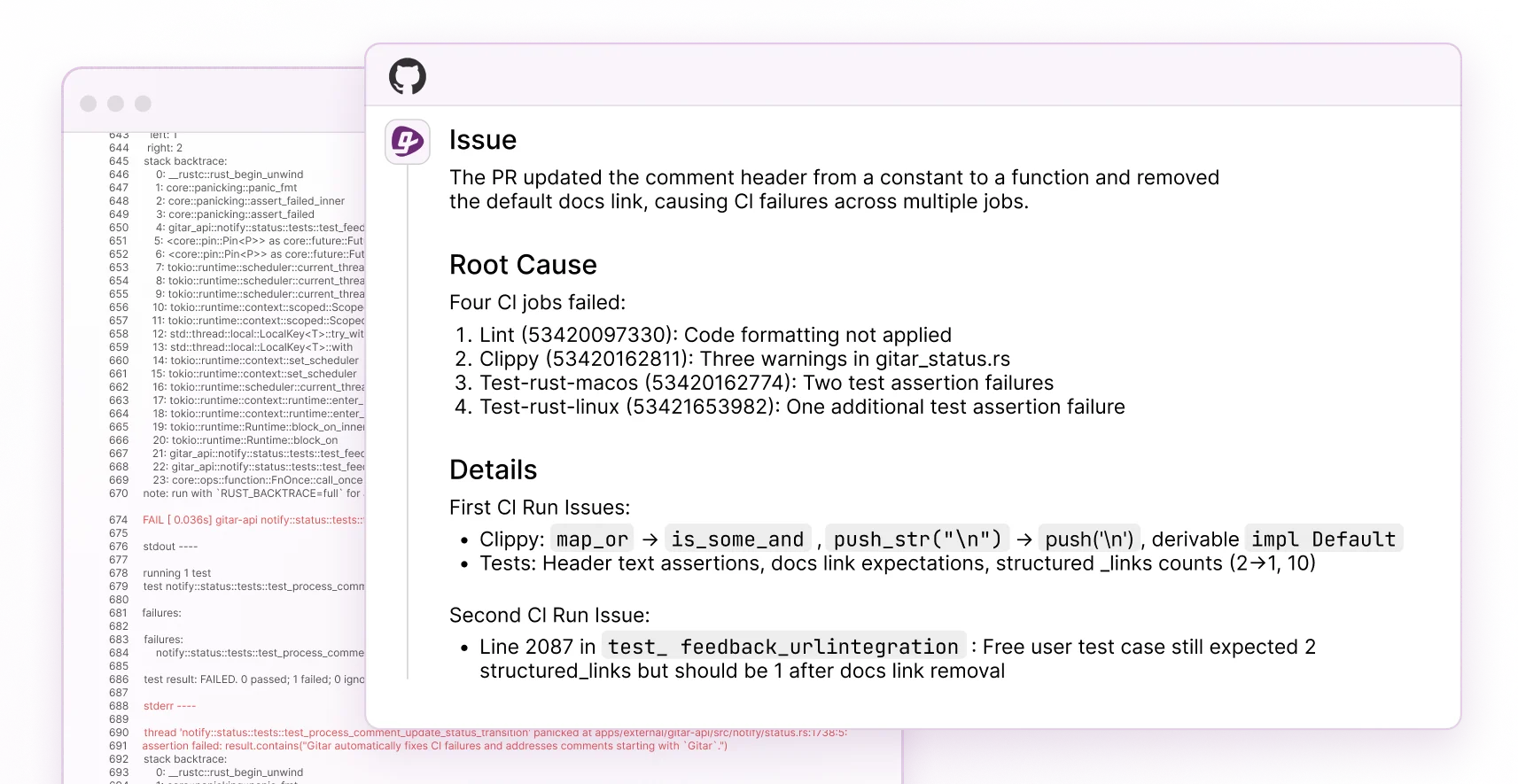
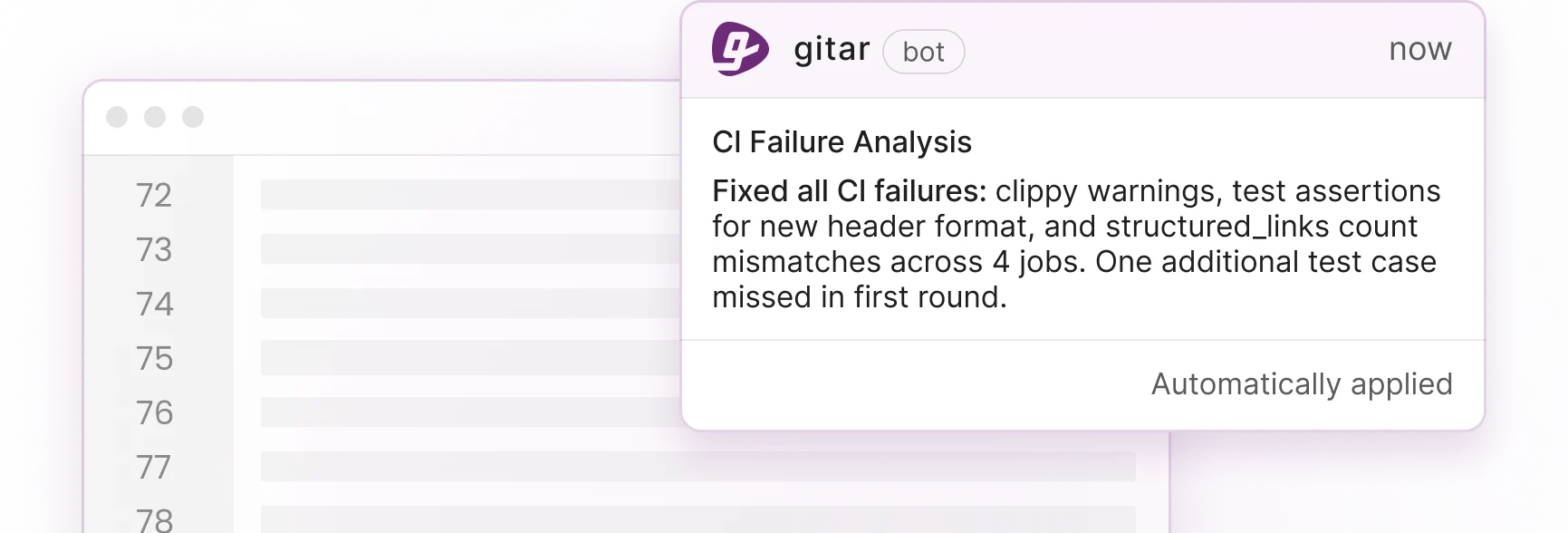
Gitar.ai delivers free unlimited code review with a 14-day autofix trial and acts as a platform that guarantees green builds through CI-validated auto-commits. The system analyzes CI failure logs, generates contextual fixes using full codebase understanding, validates solutions against your specific environment, and then commits working fixes automatically.
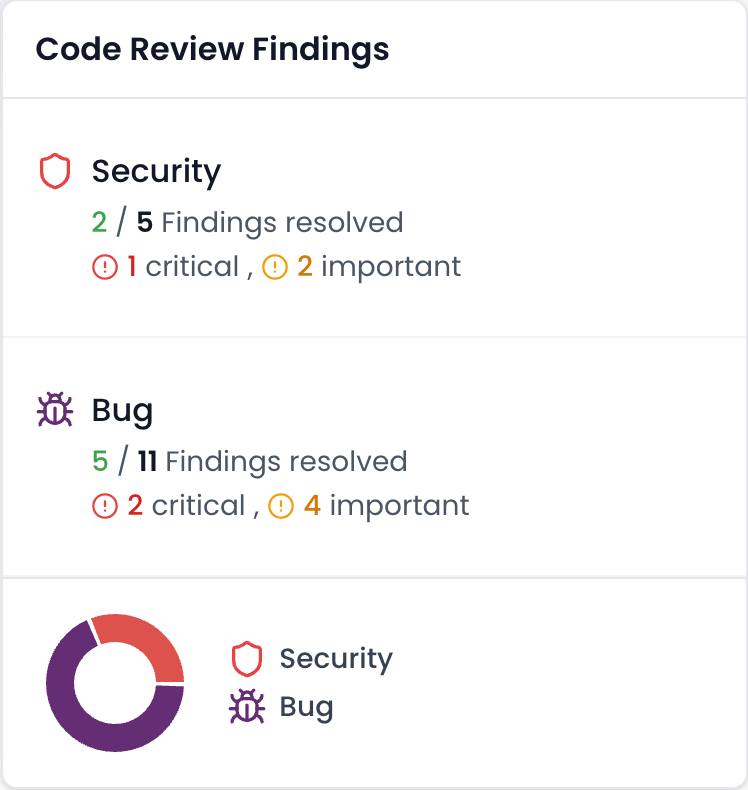
Key differentiators include a single comment dashboard that consolidates feedback and reduces notification spam. Gitar supports GitHub and GitLab with GitHub Actions, CircleCI, and Buildkite integration, and it uses natural language workflow rules so teams avoid complex YAML configuration. Enterprise deployments handle more than 50M lines of code with thousands of daily PRs, as shown by Pinterest’s production usage.
The platform connects deeply with Jira and Slack to share context across tools, and hierarchical memory systems learn team patterns over time. Security vulnerabilities that other AI tools miss get caught through Gitar’s comprehensive analysis engine. Installation takes about 30 seconds through GitHub app integration, and teams can move from suggestion mode to full automation as trust grows.
ROI metrics show major review time reductions, and Tigris engineering reports that summaries are “more concise than Greptile/Bugbot.” The free model commoditizes code review and builds toward a complete development intelligence platform. Install Gitar now to automatically fix broken builds and guarantee green CI.
#2 Snyk
Snyk provides Agent Fix for AI-generated patches that are automatically retested with CI/CD-compatible features. It focuses on security vulnerability remediation and uses DeepCode AI for contextual fixes. Pricing starts at $25 per month with enterprise tiers, and it lacks broad CI failure analysis outside security issues.
#3 SonarQube AI CodeFix
SonarQube AI CodeFix offers contextual fixes for bugs, code smells, and maintainability issues across many programming languages. It integrates with existing SonarQube workflows, but teams need enterprise licensing for full auto-fix capabilities. The scope remains limited to code quality issues and does not cover wider CI failure resolution or guaranteed green builds.
#4 Mobb
Mobb specializes in AppSec autofix functionality inside pull requests and provides deterministic security vulnerability remediation. It focuses on GitHub integration and strong security context, yet its scope stays narrow and centers on security issues instead of complete CI failure resolution.
#5 Apiiro AutoFix
Apiiro AutoFix delivers policy-compliant security fixes with runtime context integration. It targets enterprises with comprehensive security remediation, but it offers paid-only access and limited capabilities beyond security vulnerability fixing.
#6 Codacy/Ponicode
Codacy with Ponicode combines AI-powered fixes and static analysis across multiple languages. It provides automated suggestions for code quality improvements, but it does not validate fixes through CI and requires paid subscriptions for advanced features.
Start shipping higher quality software faster with Gitar’s free AI code review and autofix trial.
Suggestion Engines vs Validated Auto-Fixers: Direct Comparison
The distinction between suggestion engines and true auto-fixers becomes clear when you compare core capabilities and pricing models side by side.
|
Capability |
Gitar.ai |
CodeRabbit |
Greptile |
Others |
|
PR Summaries |
Yes (Free) |
Yes ($15+) |
Yes ($30+) |
Varies |
|
Auto-Apply |
Yes (Trial) |
No |
No |
Partial |
|
CI Analysis/Guarantee |
Yes |
No |
No |
No |
|
Cross-Platform |
Yes |
Limited |
Limited |
Varies |
Gitar’s free unlimited review and validated autofix capabilities remove the $450 to $900 monthly costs that 30-developer teams often pay for suggestion-only tools. The platform supports GitHub, GitLab, CircleCI, and Buildkite, while many competitors focus on a single platform.
Trends, Gaps, and How to Pick an AI Autofix Tool
Agentic remediation now acts as the new control layer, with enterprises achieving successful patch rates above 90% and saving about 20 engineering hours per week. The move from suggestion engines to healing engines reflects a clear industry shift, because AI-generated code volume demands automated resolution instead of extra manual work.
Common pitfalls include paying premium prices for suggestion-only tools that actually increase review overhead. Developers accept less than 44% of AI-generated code suggestions, and 56% require major changes, which highlights the inefficiency of non-validated recommendations.
Strong selection criteria prioritize free-first pricing for startups, deep enterprise CI integration, and validated fix capabilities over raw suggestion volume. The most effective AI for fixing code combines comprehensive analysis, automatic validation, and reliably green builds, and Gitar.ai currently leads this space with its platform approach.
Frequently Asked Questions
What free AI autofix tools are available in 2026?
Gitar.ai offers the most comprehensive free solution with unlimited code review and a 14-day autofix trial. Other tools like GitHub Copilot provide free tiers, but they focus on code generation instead of CI failure resolution. Gitar’s free model includes PR summaries, security scanning, bug detection, and performance review without seat limits or credit card requirements.
How does Gitar compare to CodeRabbit for code review?
Gitar provides free code review with automatic fix application and CI validation, while CodeRabbit charges $15 to $30 per developer for suggestion-only capabilities. Gitar’s single comment dashboard reduces notification noise compared to CodeRabbit’s scattered inline comments. The main difference appears in Gitar’s healing engine approach versus CodeRabbit’s suggestion engine model.
What are the CI integration steps for automated fixing?
Teams complete installation in about 30 seconds through GitHub app integration or a GitLab connection. The system then analyzes CI failures, generates fixes with full codebase context, validates solutions against your environment, and commits working fixes. Configuration options let teams move from suggestion mode to full automation as trust develops.
How secure are automated commits from AI tools?
Gitar provides fully configurable security controls and starts in suggestion mode so teams approve every fix before implementation. Auto-commit functionality can be enabled for specific failure types as trust grows. Enterprise deployments run agents inside customer CI environments with access to secrets and caches while maintaining SOC 2 Type II and ISO 27001 certification.
What ROI can teams expect from AI autofix tools?
A 20-developer team usually saves substantial costs through review time reduction and removal of CI failure overhead. Gitar’s free model removes $450 to $900 in monthly tool costs while delivering stronger functionality. Even at 50% effectiveness, the platform saves about $375K annually compared to suggestion-only alternatives.
How do teams transition from suggestion tools to autofix platforms?
Migration starts by installing Gitar alongside existing tools, then comparing results during the 14-day autofix trial and gradually shifting workflows as confidence increases. The free code review immediately shows better consolidation and context, and autofix capabilities then prove green build guarantees. Teams usually see instant productivity gains without disrupting current processes.
Conclusion: Why Gitar Leads the 2026 Autofix Landscape
The 2026 landscape clearly separates suggestion engines that create extra work from true autofix tools that guarantee green builds. Mainstream adoption of agentic remediation now approaches 90% success rates, while traditional suggestion tools continue to struggle with validation overhead and manual implementation.
Gitar.ai leads this shift by offering free unlimited code review with validated autofix capabilities and by removing productivity bottlenecks created by AI-generated code floods. The platform’s healing engine approach, cross-platform integration, and enterprise scalability position it as a definitive solution for teams that want automated CI failure resolution.