
Written by: Ali-Reza Adl-Tabatabai, Founder and CEO, Gitar
Key Takeaways
- AI coding tools now write about 41% of production code, yet they slow teams down by increasing PR review time by 91%. Auto-commit fix tools like Gitar remove that CI bottleneck.
- Gitar ranks as the top healing engine because it analyzes CI failures, validates fixes, and auto-commits changes for green builds across GitHub, GitLab, CircleCI, and Buildkite.
- Competitors such as CodeRabbit and Greptile charge $15-30 per seat for suggestions that still need manual work, while Gitar delivers end-to-end automation that removes that repetitive effort.
- Teams can save more than $750,000 per year by cutting CI and review time from 1 hour to 15 minutes per developer each day with Gitar’s configurable automation and ROI-focused features.
- Teams that want to reduce broken builds and review toil can start with Gitar’s 14-day Team Plan trial and see impact on velocity in live pipelines.
How We Evaluated AI Code Review Tools for CI Fix Automation
Our evaluation centers on CI fix automation, with priority given to tools that analyze CI failure logs, generate validated fixes, and commit working changes without manual intervention. Secondary factors include PR summary quality, noise reduction, cross-platform coverage across GitHub Actions, GitLab CI, CircleCI, and Buildkite, pricing clarity, and measurable ROI for engineering teams.
We pulled data from vendor documentation including Gitar’s technical documentation[1], 2026 productivity benchmarks, GitHub statistics, and feedback from engineering teams at companies such as Tigris and Collate. Our focus remains on end-to-end automation that moves beyond suggestion engines and delivers reliably green builds.
Top 7 AI Code Review Tools Evaluated for CI Fix Automation
The following tools represent the current landscape for CI fix automation, ranging from full auto-commit platforms to suggestion engines that still require manual implementation:
- Gitar – Healing engine that guarantees green builds through validated auto-fixes and comprehensive CI failure analysis (full auto-commit).
- Autofix.ci – GitHub Actions-focused tool that auto-commits lint and formatting fixes (limited auto-commit).
- Qodo – PR review platform with auto-remediation features and CI/CD integration (manual approval required).
- CodeRabbit – Inline suggestion engine with one-click fixes that always need manual approval (no auto-commit).
- Greptile – Codebase context tool that suggests changes without fix validation or commit automation (no auto-commit).
- DeepSource – Static analysis platform with Autofix™ for code quality and security issues, but limited CI failure coverage (partial automation).
- Aikido – Security-focused scanner that automates security checks but offers minimal CI commit automation for general failures (narrow automation).
Gitar stands apart as the only platform that combines CI failure detection, fix validation, and guaranteed green builds in a single healing engine architecture.
Gitar: Healing Engine for Self-Healing CI
1. Gitar
Gitar functions as a healing engine that resolves CI failures through validated fix generation and direct commits instead of just leaving comments. It analyzes CI logs across GitHub Actions, GitLab CI, CircleCI, and Buildkite, validates fixes against your environment, posts a single updating dashboard comment to avoid notification overload, and lets teams define repository rules in natural language instead of YAML.
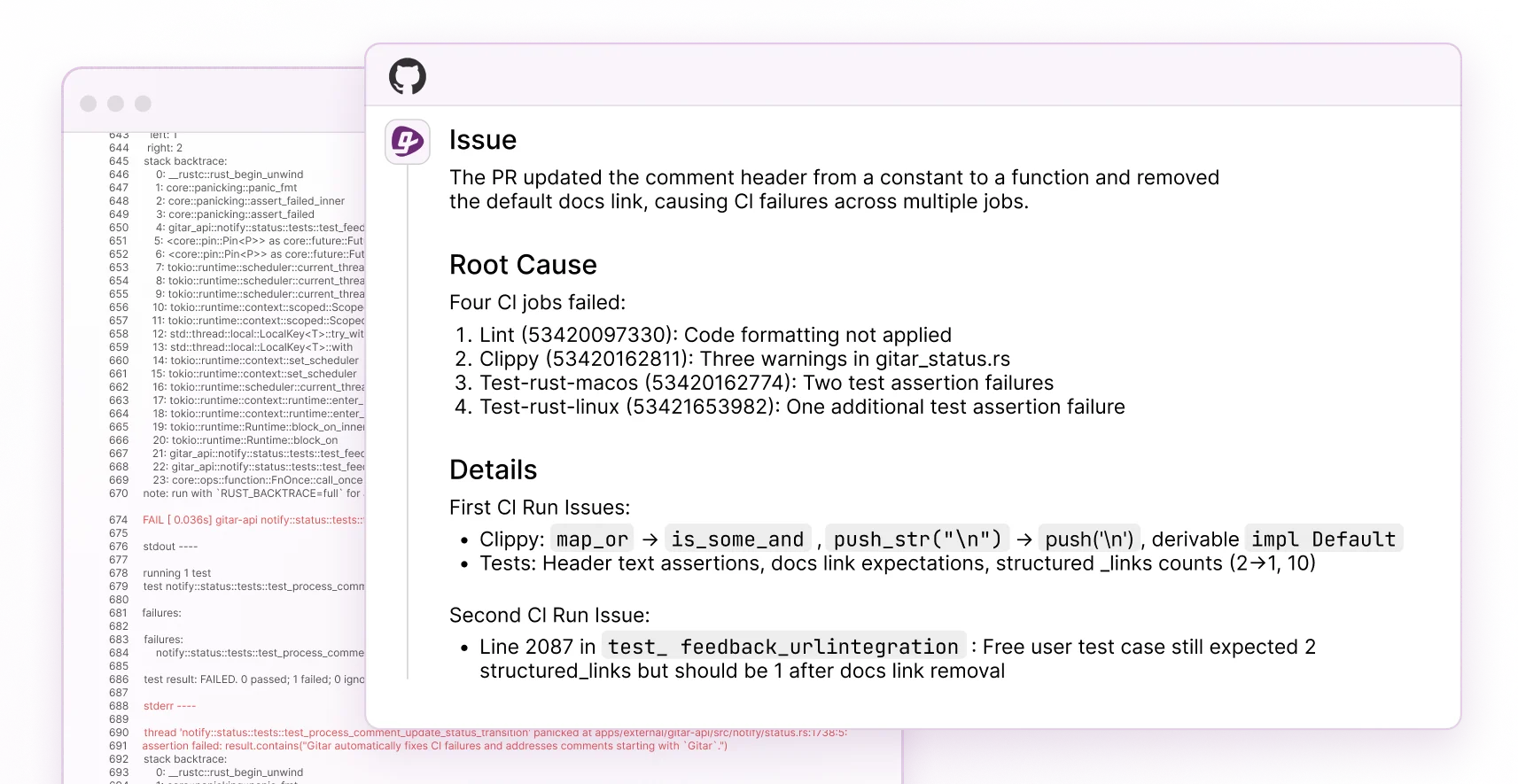
The platform installs as a GitHub App or GitLab integration with configurable automation levels. Teams can begin in suggestion mode to build confidence, then enable auto-commit for specific fix types once they trust the results. This gradual approach relies on Gitar’s hierarchical memory system, which tracks context per line, pull request, repository, and organization so it can learn patterns and improve accuracy over time. Jira and Slack integrations then bring that context into existing workflows where teams already collaborate.
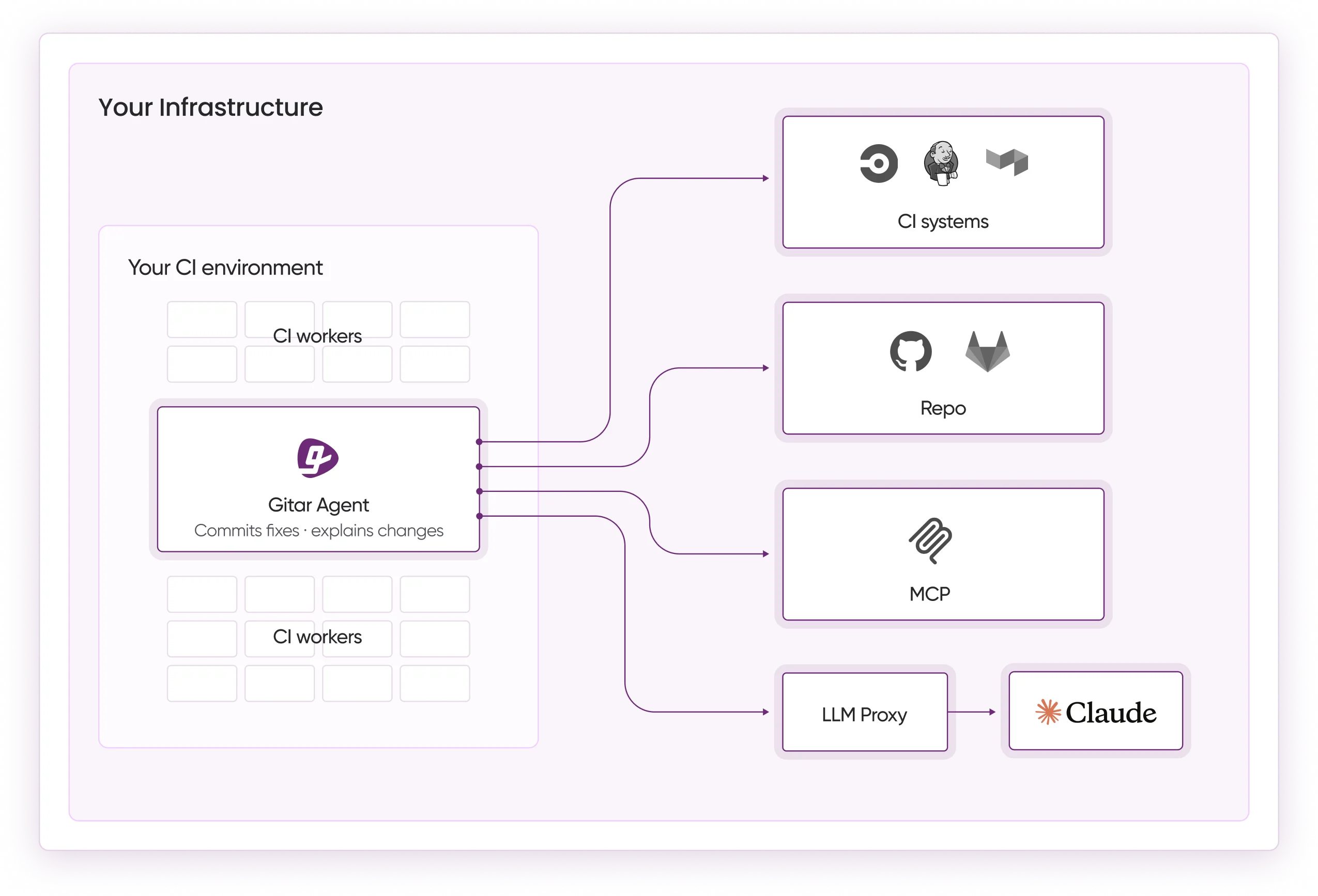
Pricing includes a 14-day Team Plan trial with full access to auto-fix capabilities, custom rules, and all integrations. This structure supports engineering leaders who want measurable velocity gains and developers who want relief from repetitive CI work. The platform focuses on teams overwhelmed by AI-generated PRs that still need human fixes and instead delivers guaranteed green builds.
2. Autofix.ci
Moving from comprehensive healing engines to more specialized tools, Autofix.ci concentrates on GitHub Actions workflows and applies automated fixes for lint errors, formatting issues, and basic code quality problems. The tool commits these fixes directly to pull requests but does not provide deep validation or guarantees that changes will pass complex CI pipelines. It works well for simple formatting corrections but cannot handle broader CI failures or deliver the cross-pipeline context that many teams now expect.
3. Qodo
Qodo provides fast, detailed code reviews with severity-based issue breakdowns and fix explanations, and it supports GitHub PR reviews with some auto-remediation features. The platform does not include explicit CI failure detection or direct commit automation, which keeps it in the enhanced suggestion category rather than a full healing engine. Pricing starts with a free tier and increases to about $30 per user each month for team plans, with custom enterprise options.
4. CodeRabbit
CodeRabbit runs automatically on new PRs with line-by-line comments, severity rankings, and one-click fixes, and it supports GitHub, GitLab, Bitbucket, and Azure DevOps. Every fix still requires manual approval, and the tool does not validate that changes will pass CI. At $24-30 per user each month, teams pay for detailed comments but still need to spend time applying and verifying changes.
5. Greptile
Greptile charges $30 per developer each month for unlimited reviews with deep codebase context analysis. The platform suggests changes but does not validate fixes or commit them automatically, which keeps manual CI work in place. The high per-seat cost amplifies the impact of that manual implementation requirement.
6. DeepSource
DeepSource offers AI-powered automated fixes through Autofix™ and focuses on static analysis for code quality, security, and dependency issues. It can open PRs with fixes and integrates with common CI systems, yet it does not specialize in real-time CI failure diagnosis across all pipeline types. Teams gain strong static analysis but do not receive guaranteed green builds for complex multi-step pipelines.
7. Aikido
Aikido provides a security platform that combines SAST, DAST, SCA, IaC, and secrets scanning with CI/CD integration and automation. Security-focused teams gain value from this coverage, especially when they enforce strict pipeline gates. The platform mainly targets security-related CI failures rather than the full range of functional or infrastructure issues, so it works best as a security layer alongside other CI automation tools.
AI Code Review Tools Compared on CI Fix Automation
The following comparison table highlights how four representative tools handle CI analysis, fix generation, and automation depth so readers can see the practical differences in workflow impact:
|
Capability |
Gitar |
CodeRabbit |
Greptile |
Autofix.ci |
|
PR Summaries |
Yes |
Yes |
Yes |
No |
|
CI Failure Analysis |
Yes |
No |
No |
Limited |
|
Auto-Generate Fixes |
Yes |
Manual |
Manual |
Yes |
|
Validate & Commit |
Yes |
No |
No |
No |
|
Guarantee Green Builds |
Yes |
No |
No |
No |
|
Cross-Platform |
All Major |
GitHub/GitLab |
GitHub |
GitHub Only |
|
Pricing |
14-day trial |
$24-30/seat |
$30/seat |
Usage-based |
This comparison shows that most tools still operate as suggestion engines that rely on developers to apply and verify fixes. Gitar stands out by providing end-to-end automation with validation and guaranteed green builds, so teams receive working solutions instead of just comments.
Why Gitar Ranks #1 for AI CI Fixes
Gitar’s healing engine architecture follows a four-phase implementation that turns CI from a bottleneck into an automated asset. Phase 1 covers installation of the GitHub App or GitLab integration with immediate dashboard comment visibility. Phase 2 uses suggestion mode so teams can review and approve fixes while they build trust. Phase 3 enables auto-commit for validated fix types with configurable aggression levels. Phase 4 expands into analytics, workflow automation, and enterprise deployment options.
The platform addresses common adoption concerns through configurable automation that lets teams start conservatively and increase automation as confidence grows. Enterprise deployments run agents inside the existing CI pipeline with access to configurations, secrets, and caches, so code never leaves the organization’s infrastructure while still meeting SOC 2 Type II and ISO 27001 standards.
The ROI impact mentioned earlier becomes clearer when you examine the calculation method. A 20-developer team that spends 1 hour each day on CI and review issues loses roughly $1 million in annual productivity at typical engineering rates. Cutting that time to about 15 minutes per day represents a 75 percent reduction and yields about $750,000 in annual savings, while also reducing the cognitive cost of constant context switching. Implementation guidance and technical documentation[1] walk teams through setup so they can realize these gains quickly.
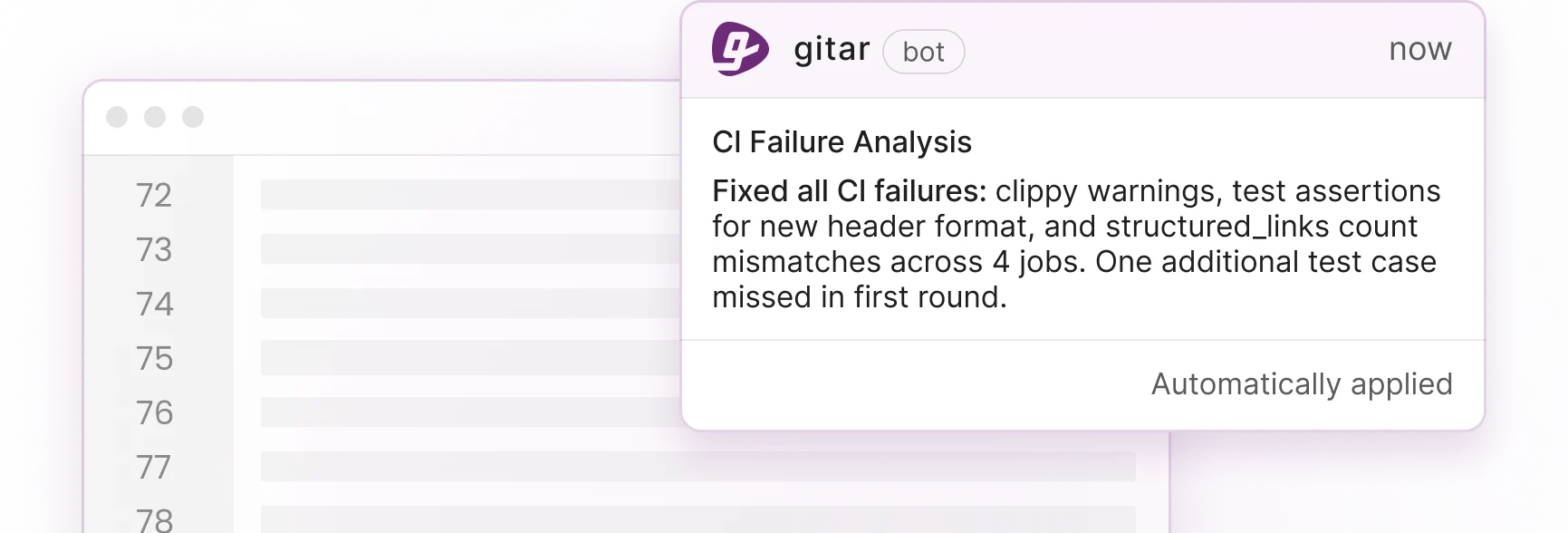
User feedback from companies such as Tigris notes that Gitar’s summaries feel more concise than alternatives like Greptile. Collate’s engineering team highlights the value of unrelated PR failure detection, which separates infrastructure flakiness from real code bugs and saves time that traditional reviewers lose due to missing CI context.
Key Personas and ROI for AI Code Review on GitHub
Different personas inside engineering organizations gain distinct benefits from AI code review automation, and understanding those perspectives supports smoother adoption. Developers, who interact with the tool daily, experience less toil through automated CI fixes and consolidated notifications that reduce context switching. Their managers, the engineering leaders, focus on measurable velocity improvements and clear ROI from less manual intervention across the team. Platform and DevOps engineers gain self-healing CI that cuts reruns and benefit from natural language rule configuration, which lowers the barrier to building and maintaining automation, making them strong internal champions.
Security concerns remain central, especially because AI coding agents introduce security bugs at roughly 1.5 to 2 times the human rate. Gitar responds to this risk with configurable automation levels, thorough validation before commits, and enterprise deployment options that keep code and infrastructure access under customer control.
Total cost of ownership should include both subscription fees and productivity gains. Suggestion engines such as CodeRabbit and Greptile charge $15-30 per seat each month while still requiring manual implementation of fixes. Gitar’s healing engine approach removes much of that ongoing labor, which produces stronger ROI by delivering real automation instead of high-priced commentary.
Conclusion: Moving from Suggestions to Self-Healing CI with Gitar
The 2026 AI code review market splits into suggestion engines that preserve manual toil and healing engines that deliver reliably green builds. Gitar’s platform, which combines CI failure analysis, validated fix generation, automatic commits, and workflow automation, represents a shift toward true development intelligence instead of static comments.
Competitors often charge premium prices for suggestions that still need manual work, while Gitar proves value through a 14-day Team Plan trial that shows concrete velocity gains and reduced toil. The platform’s cross-platform coverage, enterprise-grade security, and natural language configuration make it a strong choice for teams that want real automation instead of expensive commentary.
Frequently Asked Questions
What makes Gitar different from other AI code review tools?
Gitar operates as a healing engine instead of a suggestion platform. Tools like CodeRabbit and Greptile provide comments and suggestions that still need manual implementation, while Gitar analyzes CI failures, generates validated fixes, and commits working solutions directly to pull requests. This approach removes much of the manual toil and supports green builds through validation against the actual CI environment. A single updating dashboard comment replaces scattered inline notifications, which reduces cognitive load and notification noise.
How does Gitar ensure the fixes it commits actually work?
Gitar’s validation system mirrors the complete CI environment, including SDK versions, multi-dependency builds, and third-party integrations. Before any fix is committed, the platform runs validation against the real pipeline configuration so solutions work in production contexts instead of isolated sandboxes. Enterprise deployments run the agent inside the organization’s CI pipeline with access to secrets and caches, which increases validation accuracy. Teams can begin in suggestion mode and only enable auto-commit once they trust the results.
What platforms and CI systems does Gitar support?
Gitar supports GitHub and GitLab for version control and integrates with CI systems such as GitHub Actions, GitLab Pipelines, CircleCI, Buildkite, and Bitrise. It works with languages including Python, Go, JavaScript, TypeScript, Java, and Rust. Integrations with Jira, Slack, and Linear connect CI context to planning and communication tools so teams can adopt Gitar without changing their existing stack.
How does Gitar’s pricing compare to other AI code review tools?
Gitar offers a 14-day Team Plan trial with full access to auto-fix capabilities, custom rules, and integrations, and it does not limit seats during the trial. Competitors such as CodeRabbit, at $24-30 per user each month, and Greptile, at $30 per user each month, charge for suggestion engines that still require manual implementation. Gitar’s trial lets teams measure real velocity improvements and ROI before they commit to paid plans.
What security measures does Gitar implement for automated code commits?
Gitar manages security through configurable automation levels so teams can start cautiously and expand automation as trust grows. Enterprise deployments keep agents inside the organization’s CI pipeline, which ensures code stays within existing infrastructure while still meeting SOC 2 Type II and ISO 27001 requirements. The platform records detailed audit trails for automated actions and lets teams define which fix categories can be auto-committed and which require manual approval, balancing automation with enterprise security needs.