
Why Full-Codebase AI Analysis Matters in 2026
- AI code analysis with full codebase integration is now essential, as PR reviews take 91% longer despite 3-5x faster code generation.
- Gitar leads as the top free tool, offering unlimited PR analysis, security scanning, and automated CI fixes across 50M+ lines of code.
- Competitors like Greptile and CodeRabbit provide strong analysis but charge $12-30 per developer monthly and often show higher false positives or limited free tiers.
- Teams save $750K+ annually with Gitar’s autofix features that resolve CI failures and implement feedback automatically, unlike suggestion-only tools.
- Teams can start with Gitar’s free 30-second setup to remove CI bottlenecks and ship higher quality software faster.
Top 10 AI Code Analysis Tools with Full Codebase Integration
1. Gitar: Free AI Code Analysis with Automated Fixes
Gitar is the only free platform in this list that fixes code instead of only suggesting changes. When CI fails, Gitar analyzes failure logs, generates validated fixes, and commits them to your PR. When reviewers leave feedback, Gitar applies the requested changes directly. This healing engine approach focuses on delivering green builds instead of hoping manual fixes work. Learn more in the Gitar documentation.
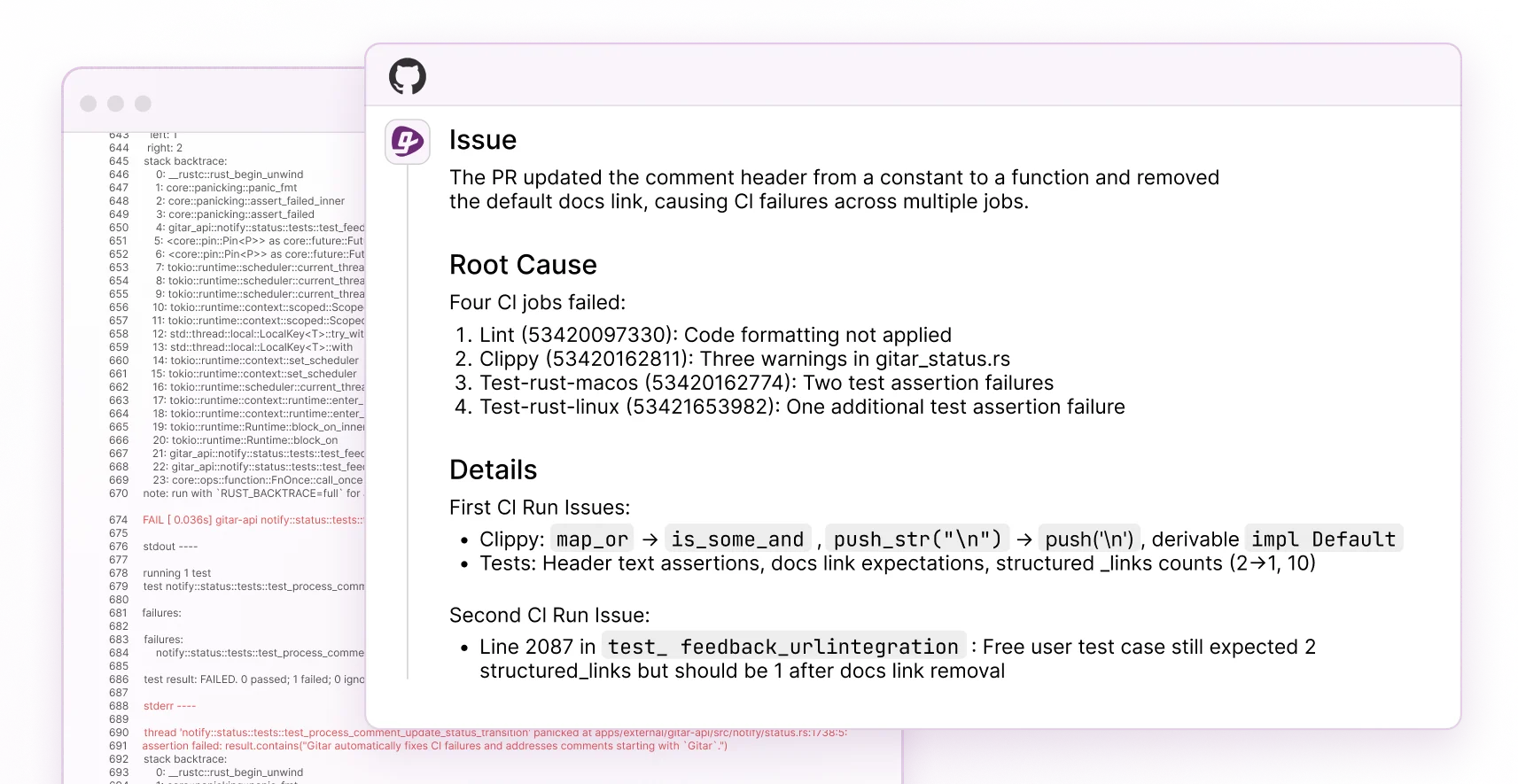
The platform provides unlimited free PR summaries, inline security scanning, and bug detection across unlimited repositories. Autofix capabilities include a 14-day free trial that covers CI failure resolution, review feedback implementation, and natural language workflow rules. Gitar’s hierarchical memory system maintains context per line, per PR, per repository, and per organization, and it learns your team’s patterns over time.
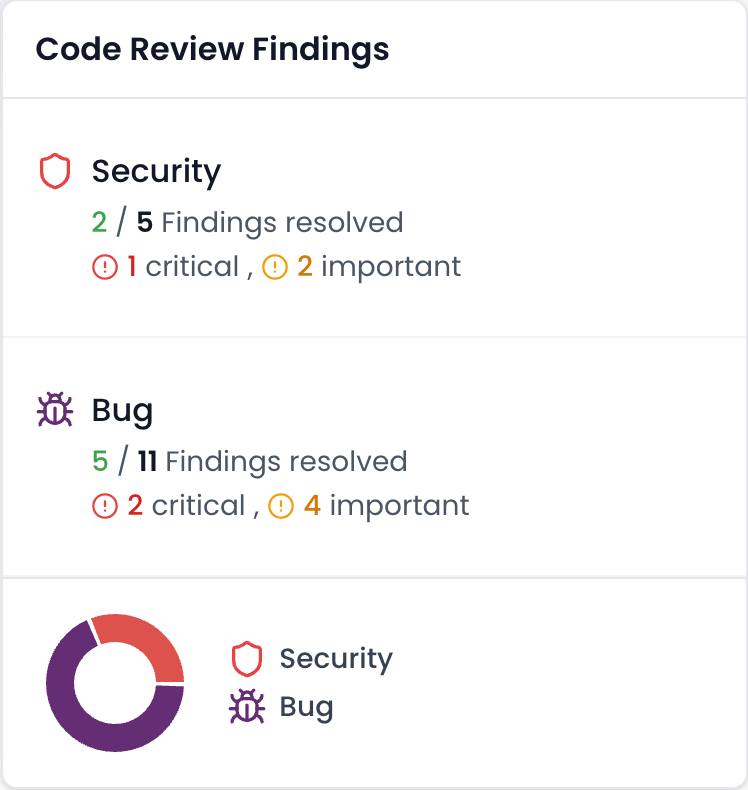
Key integrations include GitHub, GitLab, GitHub Actions, GitLab Pipelines, CircleCI, and Buildkite, plus native Jira, Slack, and Linear connectivity. The platform scales to 50M+ lines of code with enterprise-grade security. Instead of flooding inboxes with many notifications, Gitar uses a single updating comment that consolidates all findings in one clean interface.
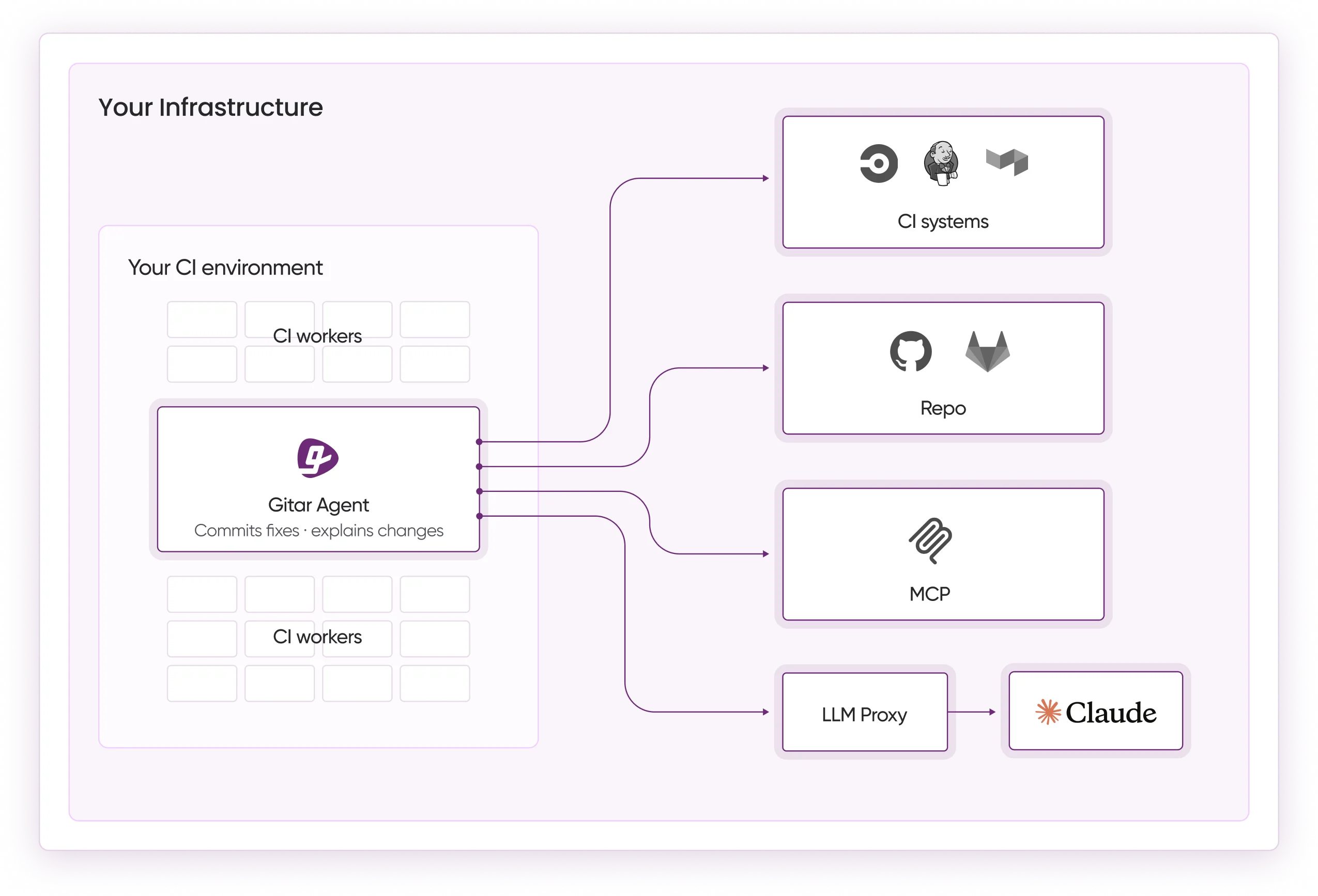
Core code review features remain completely free, while autofix capabilities are available through a 14-day free trial. For a 20-developer team, Gitar’s automated CI healing can save about $1M annually by removing the hour per day developers typically spend on CI and review issues.
| Feature | Gitar | CodeRabbit | Greptile |
|---|---|---|---|
| Autofix CI Failures | Yes (14-day trial) | Yes | No |
| Full Codebase Context | Yes | Yes | Yes |
| Free Tier | Unlimited | OSS Only | OSS Only |
| Notification Style | Single Comment | Multiple Inline | Multiple Inline |
Gitar works well for engineering leads and platform teams that want to remove CI bottlenecks while keeping code quality high. Try Gitar’s free AI code analysis tool to see automated fixes that actually work.
2. Greptile: Deep Codebase Analysis with High Detection Rates
Greptile focuses on maximum bug detection through deep full-codebase indexing on GitHub and GitLab. The platform offers comprehensive codebase integration but shows the highest false positive rate in independent evaluations. At $30 per developer monthly, teams pay premium prices for suggestions that still require manual implementation.
The tool handles complex architectural patterns and identifies subtle bugs across large codebases. However, the high false positive rate creates notification fatigue, and the lack of autofix capabilities forces developers to spend significant time validating and applying suggested changes.
Greptile fits teams that prioritize maximum bug detection over efficiency, especially those with dedicated code review specialists who can filter extensive feedback.
3. CodeRabbit: Multi-Platform Integration with Full Codebase Analysis
CodeRabbit supports broad platform integration across GitHub, GitLab, Bitbucket, and Azure DevOps. The platform has processed over 13 million PRs across 2 million repositories, which shows strong scalability. Pricing ranges from $12-30 per user monthly, and free tiers stay limited to open source projects.
The platform offers full codebase analysis with low false positive rates through code graph and LLM reasoning. CodeRabbit covers many platforms but does not provide the automated CI healing capabilities that modern teams expect for maximum productivity.
CodeRabbit suits organizations using diverse version control platforms that need advanced code review automation.
4. Augment Code: Enterprise Security with SOC 2 Compliance
Augment Code holds SOC 2 Type II certification and is the first AI coding assistant globally with ISO/IEC 42001 certification for AI Management Systems. The platform includes customer-managed encryption keys and enterprise-grade security controls.
Augment Code focuses more on code generation than on comprehensive code analysis. The platform offers a free trial tier but does not provide broad free access or full autofix capabilities, which positions it mainly for large enterprises with strict security requirements.
Augment Code works best for enterprise teams that value maximum security compliance over cost efficiency or automated fixing.
5. DeepSource: Static Analysis with CI Integration
DeepSource delivers static analysis with native CI/CD integration across multiple languages. The platform identifies security vulnerabilities, performance issues, and code quality problems through deep repository scanning.
DeepSource offers strong integration, some automated fixes, and a free tier for public repositories. It does not provide a conversational interface or the broad autofix features that many modern teams now expect. Pricing follows per-seat models for advanced capabilities.
DeepSource suits teams that prioritize static analysis with some automation over fully AI-powered conversational workflows.
6. SonarQube: Compliance-Focused Static Analysis with OWASP Coverage
SonarQube maintains SOC 2 Type II and ISO 27001:2022 certifications with OWASP Top 10 vulnerability detection. The platform provides extensive compliance reporting and secrets detection for more than 160 patterns.
SonarQube serves compliance-focused organizations with traditional static analysis instead of modern AI-powered code understanding. The platform often requires significant configuration and does not include conversational interfaces.
SonarQube fits regulated industries that need detailed compliance documentation and established static analysis workflows.
7. Snyk: Security-First Code and Dependency Analysis
Snyk specializes in security vulnerability detection across code, dependencies, and infrastructure, and it also offers code quality analysis and autofix capabilities. The platform provides broad scanning with strong integration across development workflows.
Snyk excels in security and also supports broader code quality improvements through Snyk Code. It follows traditional enterprise pricing models.
Snyk works well for security-conscious teams that prioritize vulnerability detection along with code quality and productivity improvements.
8. GitClear: Code Quality Metrics and Team Analytics
GitClear focuses on code quality metrics and development analytics instead of active code review. The platform surfaces insights about code churn, technical debt, and team productivity patterns.
GitClear provides value for management but does not deliver real-time code analysis or fixing capabilities for daily development work.
GitClear suits engineering managers who want development analytics rather than hands-on code improvement tools.
9. BugBot: Low-Noise Diff-Based Bug Detection
BugBot offers medium 8-pass diff analysis on GitHub with low to medium false positive rates. The platform focuses on accurate bug detection with minimal noise and includes autofix capabilities.
BugBot provides cleaner feedback than many high-noise competitors but does not support full codebase integration. Its diff-based approach misses some architectural and cross-file issues.
BugBot suits teams that want basic bug detection with fixes and prefer to avoid the complexity of full codebase analysis.
10. Cursor-Integrated Analysis: IDE-Native AI Assistance
Cursor’s integrated analysis offers deep codebase understanding inside the IDE, including automated fixing capabilities. The platform supports repository-level reasoning and multi-file context for broad code assistance.
This IDE-centric approach can limit some CI/CD pipeline integrations compared to dedicated review tools. Cursor focuses more on individual developer productivity than on full team workflow automation.
Cursor fits individual developers or small teams that prioritize IDE-native AI experiences.
Install Gitar now, automatically fix broken builds, and start shipping higher quality software faster to see the difference between suggestion engines and healing platforms.
AI Code Analysis Tools Compared on Context, Fixing, and Scale
| Tool | Full Codebase Context | Autofix/CI Integration | Pricing | Scalability |
|---|---|---|---|---|
| Gitar | Yes | Yes (autofix 14-day trial) | Free (core review) | 50M+ LOC |
| Greptile | Yes | No | $30/dev | Enterprise |
| CodeRabbit | Yes | Yes | $12-30/dev | 13M+ PRs |
| DeepSource | Yes | Yes | Free tier / Paid | Enterprise |
This comparison shows Gitar’s unique position combining full codebase context, advanced autofix features including CI healing, and free pricing for core capabilities. Competitors offer strong analysis, but Gitar delivers automated fixes that commit directly to PRs at no cost for core features.
Best Free AI Code Review Options for 2026
The free AI code review landscape in 2026 now includes more capable tools, and Gitar sits at the front. Gitar offers unlimited repositories, unlimited users, and comprehensive security scanning at no cost. The free tier includes PR summaries, inline suggestions, bug detection, and performance analysis, which many competitors reserve for paid plans.
Most alternatives restrict free tiers to open source projects or very small teams. CodeRabbit provides free access only for OSS projects, while paid plans range from $12-30 per user monthly. This pricing model creates barriers for growing teams.
Gitar’s model of offering enterprise-grade features for free while monetizing advanced workflow automation changes expectations in this market. Teams gain comprehensive code analysis without budget constraints or seat limits.
How to Choose an AI Code Analysis Tool for Your Team
Small teams benefit most from free tools with complete feature sets instead of narrow free tiers that force quick upgrades. Gitar’s unlimited free access removes growth constraints while still providing enterprise-grade analysis.
Enterprise organizations need tools that scale to tens of millions of lines of code and meet strict security requirements. Gitar supports 50M+ lines of code and provides enterprise-grade security, including SOC 2 Type II, without per-seat pricing that becomes expensive at scale.
Budget planning should include the real cost of suggestion-only tools. A 20-developer team paying $15-30 per seat monthly for tools that still require manual implementation spends $3,600-10,800 annually, plus the productivity loss from manual fixes. Gitar’s autofix capabilities save about 45 minutes per developer daily, which equals $750,000+ annually in productivity gains.
Setup complexity also affects adoption. Gitar’s 30-second installation removes many implementation barriers that slow traditional enterprise tools that need heavy configuration.
Frequently Asked Questions About AI Code Analysis in 2026
Best Free AI Code Review Tools in 2026
Gitar leads the free AI code review space with unlimited repositories, unlimited users, and comprehensive analysis that includes security scanning, bug detection, and performance reviews. Unlike competitors that limit free tiers to open source projects, Gitar provides full enterprise features at no cost. The platform includes PR summaries, inline suggestions, and a 14-day free trial of autofix capabilities that automatically resolve CI failures and apply review feedback.
How AI Tools Integrate with Full Codebases
Full codebase integration means the tool understands repository architecture, dependencies, and business logic instead of only analyzing individual file changes. Gitar uses hierarchical memory systems that maintain context per line, per PR, and per repository. The platform learns your team’s patterns and connects with external systems like Jira and Linear to understand the business context behind code changes. This broad understanding supports accurate fixes that work across your entire system. For implementation details, see the Gitar documentation.
How Gitar Compares to Greptile and CodeRabbit
Gitar provides automated fixes that commit directly to PRs, while Greptile and CodeRabbit focus on suggestions and one-click fixes. Greptile charges $30 per developer monthly for deep analysis but shows high false positive rates that require manual filtering. CodeRabbit costs $12-30 per developer for multi-platform support with full codebase analysis. Gitar combines deep analysis, broad platform support, and advanced autofix capabilities, all at no cost for core features.
Expected ROI for a 20-Developer Team
A 20-developer team often loses about 1 hour per developer daily to CI failures and review cycles, which can cost around $1 million annually in productivity. Gitar’s automated fixing can reduce this to about 15 minutes daily, saving $750,000+ annually. Traditional suggestion-only tools cost $3,600-10,800 annually and still require manual implementation. Gitar removes both the direct tool cost and much of the productivity loss, which delivers clear ROI from day one.
Security and Compliance Features to Look For
Leading tools maintain SOC 2 Type II and ISO 27001 certifications and provide comprehensive security scanning. Gitar offers enterprise-grade security that includes secrets detection, vulnerability analysis, and compliance reporting in its Enterprise Plan. Deployment options range from managed cloud with zero data retention to Enterprise Plan agents that run inside your CI pipeline for maximum security. Detailed audit trails support enterprise compliance requirements.
Conclusion: Why Gitar Leads AI Code Analysis in 2026
Gitar leads the 2026 AI code analysis landscape by combining free, comprehensive analysis with automated fixing capabilities that many competitors charge premium prices for without matching results. The shift from suggestion engines to healing platforms marks the next stage in development tooling.
Install Gitar now, automatically fix broken builds, and start shipping higher quality software faster to experience the future of AI-powered development workflows.