
Key takeaways
- AI-accelerated code generation increases CI load, and traditional automated testing often becomes the primary bottleneck in delivery.
- AI-driven build pipeline tools improve test creation, selection, and maintenance, which reduces flakiness and wasted compute.
- Healing engines like Gitar close the loop from failure detection to validated fixes, while suggestion-only tools still depend on developer capacity.
- Phased implementation with conservative defaults, clear metrics, and change management helps teams build trust in autonomous CI.
- Gitar provides autonomous CI failure resolution and code review support;teams can start now by installing it.
The new bottleneck: why traditional automated testing slows AI-accelerated CI/CD
The software development landscape now includes high-velocity code generation tools such as GitHub Copilot and Cursor. These tools increase pull request volume and change frequency, which can strain traditional CI pipelines and slow integration, testing, and release workflows. This shift creates delivery bottlenecks when CI cannot keep pace with AI-assisted coding.
Traditional CI test automation often suffers from high flakiness, brittle UI tests, heavy maintenance loads, and stagnant coverage. These weaknesses create a quality bottleneck even as development speed increases. Roughly 73% of test automation projects report maintenance as a primary challenge, and about 68% of automation initiatives are abandoned within 18 months.
Teams that generate more code faster often see more tests, more failures, and more time spent on CI triage. This dynamic creates a strategic inflection point where reactive CI management becomes unsustainable and pushes teams toward autonomous, AI-driven approaches.
Install Gitar to automatically fix broken builds and keep developers focused on shipping features.
Gitar as a self-healing CI solution for automated test optimization
Gitar shifts CI optimization from suggestion-only assistance to autonomous healing. The system inspects failing builds, identifies root causes, generates code or configuration fixes, validates those fixes in an environment that mirrors production CI, and commits changes once all jobs pass.
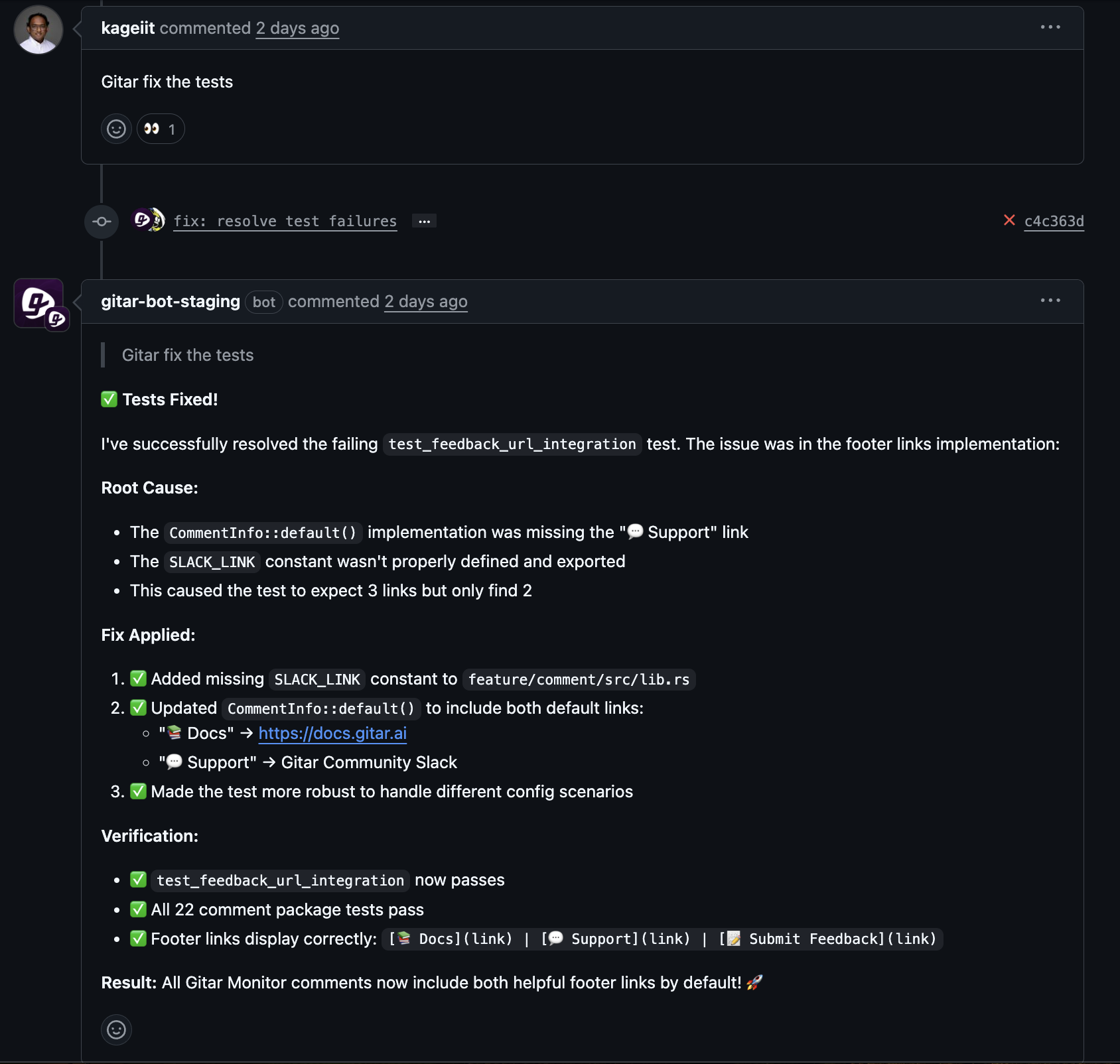
Key capabilities that define Gitar in AI-driven build pipeline optimization include:
- End-to-end fixing that applies, validates, and lands fixes so developers see green pull requests instead of raw failures
- Full environment replication across JDK versions, multiple SDKs, third-party scans such as SonarQube and Snyk, and snapshot tests
- Cross-platform support for GitHub Actions, GitLab CI, CircleCI, Buildkite, and other major CI providers
- A configurable trust model that ranges from suggestion-only to fully autonomous operation
- Integration with local AI agents such as Claude and Cursor to share context between developer machines and CI
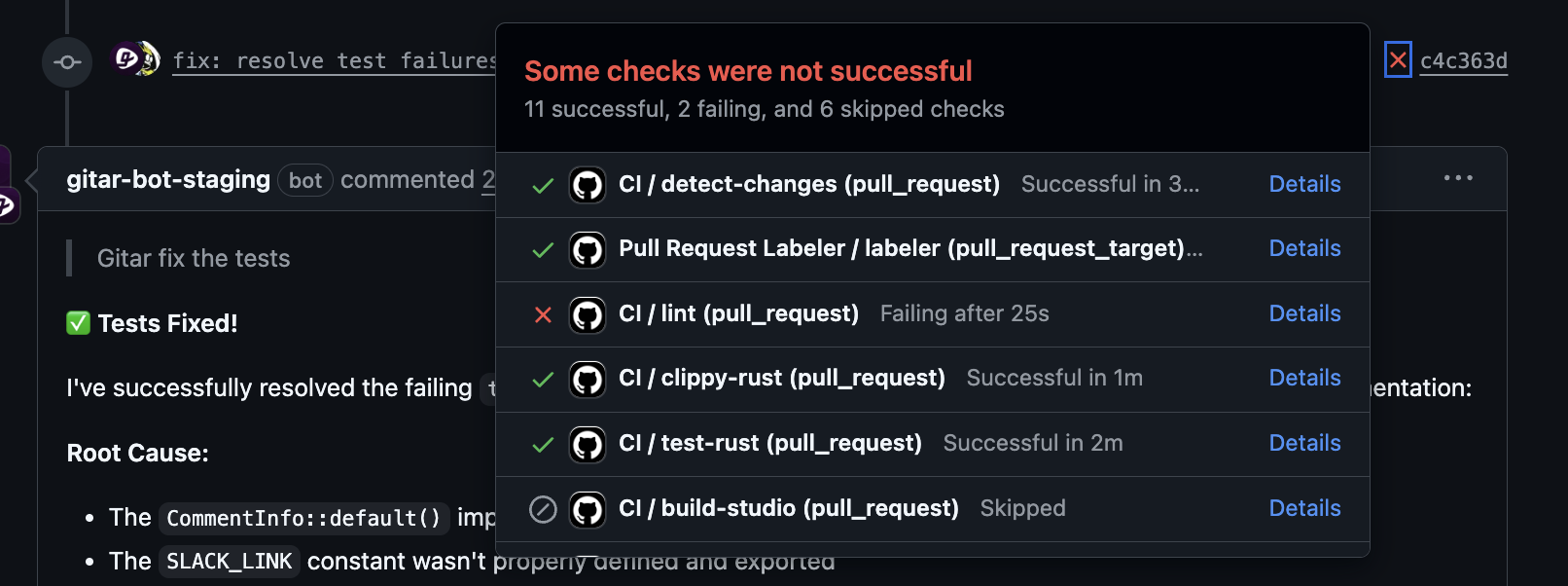
The architecture coordinates multiple agents that operate in parallel CI jobs, handle asynchronous events, and maintain a consistent state, even in noisy enterprise pipelines.
Install Gitar to introduce self-healing behavior into existing CI workflows.
Shifting from reactive debugging to proactive autonomous CI
AI-driven build pipeline optimization changes how teams approach quality and reliability. Instead of manual triage, organizations combine several AI capabilities that work together across the pipeline.
AI-generated tests that match intent
AI testing agents can turn requirements or user stories into executable tests, which reduces manual scripting effort and aligns tests with business intent. Modern tools also infer tests from existing code patterns and user flows, improving coverage without large QA backlogs.
Smarter test selection and prioritization
Targeted test execution has a large impact on feedback speed. Spotify’s Test Impact Analysis maps code changes to relevant tests, cutting test time by 67% while maintaining about 99.2% bug detection accuracy. Similar techniques prevent full-suite runs for every change and reduce compute costs.
Autonomous failure analysis and guided fixes
AI systems can use DOM snapshots, network traces, screenshots, and logs to classify failures and provide root-cause analysis. These systems also suggest concrete actions such as raising timeouts, updating selectors, or adjusting test data, which shortens recovery time.
Self-healing tests that reduce maintenance
AI-driven maintenance uses self-healing locators and pattern recognition to adapt tests when UIs change. This approach keeps test suites stable and prevents maintenance from consuming a large share of QA capacity.
Predictive failure and resource optimization
Build failure prediction with reported accuracy near 84% can avoid doomed runs and reduce wasted compute. Machine learning also improves scheduling and resource allocation, with reported CI/CD cost reductions around 35%.
Evaluating AI-driven build pipeline tools: Gitar compared with other options
Not all AI CI tools deliver the same outcome. A key distinction lies between tools that only suggest changes and tools that close the loop by delivering validated fixes.
The healing engine difference
Suggestion engines analyze logs or code and provide comments or patches that developers still need to review, adapt, and validate. Healing engines like Gitar take responsibility for applying and verifying fixes in the live CI environment, so developers spend less time on routine breakages.
Comparison: Gitar versus other AI tools
|
Feature category |
Gitar (autonomous CI fixer) |
AI code reviewers (e.g., CodeRabbit) |
On-demand AI fixers (e.g., Claude CI Action) |
|
Primary function |
Autonomous fixes and validation |
Suggestions and analysis |
Invoked fix generation |
|
Failure resolution |
Applies, validates, and delivers green builds |
Suggests fixes, manual validation |
Generates fixes, manual validation |
|
Environmental context |
Full environment replication |
Limited CI context |
Limited CI context |
|
Autonomy level |
Fully autonomous |
Developer-initiated and developer-dependent |
Developer-initiated and developer-dependent |
Handling common evaluation concerns
Teams already using AI reviewers still face manual work because those tools focus on comments and suggestions. Gitar instead commits validated fixes, so engineers mainly review completed work.
Trust in automated fixes grows when teams keep control. Gitar supports conservative modes that only propose patches and request human approval, then allows progressive expansion to auto-merge flows with full audit trails and rollback.
Complex enterprise CI setups benefit from accurate replication. Gitar models specific SDK versions, dependency graphs, and tools such as SonarQube and Snyk, so fixes match real conditions, not simplified assumptions.
Install Gitar to compare autonomous fixes against existing AI review tools in your own pipelines.
Implementing autonomous CI with a phased rollout
Successful adoption of AI-driven CI optimization depends on technical readiness and organizational alignment.
Assessing readiness and pain points
Teams benefit from investing in skills for working with AI tools and from monitoring AI performance over time. Strong candidates typically report frequent CI failures, high test maintenance overhead, and noticeable context switching caused by broken builds.
Starting with conservative settings
The initial rollout often begins with installing Gitar as a GitHub App on a subset of repositories and configuring it in suggestion-only mode. In this phase, Gitar proposes fixes and developers apply them with a click, which creates a low-risk way to evaluate accuracy.

Expanding automation and measuring impact
After teams see consistent, correct fixes, they typically enable more autonomous behavior repository by repository. Reviewers can leave comments such as “Gitar, refactor this function to use a map instead of a loop for better performance,” and Gitar performs the change and updates tests.
Impact measurement should include time saved on CI triage, fewer failed builds reaching reviewers, and improved lead time for changes. For a 20-developer team losing an hour per day to CI and review friction, even partial automation can reclaim hundreds of hours per quarter and reduce effective delivery costs.
Strategic pitfalls to avoid in AI build pipeline optimization
Teams can avoid common mistakes by scrutinizing both technology and process.
Many CI tools labeled as AI-powered still rely on static rules rather than learning from real pipeline data. Teams should favor solutions that adapt over time, understand historical failures, and refine behavior with feedback.
Adoption can become messy without attention to change management and realistic expectations. Clear communication, opt-in phases, and visible success metrics help.
Environment mismatch also creates risk. Tools that do not replicate full CI environments, including security scans and complex dependency trees, can produce fixes that only work in theory. Gitar addresses this by mirroring the real CI stack when evaluating patches.
AI-generated code only provides full value when validation and testing keep pace downstream. Aligning AI-assisted coding with AI-optimized CI ensures both sides of the delivery pipeline evolve together.
FAQs about AI-driven build pipeline optimization and Gitar
What is AI-driven build pipeline optimization?
AI-driven build pipeline optimization uses machine learning and autonomous agents to improve how code is tested, validated, and merged. It focuses on reducing flakiness, shrinking feedback loops, and cutting manual effort in CI/CD so that teams can safely ship changes faster.
How is Gitar different from traditional AI code reviewers?
Traditional AI code reviewers focus on comments and suggestions that still require developers to make changes and re-run CI. Gitar operates as an autonomous CI fixer: it analyzes failures, generates and applies code changes, validates them in a replicated CI environment, and updates pull requests once all checks pass.
Will autonomous CI tools like Gitar replace developers?
Gitar is designed to remove repetitive, low-leverage work such as chasing lint errors, flaky tests, and minor refactors requested in code review. Developers remain responsible for system design, complex changes, and final approvals, while Gitar handles routine breakages and implementation details.
How do teams safely adopt Gitar in existing pipelines?
Most teams begin in a conservative, suggestion-only mode on a limited set of repositories. Gitar proposes fixes that developers can accept with a click, making it easy to measure accuracy and impact. As confidence grows, teams enable more automation, up to fully autonomous commits with audit logs and rollback options.
Which platforms and tech stacks does Gitar support?
Gitar integrates with GitHub and GitLab and works across major CI providers, including GitHub Actions, GitLab CI, CircleCI, and Buildkite. It supports common languages and platforms such as Python, Go, JavaScript, TypeScript, Java, Rust, Docker, and Terraform, alongside enterprise tools like SonarQube and Snyk.
Conclusion: using autonomous AI to unlock CI and testing velocity
Organizations that rely on AI-accelerated development now face CI and test infrastructure as a primary constraint. Manual debugging, brittle test suites, and slow feedback loops limit the value of upstream coding assistance.
AI-driven build pipeline optimization tools, especially healing engines such as Gitar, reduce these constraints by delivering validated fixes, keeping builds green, and reducing context switching for developers. The result is faster delivery, more stable releases, and improved developer experience.
Teams that implement autonomous CI early will be better prepared for continued growth in code volume and system complexity. Gitar helps by replicating real CI environments, integrating with existing platforms, and offering a trust model that supports gradual adoption.
Get started with Gitar to automate CI failure resolution and keep AI-accelerated development flowing.