
Key Takeaways
- AI coding tools speed up code generation but increase PR review time by 91% because failed tests still need manual fixes.
- Gitar leads with an autonomous healing engine that analyzes CI logs, generates fixes, validates them, and auto-commits for guaranteed green builds.
- Competitors like CodeRabbit only provide suggestions that require manual implementation, while tools like DeepSource offer limited autofix.
- Teams save up to $750K annually with Gitar by cutting CI fix time from 1 hour to 15 minutes per developer each day.
- Teams can start transforming their CI workflow with Gitar’s 14-day Team Trial for autonomous fixing across all major CI platforms.
How We Evaluated AI CI Fixing Tools
Our evaluation criteria prioritize autonomous fixing capabilities (40%), CI integrations (20%), pricing and ROI (20%), setup ease (10%), and proven user results (10%). We tested tools against real-world scenarios including lint failures, test breaks, and build errors across GitHub Actions, GitLab CI, and CircleCI environments. Sources include vendor documentation, 2026 productivity benchmarks showing 93% AI adoption, and hands-on validation of CI healing capabilities.
Top 7 AI CI Tools at a Glance
The landscape splits into suggestion engines that leave comments and healing engines that commit validated fixes. The leading tools differ sharply across these critical capabilities:
| Tool | Auto-Fix Level | CI Support | Pricing |
|---|---|---|---|
| Gitar | Commit + Green Guarantee | All Major CIs | 14-day Team Trial |
| CodeRabbit | Suggestions Only | GitHub/GitLab | $15-30/seat |
| Qodo | Fix + Partial Validation | GitHub | Paid Plans |
| DeepSource | Autofix + Commits | GitHub/GitLab | Paid Plans |
#1 Gitar: Autonomous CI Healing With Guaranteed Green Builds
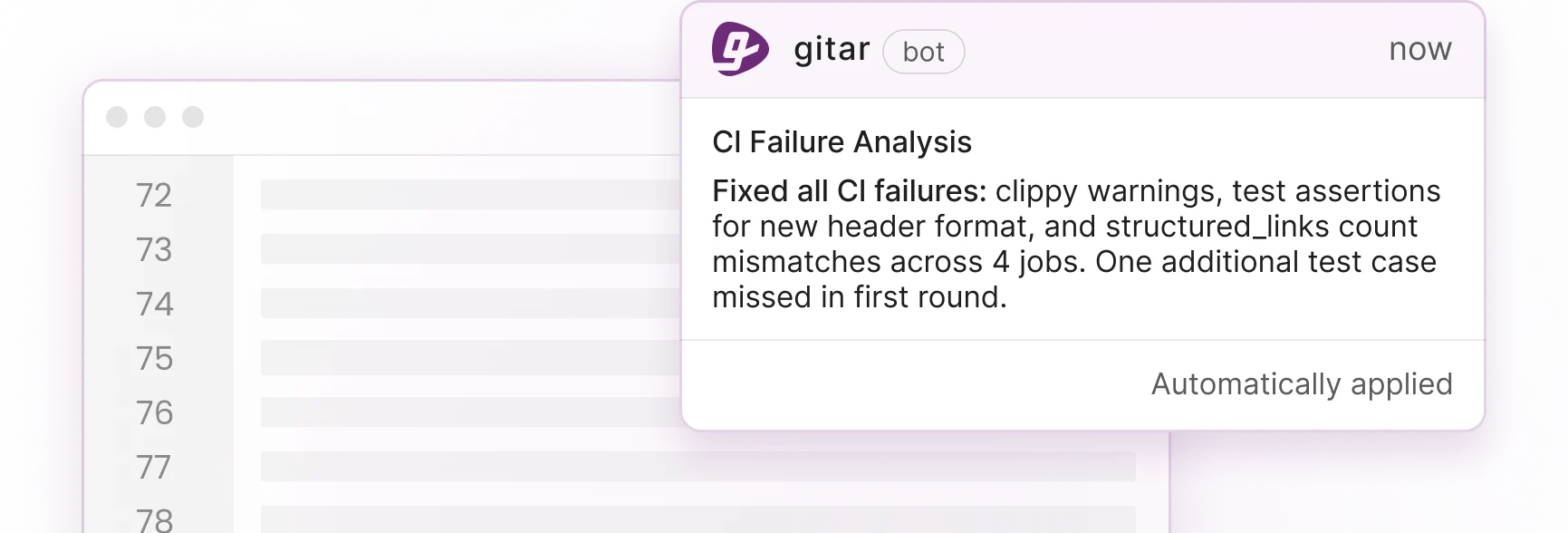
Gitar’s healing engine marks the shift from suggestion-only tools to autonomous CI repair. When tests fail, Gitar analyzes failure logs with full codebase context, generates validated fixes, and auto-commits solutions from a single PR comment. The platform includes natural language workflow rules, Slack and Jira integrations, and support for GitHub Actions, GitLab CI, CircleCI, and Buildkite. See the Gitar documentation for full details.
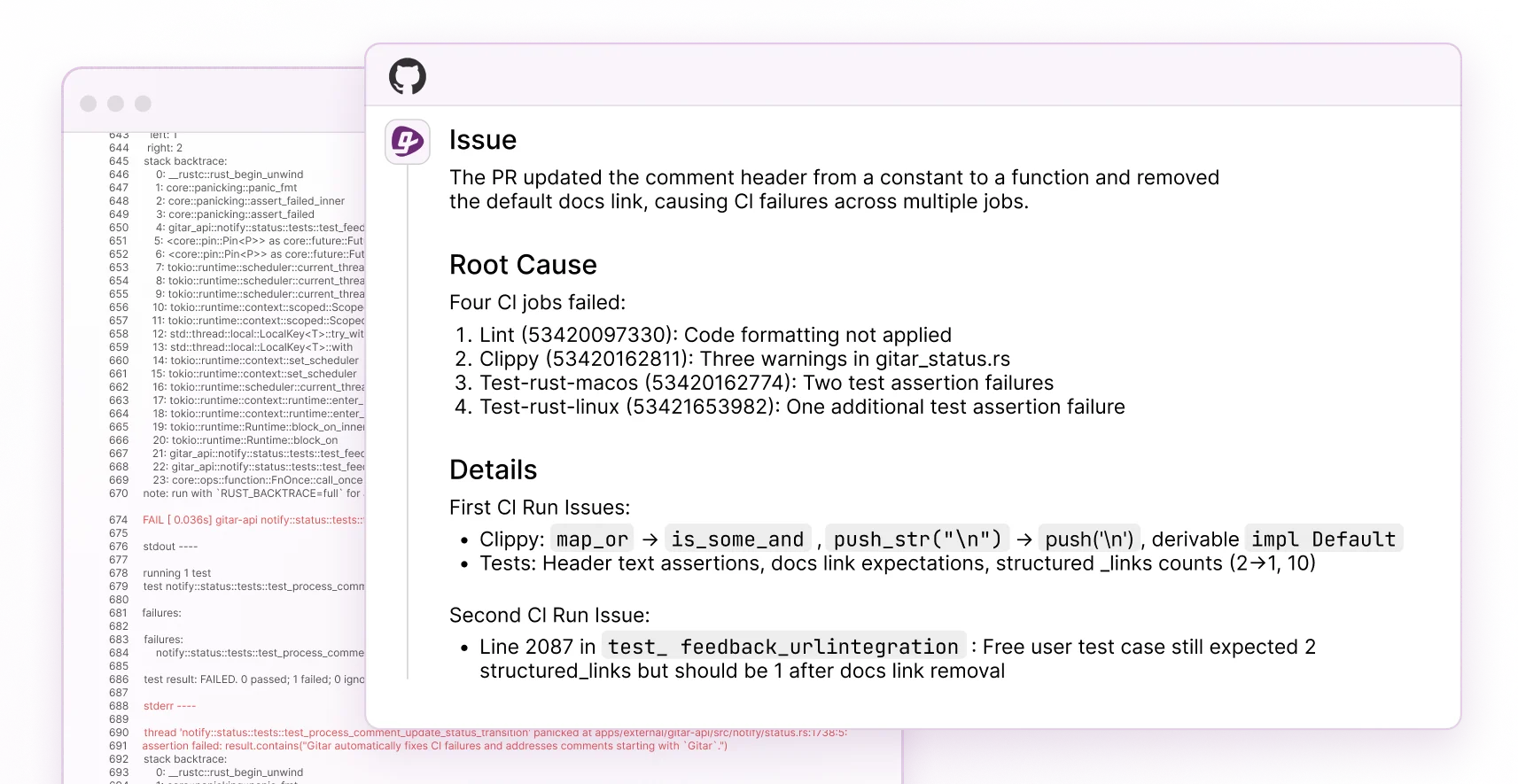
Setup finishes in under 5 minutes. Teams install the GitHub app, and the 14-day Team Plan trial starts automatically with full healing capabilities. The platform learns team patterns and maintains hierarchical memory across lines, PRs, repositories, and organizations. For a 20-developer team spending 1 hour daily on CI issues, Gitar delivers $750K annual savings by cutting that time to 15 minutes.
Key strengths include guaranteed green builds, pattern learning, and broad CI integration. Unlike competitors that flood PRs with notifications, Gitar consolidates findings into a single updating comment that reduces cognitive load while still surfacing every issue.
#2 CodeRabbit: Strong Suggestions Without Auto-Commit
CodeRabbit provides AI-powered code review that integrates with GitHub and GitLab, analyzing pull requests automatically and identifying bugs, security vulnerabilities, and performance issues. It operates as a suggestion engine without auto-commit or CI healing capabilities. At $15-30 per seat, teams still handle manual implementation and have no guarantee that suggested fixes will pass CI validation.
Best for: Small teams starting with AI code review that can handle manual fix implementation.
#3 Qodo: Test Generation With Limited Healing
Qodo focuses on test generation and PR analysis with limited validation capabilities. It can detect bugs and suggest improvements, but it lacks autonomous commit functionality and the CI integration depth needed for true healing. The platform works primarily with GitHub workflows and still requires manual intervention for most fixes.
Best for: Teams that prioritize test coverage more than autonomous fixing.
#4 Ellipsis: Context-Rich Reviews With On-Demand Fixes
Ellipsis provides contextual code reviews and suggestions with strong GitHub integration. The tool excels at understanding code relationships through hierarchical agents and multi-step RAG, and it can generate and apply bug fixes as commits when invoked, such as through an @ellipsis-dev tag. It still requires explicit invocation for autonomous fixing instead of automatic CI healing.
Best for: Teams that want detailed contextual reviews with on-demand automation.
#5 Greptile: Codebase Intelligence Without CI Commits
Greptile offers codebase search and context understanding at $30 per seat but does not provide CI commit capabilities. It delivers useful insights into code relationships and can suggest improvements, yet it does not integrate with CI systems for autonomous healing.
Best for: Teams that need codebase intelligence but not automated fixes.
#6 DeepSource: Basic Autofix Across Popular Languages
DeepSource offers automated code review with an autofix feature that can automatically commit and push changes to resolve certain issues, supporting Python, JavaScript, Go, and Ruby. It integrates with GitHub, GitLab, and Bitbucket with low false positive rates. It still lacks the comprehensive CI failure analysis and healing capabilities that more advanced platforms provide.
Best for: Teams that want basic autofix without full CI integration.
#7 Open-Source and DIY: Flexible but High Effort
Open-source options like Semgrep and custom GPT integrations provide basic code analysis but demand significant engineering effort to reach autonomous fixing. These tools perform well on isolated file reviews but struggle with architectural context across large codebases and offer no guarantee of working fixes.
Best for: Budget-constrained teams with engineering capacity for custom development.
Gitar vs. Competitors: Feature-by-Feature Comparison
The critical differences stand out clearly when you compare autonomous capabilities side by side:
| Feature | Gitar | CodeRabbit | Others |
|---|---|---|---|
| Auto-Apply Fixes | Yes | No | Limited |
| CI Log Analysis | Yes | No | No |
| Validate + Commit | Yes | No | Partial |
| Green Build Guarantee | Yes | No | No |
Suggestion tools cost $450-900 monthly for 30 developers, while Gitar’s 14-day Team Plan trial offers full autonomous fixing so teams can prove ROI before any commitment.
Agentic AI and CI Healing Trends in 2026
The shift toward agentic AI is reshaping development workflows. Anthropic’s 2026 Agentic Coding Trends Report describes autonomous agents handling routine coding, debugging, and maintenance while ensuring quality outcomes. Developers experience fewer notifications and less context switching. Engineering leaders see measurable velocity gains, and DevOps teams benefit from self-healing CI that cuts rerun costs.
Teams can address common objections about automated commits through configurable approval workflows. Many start in suggestion mode and gradually enable autonomous fixing for trusted failure types.
Frequently Asked Questions
What is the best free AI code review tool with auto-fix capabilities?
Gitar offers a 14-day free trial of its Team Plan, with full access to autonomous fixing, CI integration, and workflow automation. Unlike competitors that restrict free tiers, Gitar’s trial includes all healing engine capabilities so teams can measure real productivity impact before moving to paid plans.
How does Gitar integrate with GitHub and other platforms?
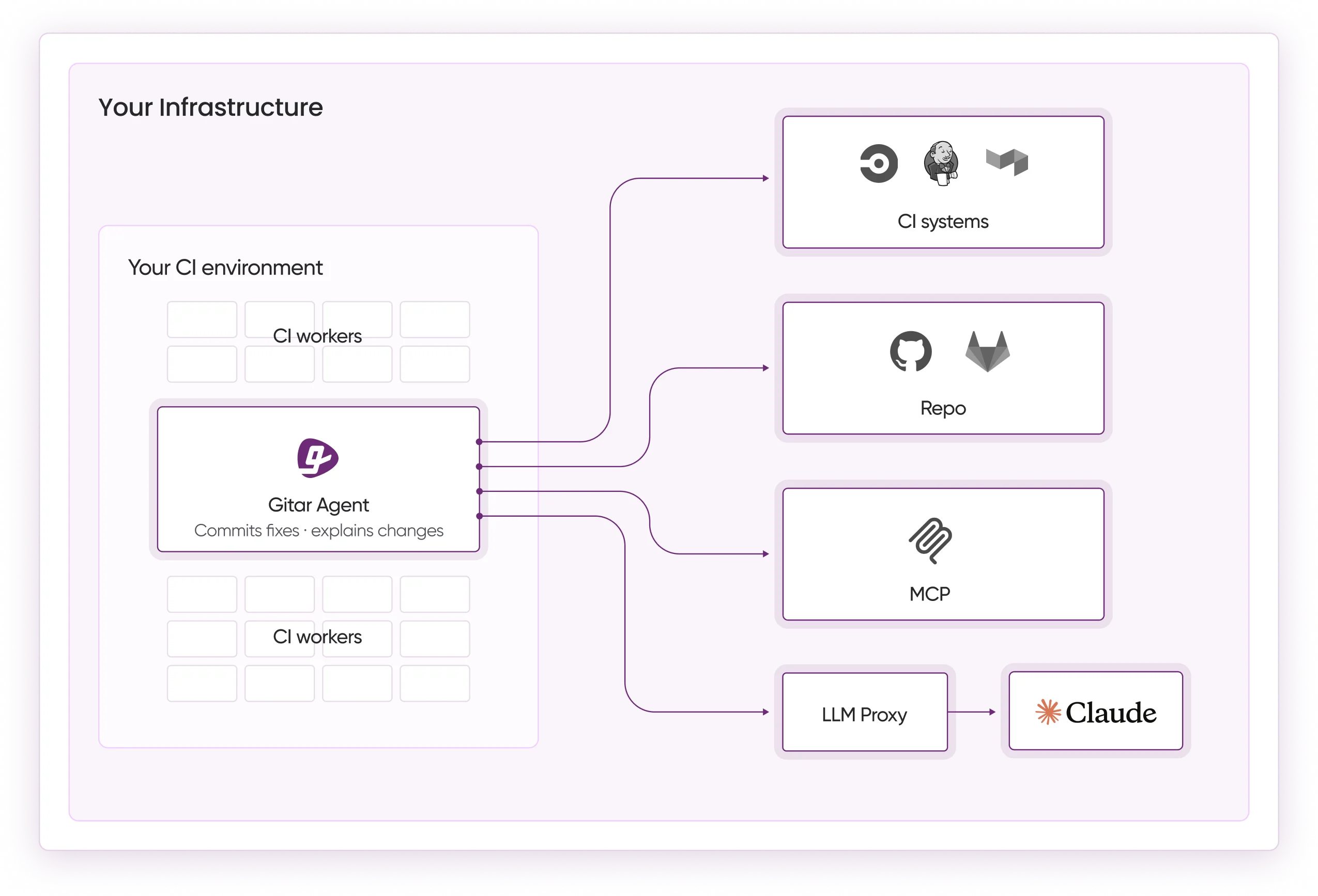
Gitar supports GitHub, GitLab, CircleCI, Buildkite, and other major CI platforms through native integrations. Installation takes under 5 minutes through the GitHub App. The platform then analyzes CI failure logs, generates fixes with full codebase context, and commits solutions directly to pull requests. See the Gitar documentation for integration details.
How does Gitar compare to CodeRabbit for fixing test failures?
CodeRabbit provides suggestions and comments but requires manual implementation of all fixes. Gitar autonomously analyzes CI failures, generates validated solutions, and commits working fixes directly to PRs. CodeRabbit costs $15-30 per seat for suggestions, while Gitar’s healing engine resolves issues and guarantees green builds.
What ROI can teams expect from AI auto-fix tools?
A 20-developer team can save about $750K annually with autonomous fixing tools like Gitar by reducing CI time from 1 hour to 15 minutes daily per developer. Teams also gain from less context switching, faster sprint velocities, and removal of manual fix implementation that suggestion-only tools still require.
Can AI tools handle complex logic errors and integration issues?
Advanced platforms like Gitar maintain hierarchical memory across codebases and integrate with project management tools like Jira to understand the intent behind changes. This design supports complex scenarios such as cross-service dependencies, authentication flows, and architectural changes that simpler suggestion engines often miss.
Why Gitar Leads the 2026 AI CI Healing Market
The 2026 landscape clearly separates suggestion engines that keep manual overhead and healing engines that deliver autonomous solutions. With 93% of developers using AI tools but productivity gains plateauing, the bottleneck now sits in code validation and fixing rather than code generation.
Gitar stands out by providing guaranteed green builds through a comprehensive healing engine that analyzes, fixes, validates, and commits solutions autonomously. While competitors charge premium prices for basic suggestions, Gitar offers a risk-free 14-day trial so teams can prove value through measurable productivity improvements.