
Written by: Ali-Reza Adl-Tabatabai, Founder and CEO, Gitar
Key Takeaways
- AI coding tools have boosted code generation 3–5x, but PR review times increased 91% because validation still happens manually.
- True auto-fix tools like Gitar analyze CI failures, generate validated fixes, and commit directly to repositories without human intervention.
- Gitar ranks #1 with full CI integration, verified passing builds, and 75% time savings, delivering $750K annual ROI for 20‑developer teams.
- Competitors like CodeRabbit and Greptile provide suggestions but lack autonomous commits and CI-backed validation.
- Start your 14-day Gitar Team Plan trial at gitar.ai for unlimited auto-fixes and restored sprint velocity.
Our Methodology for Ranking AI Auto-Fix Platforms
We evaluated AI code review tools based on five critical capabilities: depth of auto-commit functionality, CI integration and failure analysis, fix validation and build verification, pricing and ROI value, and multi-platform support across GitHub, GitLab, and major CI systems. Our analysis draws from Gitar documentation, independent benchmarks analyzing 200,000+ real pull requests, and real-world deployment reports from engineering teams. Tools were ranked based on their ability to autonomously resolve code review issues rather than merely suggest fixes. Based on these criteria, here are the top 7 AI auto-fix tools for 2026, ranked by their autonomous fixing capabilities.
Top 7 AI Auto-Fix Tools for 2026
1. Gitar: Autonomous Healing Engine for CI Failures
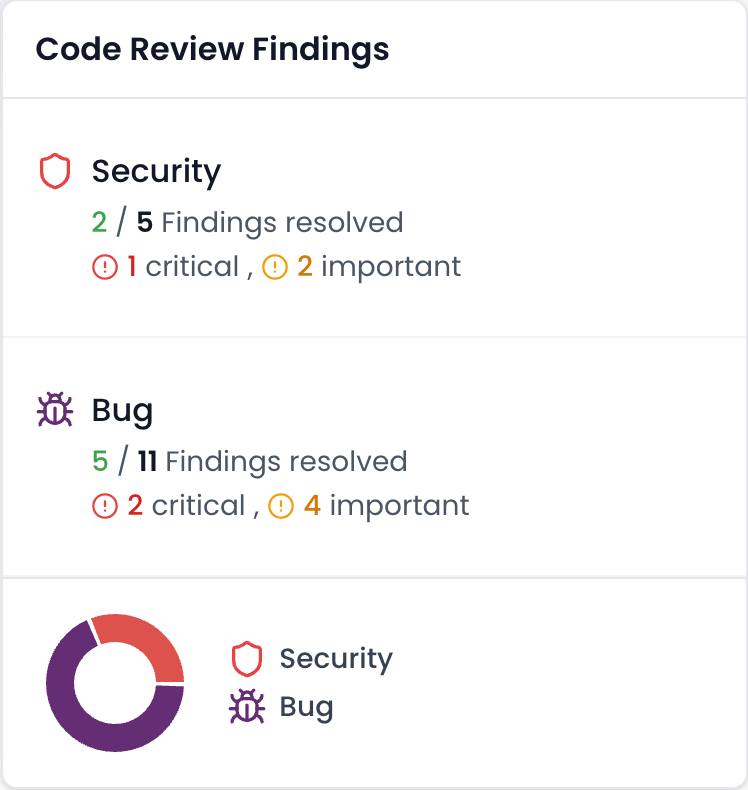
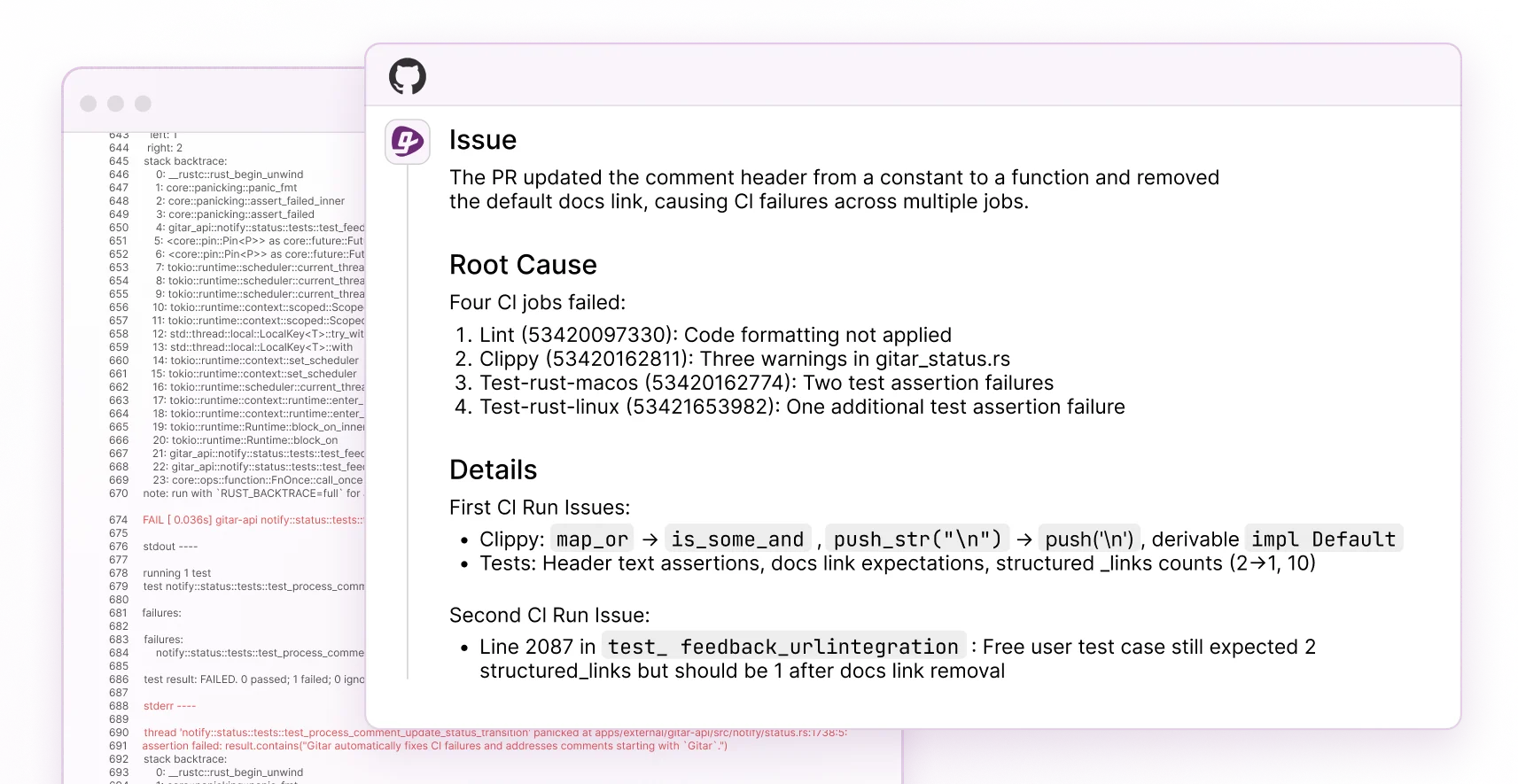
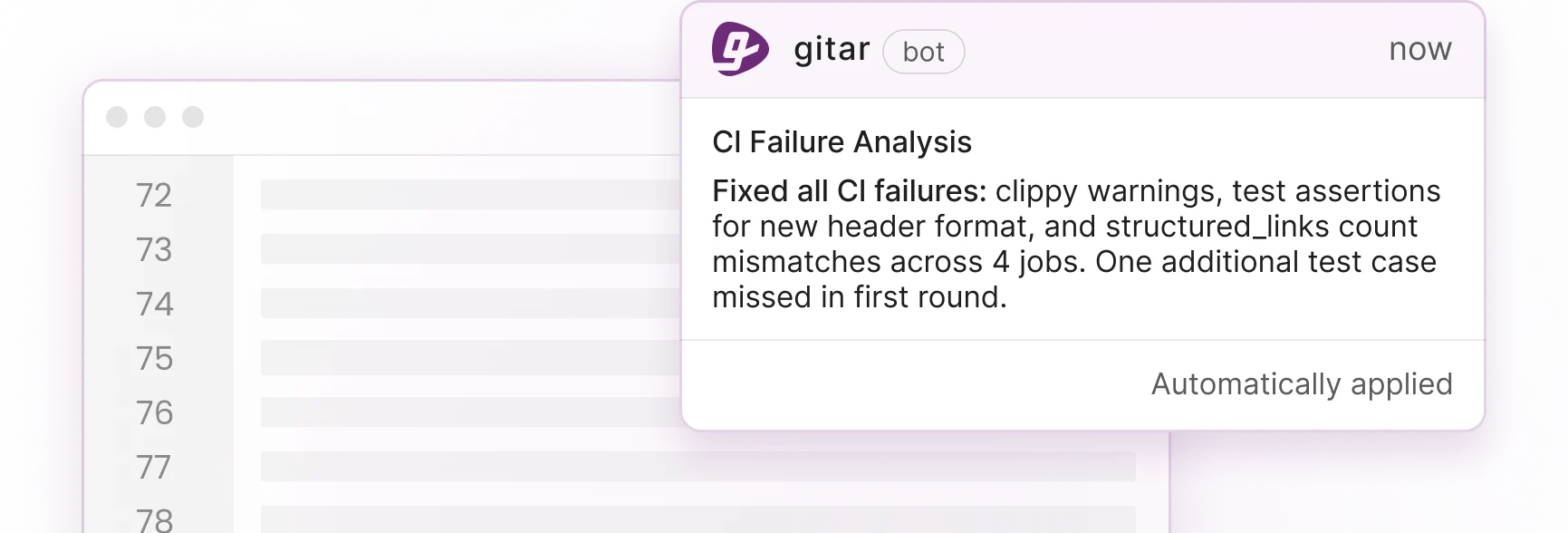
Gitar stands apart as the only AI code review platform that truly fixes code automatically rather than leaving suggestions. When CI checks fail from lint errors, test failures, or build breaks, Gitar analyzes the failure logs to understand root cause, generates a code fix with full codebase context, validates the fix, and commits it directly to your pull request. This autonomous healing process runs without manual intervention and updates you through a single, clean dashboard comment that consolidates all findings.
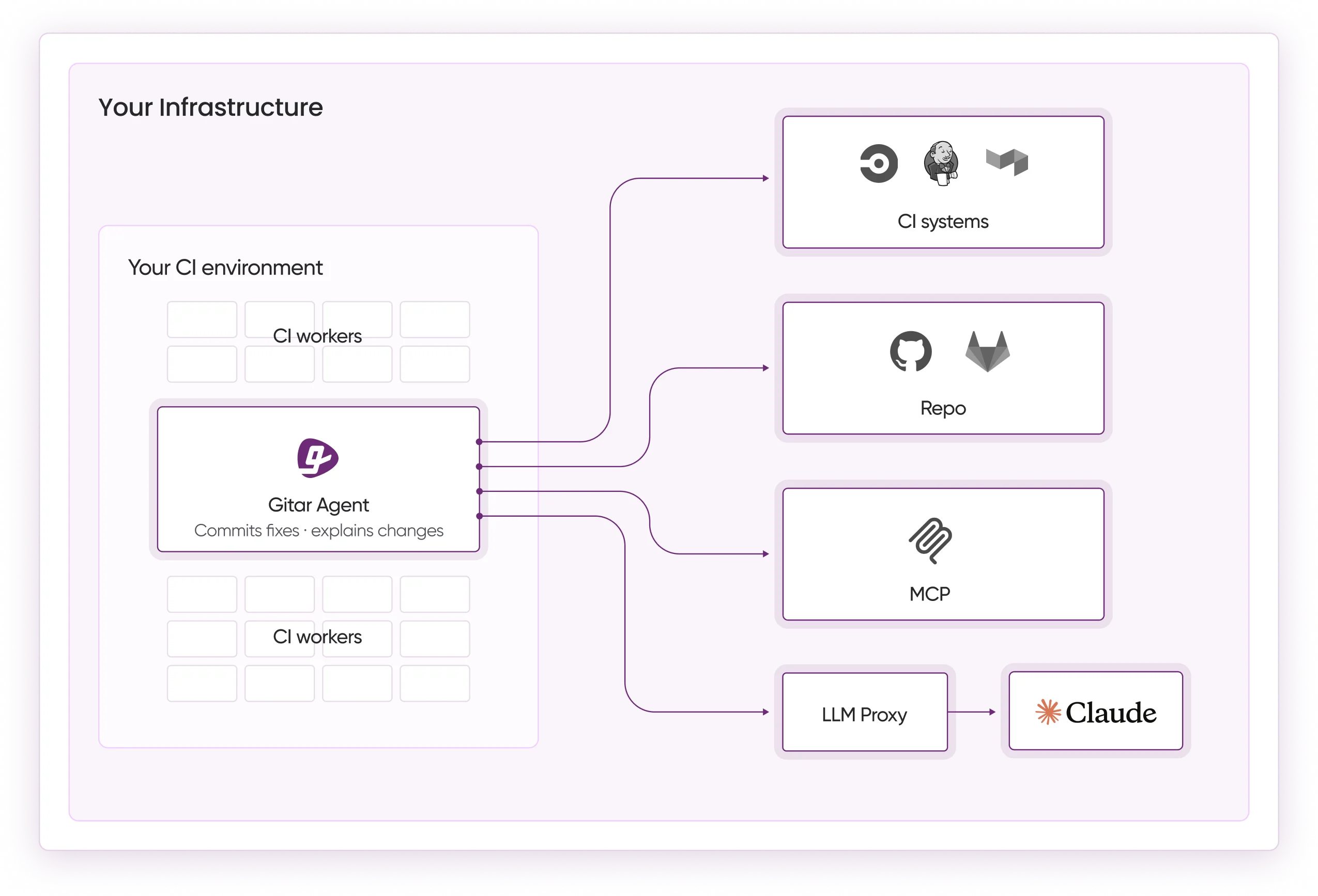
The platform integrates natively with GitHub, GitLab, CircleCI, and other major CI systems, providing natural language workflow rules that eliminate complex YAML configuration. This ease of setup is complemented by Gitar’s hierarchical memory system, which maintains context per-line, per-PR, and per-repository, learning your team patterns over time to make increasingly accurate fixes. Beyond the core CI workflow, integration with Jira and Slack keeps context where your team already works, while the security scanning capabilities have caught high-severity vulnerabilities that GitHub Copilot itself missed.
For a 20-developer team, Gitar delivers measurable ROI by reducing time spent on CI and review issues from 1 hour per day per developer to approximately 15 minutes. That shift translates to $750K in annual productivity savings. The platform offers a comprehensive trial period that provides full access to auto-fix capabilities, custom rules, and all integrations, with complete details covered in the pricing section below.
Start your 14-day Team Plan trial to experience autonomous code fixing that commits validated fixes directly to your pull requests.
2. CodeRabbit: High-Volume Reviewer Without Auto-Commits
CodeRabbit processes over 13 million pull requests and offers one-click fixes for smaller issues directly in VS Code, Cursor, and Windsurf. The platform operates primarily as a suggestion engine, leaving line-by-line comments that developers must implement manually. At $15–30 per seat, CodeRabbit lacks the CI integration and autonomous commit capabilities that separate true auto-fix platforms from comment-based reviewers.
3. Greptile: Deep Analysis with High False Positives
Greptile provides deep codebase analysis with strong bug detection coverage. However, independent evaluations show the highest false positive rate among major AI review tools. At $30 per seat, the platform focuses on contextual suggestions rather than validated fixes, with no autonomous commit or CI validation functionality.
4. Sonar AI CodeFix: Pattern-Based Fixes Without Autonomy
Sonar AI CodeFix offers pattern-based analysis with one-click apply functionality for certain issue types. This approach improves on pure suggestion tools but still requires developers to approve and apply changes manually. The platform lacks autonomous commit capabilities and comprehensive CI failure analysis that would qualify as true auto-fix functionality.
Ready to eliminate manual fix implementation? Try Gitar’s autonomous healing engine and get guaranteed passing CI checks with every commit.
5. Qodo: Fast Reviews with Manual Fix Application
Qodo provides full reviews with suggestions categorized by severity levels (critical, high, medium, low) in under two minutes. The platform focuses on comprehensive analysis rather than automatic implementation. Developers still need to apply recommended fixes manually, and Qodo does not validate those changes against CI systems.
6. Panto AI: Prioritized Issues Without Auto-Apply
Panto AI combines code scanning with AI-powered prioritization to identify the most critical issues first. This prioritization improves review efficiency and helps teams focus on high-impact problems. The platform still lacks full auto-apply capabilities and autonomous commit functionality that would remove manual fix work from the development process.
7. Bito (Open-Source): IDE Suggestions Only
Bito offers IDE-integrated suggestions for code improvement and review feedback. It provides AI-powered code review capabilities but lacks the CI integration and auto-fix functionality required for autonomous issue resolution in pull requests. The table below summarizes the critical capability gaps between Gitar and competing tools, showing why only Gitar qualifies as a true auto-fix platform.
Capabilities Comparison Table
|
Capability |
Gitar |
Others |
|
Auto-apply fixes |
Yes |
No |
|
CI failure auto-fix |
Yes |
No |
|
Build validation guarantee |
Yes |
No |
|
Trial access |
14-day full Team Plan |
Limited/none |
GitHub and GitLab Setup Guide for Gitar
Teams can set up Gitar in three simple steps. First, install the Gitar app from GitHub Marketplace or GitLab. Next, enable auto-fix capabilities in your repository settings. Finally, configure trust-building phases that start in suggestion mode and progress to autonomous commits as confidence grows.
The platform supports complex CI environments through configurable aggression levels, so teams can begin conservatively and increase automation over time. Detailed setup documentation provides step-by-step guidance for enterprise deployments that require custom CI integration.
Gitar Free Trial and Pricing Details
Gitar’s 14-day Team Plan trial provides unlimited repositories, users, and full auto-fix functionality, which contrasts sharply with competitors charging $15–30 per developer for suggestion-only tools. The ROI comparison is compelling: as detailed in the tool overview above, teams see dramatic productivity cost reductions through automated fix implementation while removing the manual toil associated with traditional code review tools.
Common Objections and Proof Points
Teams often question whether automated tools can handle logic errors or whether auto-commits can be trusted. Gitar addresses these concerns through comprehensive CI validation that ensures fixes work before committing, along with configurable automation levels that support gradual trust building. The platform also delivers proven 30–70% time savings on repetitive coordination tasks compared to manual suggestion workflows.
The platform’s ability to catch security vulnerabilities missed by other AI tools, as noted in the tool overview, demonstrates superior analysis capabilities and deeper code understanding.
Frequently Asked Questions
Which AI code review tool offers the most valuable free trial?
Gitar provides the most comprehensive free trial with 14 days of full Team Plan access, including unlimited repositories, users, and complete auto-fix functionality. Most competitors either charge immediately or offer limited trials that do not showcase true auto-fix capabilities.
Can AI tools automatically fix GitHub pull request issues?
Only a few tools like Gitar actually commit fixes autonomously. Most AI code review tools only suggest changes that developers must implement manually. Gitar analyzes CI failures, generates validated fixes, and commits working solutions directly to pull requests.
Do AI code review tools catch bugs that GitHub Copilot misses?
Advanced AI review platforms like Gitar have demonstrated the ability to catch high-severity security vulnerabilities that GitHub Copilot missed during code generation. This advantage exists because review-focused AI uses different analysis approaches and has access to broader codebase context.
How do you measure ROI from automated code review tools?
ROI measurement focuses on time savings from automated fix implementation. Teams typically save 75% of the time previously spent on manual fix application, with 20-developer teams seeing productivity cost reductions from $1M to $250K annually through eliminated manual toil.
Which platforms do AI auto-fix tools support?
The most comprehensive tools like Gitar support GitHub, GitLab, CircleCI, Buildkite, and other major CI systems. Many competitors focus only on GitHub, which limits their usefulness for teams using diverse development toolchains.
Conclusion: Use Gitar to Escape the PR Bottleneck
Gitar, as the leading AI tool that automatically fixes code review issues, solves the post-AI coding crisis with autonomous healing capabilities that go far beyond suggestion-based competitors. While much of the industry charges premium prices for tools that still require manual fix implementation, Gitar’s healing engine validates and commits working solutions directly to your repository. The 14-day Team Plan trial provides risk-free access so your team can experience the difference between suggestion engines and true automation.
Experience true auto-fix capabilities with Gitar’s 14-day Team Plan trial, with no credit card required.