
Key Takeaways
- AI autofix bots remove the code review bottleneck, where PR times rose 91% even as AI sped up code generation 3-5x.
- Gitar leads as the only tool with validated auto-commits for CI failures across GitHub, GitLab, CircleCI, and Buildkite, not just suggestions.
- Teams using Gitar save about $750K per year on a 20‑developer team by cutting CI and review time from 1 hour to 15 minutes per developer per day, with a free tier available.
- Competitors such as CodeRabbit, Greptile, and Snyk provide limited or partial fixes and lack Gitar’s full CI healing and green build guarantees.
- Teams can start automating fixes reliably with Gitar and ship higher quality software faster.
Top AI Autofix Bots for Code Review & CI Failures in 2026
|
Tool |
Auto-Fix CI Failures |
Free Tier |
Platforms |
|
#1 Gitar |
Yes (validates & commits) |
Free review + 14-day autofix trial |
GitHub, GitLab, CircleCI, Buildkite |
|
#2 CodeRabbit |
No (suggestions only) |
Limited |
GitHub, GitLab |
|
#3 Greptile |
No (suggestions only) |
Limited |
GitHub |
|
#4 Sentry Autofix |
Partial (bug reproduction) |
Limited |
GitHub |
|
#5 Aikido Security |
Yes (security-focused) |
No |
GitHub, GitLab |
|
#6 DeepSource |
No (PR suggestions) |
Limited |
GitHub, GitLab, Bitbucket |
|
#7 Snyk Code |
Partial (vulnerability fixes) |
Limited |
Multiple IDEs, CI/CD |
|
#8 GitHub Copilot Autofix |
Partial (security PRs) |
No (GHAS required) |
GitHub only |
|
#9 Qodo |
No (fast reviews only) |
Yes |
Multiple platforms |
Gitar stands out as the only tool that delivers full CI failure analysis with validated auto-commits across multiple platforms. Competitors focus on suggestions or narrow security fixes, while Gitar provides end-to-end healing for lint errors, test failures, and build breaks.
Try Gitar’s free AI autofix bot. Automatically fix broken builds and ship higher quality software faster.
Why Gitar Leads Free AI Autofix Bots
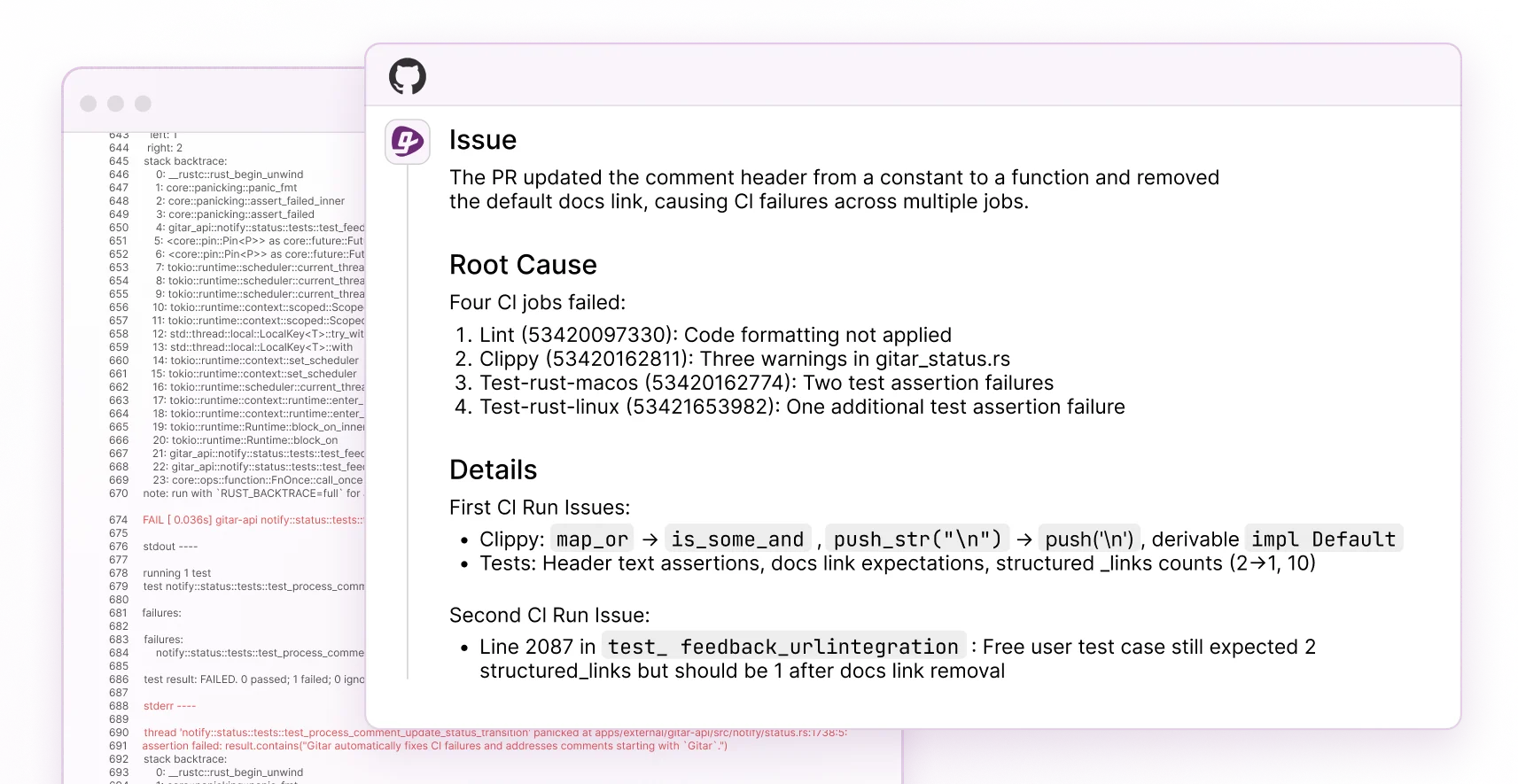
Gitar removes the suggestion engine trap that affects competitors charging $15-30 per developer. CodeRabbit and Greptile leave comments that still need manual work, while Gitar’s healing engine analyzes CI failures, generates fixes, validates them in your environment, and commits working solutions.
|
Metric |
20-Dev Team Before |
20-Dev Team After Gitar |
Annual Savings |
|
CI/Review Time |
1 hour/day/dev |
15 min/day/dev |
$750K |
|
Tool Cost |
$450-900/month |
$0 |
$5.4K-10.8K |
|
Context Switching |
Multiple/day |
Near-zero |
Productivity gain |
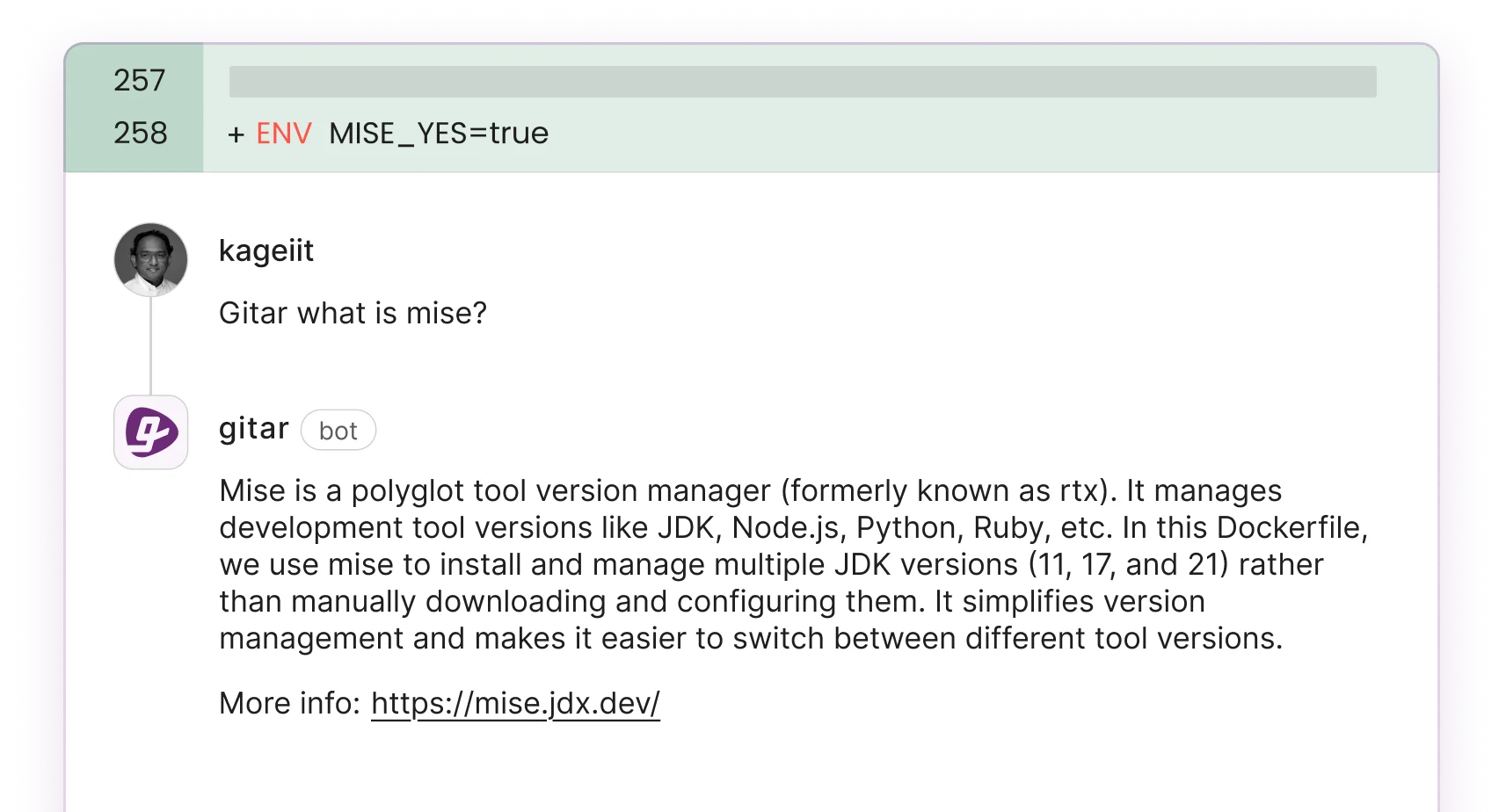
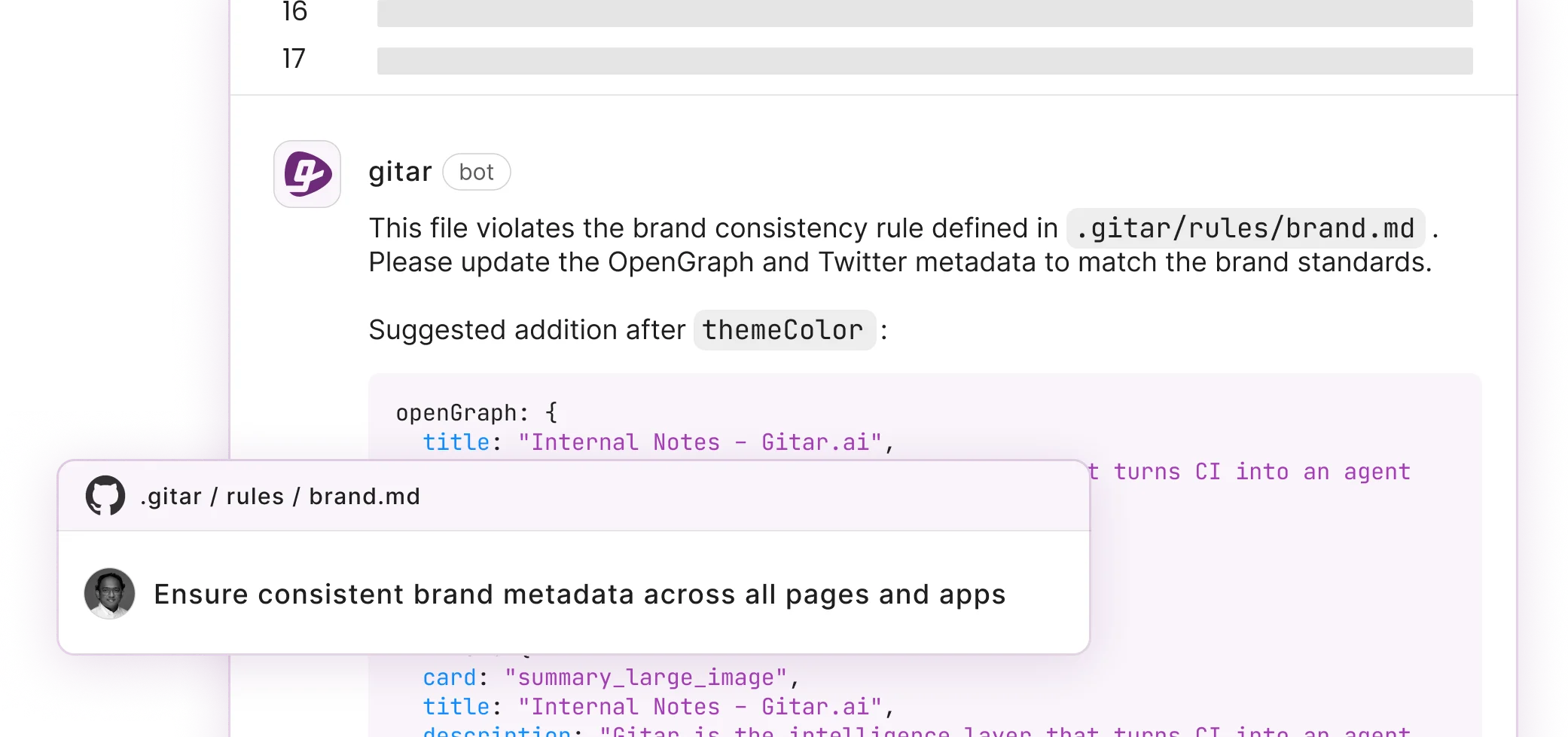
Setup finishes in about 5 minutes. Install the GitHub app or GitLab integration, configure .gitar/rules with natural language workflows, and watch automatic fixes appear in a single, updating comment. Gitar consolidates findings in one clean interface instead of flooding teams with notifications.
Pinterest validates Gitar at enterprise scale across more than 50 million lines of code and thousands of daily PRs. Collate’s engineering team highlights the “unrelated PR failure detection” that separates infrastructure flakiness from code bugs, and Tigris notes that summaries are “more concise than Greptile/Bugbot.”
For a deeper ROI breakdown, review the Gitar ROI calculator.
Install Gitar now. Automatically fix broken builds and ship higher quality software faster.
#2 CodeRabbit: Strong Reviews, No CI Autofix
CodeRabbit delivers line-by-line reviews with one-click fixes and codebase-wide reasoning, and it charges $15-30 per seat. The tool lacks CI failure analysis and auto-commit capabilities, so developers must manually apply every recommended change.
#3 Greptile: Deep Context Without Auto-Commits
Greptile offers rich codebase context for $30 per seat but does not provide fix validation or auto-commit features. It delivers fast, detailed reviews, yet it produces noisy inline comments and cannot guarantee that fixes work in production environments.
#4 Sentry Autofix: Error-Focused PRs on GitHub
Sentry Autofix creates PRs with fixes and unit tests and focuses mainly on GitHub environments. The tool does not cover CI failures comprehensively and does not guarantee green builds after teams apply fixes.
Try Gitar’s comprehensive autofix. Automatically fix broken builds and ship higher quality software faster.
#5 Aikido Security: AI Fixes for Security Issues
Aikido Security provides auto-remediations with AI-generated fixes and one-click PR patches, filtering over 90% of false positives. The product focuses on security vulnerabilities and offers access only on paid plans.
#6 DeepSource: PR Suggestions Without Healing
DeepSource offers developer-friendly autofix suggestions in real time across several languages and platforms. The tool works through PR-based feedback and does not include auto-commit functionality, so teams still need manual intervention.
#7 Snyk Code: Vulnerability Fixes First
Snyk Code provides AI-powered remediation with 80% accurate automated fixes and real-time scanning across IDEs and CI/CD pipelines. The focus stays on vulnerability fixes instead of full CI failure resolution.
#8 GitHub Copilot Autofix: Security PR Focus
GitHub Advanced Security includes Copilot Autofix for automatic remediation, but it requires a paid GHAS subscription and limits functionality to security PRs. The tool does not address broader CI healing needs.
#9 Qodo: Fast Reviews Without Autofix
Qodo delivers very fast, detailed AI code reviews with fix suggestions categorized by severity, scanning entire codebases in under two minutes. It lacks validation and auto-commit capabilities and works as a review tool instead of an autofix solution.
Gitar vs. Competitors: Free Healing in Practice
|
Capability |
Gitar |
Competitors |
|
PR Summaries |
✓ Free |
✓ $15-30/seat |
|
Auto-Apply Fixes |
✓ Validates & commits |
✗ Suggestions only |
|
CI Autofix |
✓ Full analysis |
✗ Limited/none |
|
Green Build Guarantee |
✓ Validated fixes |
✗ Hope-based |
Gitar’s healing engine validates fixes in your CI environment before committing, while competitors charge premium prices for unvalidated suggestions. This architectural difference cuts manual intervention and delivers measurable ROI with fixes that already pass CI.
AI Autofix Pitfalls and How Gitar Handles Them
Teams often face AI autofix pitfalls such as notification spam, false fixes, and low trust. AI code review best practices highlight transparent feedback and human oversight for complex decisions.
Gitar addresses these issues with a single updating comment that removes spam, fix validation against CI that prevents false fixes, and a configurable suggestion mode that builds trust. The seven-step workflow of analyze, generate, validate, commit, update, notify, and learn creates reliable automation.
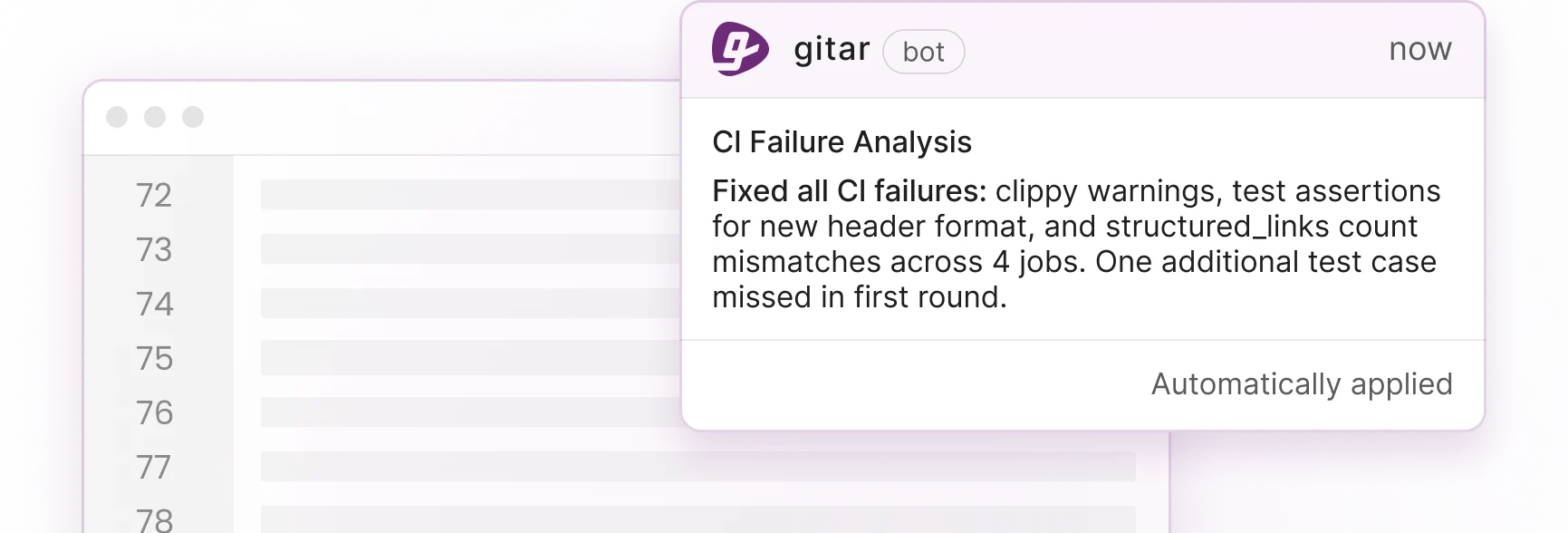
Industry trends now point toward self-healing CI pipelines. Tools like Qwiet AI’s AutoFix report large reductions in false positives and faster remediation times, which confirms the market shift from suggestions to direct action.
Start with Gitar’s self-healing CI. Automatically fix broken builds and ship higher quality software faster.
FAQs
What is the best free AI autofix for CI failures?
Gitar provides the most comprehensive free AI autofix solution for CI failures. Competing tools charge $15-30 per developer for suggestions, while Gitar offers unlimited code review and a 14-day free trial of autofix features. The platform analyzes CI logs, generates validated fixes, and commits them automatically across GitHub, GitLab, CircleCI, and Buildkite environments.
Can AI automatically fix code review feedback?
Gitar can implement code review feedback through @gitar commands. When reviewers comment with specific requests such as “refactor this to use async/await,” Gitar generates the implementation, validates it against CI, and commits the working solution. This approach removes the usual back-and-forth cycle in manual review processes.
How does AI autofix integrate with GitHub Actions?
Gitar integrates natively with GitHub Actions through its GitHub App installation. The platform monitors CI failures in real time, analyzes build logs, and automatically generates fixes that it validates in your specific environment. Gitar avoids complex YAML configuration and instead uses natural language rules in .gitar/rules files for workflow automation.
What ROI can teams expect from AI autofix tools?
A 20-developer team often saves about $750K annually by cutting CI and review time from 1 hour to 15 minutes per developer per day. Teams also save by removing paid suggestion tools that cost $450-900 per month and by reducing context switching interruptions. Even at 50% effectiveness, the ROI far exceeds implementation costs, especially with Gitar’s free tier.
How do free AI autofix tools compare to paid alternatives?
Free tools such as Gitar can deliver stronger functionality than many paid suggestion engines. CodeRabbit and Greptile charge $15-30 per seat for comments that still need manual implementation, while Gitar’s free tier includes comprehensive code review with validated autofix capabilities. The key difference lies in architecture, with healing engines that commit working fixes instead of suggestion engines that leave all implementation to developers.
The AI coding wave solved code generation but created a review bottleneck. Suggestion engines charge premium prices for small improvements, while AI autofix bots for code review and CI failures like Gitar deliver real automation with validated fixes and guaranteed green builds. For teams overwhelmed by PR floods and CI failures, free healing clearly beats paid suggestions.
Install Gitar now. Automatically fix broken builds and ship higher quality software faster.