
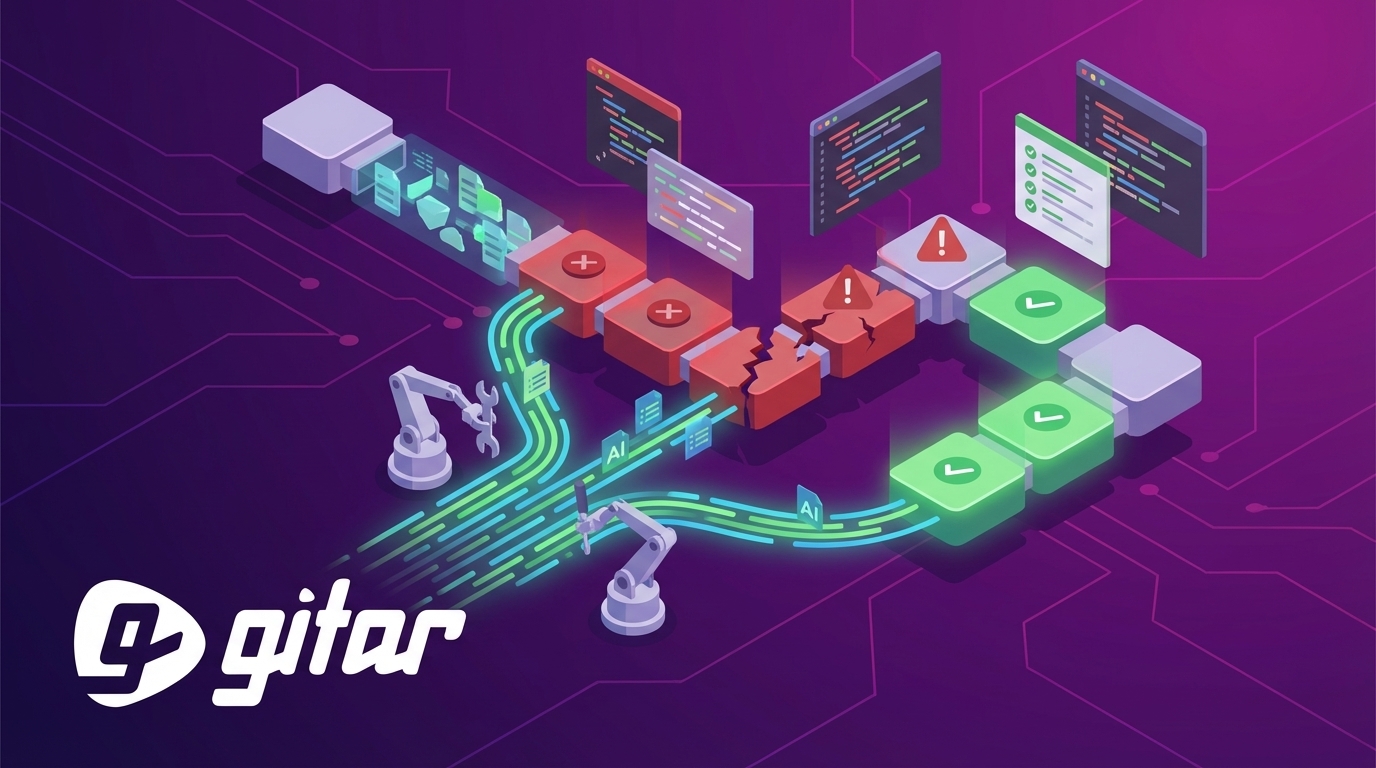
Key Takeaways for CI Failure Auto-Fixing in 2026
- 84% of developers use AI coding tools in 2026, but CI failures cause 91% longer PR reviews and stall sprint velocity due to the “suggestion trap.”
- CI failures break into 40% flaky tests, 25% infrastructure issues, 20% build breaks, and 15% lint problems, amplified by AI-generated code vulnerabilities.
- Gitar leads with a 10/10 auto-fix score, supporting GitHub Actions, GitLab CI, CircleCI, and Buildkite with full log analysis and validated commits.
- Competitors like CodeRabbit and Cursor BugBot offer suggestions and one-click fixes but lack auto-commit, cross-platform support, and green build guarantees.
- Start your 14-day free trial with Gitar to escape the suggestion trap and move toward self-healing CI pipelines.
CI Failure Categories That Slow Teams Down
CI pipeline failures fall into four primary categories, and each one needs a different analysis and resolution approach. Build breaks account for about 20% of failures and usually involve compilation errors, missing dependencies, or configuration problems. Test flakiness represents the largest category at 40% and includes intermittent failures, timing issues, and environment-dependent problems that AI-generated code increases by 75% due to logic issues and race conditions.
Lint and code quality issues make up 15% of failures and include style violations, security vulnerabilities, and maintainability concerns. Infrastructure and dependency failures cover the remaining 25% and include network timeouts, service unavailability, version conflicts, and resource constraints. Complexity rises when AI-generated code introduces 4x more duplicate code patterns and up to 30% security vulnerabilities that traditional CI tools rarely detect and resolve automatically.
Teams need clear visibility into these categories because different AI tools specialize in different failure types. Some tools focus on static analysis and lint fixes. Others specialize in test stabilization. A smaller group of platforms addresses the full spectrum of CI failures with contextual understanding of your codebase and infrastructure.
Leading AI Tools for CI Failure Analysis and Auto-Fixing
The AI-powered CI analysis market now ranges from suggestion-only engines to full auto-fix platforms. The table below compares the leading solutions on auto-fix depth and CI coverage.
| Tool | Key Features | CI Support | Auto-Fix Score |
|---|---|---|---|
| Gitar | Full log analysis, root cause detection, auto-commit validated fixes | GitHub Actions, GitLab CI, CircleCI, Buildkite | 10/10 |
| CodeRabbit | PR analysis, inline suggestions, one-click fixes | GitHub only | 4/10 |
| Cursor BugBot | One-click fixes, 70% issue resolution, requires approval | GitHub only | 6/10 |
| Graphite | Stacked workflows, merge queue optimization, 55% adoption rate | GitHub only | 5/10 |
| GitLab Duo | DevSecOps platform integration, code suggestions and workflows | GitLab.com, Self-Managed, Dedicated | 4/10 |
| Dagger | Custom agents, complex setup, no guarantee | Multi-platform | 6/10 |
| Nx Cloud | Build optimization, caching, limited auto-fix | Multiple CIs | 3/10 |
The scoring reflects each tool’s ability to resolve CI failures automatically without manual intervention. Most tools provide analysis and suggestions, while Gitar delivers comprehensive auto-fix capabilities across all major CI platforms.
How Gitar Delivers Validated Auto-Fixes for CI Failures
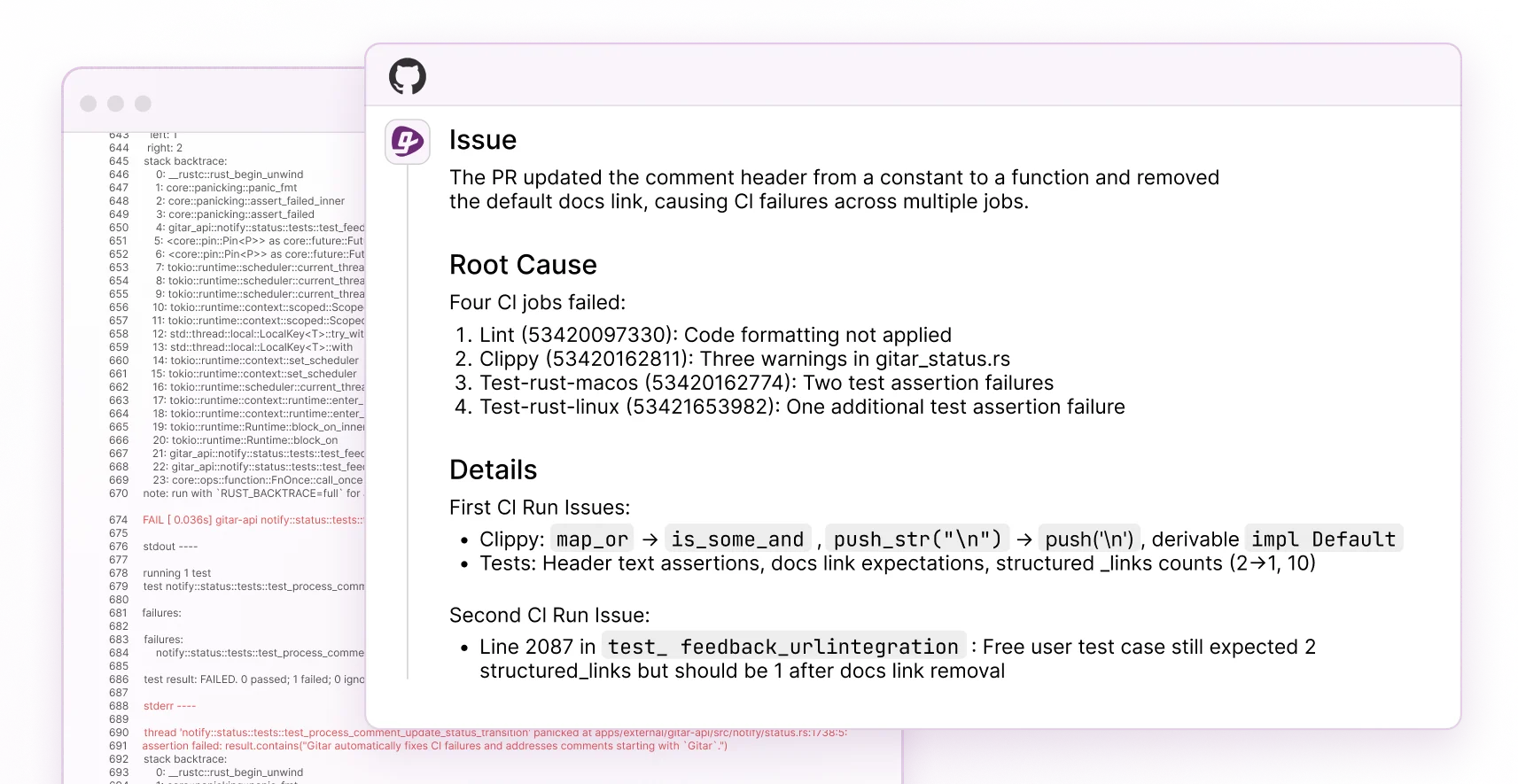
Gitar’s healing engine focuses on validated, working fixes instead of raw suggestions. When a CI failure occurs, Gitar analyzes failure logs with full codebase context, identifies the root cause across multiple failure categories, generates targeted fixes, validates them against your CI environment, and commits working solutions directly to your pull request. For detailed setup instructions, see the Gitar documentation.
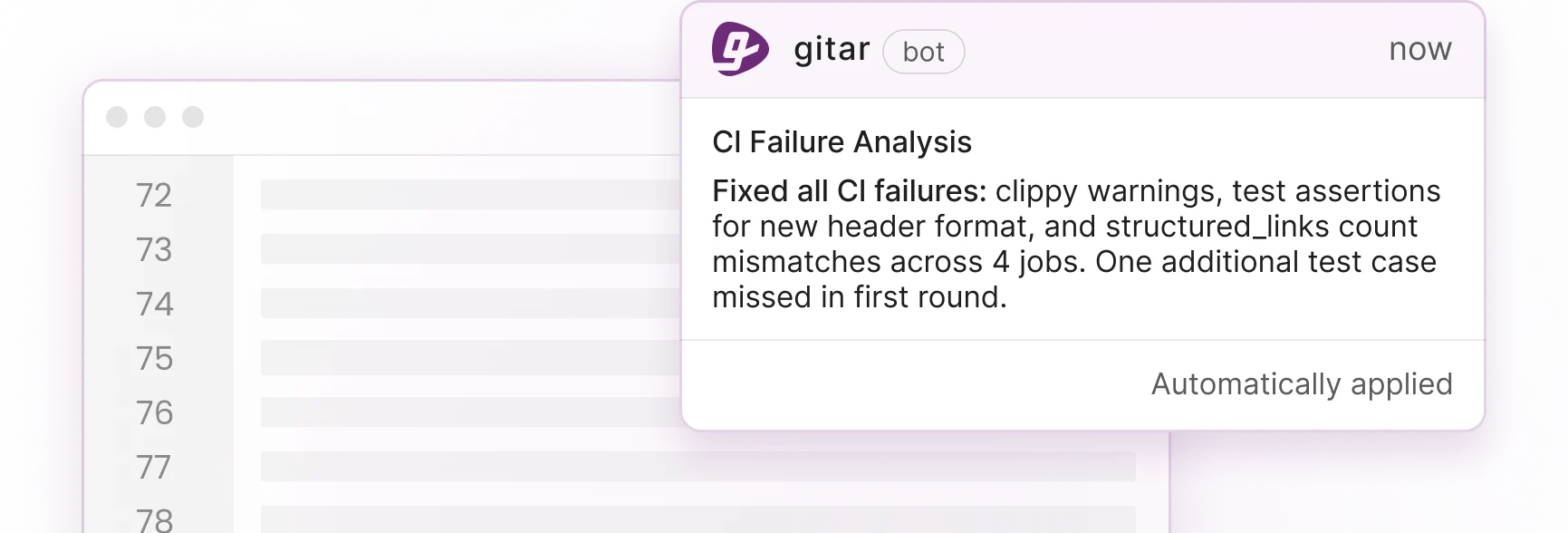
Teams can complete setup in minutes. Install the GitHub or GitLab app, start the 14-day Team Plan trial, enable auto-fix for selected failure types, and monitor results through the consolidated dashboard. Instead of scattering notifications across your diff, Gitar posts a single updating comment that consolidates findings, resolved items, and status updates in one clean thread.
Multi-platform support covers GitHub Actions, GitLab CI, CircleCI, and Buildkite. Language coverage includes Python, Go, JavaScript, TypeScript, Java, Rust, and more. Integrations include Jira ticket linking, Slack notifications, and Linear sync, which keep CI context connected to your existing workflow. For a 20-developer team, Gitar can reclaim many hours per sprint by cutting time spent on CI failures and review issues.
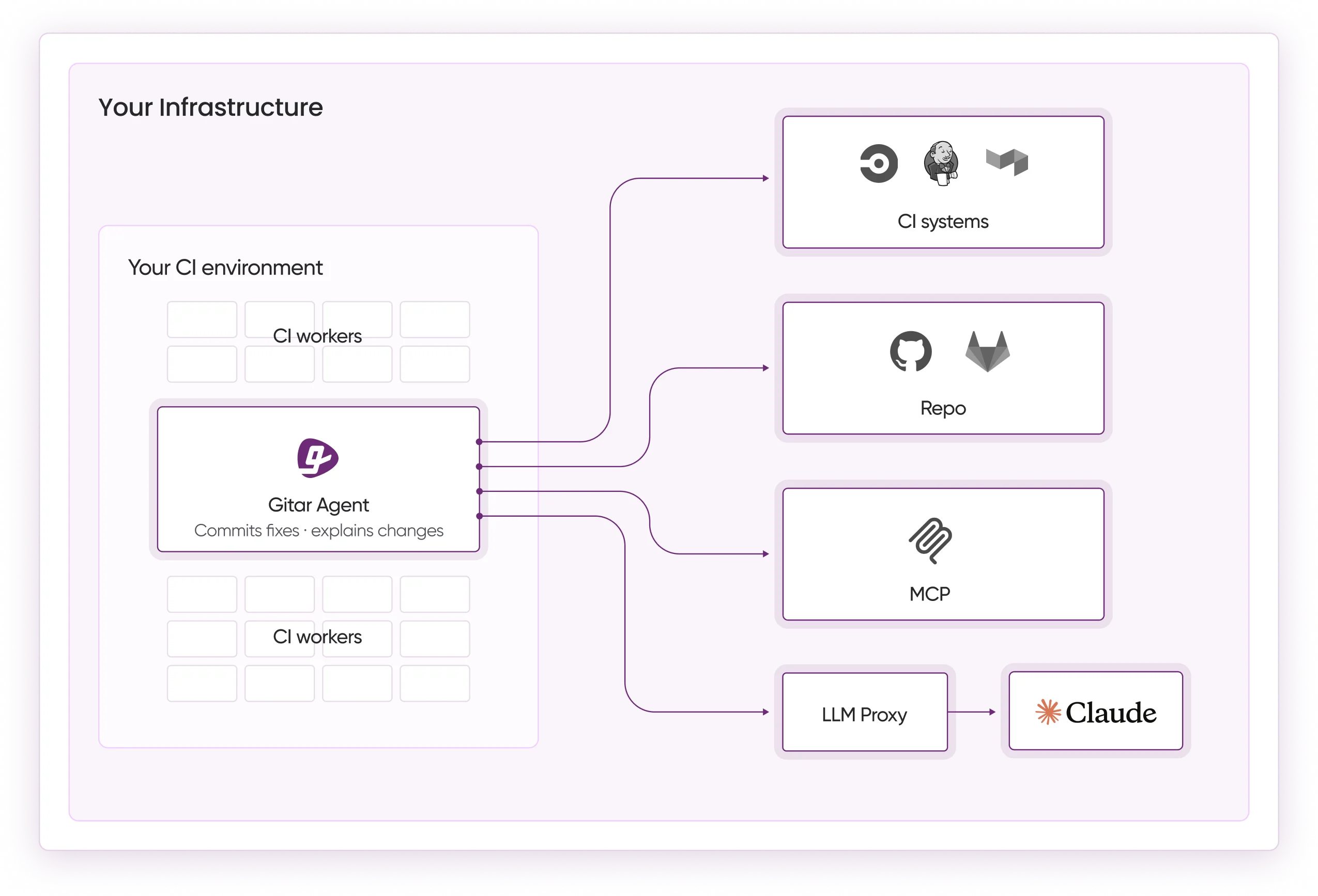
The main differentiator lies in Gitar’s validation process. Suggestion tools hope their recommendations work. Gitar’s healing engine tests fixes against your actual CI environment and commits only when builds pass, so teams see green builds instead of new failure loops.
Start your Gitar trial and experience validated auto-fixes across all major CI platforms.
Runner-Up AI Tools and Where They Fall Short
CodeRabbit for PR Suggestions on GitHub
CodeRabbit delivers detailed PR analysis with inline suggestions and one-click fixes but does not support auto-commit. The tool works only with GitHub repositories and focuses on review comments with some automated fix application. The $15–30 per developer pricing model charges for features that still require manual work for complex or multi-file issues.
Cursor BugBot for One-Click Fixes
Launched in July 2025, BugBot resolves over 70% of flagged issues before merge through one-click fixes but remains GitHub-specific and requires human approval for all commits. The tool works well for simple fixes and smaller teams. It lacks cross-platform support and automatic validation, which limits its fit for enterprise environments with complex pipelines.
Dagger for Custom CI Agents
Dagger offers custom agent capabilities with multi-platform support but does not provide green build guarantees and demands significant setup expertise. The pricing model and learning curve suit teams with dedicated DevOps resources. Smaller teams or organizations seeking quick rollout often struggle to achieve fast deployment and immediate return on investment.
Benchmarks and Strategies for Self-Healing CI Pipelines
Self-healing pipelines use AI-driven diagnostics to detect errors, identify root causes, restart failed processes, or roll back changes without human intervention. Gitar supports this model with automated failure resolution through its healing engine, which helps teams reach faster green builds and more stable pipelines.
ROI calculations for self-healing CI focus on recovered developer productivity, reduced context switching, and fewer manual debugging cycles. Teams that implement comprehensive auto-fix solutions report higher sprint velocity and better developer satisfaction. They also see measurable reductions in alert fatigue and infrastructure maintenance overhead.
Frequently Asked Questions About Self-Healing CI and Gitar
What is self-healing CI and how does it work?
Self-healing CI refers to automated systems that detect, analyze, and resolve pipeline failures without human intervention. Gitar’s implementation monitors CI runs, analyzes failure logs when issues occur, identifies root causes across different failure categories, generates contextual fixes based on your codebase, validates solutions against your CI environment, and automatically commits working fixes. This process turns reactive debugging into proactive automated resolution.
How does Gitar compare to CodeRabbit for real problem resolution?
CodeRabbit provides strong analysis, suggestions, and one-click fixes but does not offer full auto-commit capabilities. Gitar goes further by implementing, validating, and committing working solutions automatically. While CodeRabbit charges $15–30 per developer for features that still require manual work, Gitar’s 14-day trial includes full auto-fix capabilities that show immediate productivity gains through actual problem resolution instead of simple issue identification.
How can teams measure ROI from automated CI fixing tools?
Teams can measure ROI by tracking developer time savings, reduced context switching, and faster delivery cycles. Useful metrics include average time from failure to resolution, number of manual debugging sessions eliminated, developer hours saved per sprint, and overall improvement in build success rates. Many teams see a sharp drop in CI-related debugging time, which translates into faster feature delivery.
Does Gitar support complex CI environments with multiple platforms?
Gitar supports GitHub Actions, GitLab CI, CircleCI, and Buildkite with broad language coverage including Python, Go, JavaScript, TypeScript, Java, and Rust. The platform handles complex multi-dependency builds, third-party integrations, and enterprise environments. For maximum complexity, the Enterprise tier runs agents within your own CI infrastructure with full access to secrets, caches, and custom configurations.
How does Gitar help teams achieve green builds after auto-fixing?
Gitar’s healing engine validates every fix against your CI environment before committing changes. The system emulates your build process, runs tests with your specific configurations, and commits only fixes that pass all validation steps. This approach removes the guesswork common in suggestion-only tools and ensures that automated fixes lead to successful builds instead of new failures.
Next Steps to Escape the CI Suggestion Trap
Teams now move from suggestion engines to self-healing CI as a standard way to handle pipeline failures. Tools like CodeRabbit and Cursor BugBot provide valuable analysis, but only comprehensive platforms like Gitar deliver the automated resolution capabilities that modern development teams expect. The 14-day trial lets teams experience the full value of automated fixing before they commit to paid plans.