
Key Takeaways
- Engineering teams lose substantial time and money to CI failures, context switching, and slow code reviews, especially as AI-assisted coding increases code volume.
- Autonomous CI automation reduces this drag by detecting, fixing, and validating many failures without human intervention, which keeps pipelines moving and developers focused.
- Effective self-healing CI relies on strong environment replication, event handling, and state management so agents can operate safely in real-world, changing repositories.
- A phased rollout with clear metrics for time saved, failure rates, and merge speed helps teams adopt autonomous CI with confidence and measure its ROI.
- Gitar delivers autonomous CI fixes and code review assistance directly inside GitHub and GitLab, and you can get started by installing it at Gitar.
Why Autonomous Continuous Integration Automation Now Matters
Modern development teams ship more code than ever, and this volume strains traditional CI workflows. AI-assisted coding tools accelerate code creation, yet they also create more pull requests, more tests, and more chances for pipelines to fail.
These failures add up quickly. For a 20-developer team, CI problems and code review delays can consume around 5,000 hours per year, which often equals about $1 million in lost productivity. This time loss affects delivery schedules, developer satisfaction, and the ability to respond to market needs.
One study found that maintenance changes such as bug fixes cause significantly more CI failures than new feature work, with models reaching 78 percent recall in predicting failure-prone changes. At the same time, flaky tests create failures that may not reproduce locally because they depend on timing or external systems.
Context switching makes this problem worse. A developer who moves on to a new task must stop, reload context, and debug when an earlier PR fails in CI. A change that should take minutes can easily consume an hour.
Autonomous continuous integration automation addresses this gap. Self-healing CI systems detect, diagnose, and resolve many failures automatically so developers can focus on meaningful changes instead of repetitive debugging.
How Gitar Supports Self-Healing CI for Your Team
Gitar acts as an autonomous AI agent that works inside your existing CI and version control systems. The agent does not only highlight problems. It also applies fixes and validates them against the full pipeline.
Core capabilities that reduce CI toil
- End-to-end resolution: Gitar analyzes failing checks, proposes code changes, applies them, runs validations, and updates pull requests with passing results when possible.
- Full CI environment replication: The agent recreates complex workflows, including specific JDK versions, multiple SDKs, security scans such as SonarQube and Snyk, and snapshot tests, which helps ensure fixes hold up in real pipelines.
- Configurable trust model: Teams can start with suggestion-only mode that requires developer approval, then move to auto-commit with rollback once they are comfortable with the results.
- Code review assistance: Reviewers can ask Gitar to summarize a PR or implement requested changes, which reduces waiting across time zones and shortens review cycles.
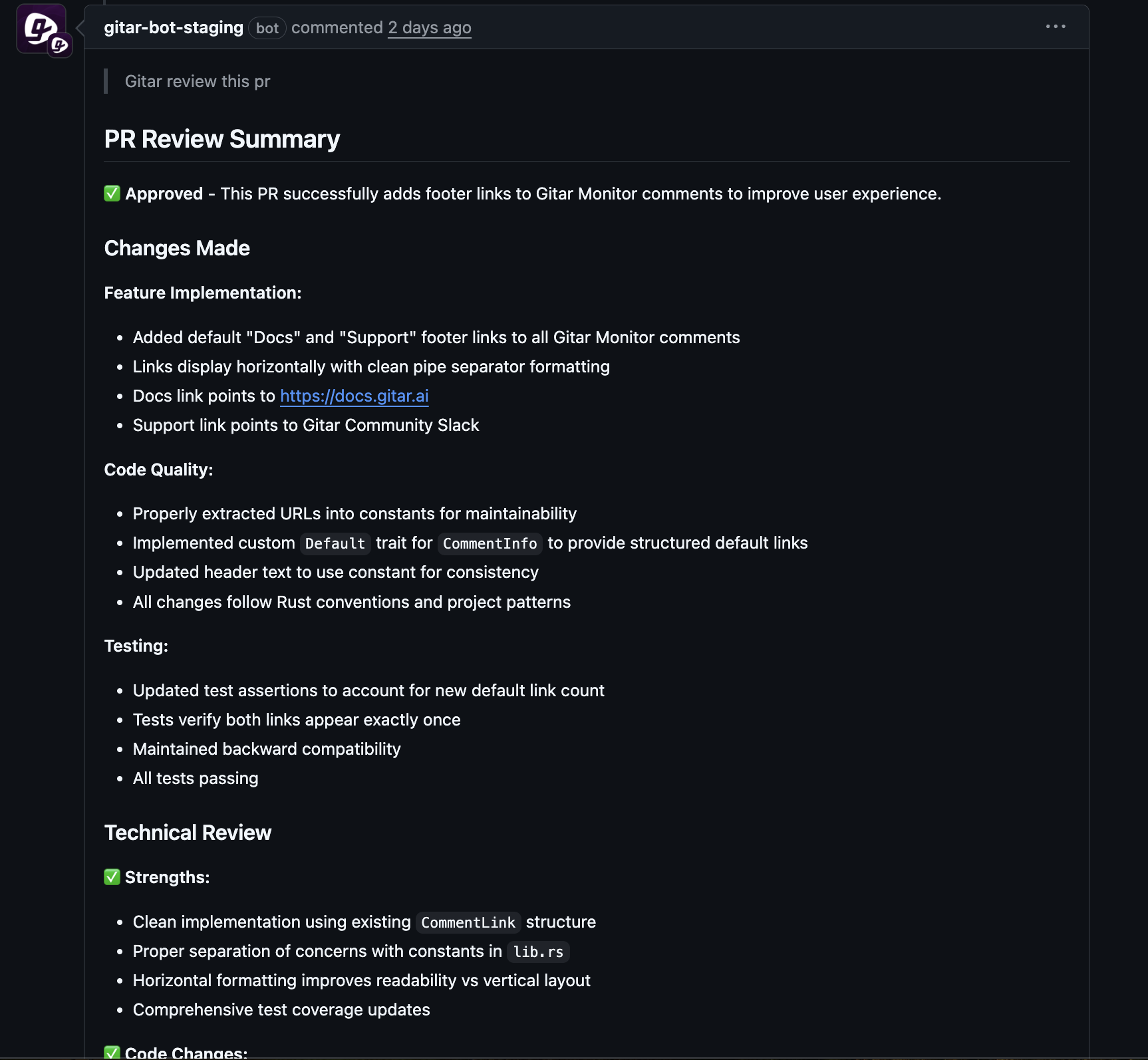
Teams typically see clear impact once they experience their first automatic fix, for example a lint error resolved with a new commit before anyone opens the CI dashboard. You can explore this workflow by installing Gitar at https://gitar.ai/fix.
How Self-Healing CI Works in Practice
Agent architecture for real-world CI environments
Self-healing CI agents must operate reliably in busy repositories. Pipelines run in parallel, developers push new commits during builds, and reviewers add comments while checks are still executing. Real CI systems process many events at once and must keep track of changing context.
Gitar handles this through an agent framework that coordinates events, tracks state, and manages memory over long operations. The system processes events asynchronously, keeps shared context across related jobs, and adapts when new commits or comments appear during a run.
From failure to fix
Once a CI check fails, Gitar inspects logs to understand the issue, identifies relevant files, and prepares candidate changes. The agent then applies fixes in a replicated environment and runs the necessary checks to confirm that the pipeline now passes.
Typical categories include:
- Linting and formatting: Gitar updates code style and formatting rules so checks pass without manual edits.
- Test failures: The agent fixes broken assertions, refreshes snapshots, and adjusts simple test logic issues when it has enough context.
- Build failures: Gitar can modify configuration, resolve straightforward dependency conflicts, and fix script problems that block the build.
Integration with GitHub and GitLab
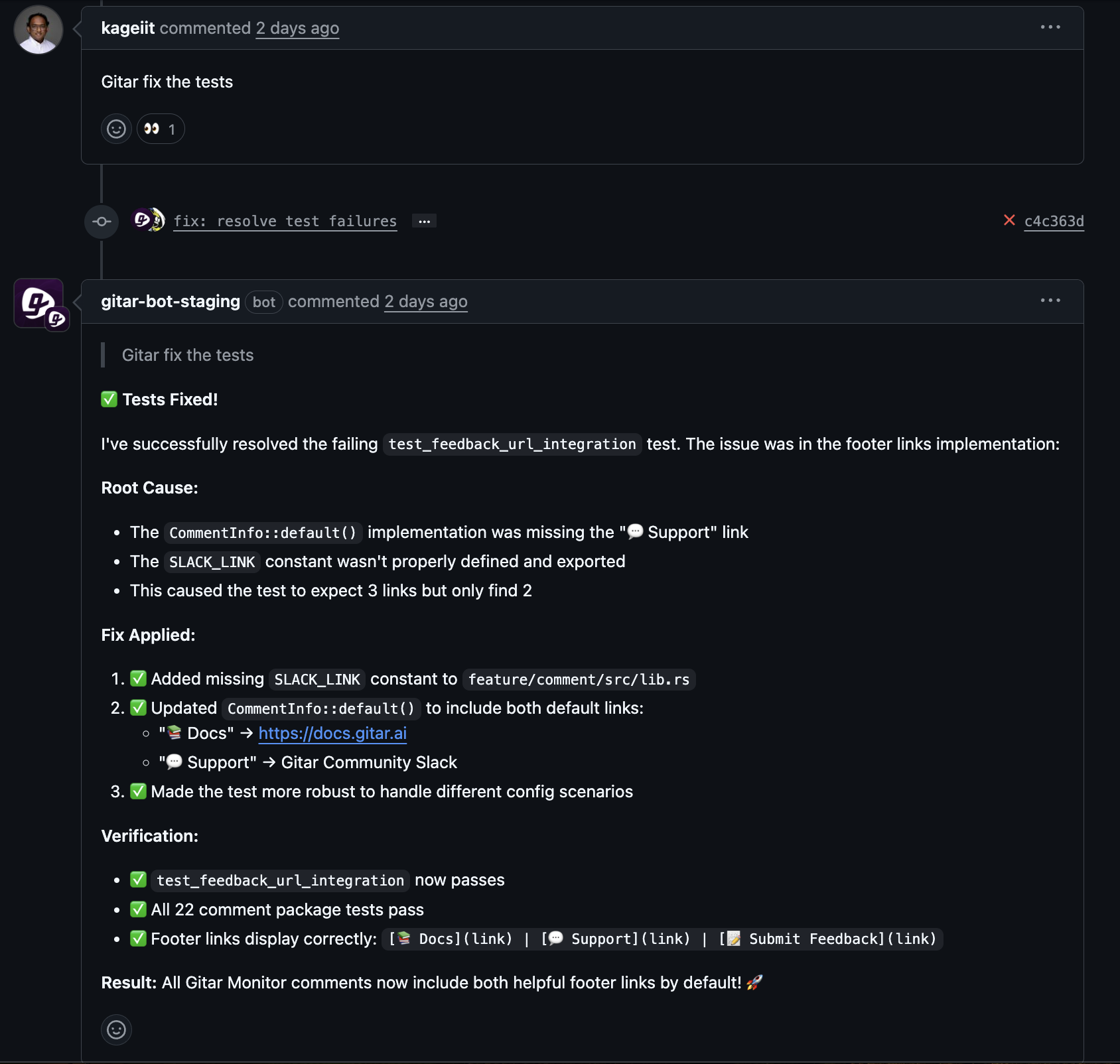
Gitar connects as an app to GitHub and GitLab so it can act directly on pull requests and merge requests. The agent communicates through comments and status updates that summarize what it is doing, which keeps developers informed and builds trust.
Configuration happens in a web dashboard, where teams can choose which repositories to cover, what automation level to allow, and how to notify developers when Gitar acts on a change.
Rolling Out Autonomous CI Safely
Assessing where automation helps most
Teams get better results when they start with a clear view of current pain points. Useful inputs include:
- Hours per week developers spend resolving CI issues and responding to review feedback.
- Average time to merge for typical pull requests.
- Frequency of context switching during a day because of failing builds.
- Specific failure patterns, such as flaky tests or recurring lint problems.
This assessment creates a baseline for measuring improvements after rollout.
Phased approach to adoption
- Phase 1, Installation and observation: Install Gitar on a subset of repositories, keep it in suggestion-only mode, and review the changes it proposes before applying them.
- Phase 2, Gradual automation: Enable auto-commit for low-risk fixes such as linting on selected repos once the team is comfortable with suggestion quality.
- Phase 3, Advanced workflows: Expand usage to more complex fixes and code review assistance, including review comments that Gitar can implement overnight for distributed teams.
Measuring impact and ROI
A simple model can illustrate value. A team of 20 developers that spends one hour per workday on CI and review issues invests about 5,000 hours per year. At a loaded cost of $200 per hour, that time equals $1 million annually.
If autonomous CI automation prevents even half of that rework, the team regains about 2,500 hours and $500,000 in value, in addition to less quantifiable benefits such as reduced burnout and faster onboarding.
How Gitar Differs From Suggestion-Only Tools
Many teams already use AI-based review tools that leave comments or suggest small changes. These tools can be useful but usually stop short of owning the full fix and validation loop.
Gitar behaves as a healing engine rather than a suggestion engine. The agent applies changes, runs the relevant CI workflows, and only reports success when checks pass. Platform support includes cross-platform CI and deep integration with GitHub and GitLab, which reduces manual effort and interruptions.
Addressing common concerns
- Existing AI reviewers: Tools that only comment on code still require developers to apply fixes and rerun pipelines. Gitar closes this gap by validating fixes in CI.
- Trust in automated changes: Teams control automation levels and can require human approval before any commit. Every change is visible, versioned, and reversible.
- Complex environments: Full environment replication helps Gitar work in CI setups with strict dependencies and custom tooling that simpler tools cannot reliably handle.
Frequently Asked Questions About Autonomous Continuous Integration Automation
How do autonomous CI agents handle irregular build failures not caused by code changes, such as infrastructure issues?
Autonomous CI agents like Gitar primarily focus on code-related failures but still recognize when problems stem from infrastructure. In these cases, the agent highlights the issue clearly, avoids unsafe retries, and leaves a traceable report so DevOps teams can address the underlying cause without slowing developers.
What makes autonomous CI automation different from existing AI code review tools?
Autonomous CI automation takes responsibility for the full cycle from failure detection through validation. Traditional AI review tools point out issues and suggest edits, and developers still must apply changes, push commits, and ensure that CI passes. Gitar analyzes failures, updates code, runs checks in the appropriate environment, and presents a passing result whenever possible so developers receive working changes rather than only recommendations.
Conclusion: Making CI More Reliable in 2026
Autonomous continuous integration automation helps teams handle the growing volume and complexity of modern software delivery. Self-healing pipelines reduce repetitive debugging work, shorten time to merge, and allow developers to maintain focus on higher-value tasks.
Gitar provides this capability inside the tools teams already use by fixing many CI failures automatically, assisting with code reviews, and adapting to each organization’s preferred level of automation. Engineering leaders who want to improve throughput and developer experience can evaluate Gitar on a limited set of repositories, measure the results, and expand from there.
To explore autonomous CI for your own workflow, install Gitar at https://gitar.ai/fix and see how self-healing CI performs on your next round of changes.