
Key Takeaways
- Traditional enterprise GitHub automation often leaves teams reacting to CI failures and flaky tests instead of focusing on feature work.
- Autonomous fixes and full environment replication increase CI reliability, reduce context switching, and keep builds green in complex enterprise stacks.
- Turning code review feedback into automated, validated changes shortens review cycles, especially for globally distributed teams.
- A configurable trust model and clear ROI metrics help enterprises adopt automation safely while proving value to engineering and business leaders.
- Teams that want autonomous CI fixes and faster code review implementation can install Gitar to automatically fix broken builds and accelerate delivery.
Why Traditional Enterprise GitHub Automation Platforms Break Down
Many enterprise teams report CI/CD adoption, yet still experience flaky pipelines, long feedback loops, and slow releases. Single failing tests often block entire deployments, and developers wait through long CI cycles before learning that a small issue stopped the build.
These problems create a direct financial drag. Environment drift between development, staging, and production leads to test flakiness and deployment failures. For a 20-developer team, productivity losses from CI friction and manual review can reach about $1M per year.
Automation that only reports failures keeps teams in reactive mode. Platforms that provide autonomous, self-healing behavior reduce mean time to recovery, cut context switching, and create more reliable deployment pipelines.
How Gitar Improves Enterprise GitHub Automation
Gitar operates as an autonomous AI agent for GitHub-based workflows. It focuses on fixing CI failures and implementing code review feedback, not just suggesting changes.
Key capabilities include:
- End-to-end fixing, where Gitar applies code changes, runs CI workflows, and validates that all jobs pass
- Full environment replication for complex workflows, including language runtimes, security tools, and snapshot testing
- Intelligent code review assistance that turns reviewer comments into implemented, tested commits
- Support for GitHub Actions, GitLab CI, CircleCI, Buildkite, and other common CI platforms
- A configurable trust model that lets teams start with suggestions and progress to direct commits
Teams that need autonomous CI healing and faster reviews can install Gitar and start reducing CI noise in their existing workflows.

1. Shift from Reactive to Proactive CI/CD with Autonomous Fixes
Reactive CI workflows force developers to drop planned work and debug builds. Each failure requires log analysis, a fix, a new commit, and another full CI run. Even small corrections turn into long interruptions, especially in large mono-repos or complex microservice architectures.
On many teams, developers spend up to 30% of their time dealing with CI failures and code review changes. For a 20-person team, that can reach roughly 5,000 hours per year, or around $1M in loaded cost.
Gitar changes this pattern by diagnosing failures and applying fixes automatically. When CI jobs fail from lint issues, tests, or build errors, Gitar:
- Parses logs and identifies root causes
- Edits code or configuration to address the issue
- Triggers validation in the full CI workflow
- Restores green builds when checks pass
This approach keeps developers in flow while CI recovers in the background. The system handles issues such as dependency conflicts, formatting violations, and broken assertions, and it turns many hour-long interruptions into automated resolutions.
2. Master Complex Enterprise Environments with Full Replication
Enterprise stacks contain many moving parts. Multiple runtimes, polyglot services, strict security policies, and layered testing make it hard for generic tools to suggest fixes that actually pass CI.
A typical setup might include specific Java versions for backend services, Node.js versions for frontends, along with tools such as SonarQube and Snyk wired into the pipeline. Suggestions that ignore these details often fail once pushed.
Gitar replicates the real CI environment before applying changes. It respects:
- Language versions and SDKs for Python, Go, JavaScript, TypeScript, Java, Rust, and more
- Dependency graphs and lockfiles
- Third-party tools such as scanners and quality gates
- Snapshot tests and other approval-style checks
This replication means Gitar does not stop at plausible code. It validates fixes in the same conditions that production code must pass, reducing the trial-and-error cycles that slow enterprise teams.
3. Turn Code Review from Bottleneck into Accelerator
Code review delays often limit throughput more than coding itself, especially on distributed teams. Time zones turn simple feedback into multi-day threads, and reviewers rarely have time to implement the changes they suggest.
Gitar shortens this loop by acting on reviewer comments. When a reviewer leaves clear feedback in a pull request, Gitar can:
- Interpret the request in context
- Update code, tests, or configuration
- Run CI checks
- Commit the changes with an explanation
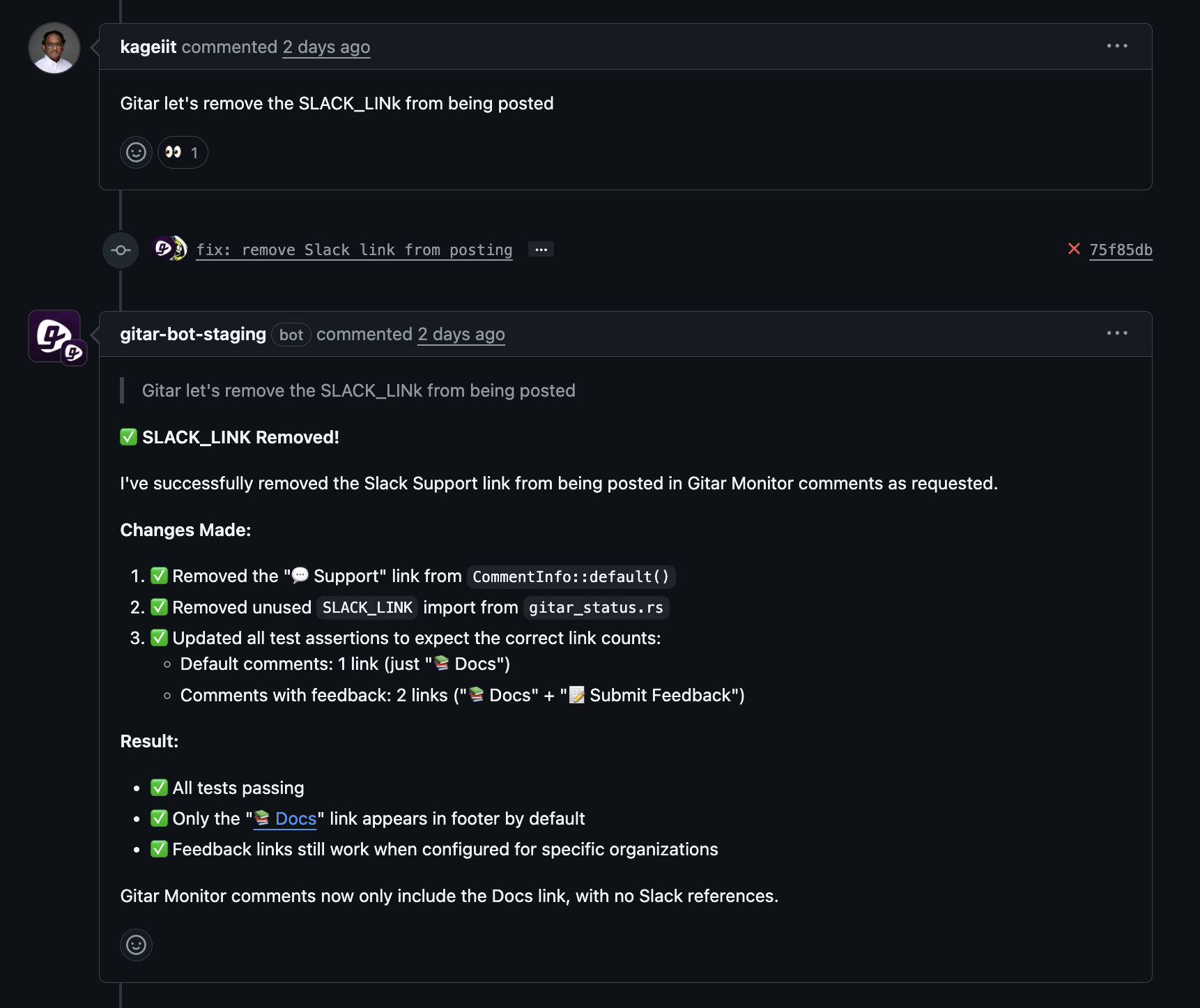
A reviewer in one region can leave comments at the end of their day, and the pull request can be updated and re-validated before the original author signs in. Code review shifts from a blocking step to a continuous, asynchronous process.
4. Use a Configurable Trust Model for Safe Enterprise Adoption
Enterprise teams need tight control over production changes. Automation that commits directly on day one can trigger resistance from engineering leaders, security teams, and compliance stakeholders.
Gitar provides a configurable trust model so teams can decide how much autonomy to grant. Common patterns include:
- Suggestion mode, where Gitar proposes diffs for human review and one-click approval
- Scoped auto-commit, where low-risk fixes such as lint or formatting changes commit automatically
- Full auto-commit with rollback options, once teams are confident in behavior
Organizations can apply stricter modes to critical services and more aggressive modes to low-risk repositories. This flexibility supports gradual rollout without sacrificing governance.
5. Prove ROI by Eliminating Developer Productivity Sinkholes
Slow CI and manual review work reduce release frequency and push out roadmap commitments. They also contribute to burnout, as engineers spend more time fighting infrastructure than building features.
For a 20-developer team, even one hour per person per day on CI failures and manual review changes totals about 5,000 hours each year. At $200 per hour, that is roughly $1M that does not go toward new capabilities.
Gitar targets this lost time by:
- Reducing time spent triaging CI failures
- Automating implementation of review feedback
- Shortening merge cycles
- Increasing confidence in frequent releases
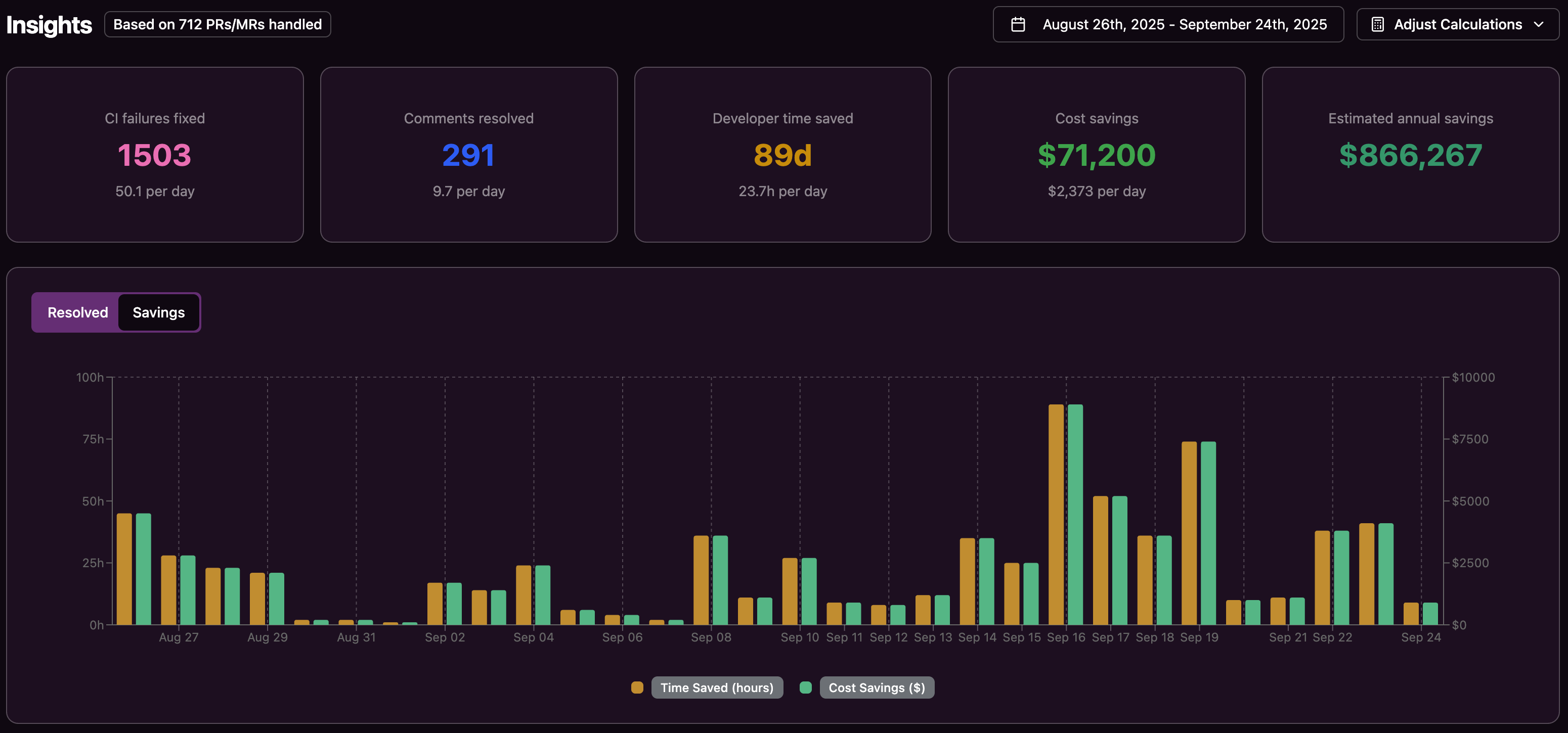
Even if automation only halves the time spent on CI and review work, the savings can reach about $500K per year for that team size. The impact grows as engineering organizations scale.
Teams that want these outcomes can install Gitar to start measuring CI fixes, time saved, and cost reductions.
Enterprise GitHub Automation Platforms: A Comparison of Solutions
|
Feature |
Gitar (Autonomous Agent) |
CodeRabbit (AI Code Review Tool) |
Manual Work (Status Quo) |
|
CI Failure Resolution |
Autonomous fix and validate |
Detailed suggestions |
Manual debug and fix |
|
Code Review Actioning |
Autonomously implements feedback |
Suggestions with code changes |
Manual implementation |
|
Environment Context |
Full replication |
Context-aware review |
Developer knowledge |
|
Integration Effort |
Out-of-the-box |
Standard integration |
High |
Frequently Asked Questions (FAQ) about Enterprise GitHub Automation
How does Gitar handle complex enterprise CI setups?
Gitar replicates your CI environment, including runtimes, dependencies, and integrations such as SonarQube and Snyk. It then runs fixes inside that context so changes match real pipeline behavior, including multi-SDK builds, custom security scans, and snapshot tests.
How do enterprises build trust in automated fixes?
Teams start in conservative modes where Gitar proposes changes as suggestions. As engineers review and approve successful fixes, they can enable scoped auto-commits and later full auto-commit with rollback. This staged approach keeps control with engineering leaders while confidence grows.
Can Gitar reduce time spent on flaky tests?
Gitar analyzes CI logs, classifies failure types, and applies corrective changes where appropriate. It can update snapshots, fix brittle assertions, and address environment-related flakiness so developers spend less time rerunning and debugging unstable tests.
How is Gitar different from tools like GitHub Copilot or CodeRabbit?
GitHub Copilot and similar tools help write code in the editor, and AI review tools such as CodeRabbit focus on comments and suggestions. Gitar focuses on the post-commit phase. It applies and validates fixes to keep pipelines green and implements review feedback directly in pull requests.
What ROI can enterprises expect from autonomous GitHub automation?
Many teams see hundreds of thousands of dollars in annual savings from reduced CI firefighting, faster reviews, and improved developer satisfaction. Savings increase with team size and the volume of CI activity.
Conclusion: Modernize Enterprise GitHub Automation with Gitar
Enterprise engineering teams need automation that fixes problems, not just reports them. CI failures, code review delays, and complex environments slow delivery and inflate costs.
Gitar addresses these challenges with autonomous CI fixes, environment-aware changes, and automated implementation of review feedback. The configurable trust model and clear ROI make it suitable for cautious rollouts in regulated or high-stakes environments.
Engineering leaders who want to reclaim developer time and increase release frequency can install Gitar and start modernizing their GitHub automation in 2026.