
Written by: Ali-Reza Adl-Tabatabai, Founder and CEO, Gitar
Key Takeaways
- CI failures and manual code review cycles absorb large amounts of engineering time and delay merges.
- Context switching between pull requests, logs, issue trackers, and local environments significantly increases debugging time, as described in this guide on handling failed checks in GitHub PRs for common CI troubleshooting workflows.
- Autonomous GitHub bots can detect, fix, and validate many CI issues inside existing workflows, which reduces interruptions for developers.
- Teams that automate CI fixes reduce failed runs, lower compute costs, and keep code quality standards consistent across pull requests.
- Gitar provides an autonomous GitHub bot that fixes CI failures and applies review feedback in GitHub; teams can install it at this link to start reducing manual CI toil.
The Problem: The High Cost of Manual GitHub Code Fixes
Developer Flow State Disruption
CI failures interrupt deep work and force context switching. When a pull request fails, developers move between the PR, GitHub Actions, issue trackers, and local environments to reproduce and debug issues. This multi-step troubleshooting pattern turns quick fixes into long debugging cycles that break focus and reduce productivity.
Hidden Costs of CI Failure
Failed pipelines and repeated runs create a substantial hidden cost. A mid-sized engineering team can lose many hours each week to:
- Linting and formatting errors
- Type checking failures
- End-to-end and integration test failures
- Cascading failures that cancel queued jobs after a single failure
Each issue usually needs manual investigation, code changes, and another CI run, which increases both labor and compute spend.
Code Review Bottlenecks in GitHub
Manual review cycles add delay, especially for distributed teams. A pull request opened in one time zone can wait a full day for review, then another cycle for requested changes, and another for follow-up fixes. Traditional AI review tools still depend on humans to implement and validate changes, so developers remain stuck in slow feedback loops.
The Right-Shift Bottleneck
Modern coding assistants generate code quickly, but validation and merging often lag behind. More pull requests lead to more tests, more CI failures, and more review comments. The productivity bottleneck has shifted from writing code to validating it and getting it merged, and manual workflows struggle to keep pace.
The Solution: Elevating GitHub Automation with an Autonomous AI Bot
Beyond Suggestions: The Self-Healing CI Paradigm
An autonomous AI bot does more than highlight problems. It edits code, re-runs checks, and verifies that the full CI pipeline passes before handing work back to humans. The bot operates as a CI healing engine that closes the loop from detection to fix to validation inside GitHub.
Direct GitHub Integration for Workflow Automation
Modern bots connect to pull requests, status checks, and GitHub Actions events without large process changes. They:
- Watch for failed checks and review comments
- Apply targeted fixes to the branch
- Trigger CI runs and review the results
This approach allows teams to automate common remediation steps while keeping their existing workflows and tools.
Introducing Gitar: Autonomous GitHub Bot for Code Fixes
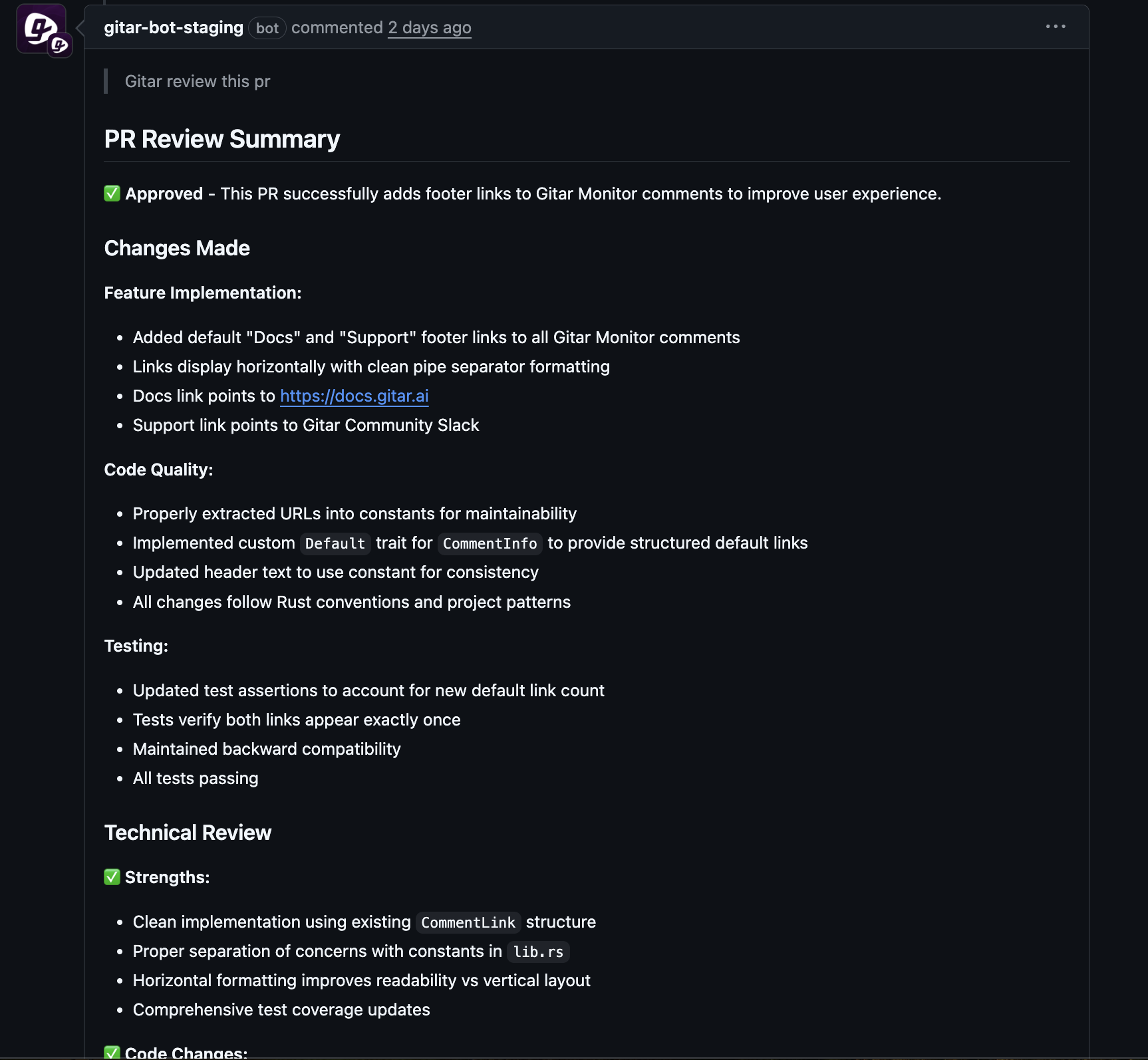
Gitar automates code fixes and keeps pull requests green inside your existing GitHub setup. The agent identifies issues, updates code, and validates fixes against your CI workflows so developers can stay focused on feature work.
- End-to-end fixing: Gitar applies changes, re-runs CI, and iterates until checks pass, instead of only proposing suggestions.
- Full environment replication: The agent respects your specific toolchain, including JDK versions, multiple SDKs, and tools such as SonarQube and Snyk, for realistic debugging and fixes.
- Code review implementation: Reviewers can leave instructions in GitHub comments, and Gitar implements those changes directly in the PR.
- Configurable trust model: Teams can start with suggestion-only mode, then progress to auto-commits with rollback options as confidence grows.
- Cross-platform support: Gitar works with GitHub Actions, GitLab CI, CircleCI, Buildkite, and other major CI providers.
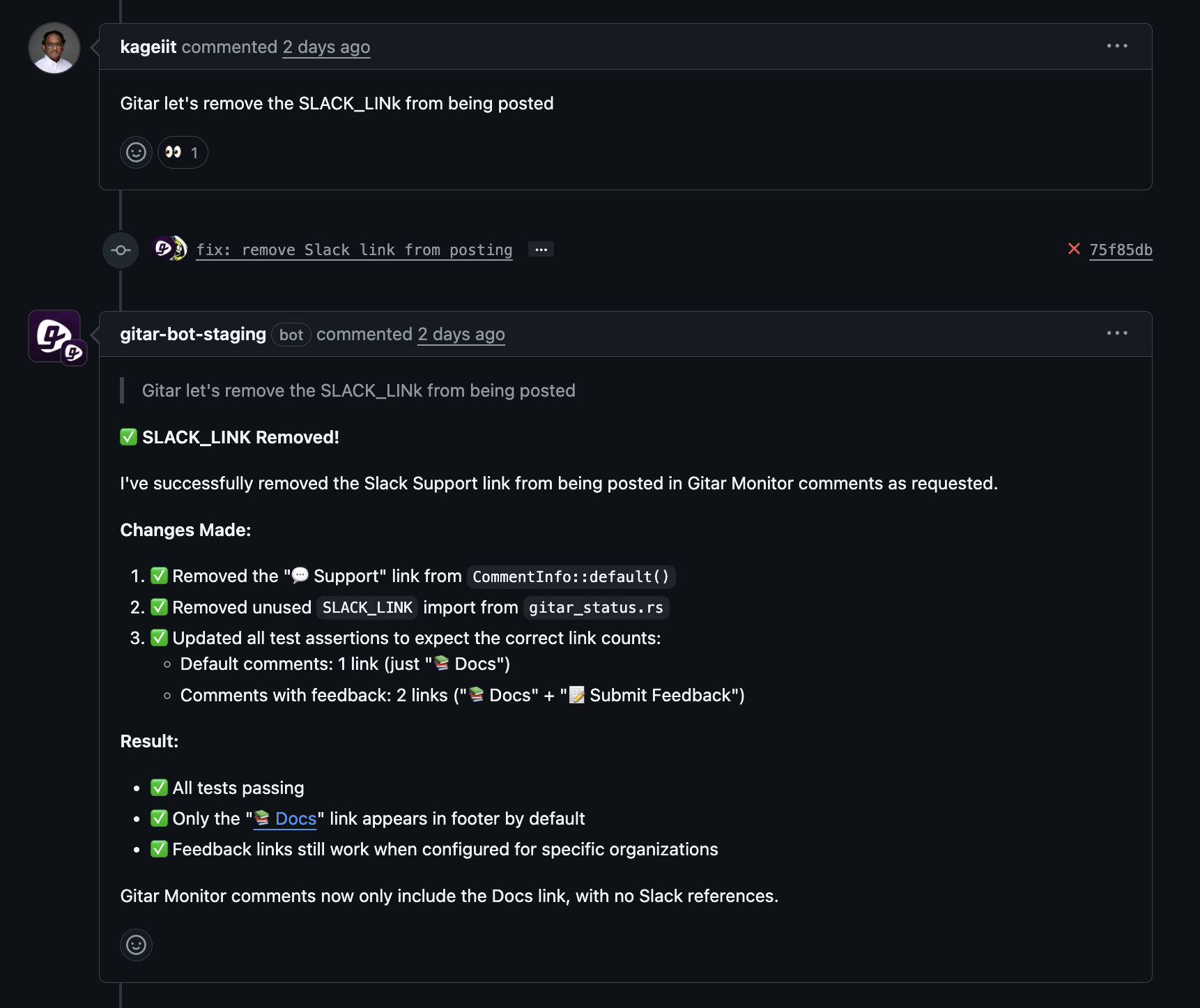
Install Gitar to automatically fix broken builds and reduce manual CI work.
Key Benefits of Using a GitHub Bot for Code Fixes with Gitar
Reclaim Developer Productivity and Flow State
Gitar handles repetitive CI fixes so engineers can maintain long stretches of focused work. Instead of chasing lint errors, flaky tests, or simple dependency issues, developers stay in their editor while Gitar updates the pull request and reports back when checks pass.
Reduce CI Costs and Accelerate Time-to-Merge
Efficient fixing cuts down on repeated workflow runs. GitHub Actions matrix strategies often run many jobs in parallel and cancel all in-progress jobs after a single failure when fail-fast is enabled. Gitar reduces these cascades by resolving root causes early, which shortens feedback cycles and lowers compute usage.
Improve Consistency and Code Quality
Automated fixes apply the same rules across repositories and teams. Gitar enforces linting, formatting, and test standards on every pull request, which reduces style drift and unnoticed breakage.
Streamline Code Reviews for Distributed Teams
Gitar shortens feedback loops for global teams. A reviewer can leave a clear instruction in a comment, and Gitar performs the change and re-runs CI before the original author comes back online. New hires also benefit, because they can rely on Gitar to handle unfamiliar CI details while they learn the codebase.
Gitar vs. Conventional Approaches in GitHub
|
Approach |
Problem Addressed in GitHub |
Fix Validation |
Developer Effort |
|
Gitar (autonomous AI agent) |
Fixes CI failures and implements code review feedback on pull requests |
Validates fixes against the full CI pipeline to keep builds green |
Low, with autonomous operation and optional human oversight |
|
Manual workflow |
Developers debug and fix all issues themselves |
Relies on manual testing and extra CI runs |
High, with frequent context switching and delays |
|
AI code reviewers |
Identify issues and provide analysis during pull request reviews |
Depends on how developers apply and test suggested changes |
Moderate, since humans still implement and validate fixes |
|
On-demand AI fixers |
Assist with fixes when triggered by developers |
Varies by tool and configuration |
Moderate, because they often require manual initiation and review |
Install Gitar to upgrade from manual CI firefighting to autonomous pull request fixing.
Frequently Asked Questions About GitHub Bots for Code Fixes
How does Gitar handle complex enterprise GitHub CI environments?
Gitar uses full environment replication to mirror your CI setup, including specific language runtimes, SDK versions, and tools such as SonarQube or Snyk. The agent tracks events across jobs and users, manages retries, and maintains consistent state even in noisy pipelines, so fixes align with real production conditions.
How does Gitar build trust when it has write access to a repository?
Teams can start with a conservative mode where Gitar proposes changes as suggestions on pull requests. After observing reliable fixes, they can move to automatic commits with the option to roll back changes. This graduated model allows each team to control how much autonomy the bot has.
How is Gitar different from AI code reviewers such as CodeRabbit?
AI reviewers focus on analysis and feedback. Gitar focuses on execution. The agent modifies code, re-runs CI, and works toward a passing pipeline so that reviewers and authors spend less time on mechanical fixes and more time on design decisions.
Can Gitar help with GitHub Actions matrix strategies and complex workflows?
Gitar is built to handle concurrent, multi-configuration pipelines. It can coordinate fixes across matrix jobs, respond to out-of-order events, and ensure that changes work for all configurations included in the workflow.
Conclusion: Put Autonomous GitHub Code Fixing to Work
CI failures and manual review workflows in GitHub create measurable delays and cost. GitHub metrics such as average run time and job failure rates highlight these bottlenecks, but they do not remove the underlying manual work.
Gitar closes this gap by autonomously fixing many CI and review-driven issues in pull requests. Teams gain faster merges, more consistent code quality, and fewer interruptions for engineers.
Install Gitar to start automating CI fixes and code review changes in your GitHub repositories.