
Key takeaways
- CI/CD failures, flaky tests, and slow review loops reduce developer productivity and delay releases, especially for distributed teams.
- Autonomous code review automation shifts work from manual triage and fixes to automated analysis, remediation, and validation inside your CI environment.
- Gitar helps engineers stay in flow, gives leaders clear productivity gains, and reduces onboarding and maintenance work for DevOps and platform teams.
- Autonomous validation closes the “right-shift” gap created by AI code generation tools, so more pull requests reach a green build and merge faster.
- Teams can use Gitar to automatically fix broken builds, resolve review feedback, and ship reliable software with less manual effort.
The problem: Manual CI/CD bottlenecks slow teams and increase costs
Many teams follow a familiar pattern. A developer opens a confident pull request, then a dependency conflict breaks the build, a flaky test fails, or a linter flags unexpected issues. The developer stops current work, reads through CI logs, experiments with fixes, pushes updates, and waits again for the pipeline. Distributed teams add more delay as feedback crosses time zones.
The financial impact can be large. A team of 20 developers that spends one hour per person each day on CI failures and review friction can lose about $1 million in annual productivity. Build-issue debugging, failure analysis, and pipeline optimization already rank among the most common CI/CD activities, drawing engineers away from feature work.
AI-assisted coding tools increased code output in 2024 and 2025. That shift produced a new constraint. More generated code now means more pull requests, more CI runs, and more failures to diagnose. The primary bottleneck often sits in validation and merging rather than in writing code.
The solution: Gitar for autonomous CI fixes and practical code review automation
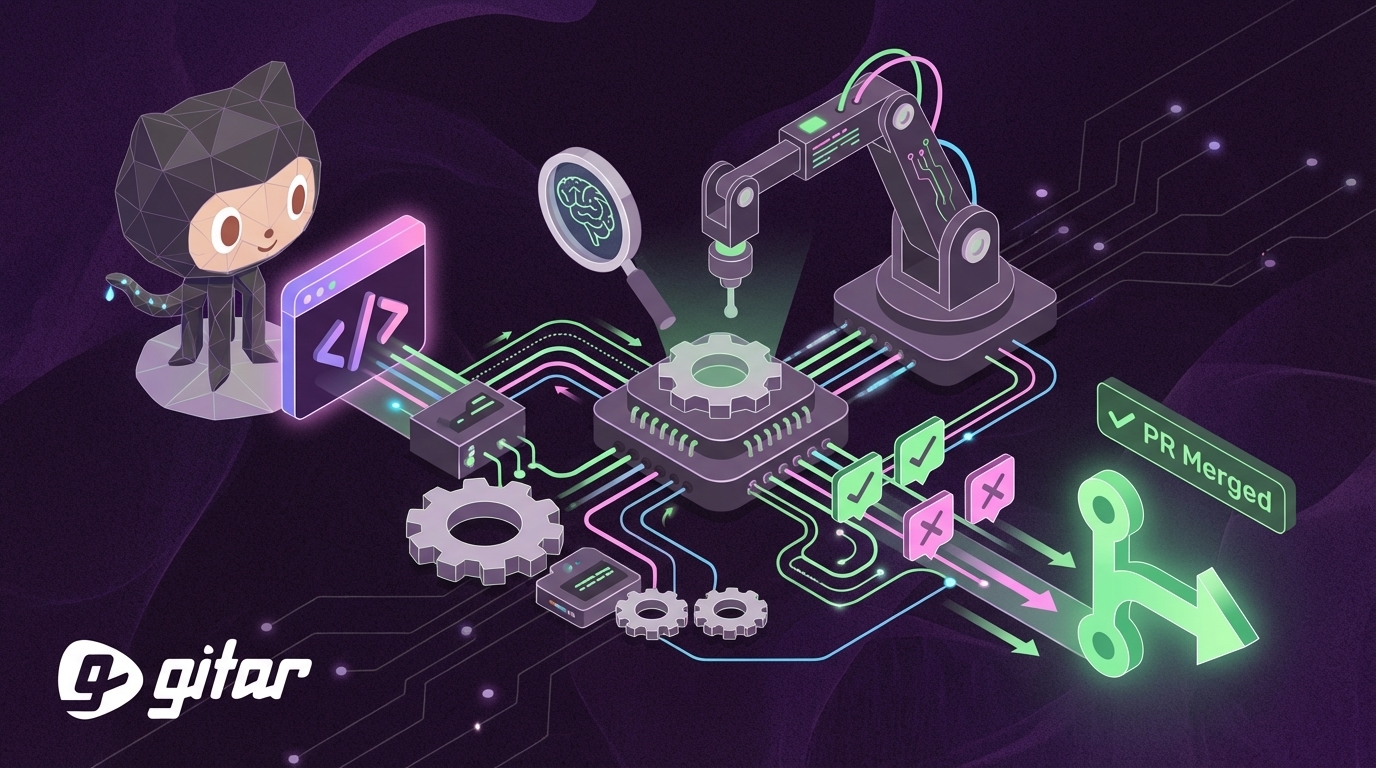
Gitar moves beyond suggestion-only AI tools and focuses on execution. The system detects CI failures, understands your project context, applies targeted fixes, and validates the results inside your pipeline.
Key capabilities in Gitar’s autonomous platform
- Autonomous CI fixer: Detects, analyzes, and fixes build failures, test issues, and linting violations, then validates results in CI.
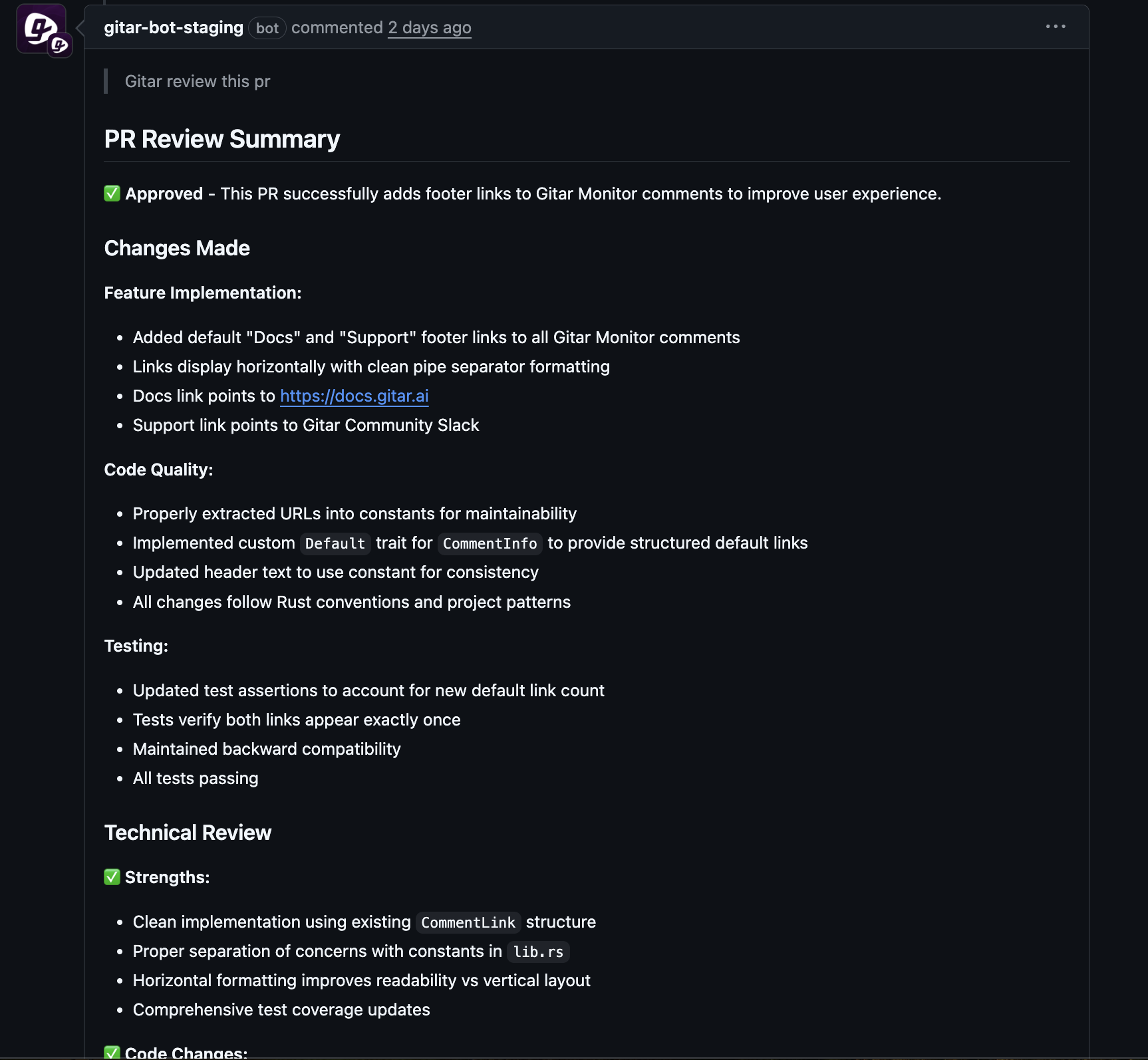
- Code review assistant: Applies human reviewer feedback directly in code, reducing manual back-and-forth and repeated pushes.
- Environment-aware execution: Mirrors complex enterprise CI environments, including SDK versions, external scanners, and compliance checks.
- Configurable trust levels: Supports modes from suggestion-only changes to fully autonomous commits with safeguards.
- Cross-platform support: Works with GitHub Actions, GitLab CI, CircleCI, Buildkite, and other major CI platforms.

Install Gitar to let an autonomous agent handle routine CI failures while your team focuses on core product work.
How Gitar reduces friction across your software delivery workflow
Engineers: Protect flow state and reduce rework
Deep work suffers every time a developer stops to debug a broken build or a flaky test. Gitar reduces these interruptions by fixing many of them automatically.
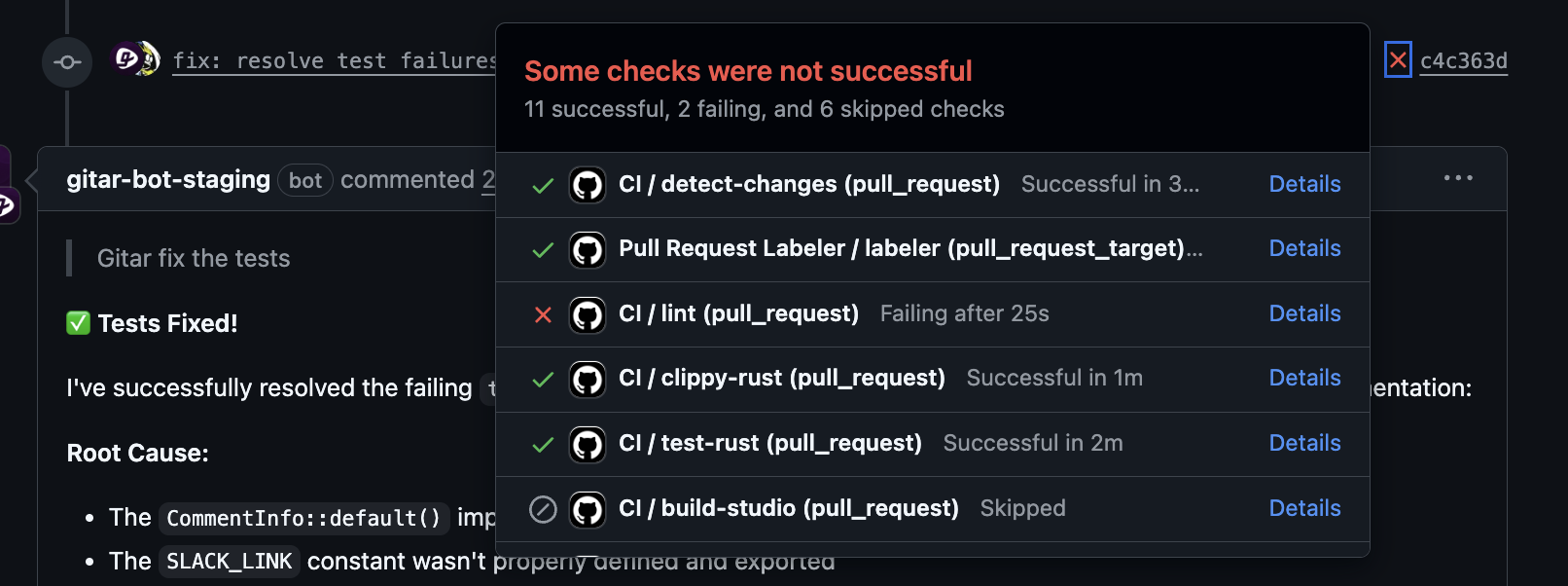
When a linting error or simple test failure appears, Gitar reads the logs, changes the code, and commits the fix. Engineers spend less time jumping between tasks and more time on design, implementation, and problem-solving.
Engineering leaders: Improve velocity and manage spend
Leaders often track time to merge, deployment frequency, and unplanned work created by red builds. Gitar supports these goals by reducing the number of issues that require human attention.
The platform turns recurring CI failures, small refactors, and routine review feedback into automated work. That shift frees engineers for feature delivery and architecture improvements, which improves throughput without constant headcount growth.
DevOps and platform teams: Stabilize pipelines and simplify onboarding
Platform teams manage complex CI setups that combine multiple languages, tools, and security scanners. New developers can struggle to match this environment locally, which slows onboarding.
Gitar operates inside the same CI configuration that already runs for your project. The agent works with your real dependencies, environment variables, and scans. New and existing team members gain consistent behavior without deep local setup knowledge.
Closing the right-shift gap: From code generation to automated validation
AI code assistants increased the volume of code that reaches pull requests. Many teams now face longer queues in validation and review. Gitar addresses this stage directly by focusing on build stability, test success, and review resolution.
The result is a pipeline that can handle more pull requests without multiplying human review cycles. Generated and hand-written code both move through CI with fewer stalls.
Distributed teams: Reduce delays across time zones
Global teams often extend review cycles over several days because feedback and fixes move slowly across time zones. Gitar reduces that gap.
Reviewers can leave clear instructions, and Gitar applies those changes quickly. Developers in other regions then see updated code and a green build when they return, rather than a queue of unresolved comments.
Why autonomous agents outperform suggestion-only tools
|
Feature or aspect |
Gitar (autonomous AI agent) |
Traditional manual workflow |
AI suggestion tools |
|
Action taken |
Automatic fixing and validation |
Manual debugging and fixing |
Suggestions and analysis only |
|
CI integration depth |
Runs inside replicated CI environments |
Relies on human effort |
Often limited to Git metadata |
|
Impact on flow state |
Reduces interruptions |
Frequent context switches |
Context switch still required |
|
Time savings |
Minutes for many issues |
Often hours for complex issues |
Partial savings, manual work remains |
The core difference sits in execution. Suggestion tools highlight problems and propose code, but developers still must modify files, push changes, and verify CI results. Gitar combines detection, code changes, and validation so that many issues reach a resolved state without extra manual cycles.
Install Gitar to replace repetitive debugging and rework with automated remediation inside your existing pipelines.
Frequently asked questions about intelligent code review automation
Gitar in complex enterprise CI environments
Many enterprise teams rely on layered CI setups that include specific JDK or SDK versions, multiple language runtimes, third-party scanners like SonarQube and Snyk, and snapshot or visual tests. Gitar operates against this real configuration so that fixes respect your dependencies, tooling, and policies.
The agent reads CI logs, understands the failing step, and proposes or applies code changes shaped by that context. This approach helps ensure that fixes are durable rather than narrow workarounds.
Differences between Gitar and AI code reviewers
AI code reviewers and bots such as CodeRabbit focus on comments, suggestions, and basic analysis. These tools can help reviewers notice issues sooner, but they still require someone to change the code and rerun CI.
Gitar functions as a CI healing engine. The platform:
- Applies fixes directly in the pull request branch.
- Runs validations through your CI pipeline.
- Reports results in context so reviewers can approve with confidence.
This automation reduces the number of manual loops between suggestion, implementation, and validation.
Adopting Gitar with a configurable trust model
Many teams prefer a gradual path when introducing an autonomous agent into their workflow. Gitar supports this preference with configurable trust levels.
- Conservative mode keeps Gitar in suggestion-only or draft-PR mode, where every change still needs approval from a human reviewer.
- Intermediate modes allow Gitar to commit changes while requiring review before merge.
- More aggressive modes let Gitar commit and help drive merges, while teams monitor logs and results to verify quality.
This model gives organizations control over how much autonomy to grant and at what pace.
Support for CI/CD tool migrations and hybrid setups
Many organizations run legacy and new CI systems in parallel during migrations, which increases complexity for developers. Gitar supports multiple CI platforms at the same time and interacts with each through its existing configuration.
Teams can keep consistent automation while they move from one provider to another. Developers experience fewer differences between pipelines, and the organization avoids steep drops in productivity during transition periods.
Conclusion: A practical path to faster, more reliable delivery in 2026
Software teams in 2026 face growing pressure to ship quickly while managing complex systems and larger code volumes. Manual CI triage and slow review loops no longer scale well under these conditions.
Intelligent code review automation with Gitar provides a pragmatic answer. The platform focuses on concrete tasks: fixing CI failures, resolving review feedback, and validating changes in real environments. That focus shortens feedback loops, protects developer time, and supports more stable releases.
Get started with Gitar to let an autonomous agent handle routine CI and review work, so your team can ship reliable software faster and with less friction.