
Key Takeaways
- Self-healing CI reduces the time developers spend on flaky tests, lint errors, and review rework, which often reaches 30% of their day.
- Flaky test detection, quarantine workflows, and clean environments keep pipelines reliable without blocking healthy code from shipping.
- Autonomous linting, formatting, and code-review implementation cut context switching and help distributed teams move faster.
- Full CI environment replication and proactive issue routing turn raw pipeline data into concrete fixes and ownership.
- Teams can use Gitar to automatically fix failing tests, lint issues, and CI errors directly from GitHub Actions; install Gitar to start self-healing your CI.
The Problem: Why Basic GitHub Actions Automation Is Not Enough
Most teams use GitHub Actions to detect problems, not to fix them. Builds fail, developers stop their work, and context switching erodes focus. Developers can spend up to 30% of their time on CI and code review issues. Delivery schedules slip for a majority of organizations when builds stay flaky.
Standard workflows report failing tests or lint checks, then hand everything back to humans. For distributed teams, each manual loop on a pull request can add hours or days. AI-assisted coding only increases code volume, which creates more CI failures and review work.
Self-healing CI changes this pattern. Automation not only detects failures but also applies, validates, and commits fixes. Install Gitar to automatically fix broken builds and keep your pipeline moving.
1. Intelligent Flaky Test Detection and Quarantining
Flaky tests slow teams down because they fail for reasons unrelated to the change under review. GitHub Actions supports automatic retries and matrix builds, which helps surface flakiness across environments, but still relies on manual follow-up.
Effective flaky test management combines automated detection, clear labeling, and quarantine workflows. Repeated reruns and structured logging reveal patterns that point to flaky behavior. Quarantine workflows keep flaky tests running in parallel without blocking main builds.
Gitar augments this setup by reading CI logs from GitHub Actions and other systems, then applying safe fixes for issues like broken snapshots or brittle assertions. Developers spend less time chasing nondeterministic failures and more time writing stable tests.
Tactical Implementation:
- Run tests in containerized GitHub Actions jobs with controlled data and network behavior.
- Set timeout-minutes on test jobs to limit resource waste from long-running flaky tests.
- Track a flaky rate metric and prefix unstable tests with a clear label such as FLAKY:.
- Route flagged tests to a separate GitHub Actions workflow that does not block main merges.
- Feed CI logs into observability tools to track how quickly flaky tests get fixed.
2. Autonomous Linting and Formatting Correction
Lint and formatting failures are predictable, yet they still trigger expensive context switches. Developers often pause feature work just to reformat code so the pipeline turns green.
Stable tests benefit from clean setup, clear assertions, and minimal global state, but style issues still slip in as teams move quickly. Traditional CI only reports these problems and waits for humans to fix them.
Gitar changes this by detecting failed lint or format checks such as npm run lint, inferring the needed edits, and pushing fixes directly to the pull request branch. Builds recover on their own, and developers can stay in their current task.
Tactical Implementation:
- Add linters like ESLint, Black, and RuboCop to GitHub Actions workflows as required checks.
- Standardize linter configurations so every repository follows the same rules.
- Use pre-commit hooks for early feedback, with GitHub Actions as the final gate.
- Connect Gitar so CI lint failures trigger automatic code fixes on the pull request.
3. AI-Powered Code Review Feedback and Implementation
Code review often becomes the slowest part of the delivery cycle. Suggestions arrive quickly, but implementation waits until a developer has time to revisit the pull request, reload context, and make edits.
Clear commit messages and links to failing runs build institutional memory for debugging. Even with that discipline, teams still lose time when reviewers and authors work in different time zones.
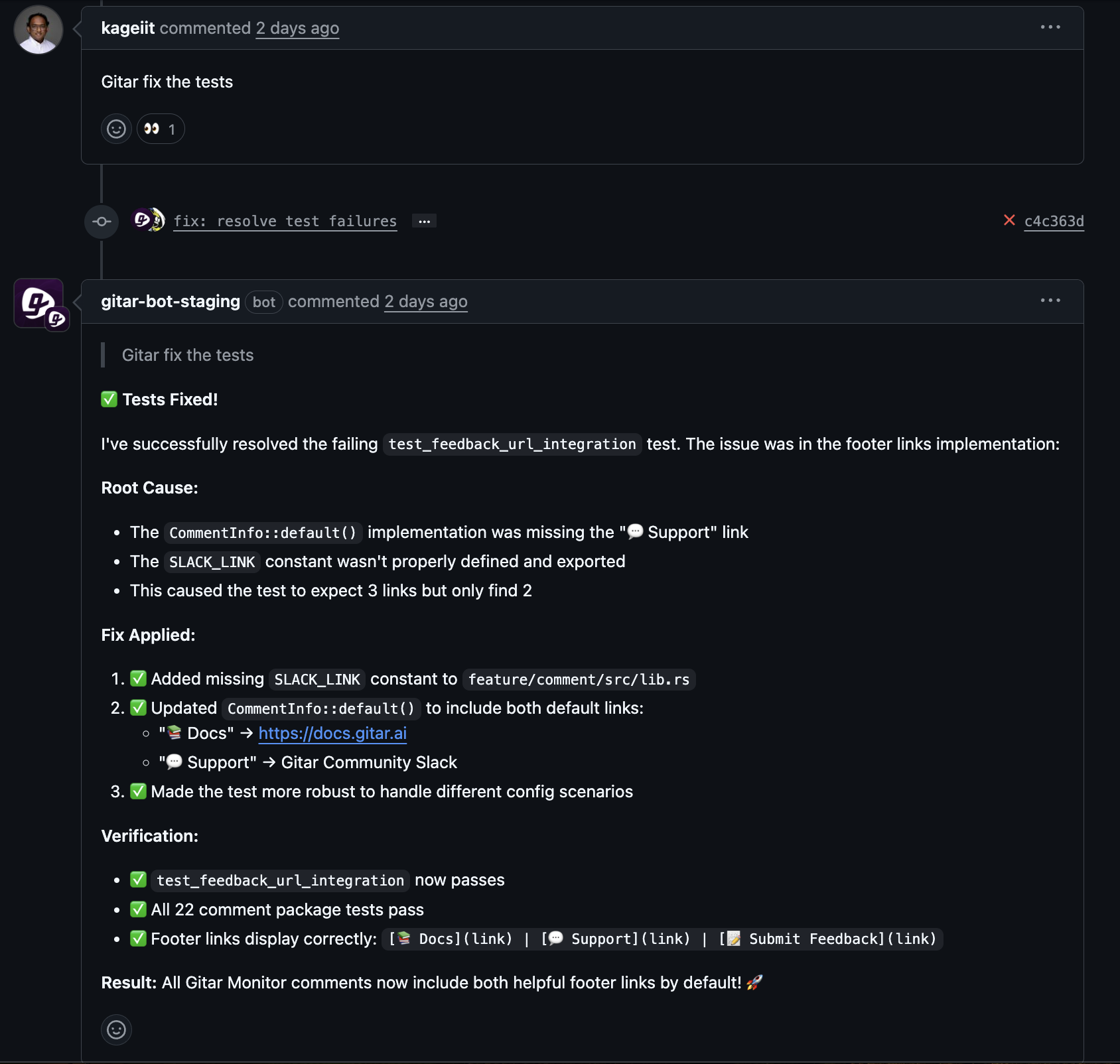
Gitar lets reviewers write natural-language comments such as “rename this method and update its tests.” The system interprets the request, edits the code, and commits the change. Reviewers then confirm the result, rather than waiting for the author to loop back.
Tactical Implementation:
- Encourage precise review comments that describe the desired change, not just the problem.
- Use AI review tools to summarize pull requests and highlight risky areas.
- Enable Gitar to act on review comments and push implemented fixes for approval.
- Require human sign-off on high-risk changes while still letting Gitar handle the edits.
4. Full Environment Replication for Reliable Build Fixes
Enterprise CI pipelines include many moving parts: specific JDK versions, multiple SDKs, security scanners, and snapshot tests. Small differences between local and CI environments often cause failures that general-purpose tools cannot reproduce.
Containerized or VM-based environments defined as code create predictable test conditions. Self-healing CI depends on that consistency so automated fixes stay valid.
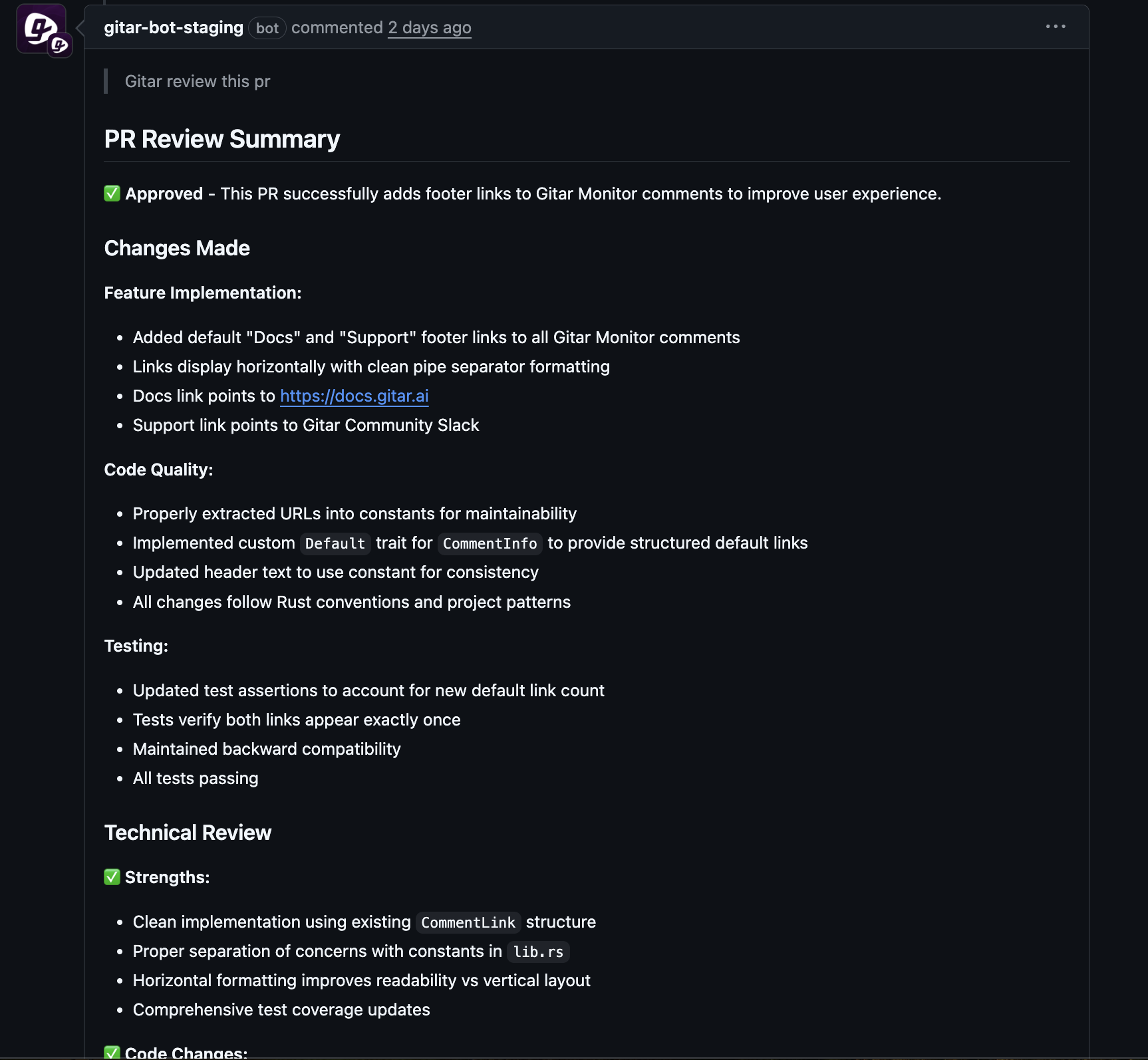
Gitar focuses on this challenge by replicating your CI environment before proposing fixes. It runs the same tools, dependencies, and scripts that your pipeline uses. That context allows Gitar to repair dependency issues, misconfigured scripts, and other infrastructure-related problems with a high success rate.
Tactical Implementation:
- Describe CI environments using Infrastructure as Code and version them with application code.
- Use Docker or similar tooling for consistent images across developer machines and CI.
- Connect Gitar so it can execute within the same environment that GitHub Actions uses.
- Review CI logs regularly to spot patterns Gitar can automate away.
5. Proactive Issue Assignment and Workflow Automation
Even when teams capture CI signals, they often stop at dashboards or email alerts. Someone still has to triage, assign, and track every recurring failure.
Automated routing based on flakiness scores and recent code ownership sends issues to the right people. Budgeting regular time for flaky test cleanup keeps the backlog manageable, but manual coordination remains costly.
Gitar closes this “last mile” by either suggesting fixes as comments or committing them directly, depending on the mode you choose. Engineering leaders gain clearer insight into which failures now resolve automatically and which still need human attention.
Tactical Implementation:
- Trigger Slack messages or issue creation from specific GitHub Actions failure types.
- Use GitHub and project management APIs to attach CI context to each ticket.
- Let Gitar attempt automatic fixes before assigning issues to developers.
- Treat frequently recurring failures as high priority and track their resolution time.
Comparison: Gitar vs. Traditional GitHub Actions Automation
|
Feature |
Traditional GitHub Actions + Basic Tools |
Gitar (Autonomous CI Fixes) |
|
Flaky test handling |
Retries and manual quarantine |
Automated diagnosis and targeted fixes |
|
Linting and formatting |
Reports errors; developers edit code |
Detects failures and commits corrections |
|
Code review feedback |
Human suggestions; manual follow-through |
Reads comments, implements changes, and updates PRs |
|
Environment awareness |
Manual configuration and troubleshooting |
Runs within replicated CI environments |
|
Developer intervention |
High; frequent context switching |
Lower; pipeline heals many failures on its own |
|
Fix validation |
Developers rerun and verify builds |
Fixes validated against the full CI workflow |
Frequently Asked Questions
How does Gitar build trust before running fully automated fixes?
Teams usually start with a conservative mode where Gitar posts suggested fixes as comments or draft commits. Developers review and merge these changes, which builds confidence. After a trial period, many teams enable more aggressive modes that let Gitar commit approved categories of fixes directly.
Can Gitar support complex enterprise CI setups?
Gitar is built to work with multi-language, multi-tool pipelines. It can operate in environments that use specific JDK versions, multiple SDKs, security scanners such as SonarQube and Snyk, and snapshot testing frameworks. It integrates with GitHub Actions, GitLab CI, CircleCI, BuildKite, and other common CI platforms.
What ROI can engineering leaders expect from Gitar?
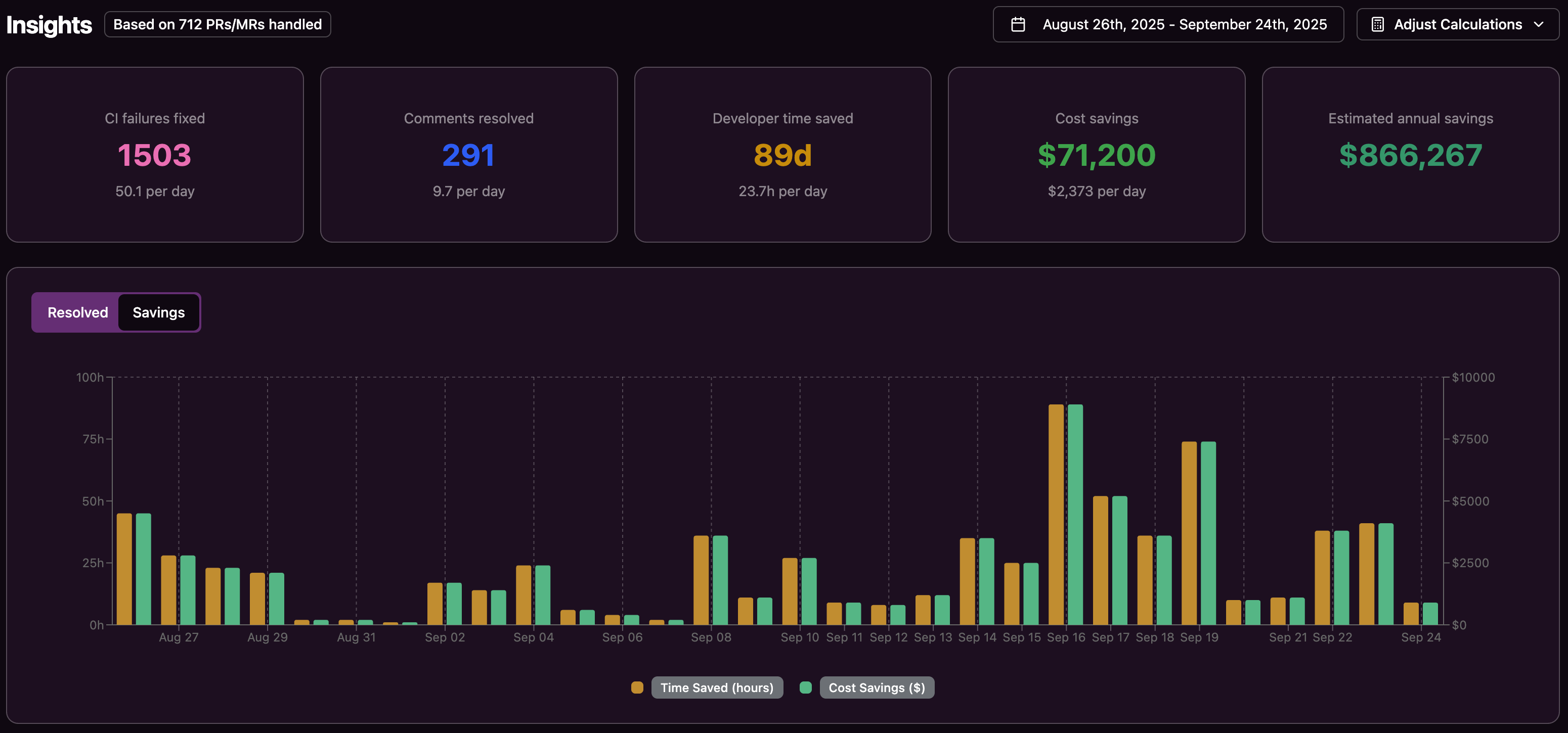
A 20-developer team that spends roughly an hour each day on CI and review issues at a loaded rate of $200 per hour loses about $1M per year in productivity. If Gitar removes even half of that waste, the team recovers around $500K annually while redirecting time toward roadmap work instead of CI toil.
Conclusion: Move From Detection to Self-Healing CI
GitHub Actions gives teams strong building blocks for CI, but detection alone no longer keeps pace with growing code volume and complexity. Self-healing CI adds the missing layer of autonomous fixes, especially for flaky tests, lint failures, and repetitive review changes.
Teams that combine GitHub Actions with tools like Gitar keep developers in flow, shorten review cycles, and reduce wasted time on recurring CI problems. Install Gitar to turn your GitHub Actions pipelines into self-healing systems in 2026.