
Key Takeaways
- Manual CI error detection and debugging consume significant developer time in 2026 and increase the cost of every release.
- Self-healing CI pipelines move teams from reactive troubleshooting to proactive, autonomous remediation of failures.
- Autonomous healing engines provide more value than suggestion-based tools by applying, validating, and committing fixes inside the CI pipeline.
- Successful adoption depends on clear build-versus-buy decisions, staged rollout plans, and alignment with security and compliance needs.
- Gitar gives engineering teams a practical path to self-healing CI with autonomous fixes, environment-aware validation, and configurable automation levels. Try Gitar for automated CI error detection.
The Strategic Imperative: Why Manual CI Error Detection Is Unsustainable in 2026
The Cost of Manual CI Firefighting and Context Switching
Manual CI error detection drains engineering productivity in 2026. Many teams see developers lose up to 30 percent of the work week to failed builds, log triage, and repetitive fixes. For a 20 person engineering team with loaded salaries near 200 dollars per hour, this can approach 1 million dollars in annual lost productivity.
Context switching amplifies that cost. A pull request that fails after a developer has moved on forces a shift back into debugging. A 30 minute fix often consumes an hour or more when factoring in the time needed to regain focus on the original task.
Limits of Traditional CI Error Detection and Suggestion Based AI
Many CI tools and AI assistants still act as suggestion engines. They highlight problems and propose patches, but developers must implement, run, and validate each fix. Teams pay almost the full context switching cost, while growing pull request volume from code generation tools increases the number of failures that need attention.
The Shift Toward Autonomous Infrastructure and Self Healing Systems
Infrastructure and operations are moving toward autonomous systems that manage routine work without human intervention. CI CD pipelines follow the same trend. Teams that adopt self healing pipelines remove manual bottlenecks, ship more frequently, and reduce burnout linked to repetitive CI work.
Install Gitar to start turning broken builds into self healing workflows.
How CI Pipelines Evolve From Reactive to Self Healing
The Evolution of CI CD and AIOps
Early CI CD systems focused on test automation and basic build scripting. Modern pipelines now combine observability, change intelligence, and AIOps to reduce delays from test failures and unstable infrastructure. Automated diagnosis shortens feedback loops and stabilizes release cycles.
What Self Healing CI and Autonomous Validation Mean
Self healing CI automatically detects, diagnoses, and resolves pipeline failures without manual steps. The system tracks context across services, configurations, and dependencies. Instead of stopping at a red build, a self healing pipeline attempts a fix, validates it against the same workflow, and returns a green build for review.
Core Elements of Modern Automated CI Error Detection
Effective automated CI error detection combines several capabilities:
- Accurate reproduction of the failing environment, including SDK versions, services, and third party tools
- Automated reasoning over logs and test output to identify root causes
- Safe code or configuration changes that address the failure
- End to end validation against the full CI workflow before changes reach developers
Best Practices for Automated CI Error Detection in 2026
Leading teams in 2026 favor systems that can adapt as pipelines change. Common practices include:
- Automating common failure classes first, such as lint issues and deterministic test failures
- Gradually increasing autonomy level as trust grows
- Tracking metrics such as time to green build, developer time saved, and change failure rate
How Gitar Delivers Autonomous CI Error Detection
Gitar moves beyond suggestion based AI by acting as an automated healing engine for CI. The platform reads failure logs, makes targeted code or configuration changes, runs validation, and presents passing builds back to the team.
Core Capabilities for Self Healing CI
End to End Fixing and Validation
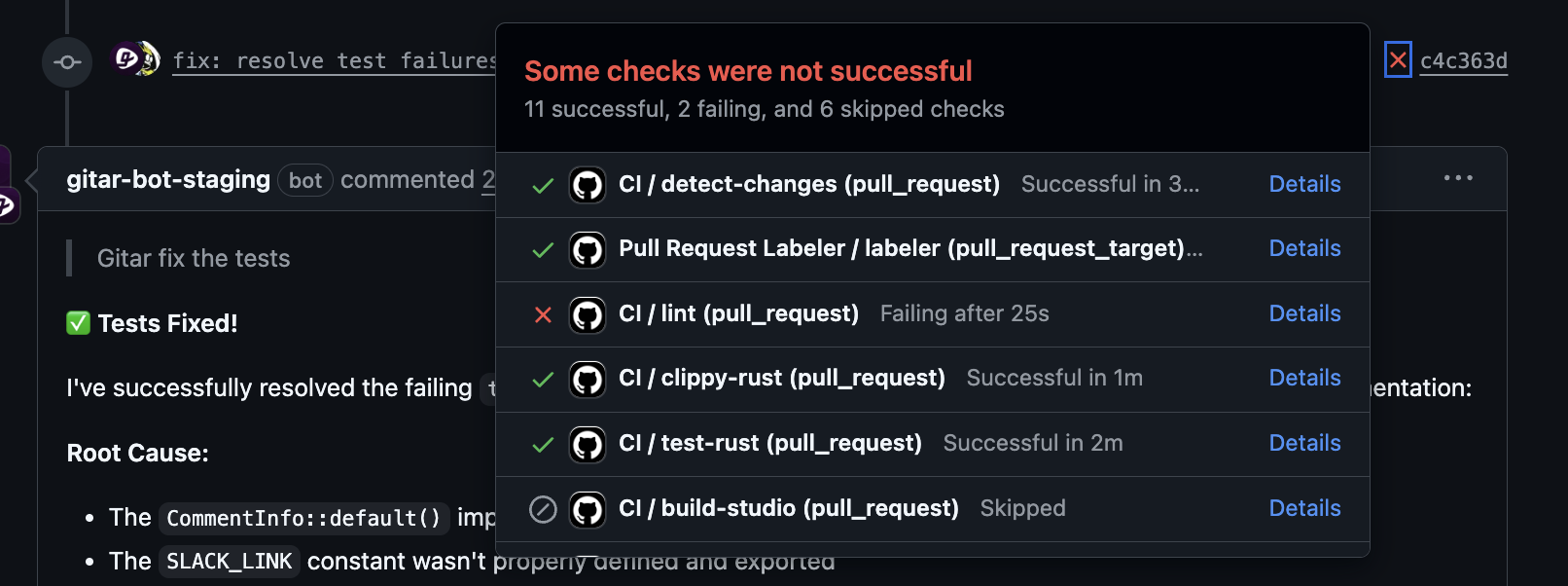
Gitar analyzes CI failure logs, proposes changes, applies them in the repository, and validates results against the full workflow. The system handles lint violations, unit and integration test failures, build breaks, and many dependency problems. Developers receive builds that already passed CI instead of raw error output.
Full Environment Replication
Gitar emulates complex enterprise environments, including specific JDK versions, multiple SDKs, and tools such as SonarQube or Snyk. This environment awareness helps ensure that generated fixes behave correctly within the same constraints as the real pipeline.
Configurable Trust Model
An in house team can tune how much authority Gitar has. A conservative mode posts fixes as suggestions that require a one click approval. An aggressive mode commits fixes directly while retaining rollback options. This flexibility lets teams increase automation only after they see reliable results.
Intelligent Code Review Assistant
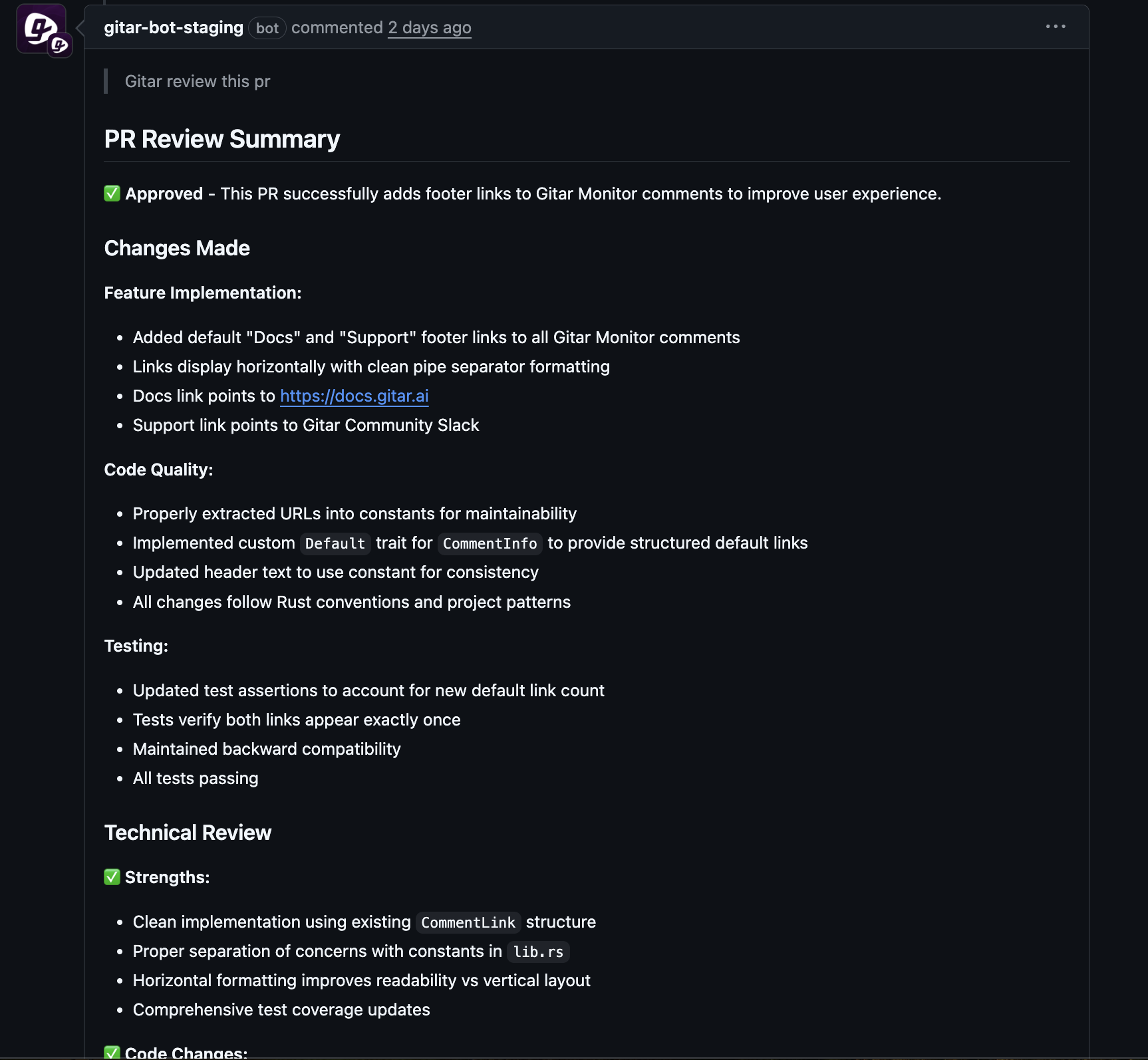
Gitar also assists during code review. Reviewers add a pull request comment with instructions, and Gitar implements the requested change and updates the pull request. Distributed teams avoid time zone delays because requested changes can be ready before the original author returns.

Book a Gitar demo to see autonomous CI error detection in your own pipeline.
Strategic Considerations for Adopting Autonomous CI Error Detection
Build Versus Buy Decisions in 2026
An in house autonomous CI system usually requires significant investment in AI infrastructure, long term model tuning, and deep integration across CI platforms. Many organizations find that dedicated platforms such as Gitar reduce both time to value and ongoing maintenance.
Organizational Readiness and Change Management
Autonomous CI changes how teams work, so adoption benefits from a clear rollout plan. Many organizations:
- Start with a pilot on lower risk repositories
- Limit automation to specific failure types at first
- Share metrics and examples of successful autonomous fixes to build trust
Integration, Scalability, and Security
Automated CI error detection should fit into existing workflows without heavy rework. Key requirements include:
- Support for common CI providers such as GitHub Actions, GitLab CI, CircleCI, and Buildkite
- Scalable workers that can handle peak CI load without slowing pipelines
- Secure handling of credentials and compliance with enterprise access policies
Measuring ROI and Success Metrics
Teams can quantify value by tracking metrics such as developer hours spent on CI issues, mean time to green build, deployment frequency, and defect rates. For a 20 developer team, even a modest reduction in CI related context switching can unlock hundreds of hours of productive time per quarter.
Healing Engines vs Suggestion Engines
Why Autonomous Healing Matters
Automated CI error detection tools generally fall into two groups. Healing engines autonomously resolve issues, while suggestion engines identify problems but rely on humans to implement fixes. Healing engines reduce manual toil, whereas suggestion engines still require developers to context switch into debugging and validation.
Gitar operates as a healing engine that covers fix generation, validation, and implementation. Suggestion engines provide recommendations and partial automation but often leave final resolution to developers.
|
Feature |
Gitar (Autonomous Healing Engine) |
AI Code Reviewers |
Big Model Integrations |
Manual Work |
|
Core Function |
Autonomously fixes and validates CI and code review issues |
Suggests code improvements or issues |
Requires custom integration to apply in CI |
Manual detection, debugging, and fixing |
|
Problem Resolution |
Applies and validates fixes, targeting a green build |
Provides suggestions and some automated fixes |
Provides raw AI output, manual work often required |
Fully manual process |
|
Environmental Awareness |
Includes full environment replication |
Often limited to repository context |
Depends on custom context engineering |
Relies on human interpretation |
|
Developer Interruption |
Minimal or none |
Lower than manual, but action often needed |
Depends on integration |
High context switching |
|
Cross Platform Support |
Designed for major CI providers |
Focused on git hosting platforms |
Requires per CI integration |
Not applicable |
Install Gitar to reduce manual CI troubleshooting and keep pipelines green.
Frequently Asked Questions About Automated CI Error Detection
We already use AI reviewers. Why do we also need Gitar?
AI reviewers such as CodeRabbit or Claude highlight issues and sometimes suggest patches, but they usually stop at advice. Gitar applies and validates fixes inside the CI pipeline, so developers see passing builds instead of error logs and proposed snippets.
How does Gitar handle a complex CI setup with many SDKs and tools?
Gitar models your environment, including specific JDKs, multiple SDKs, and tools such as SonarQube or Snyk. The system replays failures inside that environment, generates fixes, and re runs the workflow to confirm that the change works in context.
What if we do not yet trust automated fixes to push directly to our codebase?
Gitar supports a staged trust model. Teams can start with suggestion mode, where Gitar posts proposed changes for review. After the team gains confidence, administrators can enable direct commit mode for selected repositories or failure types, with audit trails and rollback paths.
How can Gitar help distributed teams with code review and CI issues?
Gitar lets reviewers leave comments that describe the desired change. The system then updates the code, re runs CI, and posts the result. Colleagues in other time zones can review and approve changes without waiting for the original author to come online.
How does automated CI error detection work with our security and compliance needs?
Gitar integrates with existing authentication and branch protection rules. Automated changes follow the same approval workflows as human changes and keep detailed logs for auditing. Organizations can restrict automation on sensitive branches or repositories if needed.
Conclusion: Moving Toward Self Healing CI in 2026
Autonomous CI error detection has become a practical option for many engineering teams in 2026. Organizations that continue to rely on manual triage and suggestion only tools face higher costs, slower feedback cycles, and more developer fatigue.
Gitar helps teams shift CI from a reactive bottleneck to a more autonomous system that keeps pipelines healthy and lets developers focus on product work. Reduced context switching, faster recovery from failures, and clearer metrics on CI health all contribute to a stronger delivery process.
Request a Gitar demo to explore self healing CI for your organization.