
Key Takeaways
- AI agents now handle many CI and code review tasks, reducing manual debugging, context switching, and idle time waiting on broken pipelines.
- Self-healing CI pipelines shorten the path from first commit to merge, which improves delivery speed, reliability, and developer focus.
- Autonomous healing engines such as Gitar apply and validate fixes, while suggestion-only tools still rely on developers to implement and test changes.
- Phased rollout, clear guardrails, and measurable KPIs help teams adopt AI safely while building trust in automated fixes.
- Gitar automatically fixes CI failures so teams ship faster with less manual toil.
Why AI Agents Are Reshaping DevOps Workflows
Many DevOps workflows still leak time and money through CI friction and slow reviews. Developers can spend up to 30% of their time on CI and code review issues. This estimate comes from GitLab’s global developer survey of professional developers.
That wasted time compounds quickly. A 20-developer team can lose close to $1 million per year in productivity when factoring in loaded costs and delayed delivery. CI failures also delay projects for most companies, which pushes out release dates and frustrates customers.
AI coding tools such as GitHub Copilot generate more code, which increases the volume of changes that need validation and safe merging. Post-commit automation has become a key lever for keeping up with that volume.
Install Gitar to automatically fix broken builds and keep your main branches healthy.
How AI Agents Automate CI/CD and Code Review
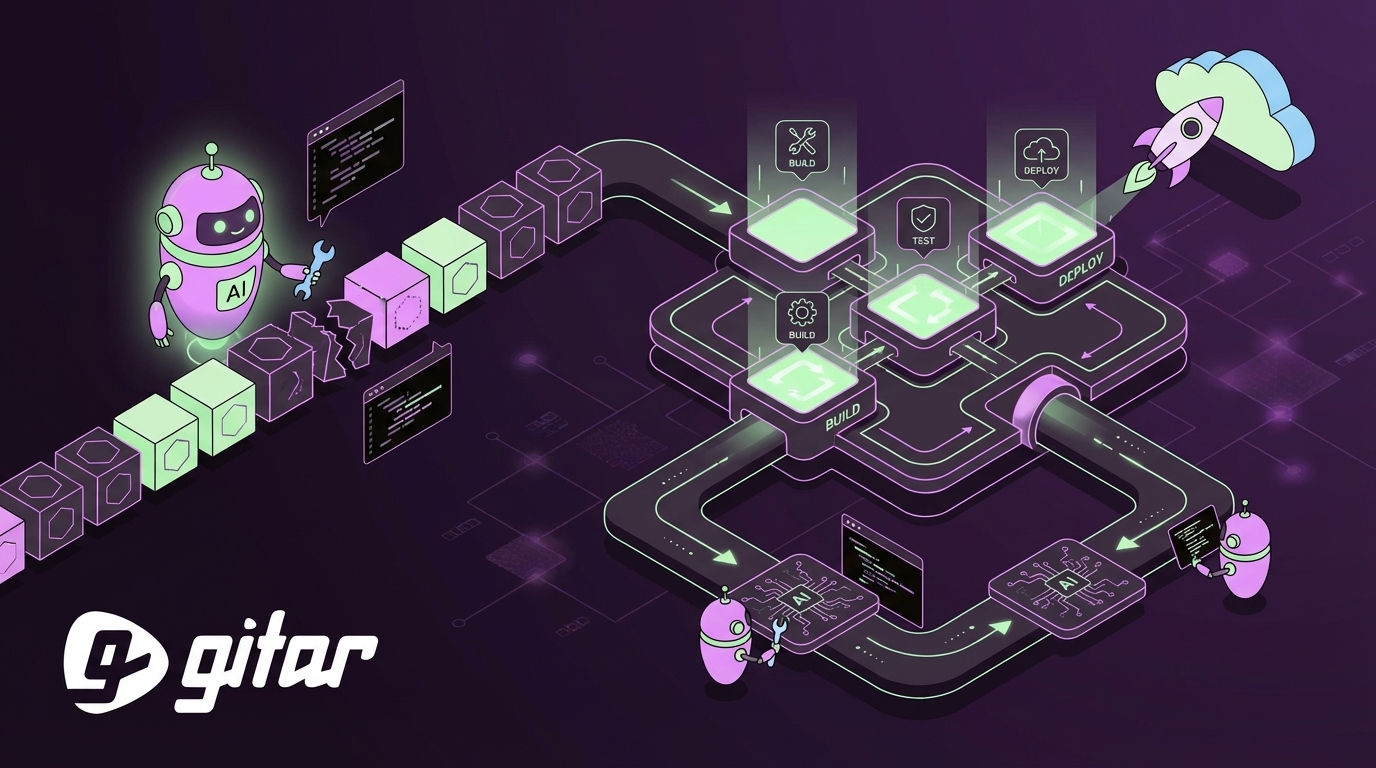
AI agents shift DevOps from assistive suggestions to autonomous execution. These agents can analyze failures, propose changes, apply fixes, and validate results inside existing CI workflows.
This self-healing model delivers several benefits:
- Less context switching because developers stay in flow while agents handle routine breakages.
- Faster merge times because many blocking issues are resolved automatically.
- Higher pipeline reliability because agents address flaky tests and common misconfigurations as they appear.
Modern agents also understand complex environments. They can work with specific SDK versions, third-party tools, and organization-specific configuration, rather than only looking at code in isolation.
Distributed teams gain an additional advantage. AI agents can process feedback, apply fixes, and validate changes overnight, so code often arrives ready for the next human reviewer regardless of time zone.
Gitar: Autonomous CI Healing and Practical Code Review Automation
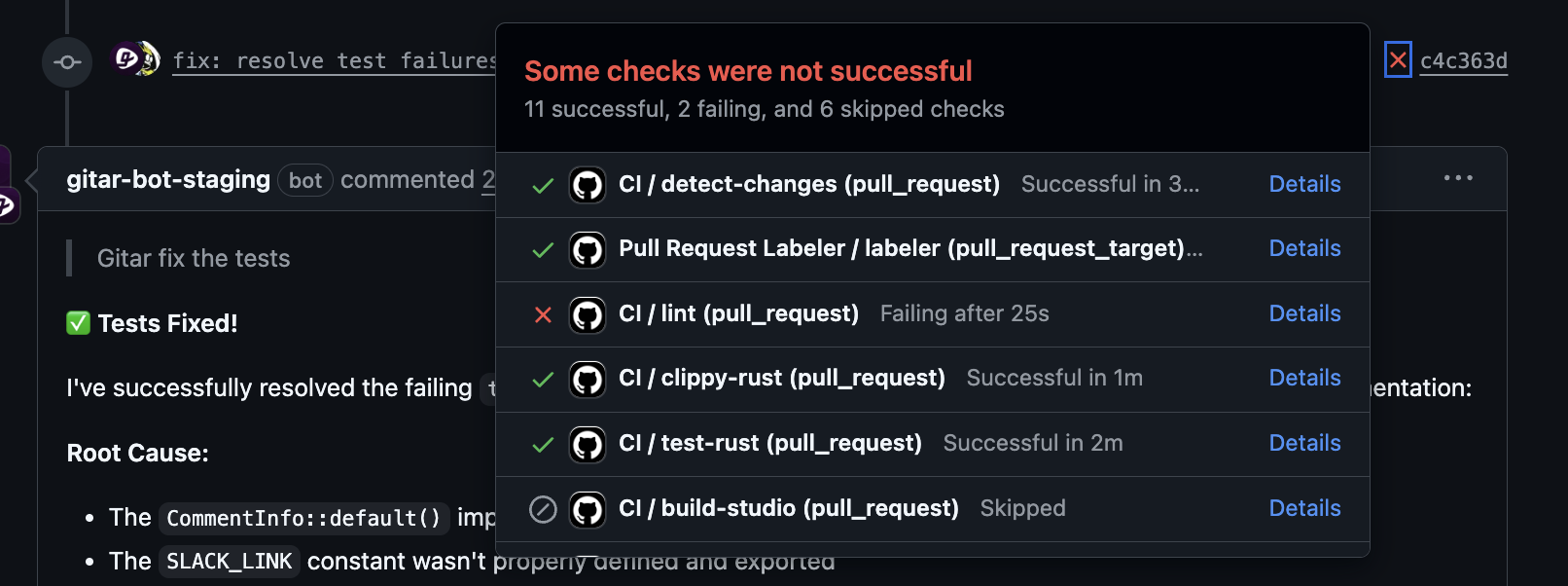
Gitar is an autonomous AI agent built for CI/CD and code review workflows. The system does more than flag issues. It focuses on end-to-end resolution inside your real build environment.
Key capabilities include:
- End-to-end fixing that applies changes, runs the full CI workflow, and presents green pull requests when checks pass.
- Full environment replication with accurate handling of JDK versions, polyglot stacks, and tools such as SonarQube or Snyk.
- A configurable trust model that ranges from suggestion-only to auto-commit for selected fix types.
- Developer-in-the-loop workflows that respect existing review rules and branch protections.
- Support for major CI platforms, including GitHub Actions, GitLab CI, CircleCI, and BuildKite.
Book a Gitar demo to see autonomous CI healing inside your current toolchain.
Choosing the Right AI Agent Strategy for Your Team
Successful AI adoption depends on clear choices about build versus buy, organizational readiness, and expected returns.
Building a custom agent requires specialized ML talent, infrastructure, and ongoing maintenance. Many teams instead favor focused products that already handle environment replication, security, and CI integration.
Organizational readiness matters just as much. Teams need clarity on:
- Comfort with automation at different stages of the pipeline.
- Fit with the existing toolchain and access controls.
- Change management plans for code review and QA practices.
ROI expectations should include objective metrics such as developer hours recovered, mean time to green, and merge time, along with softer outcomes like reduced burnout and stronger hiring appeal.
AI Agent Comparison: Healing Engines vs. Suggestion Engines
|
Feature / Tool Category |
Gitar (Healing Engine) |
AI Code Reviewers (Suggestion Engine) |
On-Demand AI Fixers |
|
Core Functionality |
Applies and validates fixes |
Provides comments and insights |
Helps when manually invoked |
|
CI Integration |
Replicates full CI workflows |
Focuses on git provider only |
Consumes CI minutes for each run |
|
Developer Toil |
Removes most repetitive fixing work |
Requires manual implementation |
Requires manual triggers and checks |
|
Context Awareness |
Deep environment awareness |
Mainly code-centric |
Limited context |
|
Autonomy Level |
High and configurable |
Low and human-dependent |
Very low |
Best Practices for Implementing AI Agents in Your DevOps Stack
Teams see the best results when they roll out AI agents gradually and tie automation to clear safeguards.
Phased Rollout for Trust and Adoption
Many teams start Gitar in suggestion mode, where every change requires human approval. Early tasks often focus on low-risk fixes such as lint issues or straightforward test failures.
Trust grows as engineers review successful fixes and observe low regression rates. Teams then expand the scope to more fix types and enable auto-commit for agreed categories while keeping manual review for higher-risk areas.
Integration with Version Control and CI/CD Platforms
Native integration keeps adoption friction low. Gitar connects directly to GitHub, GitLab, and major CI systems, so teams continue to use the same pull request flows and branch protections.
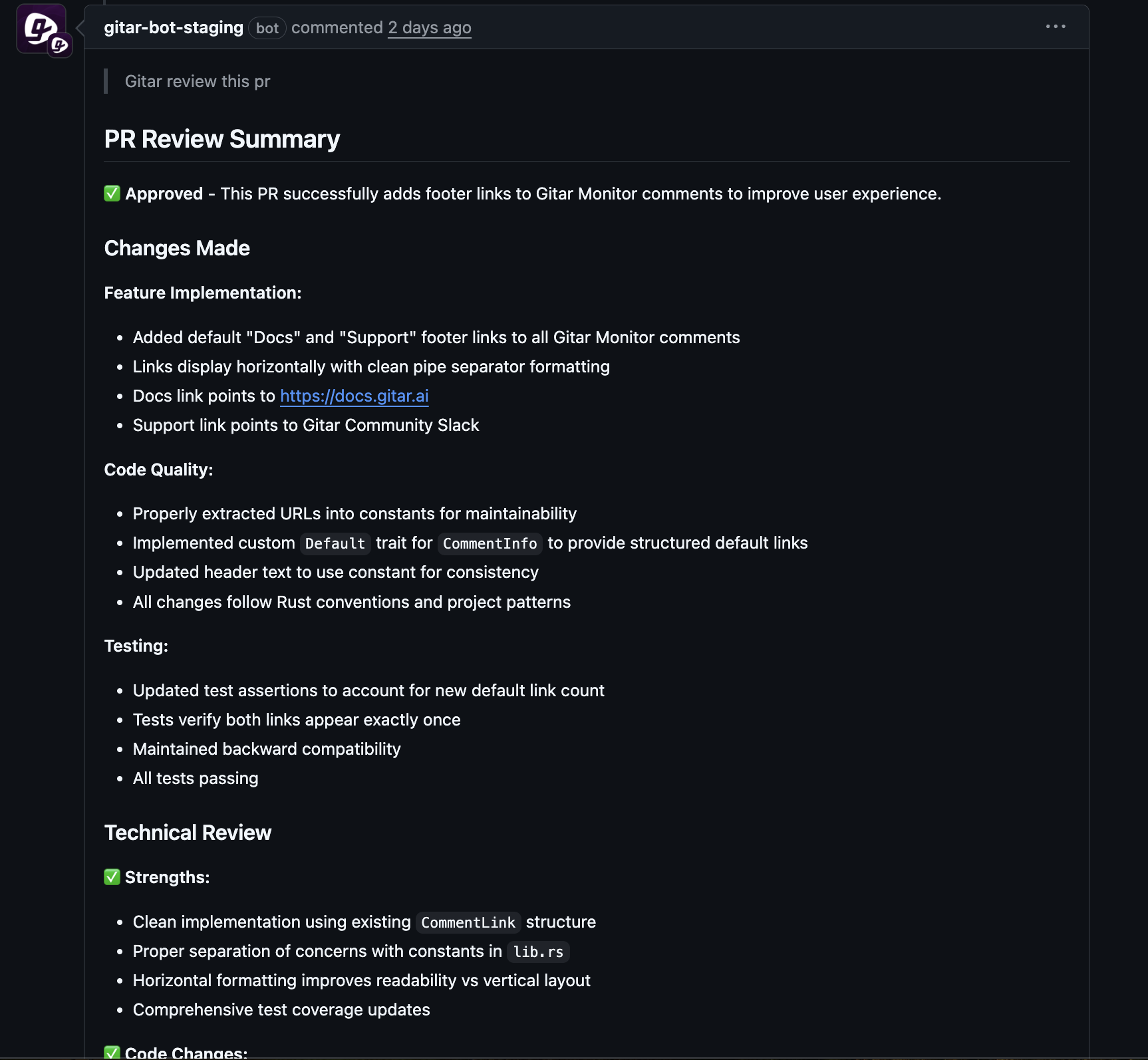
Security and compliance requirements remain important. Successful deployments align Gitar access with existing SSO, role-based permissions, and audit logging.
Defining Success Metrics for AI Automation
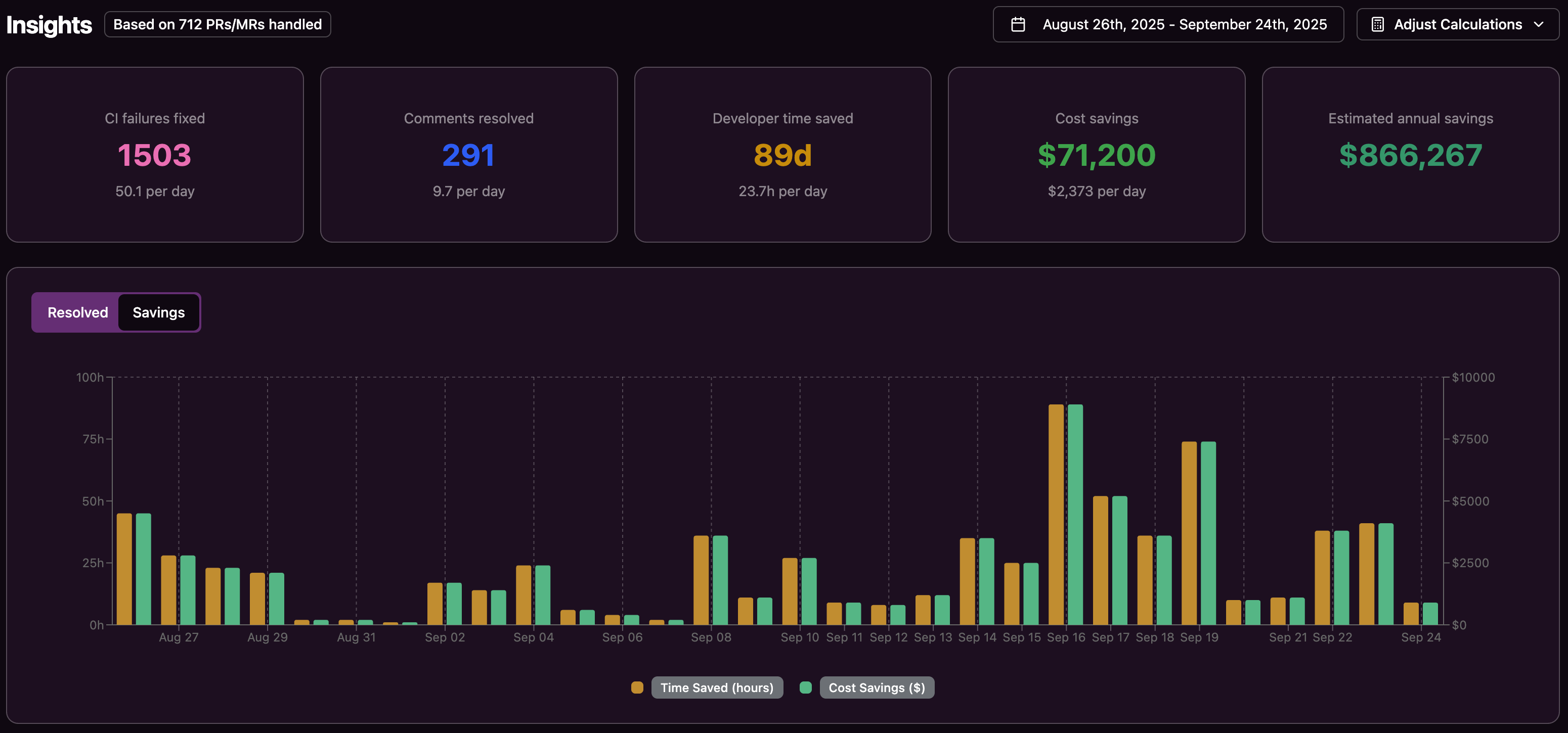
Clear KPIs help teams understand the impact of AI agents. Useful metrics include:
- Reduction in average PR merge time.
- Decrease in CI failure-related toil per developer.
- Increase in successful builds without human intervention.
- Developer satisfaction scores related to build and review work.
Advanced Use Cases and the Future of Autonomous DevOps
AI agents already extend beyond simple fix-on-fail behavior. Some teams use agents to harden test coverage, improve flaky tests, or standardize patterns across large codebases.
Autonomous agents also support true follow-the-sun development. A reviewer in one region can leave detailed feedback, and Gitar can implement and validate many requested changes before the next working day in another region.
Strategic Pitfalls to Avoid with AI Agents
Certain adoption mistakes slow or block value from AI agents. Common pitfalls include:
- Stopping at suggestion-only tools and leaving most of the manual toil in place.
- Relying on generic AI that cannot replicate real CI environments or enterprise dependencies.
- Skipping a structured trust-building phase and expecting teams to accept full automation immediately.
Addressing these risks early helps teams move confidently toward higher levels of autonomy while protecting quality.
Frequently Asked Questions (FAQ) about AI Agents for DevOps
Q1: We already use AI tools for code review. How is Gitar different?
Gitar acts as a healing engine. The system applies fixes, runs your full CI workflow, and ensures builds are green, rather than only commenting on problems. This approach reduces the manual effort that often remains with suggestion-only tools.
Q2: Our CI setup is complex and unique. Can an AI agent handle it?
Gitar is designed for complex enterprise workflows. The agent replicates your environment, including language versions, multi-SDK dependencies, and tools such as SonarQube or Snyk, so fixes align with your real pipelines.
Q3: How can we trust automated fixes in our codebase?
Gitar provides a configurable trust model. Teams can start with suggestion mode, then move to auto-commit for specific fix types as confidence grows. Every change includes clear commit messages and standard rollback options.
Q4: How will AI agents affect our existing development workflow?
Gitar works inside current pull request and CI/CD processes. Developers keep their existing tools and review practices, while Gitar handles many of the repetitive fix-and-rerun cycles in the background.
Q5: What ROI can we expect from AI agents in DevOps?
Teams commonly see large reductions in time spent on CI failures and review-related rework. A 20-developer team can recover hundreds of hours per month when even a fraction of failures are fixed automatically, which translates into lower costs and faster delivery.
Conclusion: Moving Toward Autonomous CI in 2026
AI agents now offer a practical way to unblock CI pipelines, keep developers in flow, and reduce repeated debugging work. The shift from assistive comments to autonomous healing creates space for engineers to focus on design, architecture, and higher-value tasks.
Gitar provides a focused implementation of this model through autonomous CI fixing and targeted code review automation that fits into existing workflows. Teams that adopt these capabilities build an advantage in delivery speed, reliability, and developer experience.