
Key Takeaways
- Persistent CI/CD failures, test flakiness, and slow code reviews reduce engineering throughput and add significant hidden cost.
- Context switching for CI debugging and review fixes can consume up to 30% of a developer’s day, especially in complex enterprise environments.
- Autonomous CI agents that replicate real build environments can apply, validate, and commit fixes with far less manual intervention.
- A configurable trust model lets teams adopt automation gradually while keeping clear control over code quality and deployment risk.
- Teams that want to reduce CI toil and speed up reviews can install Gitar to automatically fix broken builds and resolve review feedback.
The High Cost of Manual CI/CD Complexities for Engineering Teams
Modern engineering teams deal with CI/CD pipelines that interrupt focus, delay releases, and increase operational cost. These issues show up as context switching, unstable pipelines, and slow collaboration across distributed teams.
Context switching drains developer productivity
Developers often spend one hour per day debugging and fixing CI failures and responding to review feedback. This effort can consume up to 30% of total work time and repeatedly breaks flow, as engineers pause feature work to inspect failing jobs and logs.
Pipeline failures delay releases and increase cost
CI pipeline failures contribute to delayed projects for about 60% of companies. For a 20-person engineering team, that delay can translate into roughly $1M per year in lost productivity as code waits for fixes, reruns, and approvals.
Complex enterprise CI environments create instability
Enterprise CI stacks often rely on multiple SDKs, language versions, and third-party tools. These differences between development, staging, and production can cause test flakiness and deployment failures, lowering trust in automated testing and increasing manual checks.
Distributed teams hit review bottlenecks
Global teams frequently stretch a simple review cycle across several days. Time zone gaps, back-and-forth comments, and unclear ownership slow merges and reduce perceived velocity.
Debugging pipelines consumes more time than building features
A 2025 TeamCity report identified build-issue debugging and failure analysis as leading CI/CD activities. Many teams spend more time diagnosing infrastructure problems than shipping product improvements.
Introducing Gitar: Autonomous CI Fixes for Engineering Teams
Gitar is an autonomous AI agent that fixes failing CI pipelines and implements code review feedback. It reduces the time engineers spend on CI failures and review rework so they can focus on feature development.
End-to-end CI fixing
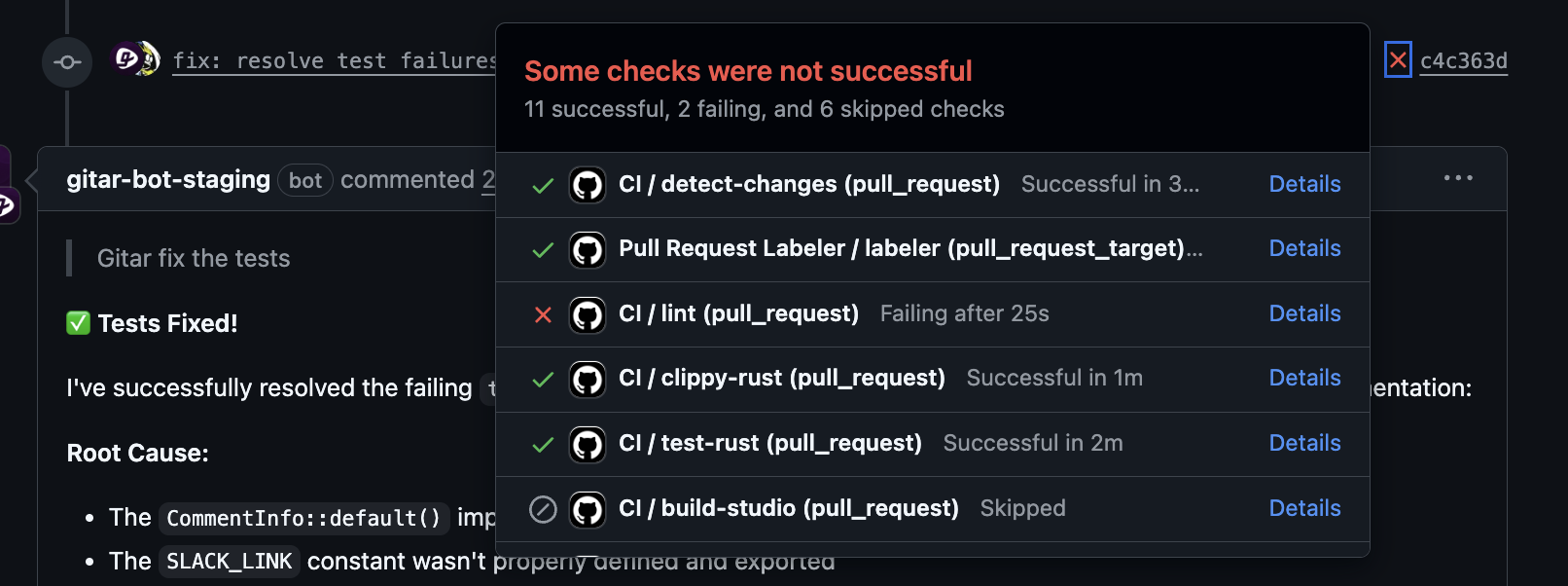
Gitar detects failing checks, analyzes root causes, and generates precise code changes. It commits fixes back to the pull request, reruns the workflow, and ensures all CI jobs pass before developers merge. This approach removes most manual log inspection and trial-and-error debugging.
Full environment replication
Gitar replicates real CI workflows, including specific JDK versions, multi-SDK builds, third-party scanners such as SonarQube and Snyk, and snapshot tests. This replication helps ensure that generated fixes match the actual environment instead of relying solely on local assumptions.
Configurable trust and control
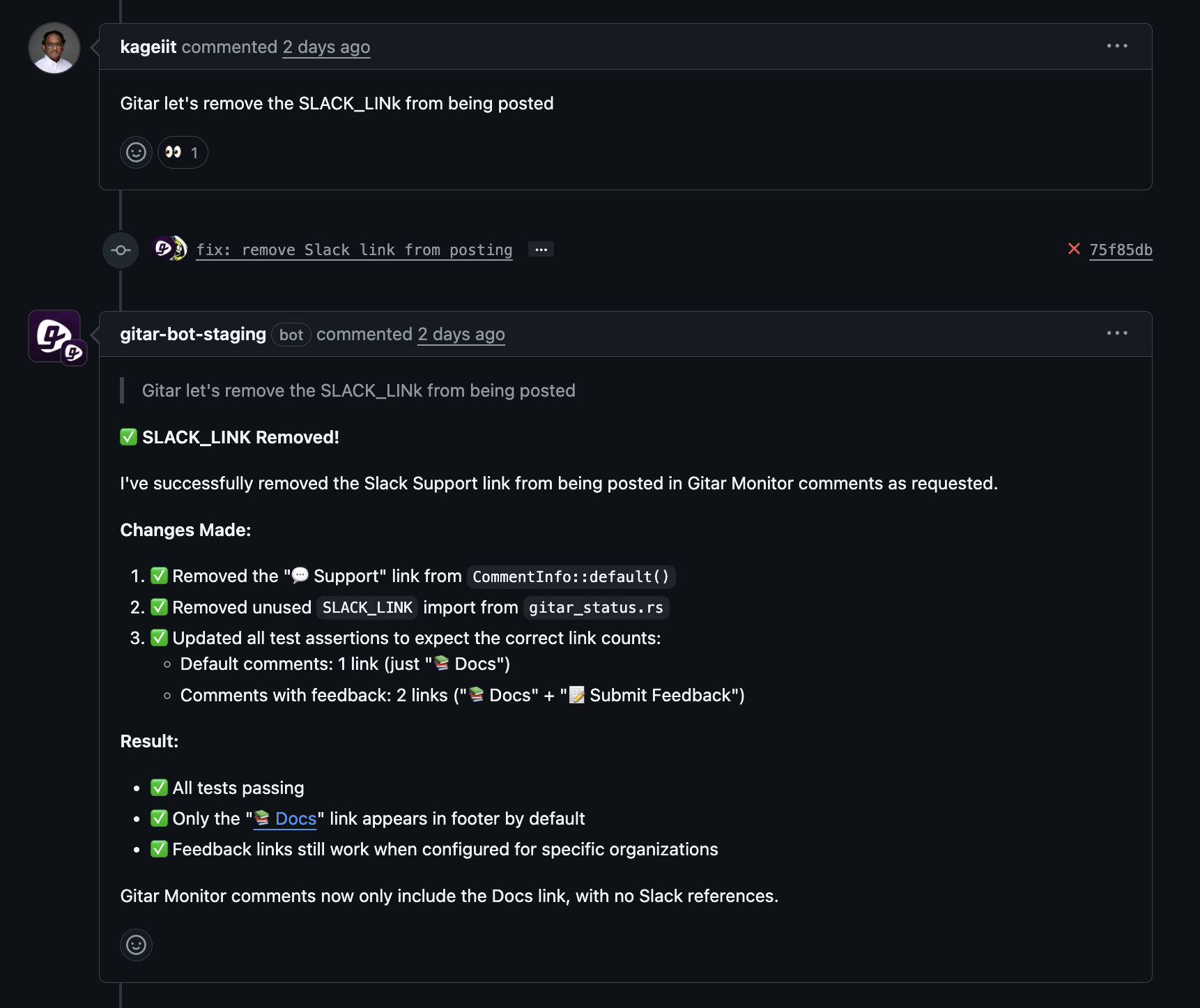
Teams can adjust Gitar’s behavior from suggestion-only to auto-commit. A conservative mode posts proposed changes for review and approval. A more aggressive mode commits fixes directly, with rollback options available so teams keep control over production code.
Intelligent code review assistant
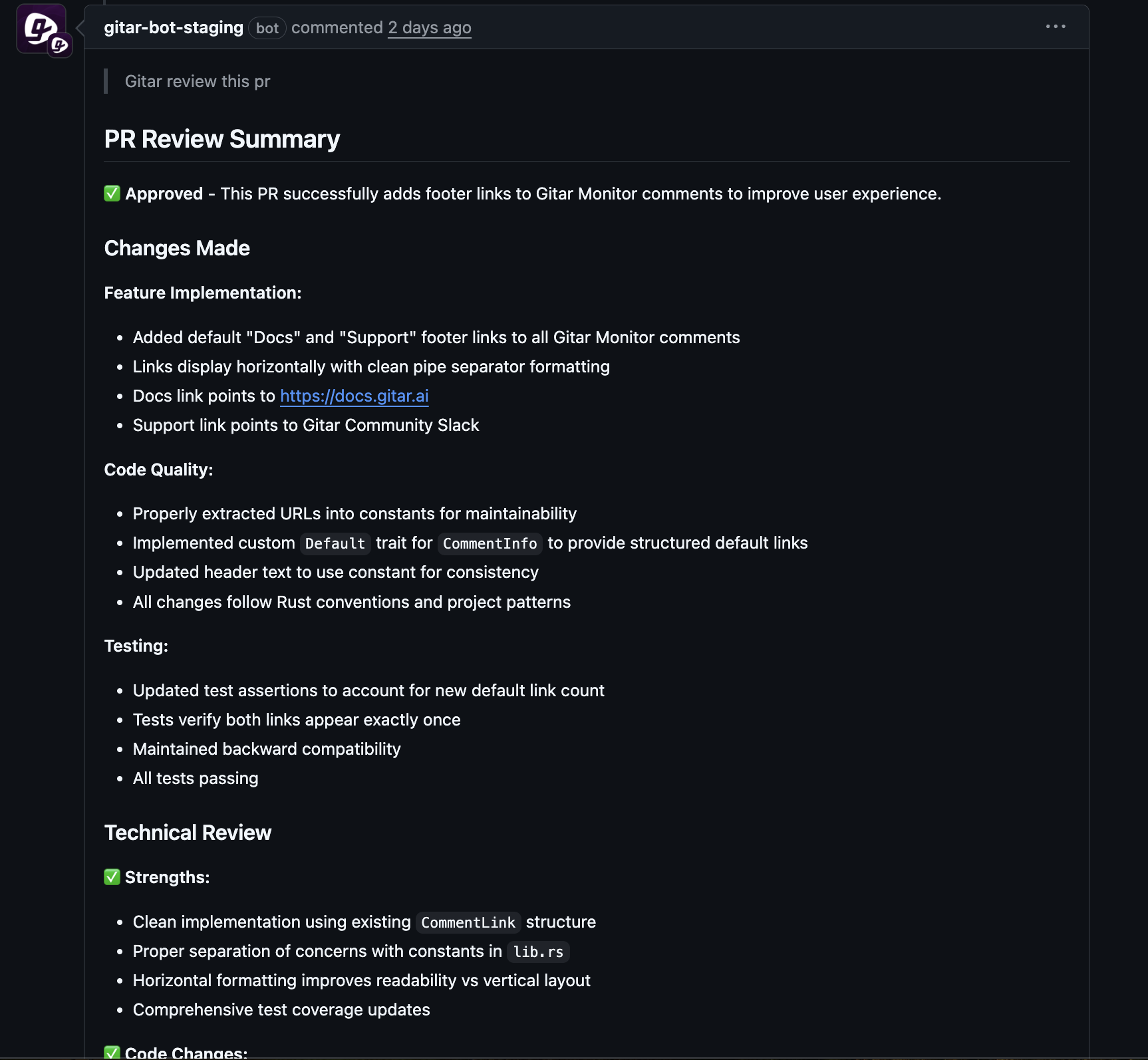
Gitar can perform an initial pass on pull requests, leave structured review feedback, and implement requested changes. Reviewers tag Gitar in comments or leave specific instructions, and the agent updates the code and status checks.
Cross-platform CI support
Gitar integrates with GitHub Actions, GitLab CI, CircleCI, Buildkite, and other major CI platforms. This compatibility lets teams adopt autonomous fixes without changing their existing tooling.
Install Gitar to start automatically fixing broken builds and shortening feedback loops.
How Gitar Delivers Self-Healing CI
Gitar focuses on the specific friction points that slow CI/CD pipelines and code reviews.
Reducing context switching and time loss
Gitar analyzes failing jobs in the background, generates code fixes, and validates them through the full CI pipeline. Developers stay in their current task while the agent handles lint errors, test failures, and configuration issues, then returns a green pull request.
Shortening release cycles and lowering cost
Faster CI recovery and automated review changes reduce time-to-merge. That improvement cuts the financial impact of idle branches and delayed features, especially for teams with large codebases and complex dependency graphs.
Improving reliability in complex CI environments
Gitar’s environment replication and context-aware fixes reduce the risk of changes that pass locally but fail in CI. The agent respects each project’s tooling, dependency versions, and policies, which supports consistent, repeatable builds.
Helping distributed teams move faster
Gitar acts as an always-available collaborator for global teams. A reviewer can leave Gitar instructions at the end of the day, and the originating developer returns to an updated pull request with passing checks.
Lightening onboarding for new engineers
New hires often struggle with unfamiliar pipelines and flaky local setups. Gitar absorbs much of this burden by handling CI failures and implementing review feedback, so new team members can stay productive while they learn the system. New engineers can merge code faster with Gitar handling CI issues in the background.
Gitar vs. The Status Quo: Healing Engines and Suggestion Engines
Traditional tools focus on suggesting improvements, while Gitar focuses on implementing and validating them.
|
Feature / Tool |
Manual Work (Status Quo) |
AI Code Reviewers (e.g., CodeRabbit) |
Gitar (Autonomous AI Agent) |
|
Core Functionality |
Manual detection, diagnosis, and remediation of CI and review issues |
Inline suggestions and code quality feedback |
Autonomous detection, fixing, validation, and commit for CI and review |
|
Actionability |
Requires full developer intervention and rework |
Suggestions with streamlined application, still requiring validation |
Implements changes and returns green builds |
|
Environmental Context |
Limited to local environment knowledge |
Code-level context and repository awareness |
Replication of enterprise environments, dependencies, and tools |
|
Automation Level |
None |
Assisted suggestions with partial automation |
Configurable autonomy from suggestions to auto-commit |
Suggestion engines still rely on developers to apply and validate changes. Gitar operates as a healing engine that closes the loop by fixing issues, running checks, and updating pull requests without constant manual intervention.
Frequently Asked Questions (FAQ) about Autonomous CI Fixes
Does Gitar replace existing AI code reviewers like CodeRabbit?
Gitar complements AI code reviewers rather than replacing them. Review tools focus on code quality feedback, while Gitar focuses on applying, validating, and committing fixes so builds pass in the real CI environment.
How does Gitar handle unique CI setups with specific dependencies and tools?
Gitar emulates each project’s CI workflow, including language versions, build tools, and integrations such as SonarQube and Snyk. That replication lets the agent generate fixes that align with the actual pipeline instead of generic suggestions.
How does Gitar address trust and control concerns?
Teams can start with a conservative mode where all Gitar changes appear as suggestions that require approval. Over time, teams can enable auto-commit for certain scopes while keeping rollback options and clear audit trails.
How does Gitar benefit distributed engineering teams?
Gitar reduces idle time between review cycles across time zones. Reviewers can delegate changes to the agent, and the next person in the chain sees updated code, passing checks, and a shorter path to merge.
What is the ROI of implementing autonomous CI fixes with Gitar?
A 20-developer team that spends an hour per day on CI and review issues invests roughly 5,000 hours per year, or about $1M in loaded cost. Even if Gitar removes half of this work, the savings can reach $500K annually, alongside gains in throughput and developer satisfaction.
Conclusion: Moving Toward Self-Healing CI with Gitar
Manual CI debugging and slow review cycles limit delivery speed, raise costs, and reduce developer satisfaction. Autonomous agents that understand real CI environments and apply validated fixes offer a practical way to reduce that friction.
Gitar provides this self-healing experience by fixing CI failures, implementing review feedback, and adapting to complex enterprise setups. Teams that adopt this model can reclaim engineering time, improve release predictability, and focus more on product work.