
Key Takeaways
- Developer productivity often stalls in the validation and merging stages, where CI failures and code review feedback create frequent interruptions and delays.
- AI-powered Continuous Integration can turn CI from a detection system into a self-healing environment that diagnoses and fixes many issues without manual effort.
- Teams gain the most value when they approach AI CI adoption strategically, with clear trust models, staged rollouts, and measurable ROI goals.
- Healing engines that apply and validate fixes provide more meaningful time savings than suggestion-only tools that still rely on manual remediation.
- Gitar offers an autonomous AI agent that fixes CI failures and addresses review feedback directly in your PRs, which you can try by visiting Gitar.
The New Frontier: Why AI-Powered Continuous Integration Solutions Are Essential
Development teams now lose a large share of their time to debugging failed builds, fixing tests, and responding to code review comments. Even as AI accelerates code creation, many developers still spend a significant portion of their week resolving CI issues and shepherding pull requests to a green state.
Context switching from feature work back to failing pipelines carries a high cost. A developer might move on after opening a pull request, then return hours later when a build fails. Regaining context, reading logs, and patching the issue can turn a small fix into a sizable interruption in focused work.
Distributed teams feel this friction even more. A pull request that shuttles between time zones can take days to clear, especially when reviewers and authors wait on each other for small fixes or clarifications. Tools that only suggest changes add extra steps, since developers still need to implement, validate, and commit the final fix.
AI-assisted coding has shifted the bottleneck to the right. More generated code means more pull requests, test runs, and potential failures. The main challenge now lies in validating, fixing, and merging code quickly and safely, which makes autonomous CI a practical requirement for teams that want to keep pace in 2026.
Install Gitar to automatically fix many broken builds and reduce time spent on CI firefighting.
Beyond Automation: Understanding Self-Healing CI and Its Capabilities
AI-powered Continuous Integration extends traditional CI by handling both detection and resolution. Instead of only flagging red builds, a self-healing CI system analyzes logs, identifies likely root causes, proposes changes, and applies fixes that it then validates through the existing pipeline.
These systems parse build and test output, map errors to specific files or configuration issues, generate targeted patches, and run the relevant checks. When the fixes pass, they can commit back to the pull request branch, which reduces the back-and-forth usually required to get CI to green.
Common CI Failures Addressed by AI-Powered Solutions
Many teams use AI-powered CI to cover recurring classes of issues such as:
- Build failures from missing dependencies, misconfigured scripts, or version mismatches.
- Test failures from assertion errors, snapshot mismatches, or flaky tests that require small code or fixture updates.
- Lint and formatting violations that block merges but do not require complex logic changes.
Addressing these issues automatically frees developers to focus on design and feature work instead of repetitive cleanup.
Gitar: Practical Autonomous Support for Continuous Integration
Gitar provides an autonomous AI agent that participates directly in your existing CI workflows and pull requests. The agent focuses on fixing failing checks and implementing code review feedback so teams can keep work moving without constant manual intervention.
End-to-end autonomous fixes
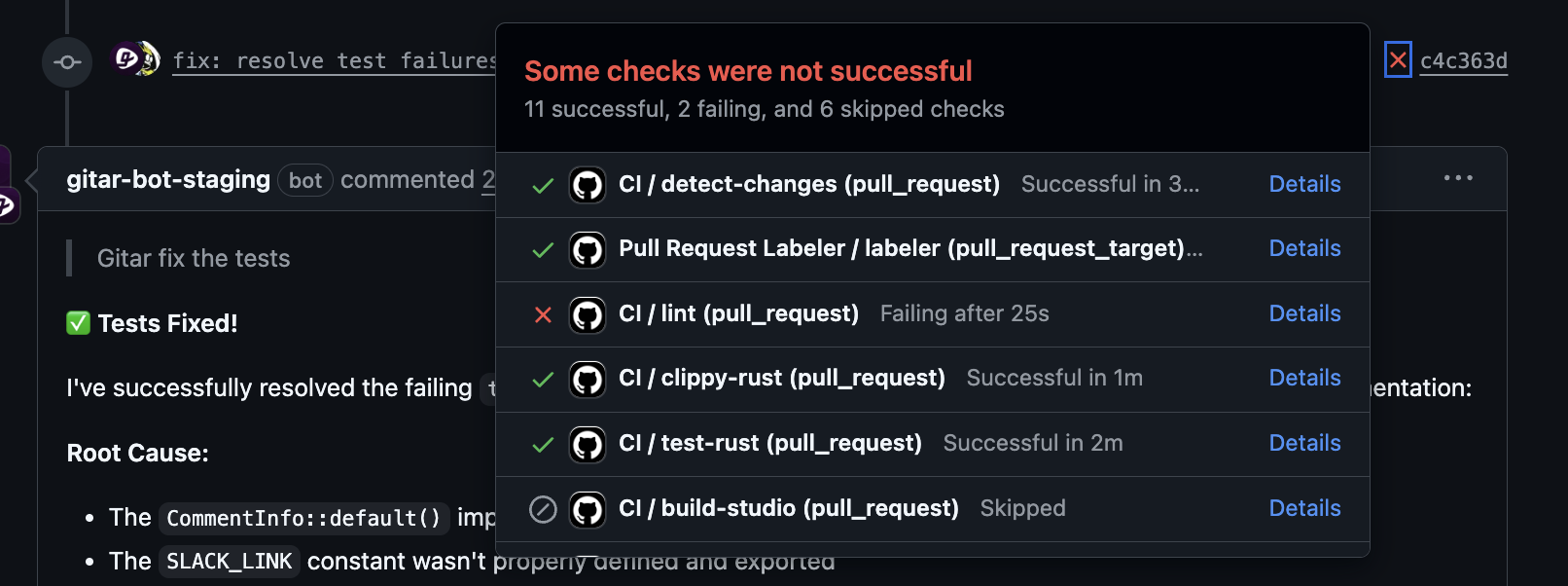
Gitar analyzes failing CI runs, reads the logs, identifies likely root causes, and proposes concrete code or configuration changes. It can apply these changes, re-run the relevant checks, and commit verified fixes back to the pull request branch, especially for issues such as lint violations, test failures, and common build errors.

Full environment replication
Gitar can mirror complex CI environments that rely on specific JDK versions, multiple SDKs, or tools such as SonarQube and Snyk. Matching the production-like setup helps ensure the generated fixes work reliably in real pipelines, not just in simplified sandboxes.
Configurable trust and control
Teams can configure Gitar from low to high automation. New users often start in suggestion-only mode, where the agent proposes patches as comments or pull request updates. As confidence grows, teams can enable one-click approvals and then fully autonomous mode with rollback options, keeping developers in control while reducing manual work.
Code review assistance
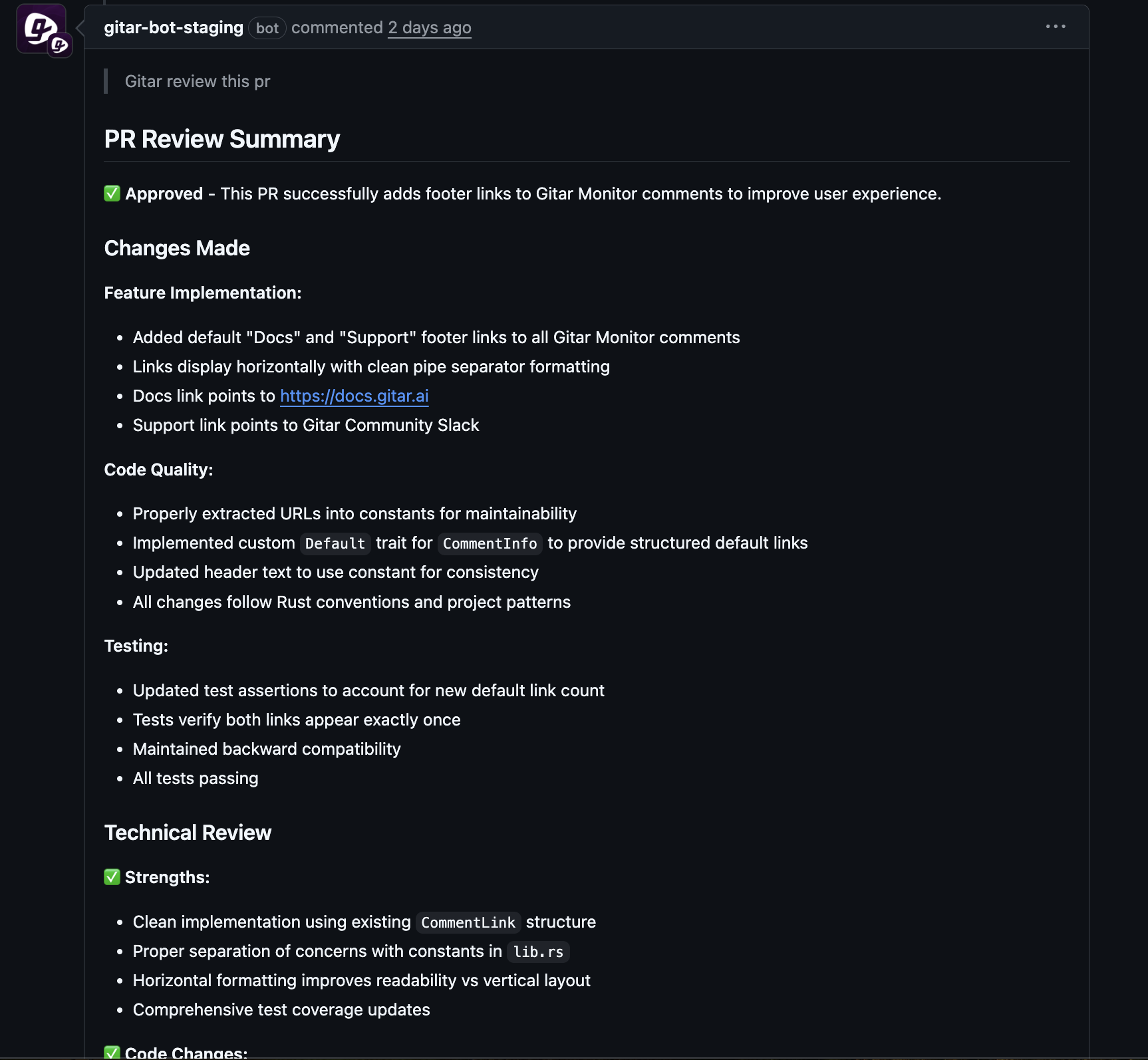
Reviewers can tag Gitar in comments to request an AI review or ask it to implement specific changes. This pattern helps distributed teams move faster, because reviewers can delegate mechanical edits to the agent instead of waiting for multiple iterations across time zones.
Cross-platform CI support
Gitar integrates with popular platforms such as GitHub Actions, GitLab CI, CircleCI, and BuildKite. Teams can connect the agent without overhauling existing infrastructure or changing version control providers.
See how Gitar fits into your current CI stack.
Strategic Considerations for Adopting AI-Powered Continuous Integration Solutions
Build vs. buy for AI-powered CI
Engineering leaders weighing in-house development against specialized tools need to account for more than model quality. Building an agent that can process logs, manage context, handle concurrent pipelines, and act safely across repositories requires sustained investment that competes with core product work. Purpose-built platforms provide this capability out of the box, with maintenance and updates handled externally.
Trust models and automation levels
Thoughtful configuration helps teams adopt AI safely. Many organizations start with:
- Suggestion-only mode, where AI proposes fixes for developer review.
- Approval workflows, where trusted reviewers can apply AI changes in one step.
- Autonomous mode, where the agent commits fixes that still remain subject to rollback and audit.
This path lets teams evaluate quality and build confidence before granting broader autonomy.
Integration strategies that respect existing workflows
Teams see smoother rollouts when they begin with pilot repositories, tune settings, and expand after early success. AI CI should connect to existing Git providers and CI systems without major changes and should present its actions clearly through comments, logs, and status checks so developers always understand what changed and why.
Measuring ROI of AI-powered CI
Clear metrics help demonstrate value. Many teams track reductions in time spent on failed builds, frequency of context switches, and average time from pull request creation to merge. Indirect gains, such as less burnout from repetitive debugging and faster onboarding for new hires, contribute to long-term productivity and retention.
Change management and team adoption
Successful adoption depends on transparent communication and developer involvement. Teams benefit from explaining where AI will help, how automation levels work, and how developers can review, override, or roll back changes. Positioning the agent as support for tedious tasks, not a replacement for engineering judgment, encourages participation and feedback.
Comparison: Healing Engines vs. Suggestion Engines in CI
Teams choosing among AI tools need to understand the difference between engines that complete fixes and tools that only suggest them. The level of automation in the last mile from diagnosis to validated resolution drives most of the time savings.
|
Feature/Solution |
Gitar (Healing Engine) |
AI Code Reviewers (Suggestion Engines) |
Manual Work (Status Quo) |
|
Problem Resolution |
Autonomous diagnosis, fix generation, and validation |
Suggestions with partial implementation support |
Manual debugging, coding, and validation |
|
Developer Intervention |
Minimal, with configurable approval modes |
Moderate to high, implementation often manual |
Very high, frequent context switching |
|
Green Builds |
Validated against real CI workflows |
Not guaranteed to pass CI |
Dependent on developer accuracy |
|
Cross-Platform CI Support |
Broad support across major CI tools |
Varies by vendor and platform |
Manual adaptation required |
Healing engines like Gitar handle the full path from failure to passing build, which reduces the number of manual steps per incident and shortens the feedback loop for developers.
Strategic Pitfalls for Experienced Teams in Adopting AI-Powered CI
Even seasoned engineering organizations can encounter friction when they adopt AI CI. Common pitfalls include:
- Skipping trust-building stages and enabling aggressive automation before developers understand how the agent behaves.
- Overlooking differences across CI platforms and log formats, which can limit coverage if the tool does not support every environment.
- Investing only in better detection instead of tools that also implement and validate fixes.
- Underestimating developer experience, where unclear AI actions or noisy comments reduce confidence and adoption.
Explore how Gitar can reduce these risks in your CI environment.
Frequently Asked Questions (FAQ) About AI-Powered CI
How do AI-powered Continuous Integration solutions handle complex enterprise CI environments with unique dependencies?
Advanced AI-powered CI solutions such as Gitar can replicate enterprise workflows that rely on specific language runtimes, multiple SDKs, and security or quality tools like SonarQube and Snyk. This approach helps the agent generate fixes that work with the same constraints as the real pipelines.
What ROI can teams expect from AI-powered Continuous Integration solutions?
For a team of 20 developers, time spent on CI failures and review-related fixes can translate into substantial annual cost. Automating a large share of this work and reducing context switching can return a meaningful portion of that investment while improving delivery speed.
How should teams approach trust in autonomous AI fixes?
Teams benefit from starting with suggestion-only modes where every AI change requires review. After the agent proves reliable on smaller issues, organizations can gradually enable higher automation levels while keeping clear logs and rollback mechanisms in place.
Conclusion: Moving Toward Autonomous CI with Gitar
AI-powered Continuous Integration in 2026 gives teams a way to address the new bottleneck created by faster code generation. By automating the diagnosis and resolution of many CI failures and supporting code review workflows, tools like Gitar help developers spend more time on design and features and less time on rework.
Organizations that adopt self-healing CI gain earlier insight into issues, shorter feedback cycles, and fewer interruptions from failing pipelines. Teams ready to explore this shift can start with targeted automation and expand as trust grows.
Get started with Gitar and see how autonomous CI fits into your engineering workflow.