
Key Takeaways
- Traditional code reviews and CI firefighting slow teams, create context switching, and reduce engineering capacity.
- AI assistants can automatically fix CI failures, keep builds green, and shorten feedback loops across time zones.
- Consistent AI checks help enforce standards, reduce review fatigue, and improve overall code quality.
- Engineering teams can redirect time from repetitive review and debugging tasks to higher-value feature and architecture work.
- Gitar provides an autonomous AI agent that applies and validates fixes in your CI pipeline, and teams can get started at https://gitar.ai/fix.
How Traditional Code Reviews Slow Your Engineering Team
Traditional code review processes now act as a primary bottleneck in many software delivery pipelines. They can delay releases and constrain productivity when every change waits for human availability.
The impact spans several areas. Time-consuming reviews block project timelines, and inconsistent feedback creates confusion about standards. Large codebases often expose knowledge gaps, and feedback fatigue over long sessions reduces review quality.
For a typical 20-developer team, inefficient CI and review workflows can translate into roughly $1M per year in lost productivity when each engineer loses an hour a day to context switching and CI issues. Short fixes turn into long interruptions once developers leave deep work to chase failing builds.
AI assistants for faster code reviews give teams a way to automate many of these tasks. These systems identify issues, apply targeted fixes, and reduce the amount of human effort required to maintain code quality.
How Gitar Uses Autonomy To Speed Up Code Reviews
Gitar is an autonomous AI agent for code review and CI remediation. The system goes beyond static suggestions and focuses on applying and validating fixes directly in your workflow.
Key capabilities that enable faster code reviews include:
- End-to-end fixing, where Gitar applies changes and validates them against your full CI workflow to restore green builds.
- Full environment replication, including enterprise CI setups, dependencies, and third-party tools such as security or quality scanners.
- A configurable trust model that lets teams start with suggestions and gradually move to auto-commits as confidence grows.
- Support for distributed teams, which reduces time zone delays by implementing reviewer feedback while others are offline.
- An intelligent code review assistant that performs first-pass reviews and acts directly on human feedback in pull requests.
Teams can introduce Gitar incrementally, beginning with low-risk tasks such as lint fixes or straightforward test failures, then expanding to broader CI and review automation over time.

5 Ways To Use AI Assistants For Faster Code Reviews
1. Remove CI Failures With Autonomous, Self-Healing Pipelines
CI failures interrupt deep work and force developers into log reading, local replication, and repeated pipeline runs. Simple lint or test issues can consume significant time across a team.
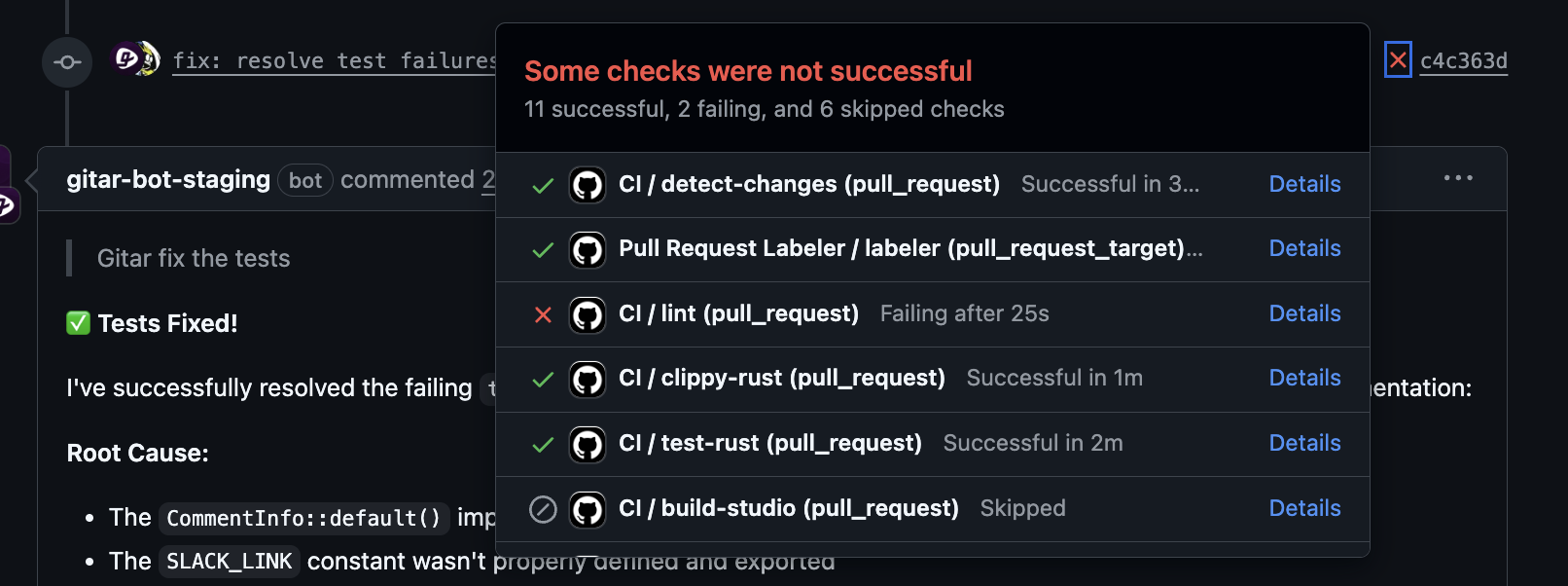
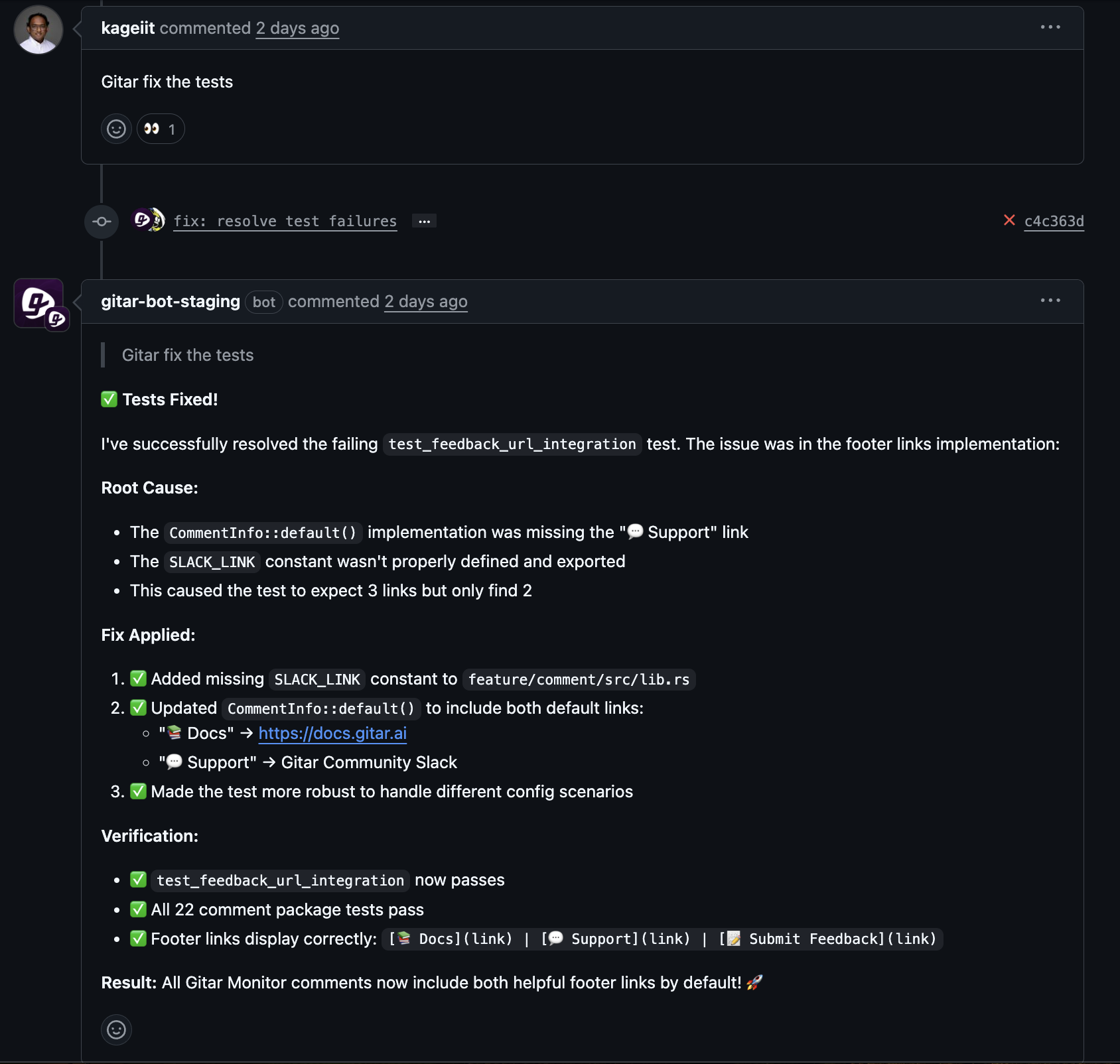
AI assistants can move from detection to direct remediation. When a lint error, test failure, or build issue appears, systems such as Gitar parse logs, identify likely root causes, propose code changes, and commit fixes back to the pull request for validation in CI. Developers often return to a green build instead of a red one that needs manual attention.
Tactical implementation starts with low-risk fixes. Teams can configure conservative behavior where the AI opens a suggested commit or patch for review. Over time, teams can allow automatic commits for clearly defined cases, such as formatting or simple test adjustments, while keeping more complex changes under manual review.
2. Shorten Feedback Loops And Reduce Multi-Day Review Cycles
Slow feedback cycles create long-tail delays, especially for distributed teams. Time zone gaps can turn simple review conversations into multi-day exchanges.
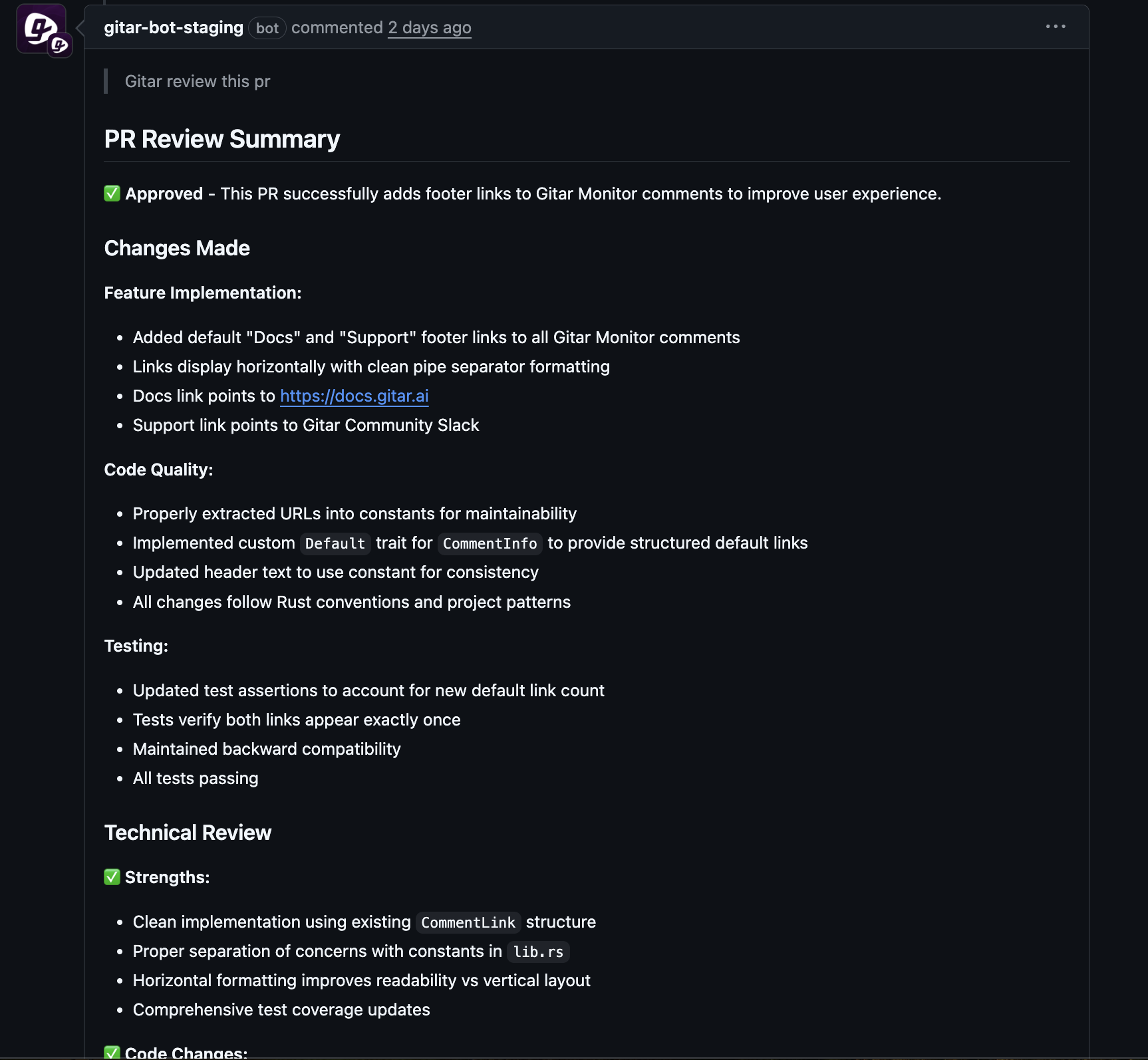
AI assistants can deliver an immediate first-pass review and implement routine feedback. A reviewer can leave a structured comment that instructs Gitar to refactor, rename, or adjust tests. The AI then updates the code and pushes a commit, so the original author sees concrete changes instead of only comments.
Teams can standardize this flow with clear tagging, such as prefixing comments with a keyword for AI action. Reviewers then focus on intent and design, while the AI performs the mechanical edits and validation.
3. Bridge Knowledge Gaps In Large Or Unfamiliar Codebases
Many reviewers operate without full context on legacy modules or less familiar services. Missing tribal knowledge and outdated documentation can cause reviewers to miss important dependencies or architectural constraints.
AI assistants help mitigate this by summarizing related files, pointing to relevant past commits, and explaining how a change interacts with other parts of the system. This support reduces the cognitive load on reviewers and helps newer team members contribute to reviews more effectively.
Teams can use AI-generated summaries as part of the pull request description or as on-demand context while reviewing individual files.
4. Enforce Consistent Standards Across Every Review
Inconsistent feedback across reviewers often leads to uneven quality and confusion about expectations. Individual style preferences and varying levels of experience can produce different outcomes for similar changes.
AI assistants apply the same set of rules every time. They can check formatting, naming conventions, error handling, and other policy-driven concerns on each pull request, reducing variation and ensuring baseline quality.
Teams can configure AI checks as quality gates for common issues while reserving deeper architectural and product decisions for human reviewers.
5. Free Engineers To Focus On High-Value Engineering Work
Sustained review work and frequent context switching are mentally demanding for engineers. Over time, this workload can reduce both feedback depth and overall job satisfaction.
Automation of repetitive review and CI tasks gives developers more uninterrupted time for design, feature development, and complex debugging that benefits from human insight. For a 20-developer team, even a modest reduction in time spent on mechanical review tasks can reclaim hundreds of hours per month.
Teams can measure this effect by tracking time spent on CI fixes and low-level review comments before and after AI adoption, then redirecting the saved capacity toward roadmap work. To explore this approach, you can start with Gitar at https://gitar.ai/fix.
How Gitar Compares To Other AI Assistants For Faster Code Reviews
Gitar vs. Other AI Code Review Solutions
|
Feature / Tool |
Gitar Autonomous AI |
CodeRabbit (AI Review Tool) |
Manual Code Review (Status Quo) |
|
CI failure fixing |
Applies end-to-end fixes that are validated against full CI |
Provides detailed feedback and fix suggestions |
Requires manual investigation and fixes |
|
Code review feedback |
Implements reviewer feedback and provides additional suggestions |
Generates automated feedback with inline suggestions |
Depends on human availability and can involve long cycles |
|
Environment replication |
Supports full enterprise CI environments |
Integrates with Git platforms and related workflows |
Relies on individual human context and setup |
|
Trust model |
Configurable from conservative suggestions to aggressive auto-commits |
Designed primarily to complement human review |
Fully dependent on human judgment and process |
Autonomy is the main differentiator. Many tools emphasize analysis and suggestions, while Gitar applies fixes, runs CI, and reports back on the outcome. This approach reduces the number of manual steps between identifying a problem and merging a safe change.
You can evaluate this workflow in your own environment by installing Gitar at https://gitar.ai/fix.
Frequently Asked Questions About AI Assistants For Faster Code Reviews
How does Gitar handle complex CI environments with unique dependencies?
Gitar is built to emulate full enterprise workflows, including specific language versions, multiple SDKs, and tools such as SonarQube or Snyk. The agent runs fixes in that context so changes respect the same checks and constraints as your existing CI pipeline.
We already use AI reviewers like CodeRabbit. How is Gitar different for faster code reviews?
Tools such as CodeRabbit focus on generating review comments and suggestions. Gitar adds an execution layer that applies changes, runs CI, and updates pull requests with validated fixes. Teams can keep existing AI reviewers for commentary while using Gitar to handle implementation and CI recovery.
What if we do not fully trust automated fixes for code reviews?
Gitar supports a staged trust model. Teams can begin with a mode where the AI opens suggested changes for review, then approve or modify them like any other commit. As successful fixes accumulate, teams can choose to enable auto-commits in clearly defined categories while keeping rollback options and human oversight in place.
Conclusion: Moving Toward Faster, More Automated Code Reviews
AI assistants are shifting code review from a fully manual step into a shared workflow between humans and automation. Teams can use these systems to keep CI green, shorten review cycles, bridge knowledge gaps, standardize quality checks, and reduce review fatigue.
Gitar focuses on autonomous implementation and validation of fixes inside your existing tools and pipelines. Teams that adopt this style of automation in 2026 can reduce review overhead and gain more time for complex engineering work. To see how this fits your environment, visit https://gitar.ai/fix.