
Key Takeaways
- CI failures and slow reviews consume thousands of developer hours each year and create a direct, measurable productivity and cost impact.
- Healing engines that apply and validate fixes, such as Gitar, reduce manual toil more than suggestion engines that only propose changes.
- Most CI tools focus on test automation, analytics, or infrastructure optimization, while only a subset address end-to-end autonomous repair.
- Teams see the greatest benefit when automated repair integrates with existing CI platforms and mirrors real enterprise environments.
- Engineering teams that want to cut CI toil and speed up merges can install Gitar in a few minutes and start fixing failures automatically: Try Gitar for autonomous CI repair.
The Critical Need for Automated Pipeline Repair
CI failures and code review delays slow down engineering teams and increase delivery costs. For a typical group of 20 developers, lost time from CI failures and review cycles can reach about 5,000 hours per year, which often maps to roughly $1M in productivity loss.
Developer focus also suffers when every failed build forces a context switch. Each failure requires re-reading logs, tracking down root causes, applying fixes, and waiting for CI to rerun, even when the correction is a small change. This pattern repeats across the team and reduces overall throughput.
Teams that automate CI/CD pipelines often see faster time-to-market, fewer deployment errors, higher developer productivity, and lower operational costs. These gains improve developer satisfaction, shorten onboarding, and keep code quality standards consistent across projects.
Teams that want to reduce CI toil and speed up merges can get started quickly: Install Gitar and begin automating CI repair.
Gitar: The Autonomous CI Healing Engine Leader
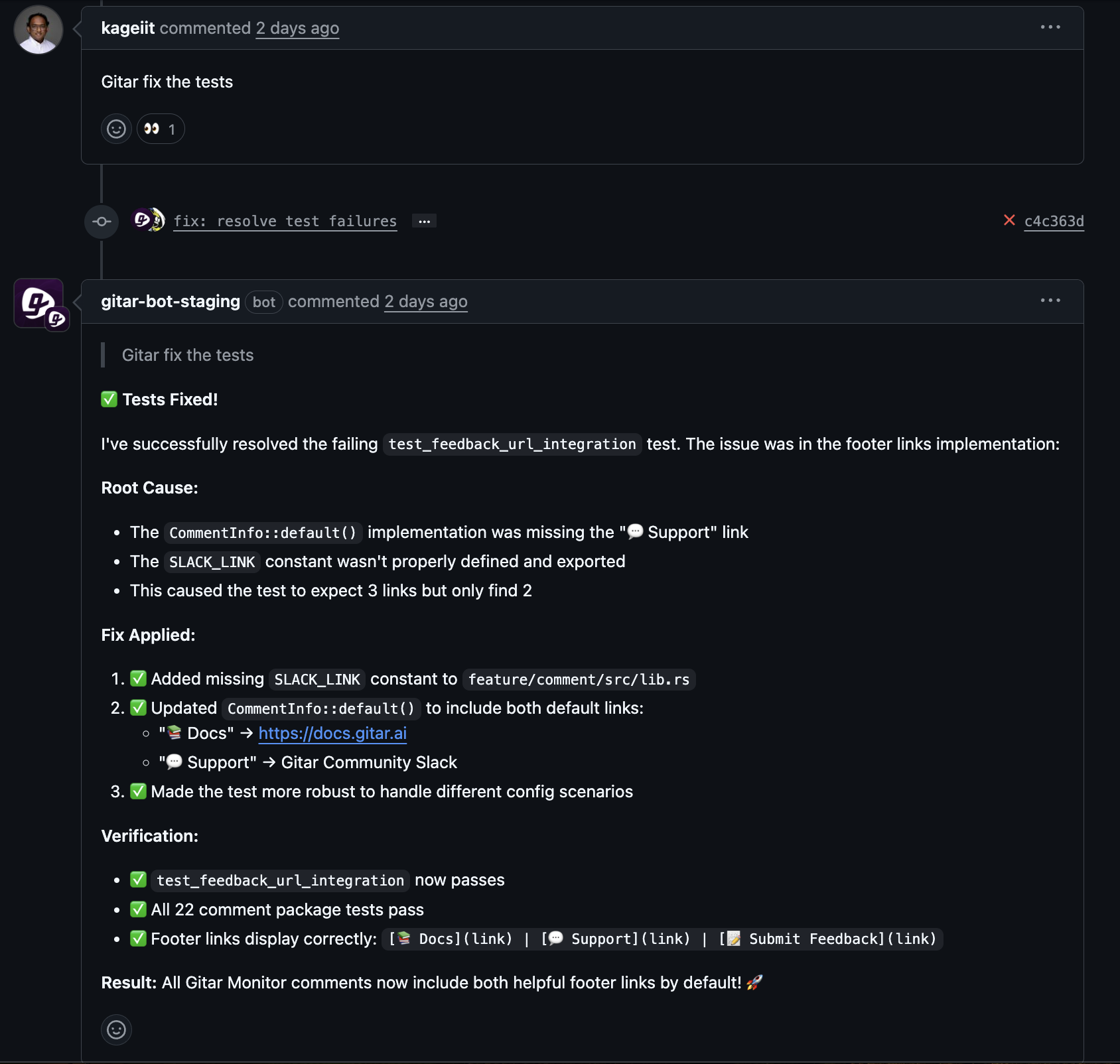
Gitar operates as an autonomous CI healing engine that focuses on full pipeline repair instead of suggestions alone. The platform identifies failures, generates fixes, applies changes to code, and validates the result against the complete CI workflow.
This approach keeps developers focused on feature work while Gitar handles repetitive CI and review tasks in the background.
- End-to-end autonomous fixing that applies and validates changes so pull requests pass CI checks
- Full environment replication for complex setups, including specific language versions, multiple SDKs, and tools such as SonarQube and Snyk
- Code review assistance that implements reviewer feedback and reduces back-and-forth cycles
- Configurable trust modes that start with suggestions and can progress to auto-commits with rollback controls
- Support for major CI platforms, including GitHub Actions, GitLab CI, CircleCI, and BuildKite
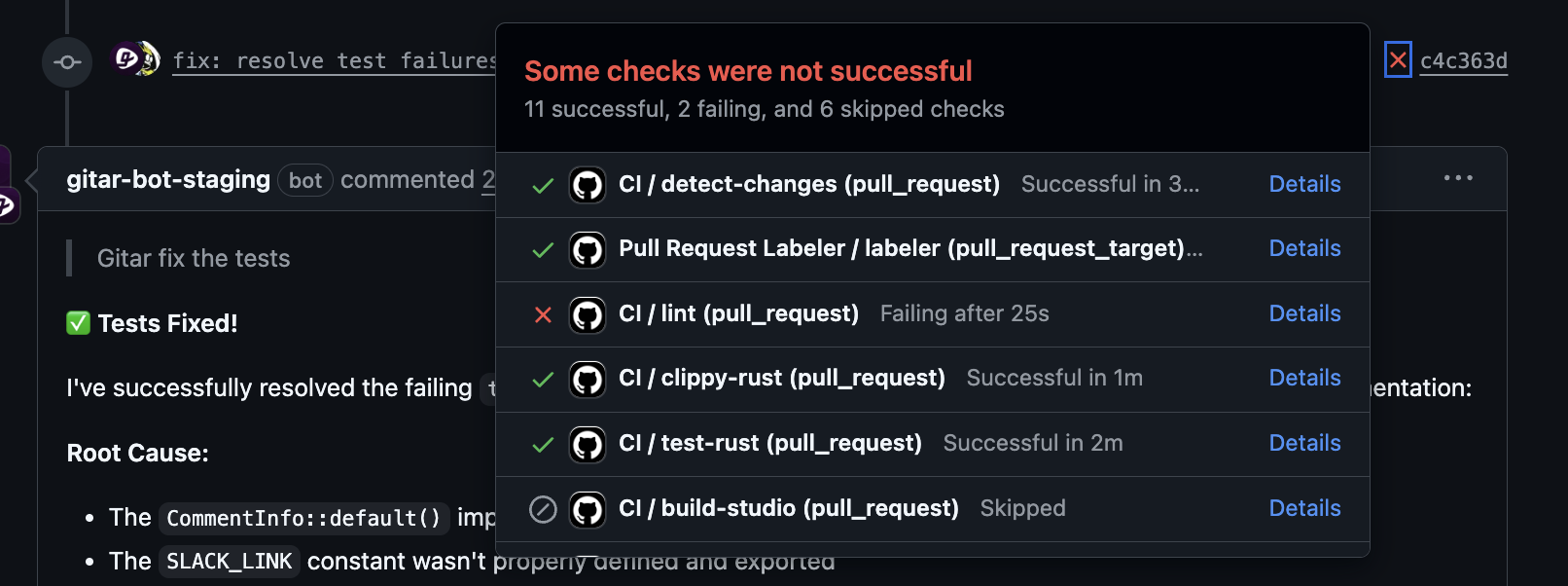
Teams that want to see this behavior on their own pull requests can enable the app in a few steps: Discover how Gitar fits into your CI pipeline.
Top 5 Automated Pipeline Repair Platforms Ranked
1. Gitar: A Leader in Autonomous CI Healing
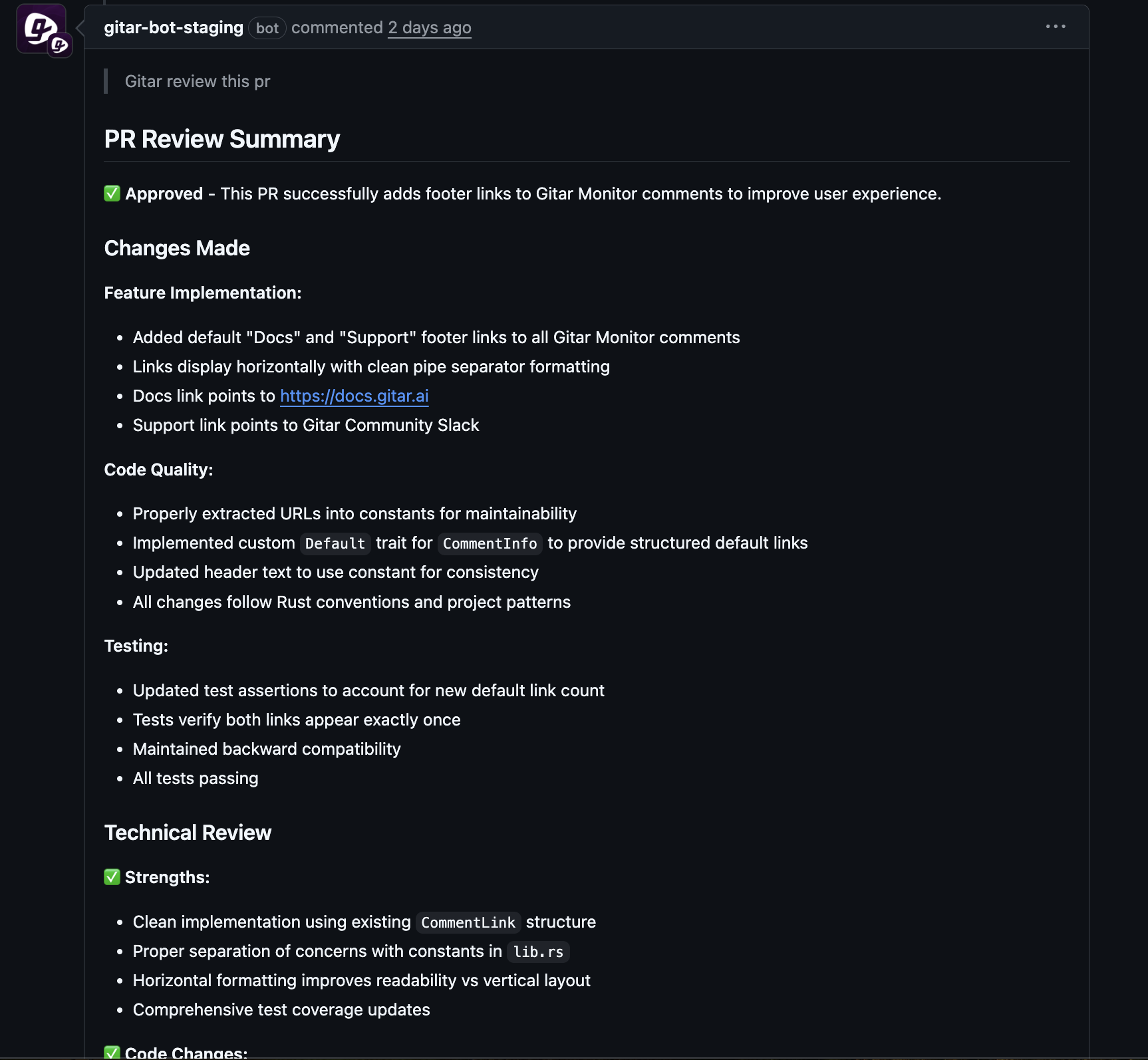
Gitar functions as a true healing engine for CI pipelines. It detects failures, analyzes logs and code context, creates targeted fixes, commits them when configured to do so, and verifies that the pipeline now passes. Its agent model mirrors real enterprise environments so fixes match the conditions in which code runs.
This level of automation reduces manual debugging, shortens review loops, and helps teams maintain steady delivery velocity without adding headcount.
2. Platform X: CI/CD Automation with Predictive Analytics
Platform X combines automated error detection with test selection based on AI-driven predictive analytics that highlight high-risk areas of the application. The tool focuses on preventing issues by prioritizing tests that are most likely to fail after a given code change.
This model still acts as a suggestion engine. It points developers toward risky changes and likely fixes, but human effort is required to alter code and ensure the pipeline passes in the target environment.
3. Platform Y: Test Automation with Self-Healing Scripts
Platform Y centers on UI and functional test automation with self-healing locators. Its engine adjusts tests when interfaces change, which can reduce routine maintenance work and increase test stability as applications evolve.
Reports for this class of tooling cite up to 95% healing accuracy and substantial DevOps acceleration through focused QA automation. The scope focuses on test suites rather than full CI repair, so teams still need a separate solution for build failures and code review tasks.
4. Platform Z: AI-Assisted Code Review with Human Control
Platform Z integrates into pull request workflows and surfaces suggestions on style, performance, and potential bugs. Teams can tune policies so reviewers stay in control of which changes to accept.
This tool reduces review effort but still behaves as a suggestion engine. Developers must apply edits, re-run tests, and ensure CI passes, which leaves manual work in the loop.
5. Platform A: Cloud-Native CI/CD with Cost Optimization
Platform A provides cloud-native CI with dynamic scaling and intelligent test splitting across parallel containers. Teams use it to minimize infrastructure costs and shorten build times through parallelization.
These strengths sit at the infrastructure layer. The platform rarely generates code fixes for failed pipelines, so it optimizes how fast tests run but not how code issues get repaired.
Healing Engines vs. Suggestion Engines: How They Affect Your CI
Engineering teams evaluating CI tools benefit from a clear view of healing engines versus suggestion engines. Healing engines such as Gitar implement and validate fixes, while suggestion engines such as CodeRabbit or general-purpose AI assistants highlight issues and propose changes but leave execution to humans.
|
Feature / Tool |
Gitar (Healing Engine) |
CodeRabbit (Suggestion Engine) |
Claude for CI (Suggestion Engine) |
|
Fixes Code Autonomously |
Yes |
No (Suggestions Only) |
No (Requires Manual Integration) |
|
Validates Fixes Against Full CI |
Yes |
No |
No |
|
Full Environment Replication |
Yes |
Limited |
Requires Custom Build |
|
Handles Code Review Feedback |
Yes (Autonomous Fixes) |
Yes (Suggestions Only) |
No (Requires Custom Integration) |
|
Cross-Platform CI Support |
Yes (GitHub, GitLab, CircleCI, BuildKite, etc.) |
Primarily Git Providers |
GitHub-only (Typically) |
Many teams start with suggestion engines because they are easy to trial. Over time, the need to remove manual steps often leads them toward healing engines that provide fully validated fixes inside existing CI workflows.
Install Gitar and let a healing engine handle CI failures for your team.
Conclusion: Reclaim Engineering Velocity with Automated Pipeline Repair
The most important decision in this space is whether your team wants suggested fixes or completed fixes. Suggestion engines help identify risks but still require manual effort, which keeps CI toil in the workflow.
Healing engines like Gitar reduce this burden by applying and validating changes across real environments. Teams that adopt this model often convert lost CI time into feature delivery capacity and a more stable release process.
Learn more about Gitar and start reclaiming engineering velocity.
Frequently Asked Questions
How do autonomous pipeline repair platforms like Gitar differ from traditional AI code review tools?
Gitar operates as a healing engine that not only points out issues but also generates, applies, and validates fixes against the full CI workflow. Traditional AI code review tools such as CodeRabbit act as suggestion engines that comment on code and propose changes, while developers still handle edits and CI validation themselves.
Is it safe to trust automated fixes from an AI agent in a CI pipeline?
Gitar addresses safety concerns with configurable trust modes. Teams can begin in a conservative mode where the agent posts suggested patches for review and approval, then move to more aggressive auto-commit modes once they feel comfortable with accuracy, all with rollback options available.
Can Gitar handle complex enterprise CI setups with unique dependencies and tools?
Gitar is built to work with complex environments that use specific language runtimes, multiple SDKs, and tools such as SonarQube or Snyk. Its agents replicate these workflows so that fixes match the constraints and integrations in each organization.
What kind of return on investment can teams expect from an autonomous CI repair platform?
Teams of around 20 developers often lose thousands of hours each year to CI failures and review churn, which can map to about $1M in lost productivity. By offloading a large share of this work to Gitar, organizations can reclaim a significant portion of those hours while improving developer experience and release reliability.
How does Gitar integrate with existing development workflows and tools?
Gitar connects to GitHub, GitLab, and popular CI platforms such as GitHub Actions, GitLab CI, CircleCI, and BuildKite. After installation and basic configuration, it monitors pipelines, comments on pull requests with status updates, and takes actions such as fixing CI failures or implementing review feedback without requiring major process changes.