
Key Takeaways
- Engineering teams in 2026 lose significant time and budget when CI pipelines fail, so build automation choices directly influence productivity and delivery speed.
- Manual CI debugging creates heavy context switching, especially for distributed teams, and often converts quick fixes into long, expensive interruptions.
- AI suggestion tools improve code review speed but still require engineers to apply and validate fixes, which limits overall ROI.
- Autonomous CI healing that can understand the environment, generate fixes, and validate builds provides the clearest path to consistent, measurable ROI from CI automation.
- Teams that want autonomous CI healing and higher developer throughput can evaluate Gitar in their own pipelines by installing Gitar and measuring its impact on broken builds.
The Challenge: The Hidden Costs of Inefficient CI Pipelines on Build Automation ROI
CI failures in 2026 still cause an expensive productivity drain. Each failed build forces developers to stop deep work, inspect logs, experiment with fixes, and wait for reruns. A fix that looks simple on paper can consume an hour or more once context loss and recovery time are included.
Distributed teams feel this even more. A developer in San Francisco who waits on review feedback from a colleague in Bangalore can see basic back-and-forth cycles stretch into several days. AI coding assistants such as GitHub Copilot speed up code creation, yet they also increase the number of pull requests, tests, and potential CI failures. The bottleneck moves from writing code to validating, fixing, and merging it.
A 20-developer team that spends one hour per day on CI and code review issues loses roughly 5,000 hours per year. At standard loaded engineering rates, that can approach one million dollars in lost productivity that never turns into new features or customer value.
Install Gitar to reduce time spent on broken builds and code review rework
Gitar: Autonomous CI Healing That Focuses on ROI
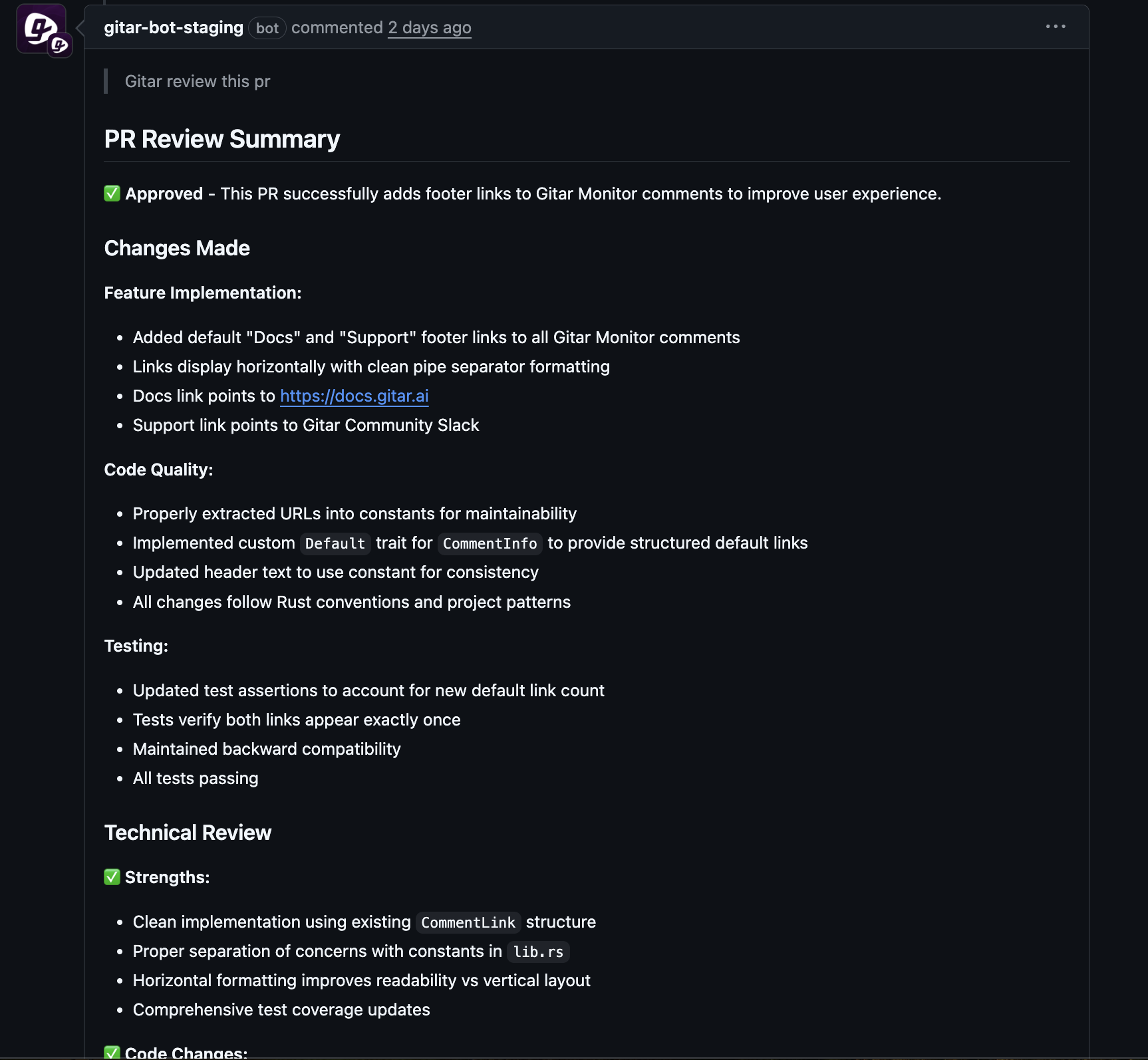
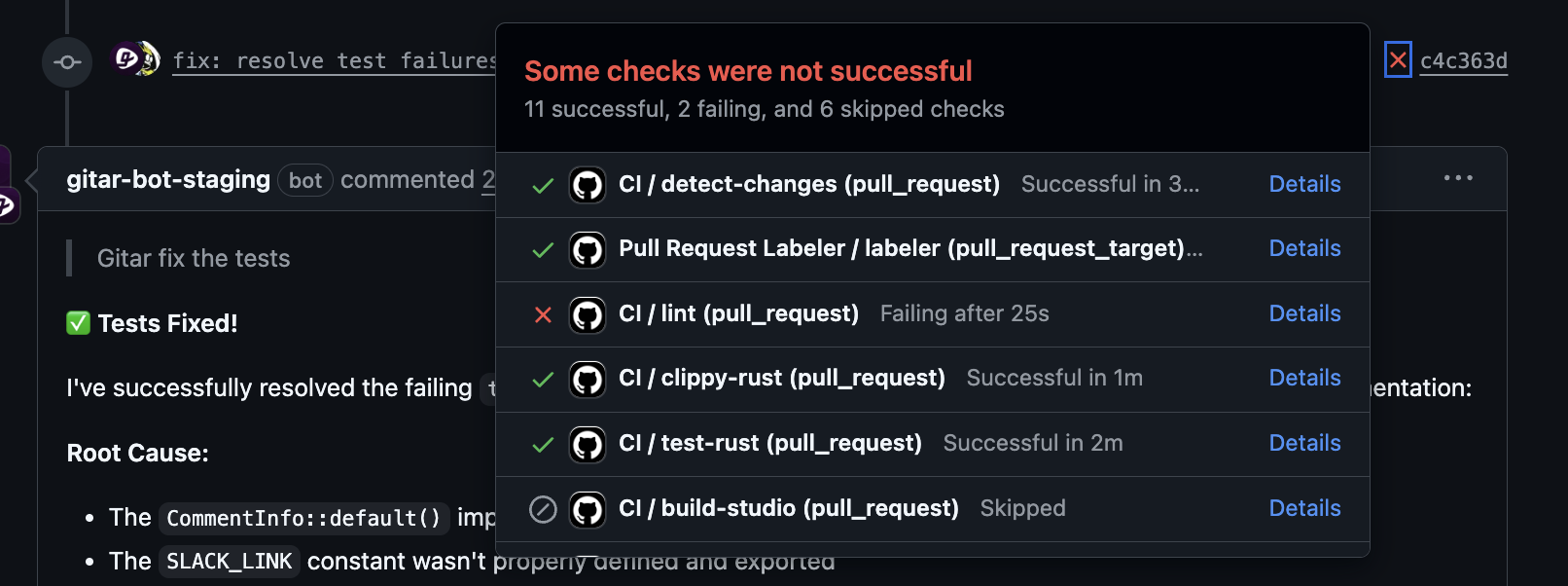
Gitar operates as an autonomous AI agent that fixes failing CI pipelines and resolves code review feedback without requiring developers to perform repetitive repair work. The system analyzes failures, generates code changes, validates them in the CI environment, and commits updates directly to pull requests.
Key capabilities that influence build automation ROI include:
- End-to-end fixes that include code changes, CI reruns, and confirmation that all jobs pass before a pull request returns to green status
- Environment replication for complex enterprise pipelines, including specific SDK or JDK versions, multi-language stacks, and tools such as SonarQube or Snyk
- Support for platforms such as GitHub Actions, GitLab CI, CircleCI, and BuildKite, so teams do not need to standardize on a single CI provider first
- A configurable trust model that ranges from suggestion-only to direct commits, which lets teams adopt autonomy at their preferred pace
- Support for distributed teams where reviewers can leave comments at the end of their day and return to updated, fixed pull requests
Request a demo of Gitar to see autonomous CI healing in your own pipeline
Head-to-Head Comparison: How Build Automation Approaches Affect ROI
Manual Processes: High Effort, Limited Return
Manual CI debugging often produces negative ROI for mature teams. Engineers must inspect logs, debug locally, adjust code, and push multiple attempts before builds pass. Each failure interrupts flow, increases frustration, and delays releases.
This approach may suit small, early projects with simple CI setups and infrequent failures. Once teams operate production systems or manage multiple services, manual handling of every failure becomes expensive and difficult to justify.
AI Suggestion Engines: Helpful Review, Partial Automation
AI suggestion engines provide summaries, inline comments, and proposed code changes during review. These tools identify issues in performance, security, or logic, which can shorten review cycles and improve code quality.
Developers still own validation and application of fixes, though. The need to interpret suggestions, modify code, and re-run tests keeps context-switching costs in place and limits overall ROI.
On-Demand AI Fixers: Targeted Help on Request
On-demand AI fixers, such as GitHub Actions that wrap large language models, can analyze repositories, run commands, and propose targeted fixes when developers invoke them. This support works well for isolated problems.
These tools usually require explicit triggers and human oversight. Teams gain value on specific issues but do not remove the continuous burden of monitoring and healing CI pipelines.
Gitar: Autonomous CI Healing for Ongoing ROI
Gitar focuses on continuous, autonomous resolution of CI failures and code review comments. The system applies fixes, re-runs jobs, and keeps detailed logs so teams can audit or roll back changes when necessary.
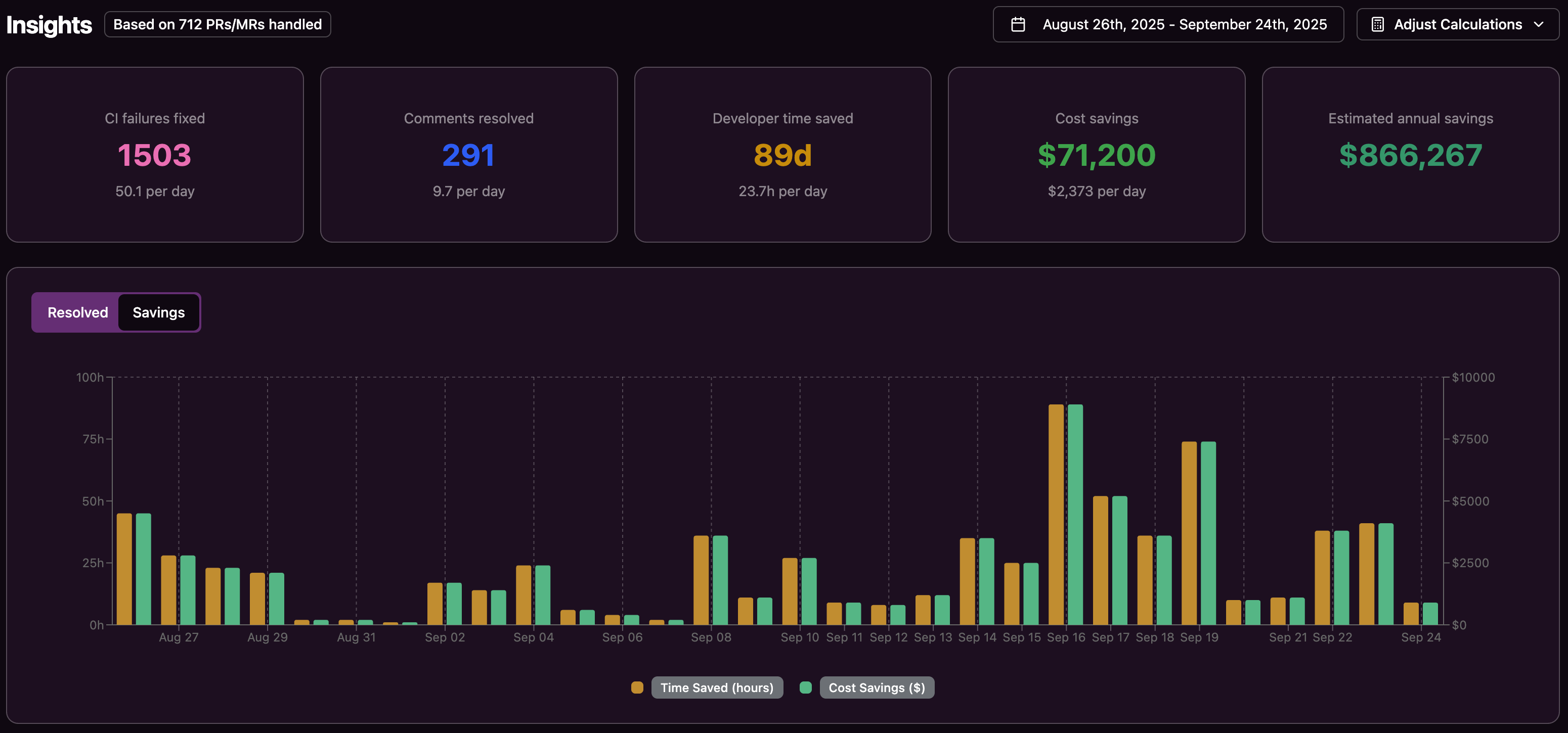
For a 20-developer team, even modest effectiveness can reclaim hundreds of hours per month. That time shows up as faster merges, shorter lead times, and less time spent on repetitive maintenance work.
Build Automation ROI Comparison Table: Manual vs AI-Driven vs Autonomous
|
Feature |
Manual Processes |
AI Suggestion Engines |
Gitar Autonomous |
|
Fix Application |
Manual implementation required |
Suggestions require manual validation |
Automatic code changes and CI validation |
|
Environmental Context |
Depends on individual developer knowledge |
Focuses on code-level analysis |
Replicates full CI environment |
|
Developer Flow Impact |
Frequent and long interruptions |
Reduced but persistent interruptions |
Minimal interruption to daily work |
|
Cross-Platform Support |
Works anywhere but requires manual effort |
Often tied to specific ecosystems |
Integrates with major CI platforms |
Calculating Build Automation ROI: Metrics and Decision Framework
Clear baseline metrics help teams evaluate build automation ROI. Useful inputs include labor hours per CI failure, lead time from pull request to merge, failure rates, and rework volume. The core ROI formula, (Net Return ÷ Investment Cost) × 100, becomes more reliable when teams capture accurate time and cost data.
Key metrics for build automation include:
- Reduction in time spent diagnosing and fixing CI failures
- Decrease in error rates and production incidents traced to CI gaps
- Improvement in deployment frequency and cycle time
- Change in developer satisfaction scores related to build and review processes
- Effort required to maintain automation compared with manual workflows
Teams that prefer incremental change may adopt AI suggestion tools first and move to higher automation over time. Teams that need faster gains in developer throughput and predictable CI health often see stronger ROI from autonomous systems that handle detection, fixing, and validation in one loop.
Install Gitar to start measuring CI time savings and build automation ROI
Frequently Asked Questions About Build Automation ROI
How does build automation improve developer productivity ROI?
Build automation reduces time spent on repetitive CI tasks. When systems handle routine failures, developers spend more hours on feature work, design, and problem solving. Less context switching also supports better focus and higher-quality output, which improves both delivery speed and morale.
What is a typical ROI range for CI automation?
CI automation often pays back within the first year as teams avoid manual debugging, shorten release cycles, and catch defects earlier in the pipeline. The exact ROI depends on team size, current failure rates, and adoption level, but even moderate reductions in CI overhead can translate into large annual savings for organizations with many engineers.
Can AI replace manual debugging in CI pipelines while maintaining positive ROI?
AI can replace a large share of manual debugging effort when it can both identify failures and implement validated fixes. Suggestion-only tools stop short of this outcome. Autonomous agents such as Gitar that analyze logs, modify code, and re-run CI jobs move closer to full replacement for common issues like lint errors, flaky or failing tests, and dependency conflicts.
How does Gitar handle complex enterprise CI environments?
Gitar mirrors enterprise CI environments by using the same language versions, dependencies, and third-party scanners that production pipelines use. This alignment reduces the risk of fixes that pass in a sandbox but fail in real CI runs. Accurate replication improves first-attempt success rates and supports stable green builds over time.
Conclusion: Using Gitar to Improve Build Automation ROI in 2026
Build automation strategy now plays a central role in engineering economics. Manual CI handling and suggestion-only AI tools reduce some friction but still rely on developers for the most time-consuming work: implementing and validating fixes.
Autonomous CI healing with Gitar addresses the full loop, from detection through resolution, inside the pipelines teams already use. The result is less time spent on broken builds, more capacity for feature delivery, and clearer, measurable ROI from CI automation investments.