
Key Takeaways
- CI failures and context switching slow engineering teams, especially when small issues turn into long feedback loops across time zones.
- AI code repair tools that act as healing engines apply and validate fixes in pipelines, which reduces manual effort compared with suggestion-only tools.
- Gitar automates CI fixes end to end, replicates real environments, follows configurable trust settings, and acts on code review comments directly.
- A phased rollout of AI code repair, combined with clear KPIs like time-to-merge and CI failure rate, helps teams realize measurable ROI and build trust.
- Teams that want to reduce CI toil and improve developer focus can try Gitar by visiting Gitar’s installation and onboarding page.
The Developer Productivity Crisis: Why Manual CI/CD Falls Short
Modern engineering teams often ship code into pipelines that fail on small issues like missing dependencies, flaky unit tests, or linter complaints. Each failure forces developers to stop what they are doing, read logs, recreate the issue locally, fix it, push again, and then wait for another CI run.
This pattern does more than consume minutes on a clock. It breaks concentration and makes deep work difficult. A simple CI fix that takes 10 minutes of hands-on work can easily cost an hour of productive time once task switching and waiting are included. Distributed teams feel this more acutely, since a pull request that spans several time zones can stretch a minor fix into a multi-day delay.
Generative coding tools such as GitHub Copilot and Cursor increase code output and pull request volume. More code means more tests and more CI runs, which amplifies the impact of failures unless pipelines gain their own automation layer.
How Gitar Automates CI Fixes and Code Review Feedback
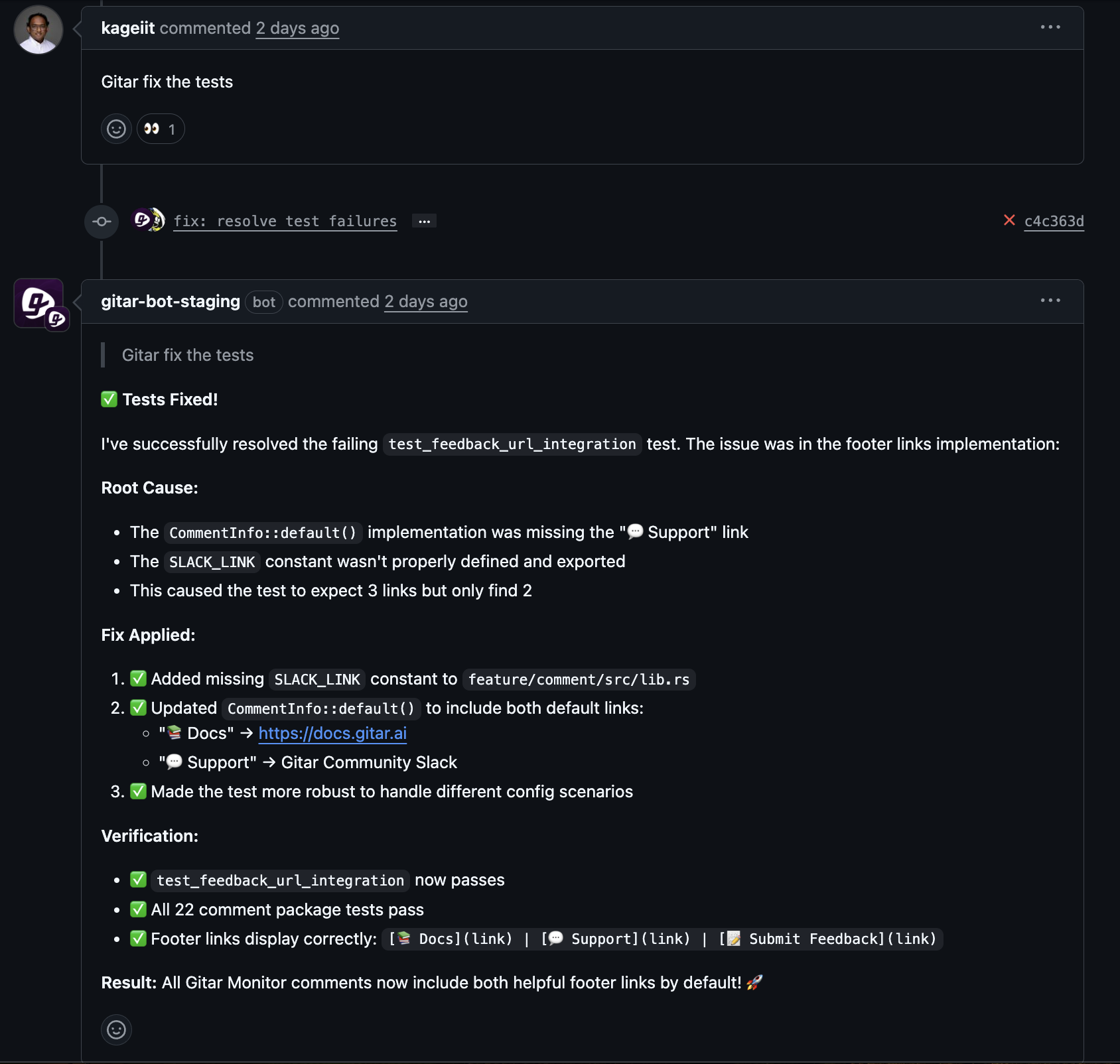
Gitar is an autonomous AI agent that focuses on fixing failing CI pipelines and implementing code review feedback. It behaves as a healing engine that not only suggests changes but also applies and validates them inside your existing CI workflows.
Key capabilities include:
- End-to-end CI fixing: Gitar applies code changes, triggers checks when needed, and ensures all CI jobs pass before a pull request is ready to merge.
- Environment-aware execution: The agent can respect specific JDK versions, SDK combinations, third-party scanners such as SonarQube or Snyk, and snapshot tests so fixes align with real production constraints.
- Configurable trust levels: Teams can start with conservative modes that require human approval, then move toward auto-commit with safeguards as confidence grows.
- Actionable code review assistant: Reviewers can leave comments that instruct Gitar to make edits, refactors, or cleanups, which shortens review cycles for distributed teams.
- Cross-platform CI support: Gitar works with GitHub Actions, GitLab CI, CircleCI, BuildKite, and other common CI systems.
AI Code Repair for Pipelines: From Suggestions to Automated Healing
Why Autonomous AI Code Repair Matters
AI code repair for pipelines shifts work from passive suggestions to active remediation. Suggestion tools still require developers to interpret outputs, modify code, and wait for validation. Healing engines act directly in the repository and pipeline, closing the loop from diagnosis to verified fix.
The core ingredients of an effective healing engine are an agent that understands the codebase and environment, a planning layer that can design likely fixes, and a validation loop that runs CI and inspects results. When these parts work together inside existing CI systems, teams remove a large portion of routine pipeline maintenance.
Market Context and Business Impact
Engineering teams can lose close to a third of their time on CI failures and code review churn. As AI-assisted coding speeds up feature development, review and pipeline time become the limiting factors. Self-healing CI helps restore balance by reducing time lost to repetitive break and fix cycles.
For a team of 20 developers that spends an hour each workday dealing with CI or review issues, the total comes to about 5,000 hours per year. At a loaded rate of 200 dollars per hour, this represents roughly 1 million dollars in lost productivity.
Strategic Considerations and ROI
Engineering leaders should treat autonomous AI code repair as a build-versus-buy decision. Internal experimentation can work for narrow problems, but full coverage across pipelines often requires dedicated infrastructure, prompt management, and ongoing maintenance.
Clear success metrics help guide the rollout. Useful measures include:
- Average time-to-merge for key repositories
- Percentage of pipelines that pass on first run
- Number of manual CI fix commits per week
- Developer sentiment scores related to build and review friction
Comparing Gitar to Other AI Code Repair Approaches
The AI Code Repair Landscape
The current ecosystem ranges from manual fixes, to suggestion engines such as AI reviewers, to autonomous healing engines. Most tools today sit in the suggestion tier, where they highlight issues or propose patches but still rely on humans to integrate and validate changes.
How Gitar Addresses the Last Mile of CI Fixes
Gitar focuses on the last mile of CI by operating as a full agent in your repositories. Competitors that specialize in review summaries or inline comments provide useful insights, yet they typically stop short of applying and verifying fixes across full pipelines. Gitar closes that gap by committing changes, running checks, and reporting back on status.
Comparison Table: Manual Work, Suggestions, and Gitar
|
Feature |
Manual Work |
Suggestion Engines |
Gitar |
|
Fixes implemented |
Manual edits in local environment |
Developer applies suggested patches |
Automated edits with CI validation |
|
Autonomy level |
None |
Guidance only |
Agent that plans, edits, and validates |
|
Environment context |
Developer knowledge |
Limited file or diff scope |
Awareness of full project and CI setup |
|
CI system coverage |
Not applicable |
Often limited to a single platform |
Support for GitHub, GitLab, CircleCI, BuildKite, and others |
Avoiding Common Implementation Pitfalls
Teams sometimes underestimate the integration effort of do-it-yourself setups based on general-purpose models. Prompt engineering, log routing, and context management across many repositories can consume significant engineering capacity. Platforms that ship with CI and code host integrations reduce this ongoing overhead and keep teams focused on product work.
Putting AI Code Repair to Work in Your Workflow
Assessing Readiness for Autonomous CI Fixes
Organizations can start by mapping where time currently goes in their delivery process. High pull request volume, frequent flaky tests, or long queues for senior review are indicators that automated repair may provide strong value. A clear policy on where automation is allowed and where human review remains mandatory helps set expectations.
Phase 1: Install Gitar and Establish Guardrails
Initial setup involves installing Gitar as a GitHub App on selected repositories and configuring scopes in a web dashboard. Most teams begin with conservative modes where Gitar proposes changes or opens pull requests that still require human approval before merge.
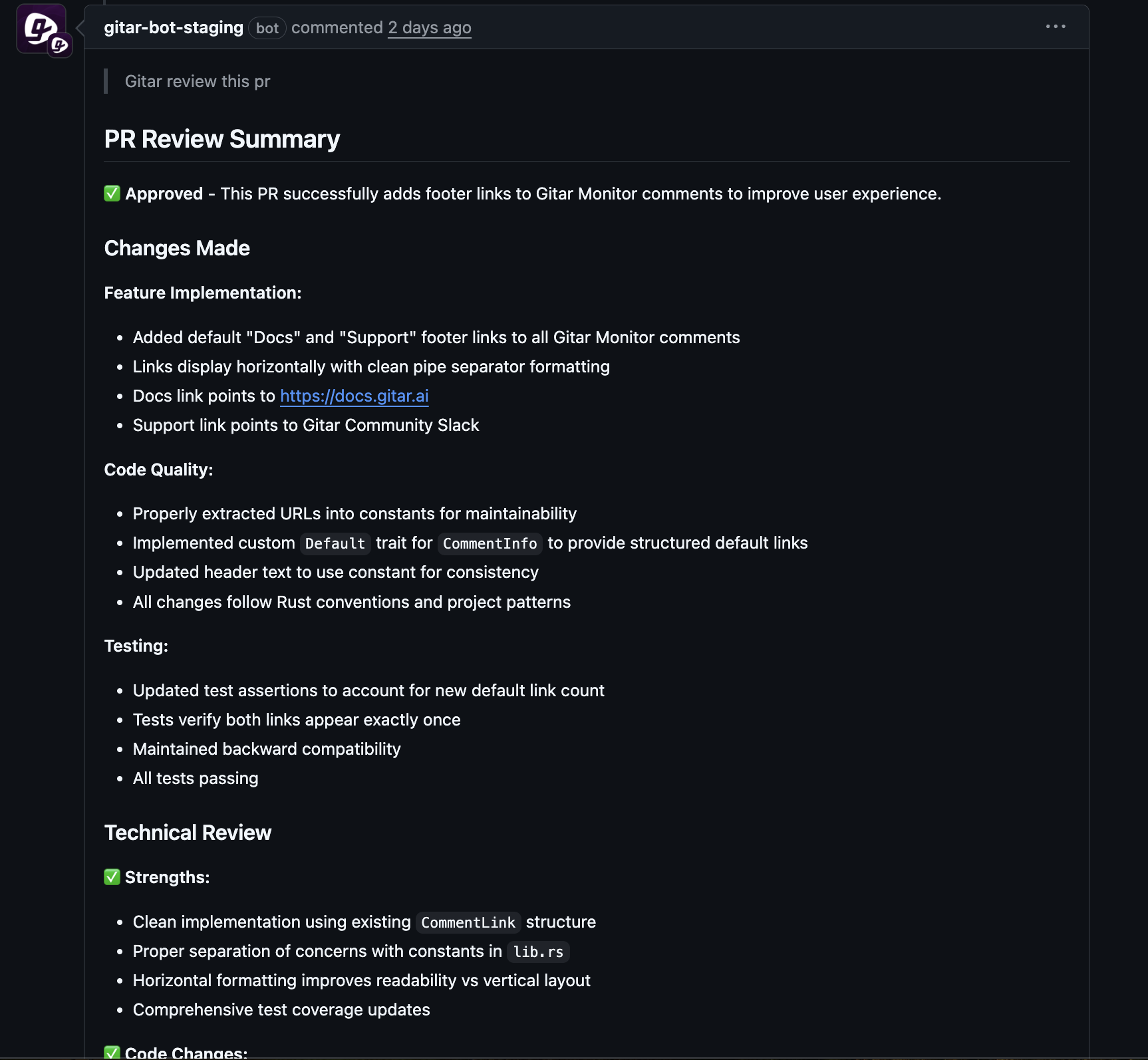
This phase allows teams to inspect diffs, confirm that fixes are safe, and tune configuration such as which branches or repositories Gitar may modify.
Phase 2: Build Trust Through Repeated Successful Fixes
Trust grows as developers see Gitar resolve routine failures such as lint issues, missing imports, or snapshot mismatches before they even return to a pull request. After enough small and accurate fixes, many teams enable auto-commit for certain repositories or failure types.
Phase 3: Expand to Advanced Review and Refactor Workflows
More mature deployments use Gitar as a partner in code review. A reviewer can write a comment such as “Gitar, refactor this function to remove duplication and use a helper” and then let the agent implement the change. This pattern is especially helpful for distributed teams, since reviewers can leave instructions at the end of their day and developers can arrive to completed fixes.
Estimating ROI for AI Code Repair
A 20 person engineering team that saves even half of the 5,000 annual hours lost to CI and review churn recovers about 2,500 hours of capacity. At 200 dollars per hour, that is roughly 500,000 dollars in yearly value, in addition to improvements in developer morale and delivery consistency. Gitar helps teams capture this value by turning CI from a manual bottleneck into a mostly automated system.
Key Questions About AI Code Repair for Pipelines
How Gitar Differs From AI Reviewers
Many AI reviewers produce comments, suggestions, or summaries that still require developers to make changes and rerun CI. Gitar instead applies the changes directly in the repository, runs the relevant checks, and updates the pull request once the pipeline passes. This approach shifts AI from advisory support to hands-on CI repair.
How Gitar Handles Trust, Security, and Complex Environments
Gitar supports modes that range from suggestion only to full auto-commit, which allows teams to align automation with their risk tolerance. For organizations with strict security or compliance needs, Gitar can run in controlled environments and emulate full enterprise stacks, including specific dependencies, SDK versions, and tools such as SonarQube or Snyk.
Types of CI Failures Gitar Can Fix
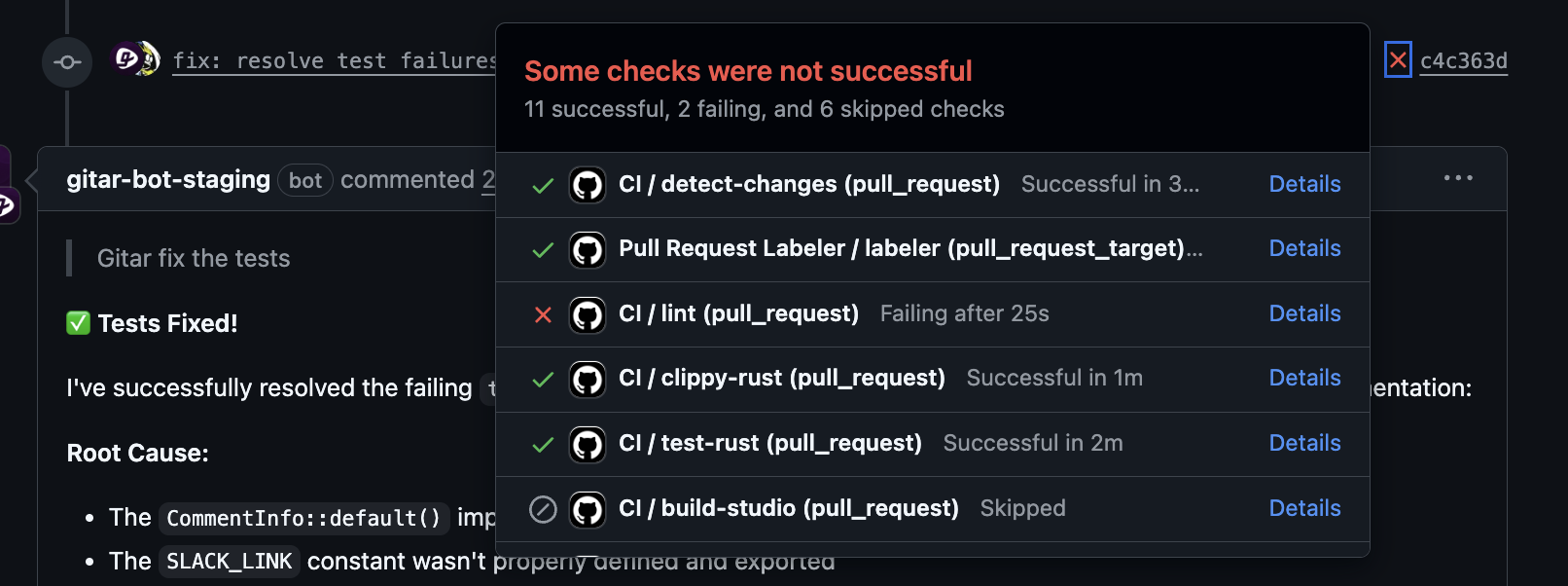
Gitar can address many recurring CI issues, including lint and formatting errors, straightforward test failures such as outdated snapshots or simple assertions, and build problems related to configuration or dependency mismatches. The agent reads logs, plans a fix, edits code or configuration, and then commits the change back to the pull request branch.
Conclusion: Make CI an Asset With Autonomous AI Code Repair
Manual CI troubleshooting and slow review loops no longer match the pace of modern software delivery. AI code repair for pipelines gives engineering teams a way to keep quality high while reducing repetitive work and context switching.
Gitar delivers this capability by acting as an environment-aware agent inside your repositories and CI systems. With a gradual rollout, clear guardrails, and defined metrics, teams can turn pipelines into self-healing systems that support deep work instead of interrupting it.