
Key Takeaways
- Engineering leaders in 2026 need to evaluate deployment automation platforms based on clear ROI, not only on feature lists.
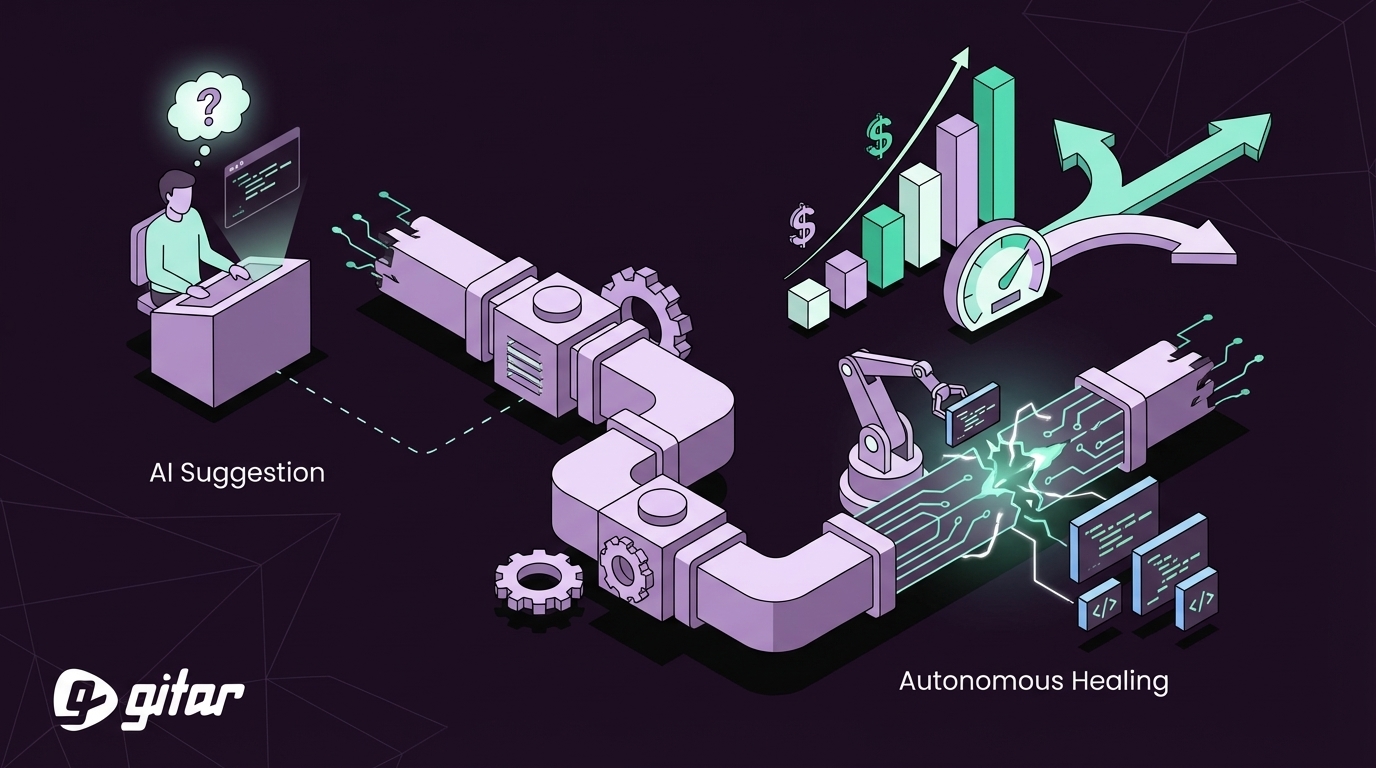
- AI suggestion tools improve issue detection but still rely on manual fixes, which keeps context switching and CI delays in place.
- Autonomous CI healing engines reduce CI toil, protect developer focus, and support complex environments at scale.
- Tracking DevOps metrics, financial impact, and developer experience provides a complete view of automation ROI.
- Teams can use Gitar to automatically fix failing builds and resolve review feedback to reclaim developer time and ship faster, install Gitar.
Evaluate Deployment Automation Platforms for ROI in 2026
Deployment automation choices in 2026 have direct impact on productivity, costs, and time-to-market. Customer support automation through AI achieves 30–50% reduction in support ticket volume, and similar efficiency ranges apply when teams automate CI and CD workflows.
Many engineering teams lose up to 30% of developer time to CI failures and code review cycles. For a 20-developer team, that loss can reach about $1 million per year in wasted productivity. This pattern represents a structural drain on delivery capacity that slows feature releases and increases operating costs.
Context switching drives much of this waste. When a pipeline fails, a developer must pause current work, inspect logs, test fixes, and wait for another CI run. A fix that takes minutes to code may take an hour of elapsed time and attention. Distributed teams feel this even more, since time zones extend review cycles into multi-day delays.
Return on investment for deployment automation should reflect both cost savings and competitive impact. A platform that cuts developer toil and shortens merge times reduces direct expenses and also raises engineering velocity and morale.
Key ROI Metrics and Cost Framework for Automation
Effective ROI analysis for deployment automation starts with a clear financial model. A standard ROI formula often shows about 240% ROI when automation is measured across several dimensions, which provides a useful benchmark for new initiatives.
Hard metrics form the quantitative base of this model:
- Teams adopting MLOps often cut manual deploys by about 70% and reduce mean time to recovery from days to hours, which translates into direct operational savings.
- Deployment frequency, lead time for changes, mean time to recovery, and change failure rate closely track productivity and reliability gains from automation.
Soft metrics describe the strategic and human side of ROI. Developer satisfaction, burnout levels, team velocity, and product responsiveness influence long-term value but can be harder to quantify. These factors often determine whether automation benefits persist as systems and teams grow.
Total cost of ownership also matters. Licensing is only one part of the picture. Implementation, integration work, maintenance, and change management all affect ROI. Training time and productivity dips during transition often show up as hidden costs that need to be included in the business case.
Compare AI Suggestion Tools and Autonomous CI Healing Engines
AI suggestion tools provide guidance but keep manual effort in the loop
Many teams use AI suggestion tools such as specialized review platforms or general-purpose code reasoning models. These tools flag possible issues, highlight code quality problems, and propose fixes as recommendations. Early feedback can reduce some errors before they reach production.
Limitations appear when teams look at end-to-end workflows. Suggestion tools usually require developers to review, adjust, and apply each change, then wait for CI to validate it. The manual steps preserve context switching and delay, even if detection becomes faster.
Another constraint is limited validation. Some tools suggest changes without running the full CI pipeline, which leaves uncertainty about whether the recommendation will actually fix the failure or introduce new ones.
Autonomous CI healing engines close the loop with end-to-end fixing
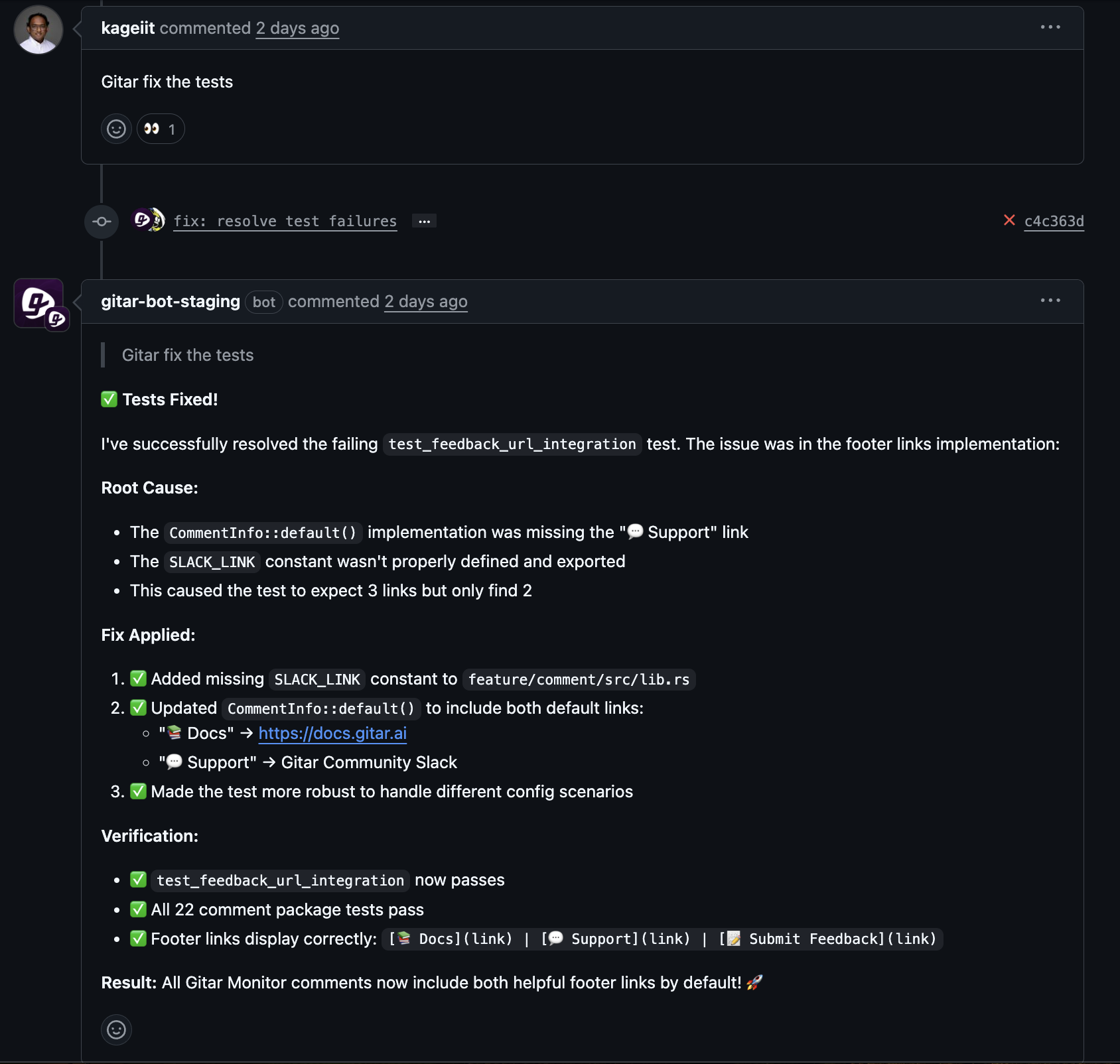
Autonomous CI healing engines move from suggestion to execution. These systems detect failures, diagnose the root cause, generate a fix, apply it, and validate it through CI without human intervention. Gitar follows this model and aims to present pull requests that already have green builds.
Key strengths of healing engines include:
- Automated fixes that run through the full CI pipeline before reaching reviewers
- Removal of repetitive CI debugging and related context switching for common issues
- Context-aware changes that respect real enterprise environments and dependencies
- Support for multiple CI platforms so teams can standardize automation across tools
|
Feature or capability |
AI suggestion tools |
Healing engine (Gitar) |
|
Primary function |
Identify problems and suggest fixes |
Detect, implement, and validate fixes |
|
Automation level |
Semi-automated with manual steps |
Autonomous with configurable trust controls |
|
Fix validation |
Often limited or partial |
Full CI pipeline validation |
|
Developer impact |
Context switching usually remains |
CI failure handling shifts away from developers |
ROI Impact: Cost, Speed, and Scalability
Cost savings and efficiency gains from autonomous healing
ROI benchmarks for automation often target reductions in processing time and errors. Deployment automation initiatives commonly aim for 25–40% cuts in processing time and 20–30% reductions in errors.
Suggestion tools contribute by shortening investigation time, yet they leave manual implementation and validation in place. Productivity gains stay modest when developers still need to stop their work, review suggestions, and shepherd each fix through CI.
Healing engines such as Gitar reduce entire categories of manual work. For a 20-developer team where each person spends about an hour per day on CI and code review issues, automation can recover hundreds of thousands of dollars per year in productive capacity while also improving developer satisfaction. Install Gitar to automatically fix broken builds and ship higher quality software faster.
Developer focus and speed-to-market
Developer flow requires uninterrupted attention. Suggestion tools may shorten some tasks but still interrupt work, since developers remain responsible for implementing and validating fixes.
Autonomous CI healing keeps developers focused on feature work. When a pipeline fails, the system handles triage and correction, then re-runs CI. Developers can stay in deep work and simply review completed, green pull requests. This pattern shortens merge times and reduces the cognitive load that contributes to burnout.
Faster merges and fewer bottlenecks speed up the entire delivery pipeline. Over time, this raises release frequency and helps teams respond more quickly to customer needs.
Scalability and long-term maintainability
Long-term ROI depends on how well a solution scales with team size and system complexity. Suggestion tools usually add more alerts and recommendations as codebases grow, which increases review effort and oversight demands.
Healing engines like Gitar aim for the opposite effect. As pipelines, checks, and dependencies grow, the automation layer handles more of the routine failure modes. That shift supports larger teams and more services without a matching rise in manual CI maintenance.
Gitar: Autonomous CI Healing for Practical ROI
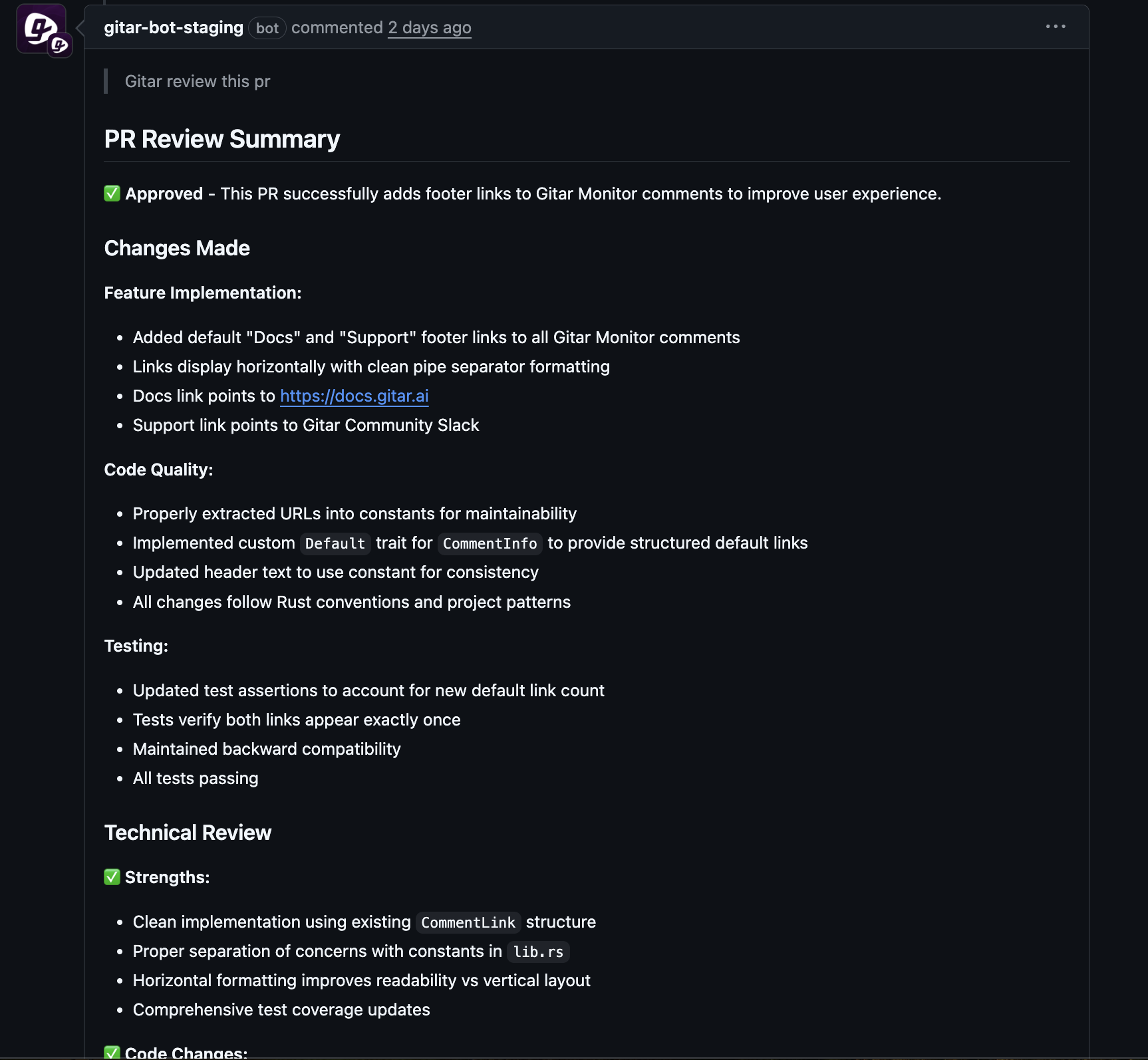
Gitar focuses on a specific pain point for developers in 2026: time lost to failing CI runs and repetitive review feedback. The product uses an autonomous agent that fixes CI failures and addresses review comments, then validates those changes through the full pipeline.
Core capabilities that differentiate Gitar
End-to-end fixing sets Gitar apart from suggestion-based tools. It generates code changes, applies them, and runs the full CI workflow before surfacing results to the team.
Full environment replication supports realistic fixes. Gitar emulates the actual build context, including SDK versions, multi-SDK configurations, and tools such as SonarQube and Snyk, so changes align with the real production path.
A configurable trust model lets teams choose how aggressive automation should be. Teams can start with a suggestion-style mode that proposes commits for quick approval. As confidence grows, they can shift to auto-commit modes with rollback options for safety.
Cross-platform support allows adoption without a full tooling change. Gitar integrates with GitHub Actions, GitLab CI, CircleCI, Buildkite, and other CI systems so teams can extend automation across their existing ecosystem.
Quantifying Gitar ROI for typical teams
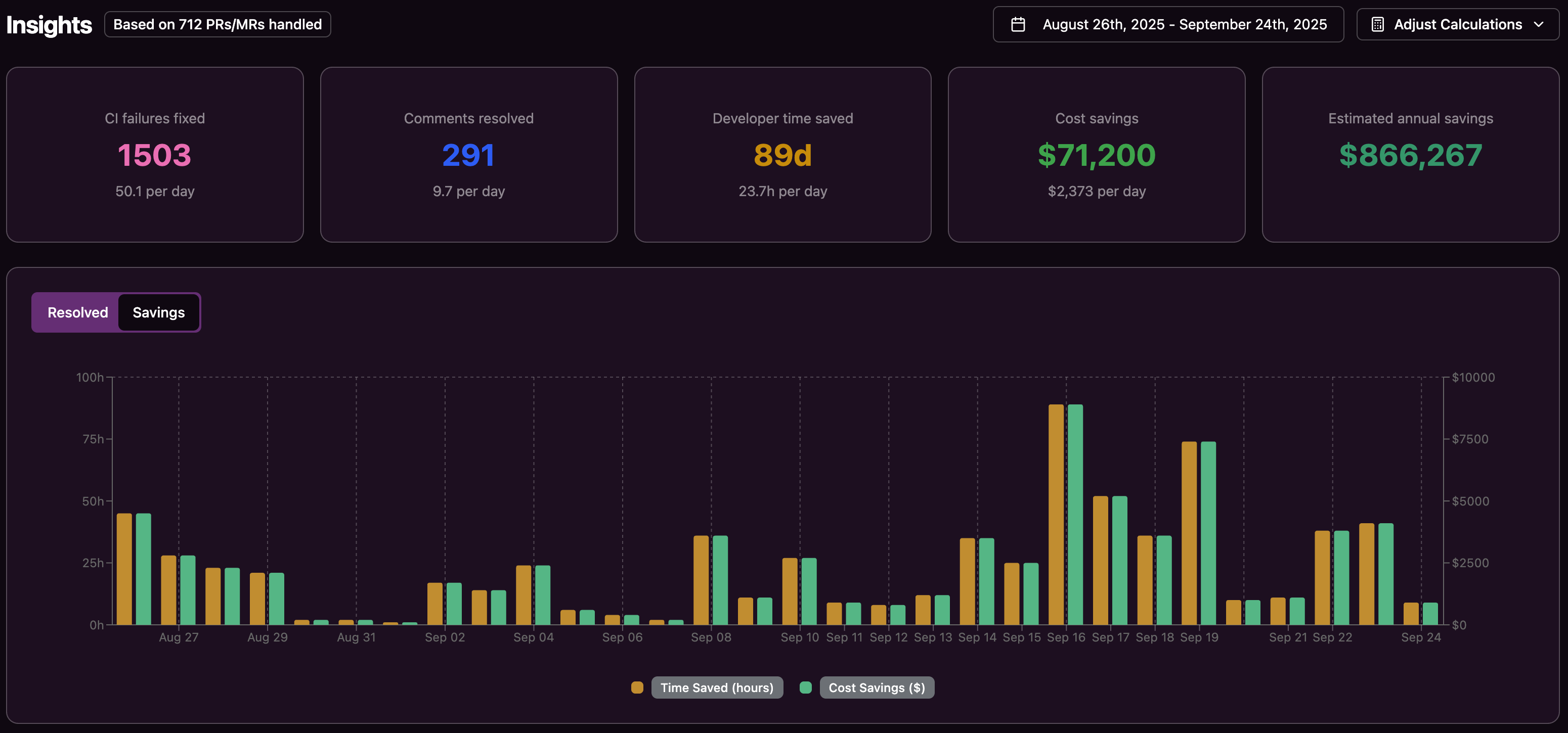
A 20-developer team that spends about one hour per developer per day on CI and review issues incurs roughly $1 million per year in productivity losses. If Gitar cuts that time in half, the recovered value approaches $500,000 per year, even before considering secondary effects like better retention or faster releases.
The business impact reaches beyond hours saved. Shorter feedback loops, fewer failed builds, and more predictable pipelines support higher delivery velocity and more stable schedules. Install Gitar to reduce CI debugging work and restore developer focus.
Implementation Considerations and Common Questions
Benefits of CI healing engines when a team already uses AI suggestion tools
Teams that already use AI suggestion tools often still experience frequent context switching and delayed merges. A CI healing engine like Gitar shifts effort from manual review and implementation toward automated detection, fixing, and validation. Suggestion tools can reduce investigation time, but healing engines reduce whole categories of manual work and related interruptions.
How Gitar manages security and trust for automated code changes
Gitar uses a configurable aggression model to control automation levels. Teams can begin with conservative settings that post fixes as suggestions for quick human approval. Over time, they can move to more automated modes where Gitar commits changes directly, while preserving full visibility and rollback options.
How complex CI environments fit into Gitar’s model
Gitar is designed for complex enterprise CI setups. The platform replicates build environments, honors language and SDK combinations, and runs third-party scans so that fixes are tested in conditions that match production paths.
Key DevOps metrics to track after adopting Gitar
Useful metrics include lead time for changes, deployment frequency, mean time to recovery, and change failure rate. Teams can also track hours spent on CI debugging and review rework, context-switching incidents, and internal satisfaction scores to capture the full ROI picture.
Conclusion: Use Autonomous CI to Unlock Deployment Automation ROI
AI suggestion tools and CI healing engines solve different parts of the deployment problem. Suggestion tools improve detection and guidance. Autonomous CI healing engines such as Gitar focus on execution, validation, and removal of manual toil.
Teams that want higher ROI from deployment automation in 2026 benefit from solutions that not only highlight issues but also resolve them automatically. That shift reduces CI bottlenecks, raises throughput, and frees developers to spend more time on product work.
Gitar offers a practical path to this outcome through an autonomous healing engine that scales with organizational complexity while keeping teams in control of changes. Request a demo with Gitar to see how autonomous CI healing can improve your deployment automation ROI.