
Key Takeaways
- Developers can lose up to 30% of their time on CI/CD issues such as debugging pipeline failures and addressing code review feedback, which slows delivery and reduces engineering capacity.
- Common CI/CD failures include test failures, build misconfigurations, dependency problems, flaky tests, and intermittent errors, with pre-merge checks failing more often than post-merge checks, and environment inconsistency across dev, staging, and production increases flakiness and makes issues harder to reproduce.
- A 20-developer team can lose up to $1M in annual productivity to repeated debugging, failed builds, and context switching, especially in distributed organizations.
- Autonomous AI agents can detect, fix, and validate CI/CD failures, apply code review feedback, and keep PRs moving without constant manual intervention, which reduces context switching and review lag.
- Teams can use Gitar for automated PR updates and fixes to keep builds green, resolve review comments, and reclaim developer time; try Gitar to automatically fix broken builds and streamline CI/CD.
The Escalating Problem: Manual CI/CD Fixes & Developer Toil
The CI/CD Gauntlet and Context Switching Tax on Developers
Modern development velocity often stalls at the CI and review stages. Developers can lose up to 30% of their time on CI/CD issues such as debugging pipeline failures and addressing code review feedback, which drains engineering capacity that could go into feature work.
Frequent CI/CD failures include test failures, build misconfigurations, dependency conflicts, flaky tests, and intermittent errors, with pre-merge checks failing more often than post-merge checks. Each failure pulls developers out of their flow to read logs, trace root causes, and try fixes that may not hold. Inconsistent environments between development, staging, and production also create flaky tests and deployment failures, so changes that work locally can still fail in CI and require lengthy investigation.
Business Impact: Reduced Velocity, Burnout, and Financial Losses
These CI/CD bottlenecks add up to real financial impact. A 20-developer team can lose as much as $1M per year in productivity from repeated debugging, failed builds, and context switching, even before factoring in slower feature delivery and missed opportunities.
Distributed teams feel this even more. A PR opened in San Francisco and reviewed in Bangalore can sit idle for full days as reviewers leave comments, wait for changes, and run CI again. Simple issues stretch into multi-day cycles, slowing project timelines and increasing frustration across the team.
The Solution: Autonomous AI Agents for Self-Healing CI/CD Pipelines
Autonomous AI agents shift CI/CD from manual, reactive work to self-healing systems that diagnose and resolve issues without constant human involvement. These agents monitor runs, analyze failures, and apply targeted fixes so developers can stay focused on building features.
This approach moves beyond suggestion-only tools. Suggestion engines rely on developers to apply recommendations and re-run CI, which still consumes time and attention. Healing engines detect the problem, implement a fix, re-run affected checks, and only surface results once the pipeline is green or a deeper issue needs attention.
Effective agents operate with environment awareness. They account for specific SDK versions, dependency graphs, and third-party scanners so that proposed fixes work reliably in the actual CI environment rather than only in theory.
Install Gitar to introduce autonomous fixing into your PR and CI/CD workflows.
Introducing Gitar: Your Autonomous AI Agent for Automated PR Updates and Fixes
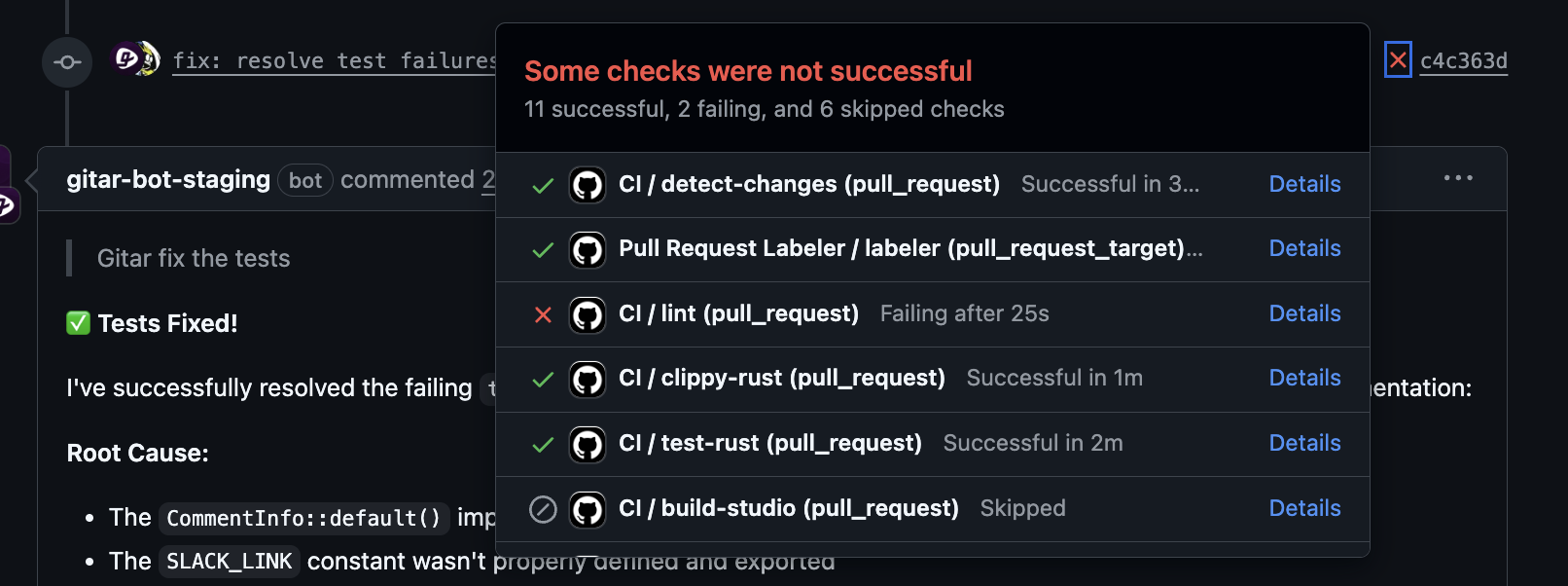
Gitar is an autonomous AI agent that detects, fixes, and validates CI/CD issues while also updating pull requests based on review feedback. It acts as a healing layer on top of existing CI tools rather than a suggestion-only assistant.
- End-to-end automated fixing: Gitar applies fixes, runs the relevant CI workflows, and ensures jobs pass before surfacing a green pull request.
- Environment-aware execution: Gitar emulates complex enterprise setups, including specific JDK versions, multi-SDK builds, and third-party scans such as SonarQube and Snyk, so fixes match the real pipeline.
- Actionable code review support: Gitar can implement changes requested in review comments, push commits, and summarize what changed directly on the PR.
- Configurable trust levels: Teams can start in suggestion mode, where Gitar proposes changes for review, and later move to auto-commit with rollback options when they are comfortable.
- Cross-platform support: Gitar integrates with GitHub Actions, GitLab CI, CircleCI, BuildKite, and other popular CI platforms.
Book a demo to see automated PR updates and fixes with Gitar in your own workflows.
How Automated PR Updates and Fixes Transform Development Workflows
Restoring Developer Flow State and Reducing Toil
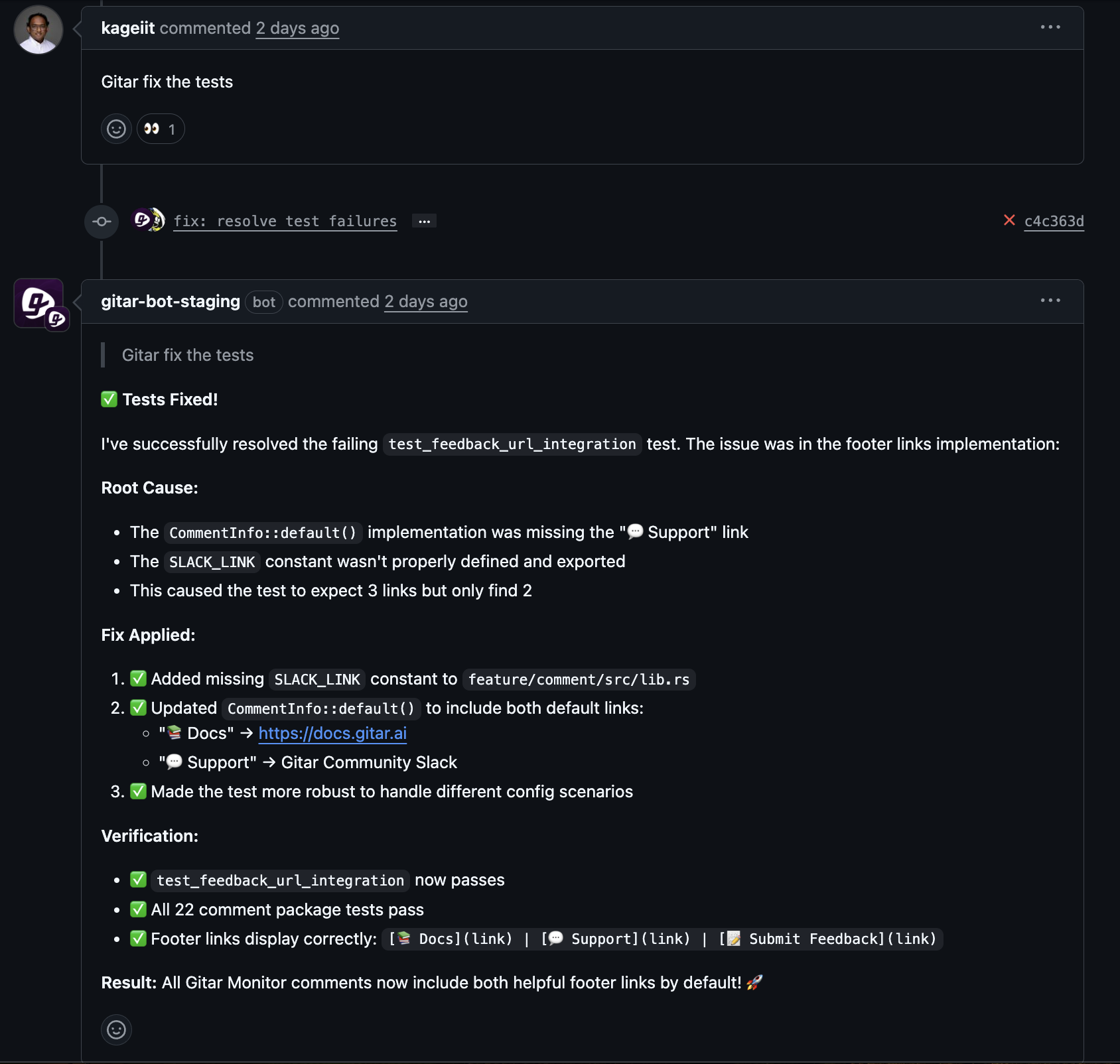
Automated PR fixes allow developers to stay in a focused flow state instead of bouncing between feature work and CI failures. Engineers submit pull requests knowing that routine issues such as flaky tests or minor style violations can be handled in the background, which reduces context switching and lowers burnout.
Accelerating Time to Production and Lowering Operational Costs
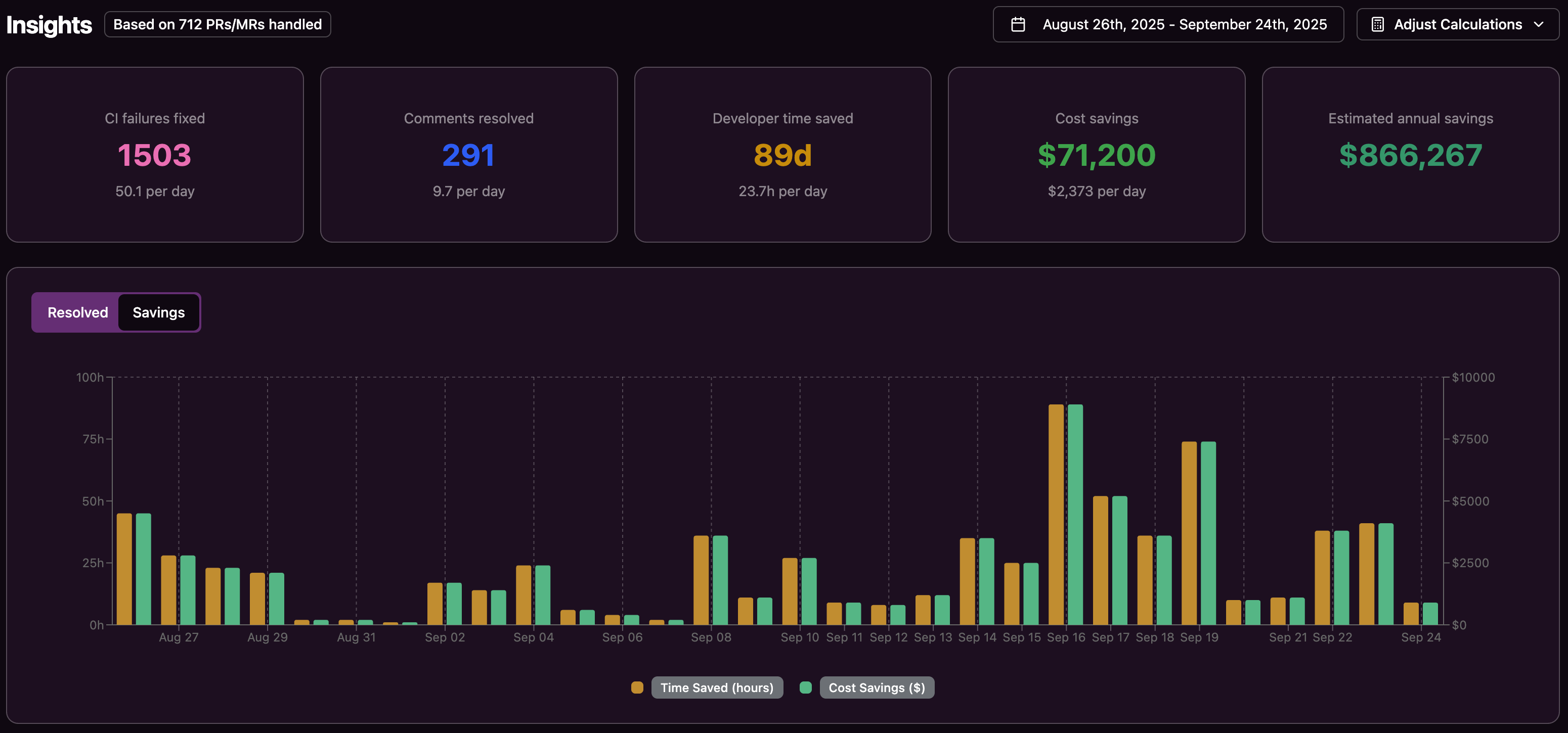
Key CI/CD health metrics include build duration, failure rate, deployment frequency, and lead time for changes, and autonomous fixing helps improve each of them. For a 20-developer team, reclaimed time from fewer failed runs and faster fixes can reach $1M per year in productivity at full effectiveness, with half that impact still representing roughly $500K in savings.
Enhancing CI/CD Pipeline Reliability
Consistent autonomous fixing keeps pipelines green and reduces the risk of broken main branches. Teams gain confidence to ship more frequent releases when they see issues resolved quickly and predictably instead of piling up as technical debt.
Bridging Time Zones for Distributed Teams
Automated PR updates help distributed teams move work forward around the clock. A reviewer can leave feedback at the end of a workday, have Gitar apply changes and re-run CI overnight, and return to a ready-to-merge PR the next morning, which shortens review cycles across regions.
Automated PR Updates and Fixes: Gitar’s Healing Engine vs. The Rest
|
Feature or capability |
Gitar (healing engine) |
Suggestion engines (for example, CodeRabbit) |
Big model integrations (for example, Claude for CI) |
|
Fixes CI/CD failures |
Applies fixes automatically and validates through CI |
Suggests fixes and may offer limited automation |
Can support automation but often requires custom setup |
|
Green build assurance |
Runs checks in the full CI workflow before marking builds green |
No explicit guarantee of passing builds |
No explicit guarantee of passing builds |
|
Environment replication |
Handles complex enterprise environments with specific tools and dependencies |
Environment handling not always fully detailed |
Environment handling not always fully detailed |
|
Code review feedback handling |
Implements requested changes directly in the PR |
Focuses on suggestions that developers must apply |
Can implement changes with additional configuration |
Eliminate repetitive CI/CD work by installing Gitar’s automated PR update and fix engine.
Frequently Asked Questions (FAQ) about Automated PR Updates and Fixes
Q1: We already use AI reviewers like CodeRabbit. How is Gitar different?
Many AI reviewers focus on recommending fixes. Gitar focuses on executing them. It applies changes, runs your CI workflows, and presents results once builds are passing or a problem needs attention, which closes the last-mile gap between suggestions and working code.
Q2: How does Gitar handle complex and unique CI environments?
Gitar emulates your CI environment, including language runtimes, dependencies, and tools such as SonarQube and Snyk. It tests fixes in that context so the changes it commits or proposes align with your production setup.
Q3: What if we do not fully trust automated fixes yet?
Teams can start with conservative settings where Gitar only posts suggested changes for review. After developers gain confidence, they can enable auto-commit for specific repositories, branches, or failure types while still keeping rollback options and full visibility.
Q4: How does Gitar help reduce CI costs and improve ROI?
Gitar reduces the number of failed runs and the time engineers spend analyzing logs and re-running pipelines. For a 20-developer team, even partial adoption can reclaim hundreds of thousands of dollars in annual productivity by cutting time spent on repetitive CI work.
Q5: Does Gitar work with our existing CI/CD tools and workflows?
Gitar integrates with common CI platforms such as GitHub Actions, GitLab CI, CircleCI, and BuildKite. It operates as an additional layer that reacts to failures and review comments rather than requiring a full rebuild of your toolchain.
Conclusion: Reclaim Developer Productivity with Gitar’s Automated PR Updates and Fixes
Manual CI/CD debugging and repetitive review changes slow teams and increase burnout, especially as codebases and organizations grow. Autonomous agents such as Gitar provide a practical way to keep pipelines healthy, shorten feedback loops, and let developers focus on higher-value work.
Request a demo of Gitar to see automated PR updates and self-healing CI in your environment.