
Key Takeaways
- Manual CI debugging consumes a large share of developer time, disrupts deep work, and slows down delivery.
- Automated deployment error resolution tools detect, diagnose, and fix common CI failures, which shortens the path from commit to merge.
- Self-healing CI pipelines improve reliability, reduce flaky failures, and keep builds green without constant human intervention.
- Gitar provides autonomous CI fixes, replicates complex environments, and supports flexible trust modes to match your team’s risk tolerance.
- Teams can install Gitar to cut CI toil, reduce merge delays, and ship changes faster in 2026.
The Cost of Manual Deployment Error Resolution for Engineering Teams
Developer Productivity Drain and Context Switching
Manual CI debugging pulls developers out of focused work and into log reading, local reproductions, and trial-and-error fixes. Industry research shows that developers can spend up to 30% of their time on CI and review issues instead of feature development.
Each failed build, flaky test, or linter error forces a context switch. Developers stop what they are doing, interpret logs, sync local environments, push fixes, and wait for another pipeline run. A simple fix that should take minutes can stretch into an hour once interruptions and re-runs are included.
Delayed Releases and Slower Time to Market
CI failures directly delay merges and releases. Manual testing is slow and error-prone, and it does not scale with the volume of code modern teams ship. Poor CI and CD pipeline implementation makes it harder to pinpoint failure causes and increases the need for clear, actionable logs.
Code generation tools such as GitHub Copilot increase the number of pull requests and test runs. Without automation in validation and error resolution, the bottleneck shifts from writing code to getting it reviewed, fixed, and merged.
Rising Operational Costs and Misused Engineering Capacity
Repeated CI runs, manual debugging, and stalled projects add up in both direct infrastructure costs and lost productivity. For a 20-person engineering team that spends an hour per day on CI and review issues, the annual productivity loss can reach roughly one million dollars in loaded engineering costs.
This time rarely advances core product goals. It shifts expensive engineering capacity away from feature work, experimentation, and long-term improvements, and it contributes to burnout.
Complex Environments and Hard-to-Reproduce Failures
Enterprise CI stacks often include multiple SDK versions, language runtimes, and third-party tools. These setups make it difficult to reproduce failures locally or to isolate the real cause quickly. Teams can spend days chasing issues that only appear in the CI environment.
How Automated Deployment Error Resolution Tools Help
Automated deployment error resolution tools turn CI from a manual, reactive system into one that actively identifies and fixes issues with minimal human input.
Protecting Developer Focus and Reducing Toil
These tools watch CI pipelines for failures such as lint errors, test failures, and build issues. When a problem appears, they analyze logs, diagnose the cause, and prepare or apply a fix. Developers spend more time on product work and less time on routine break/fix tasks.
Shortening Merge Times and Release Cycles
Automated fixes compress the loop between failure and recovery. Instead of repeated back-and-forth cycles, pipelines recover quickly, and pull requests move from open to merged with fewer delays. Teams can ship smaller, safer changes more frequently.
Improving Pipeline Reliability and Stability
Self-healing CI prevents failures from lingering. Automated tests that run in CI and stop deployments on failure help prevent faulty code from reaching production. When automated resolution sits on top of those tests, teams gain faster feedback and more consistently green pipelines.
Lowering Operational Costs and Increasing Engineering ROI
Automation reduces the time developers spend fixing the same classes of problems. It also reduces the number of CI re-runs triggered by small issues such as style violations or flaky tests. Over time, this shift can reclaim hundreds of thousands of dollars in productivity and infrastructure savings while improving developer satisfaction.
How Gitar Delivers Autonomous CI Fixes
Gitar is an automated deployment error resolution tool that focuses on fully autonomous CI fixing rather than just suggesting code changes.
End-to-End Autonomous Fixes
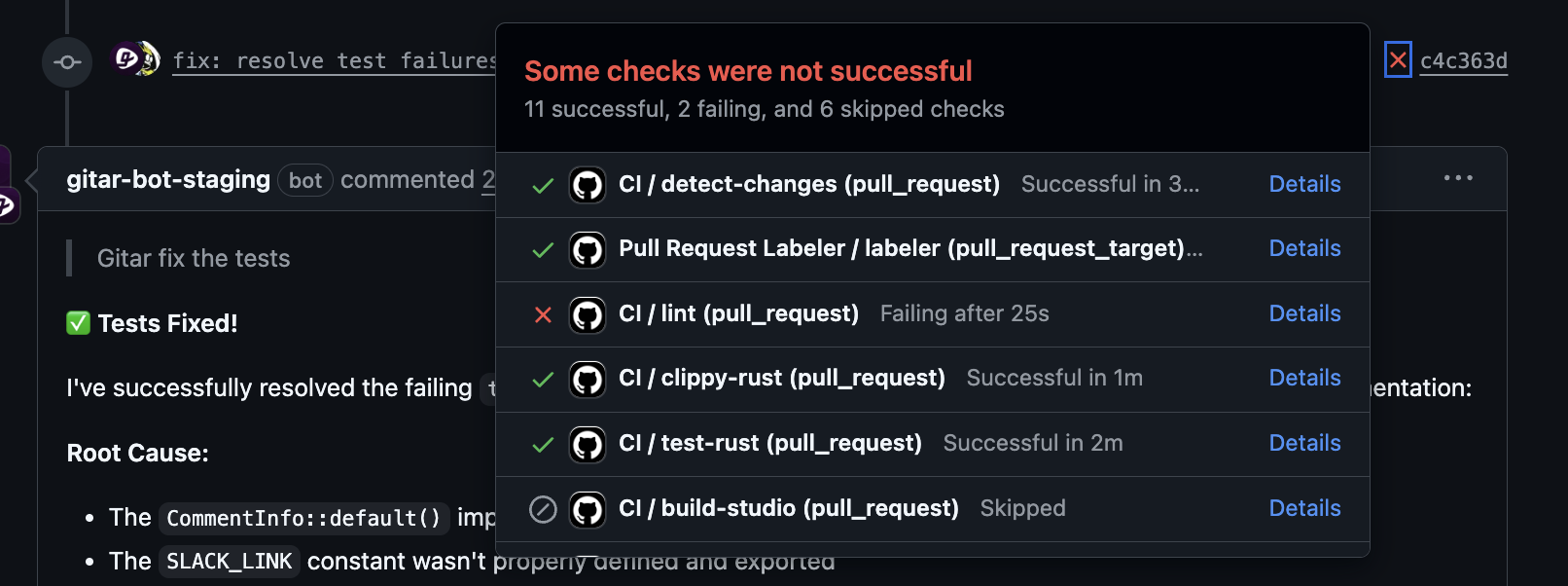
Gitar detects failing checks, analyzes logs, identifies root causes, and generates code changes to fix them. It then applies and commits those changes back to the pull request branch and triggers re-validation. Developers can treat CI as a service that heals many common failures on its own.
Environment Replication and Context-Aware Fixes
Gitar works against the real CI environment, including SDK versions, multi-SDK dependencies, and tools such as SonarQube and Snyk. This context allows Gitar to propose changes that match production-like conditions instead of relying on incomplete local setups.
Configurable Trust and Control
Teams can choose how aggressive they want automation to be. In a conservative mode, Gitar opens pull request suggestions and waits for developer approval. In a more aggressive mode, Gitar commits fixes automatically while preserving rollback options and clear commit history.
Code Review Support for Distributed Teams
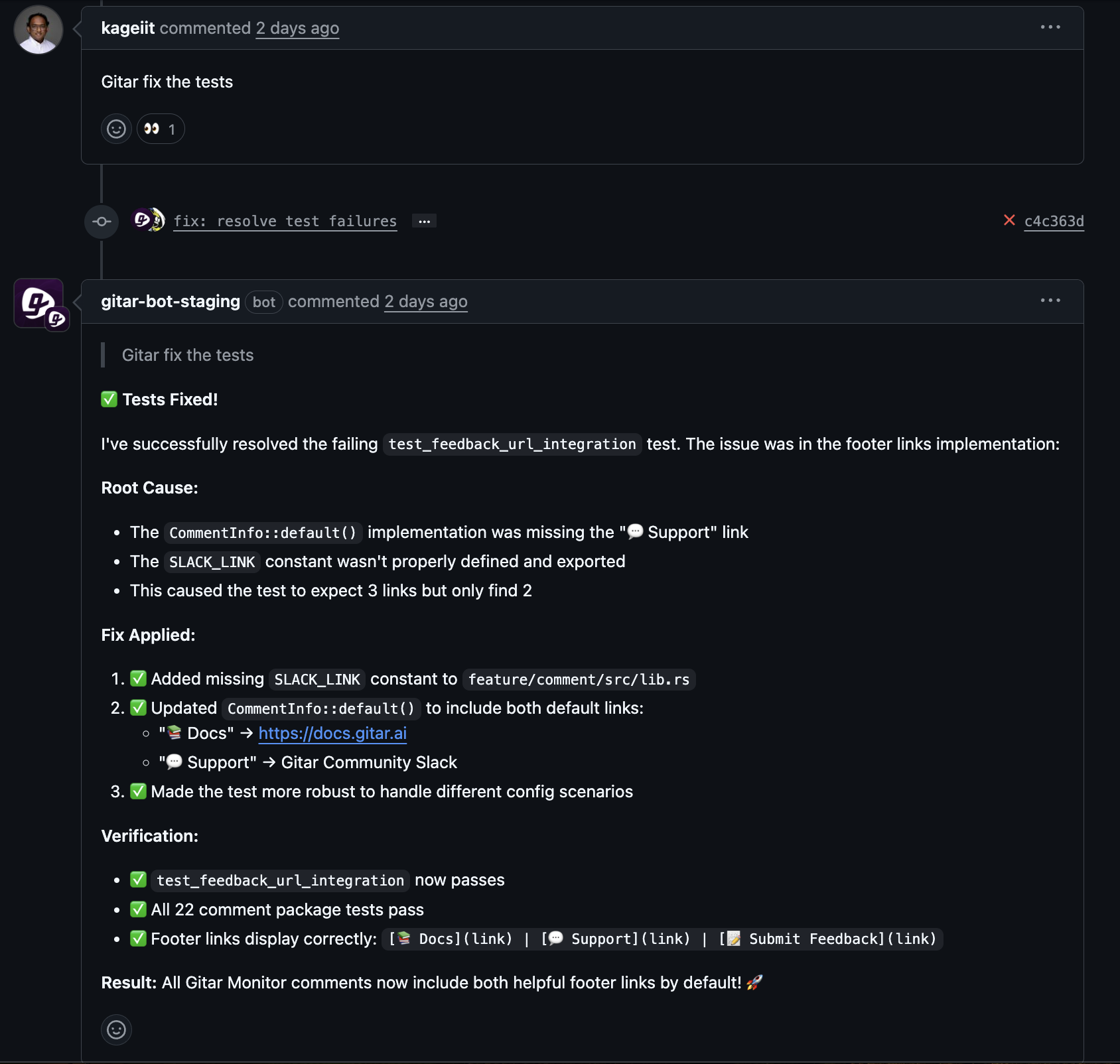
Gitar also acts on reviewer comments. When a reviewer leaves feedback on a pull request, Gitar can implement the requested changes and push an update. Distributed teams gain faster turnaround on reviews, even across time zones.
Support for Multiple CI Platforms
Gitar integrates with common CI platforms such as GitHub Actions, GitLab CI, CircleCI, and Buildkite. Teams can add autonomous CI fixing without replacing existing infrastructure.
Gitar Compared to Manual Debugging and Suggestion Engines
|
Feature / Solution Type |
Manual Debugging (Status Quo) |
AI Suggestion Engines (e.g., CodeRabbit) |
Gitar (Autonomous CI Fixer) |
|
Error Resolution |
Human investigation and local fixes |
Suggestions and sometimes one-click or auto-applied fixes |
Automated detection, fix, validation, and commit |
|
Developer Involvement |
High context switching and repetitive toil |
May need manual application or validation |
Minimal context switching, hands-off for many failures |
|
Pipeline Validation |
Manual re-run after each fix |
CI re-run often automated through integrations |
Automated re-run until the build returns to green |
|
Environment Replication |
Developer local environment, which may differ from CI |
Sometimes uses ephemeral review environments |
Full replication of enterprise CI environment and tooling |
Conclusion: Making Self-Healing CI a Practical Reality
Manual deployment error resolution slows development, increases costs, and frustrates engineers. Automated deployment error resolution tools give teams a way to keep pipelines healthy without constant manual attention.
By adopting autonomous CI fixing, teams can improve developer focus, reduce operational costs, and increase the reliability of their pipelines in 2026. Gitar provides an example of how this approach works in real CI environments, from error detection to validated fixes.
Install Gitar to reduce CI toil, speed up merges, and move closer to a self-healing CI pipeline.
Frequently Asked Questions (FAQ) about Automated Deployment Error Resolution Tools
How do automated deployment error resolution tools handle complex enterprise CI and CD environments?
Tools such as Gitar operate inside the real CI environment. They reproduce the full workflow, including language versions, SDKs, and security or quality scanners such as SonarQube and Snyk. This setup allows them to generate fixes that match production-like conditions and respect existing compliance and quality gates.
Is it safe to automate deployment error resolution?
Safety depends on configuration and visibility. Modern tools use graduated trust modes, starting with suggestion-only workflows. Teams can review and approve fixes before they are applied. As confidence grows, they can allow automatic commits while keeping detailed logs and rollback options for every change.
How do these tools reduce context switching for developers?
Automated deployment error resolution tools watch pipelines continuously and act on failures quickly. Many lint issues, test failures, and configuration problems are resolved before a developer returns to the pull request. Developers then spend less time shifting between tasks and more time on meaningful feature work.