
Key Takeaways
- CI failures consume a large share of developer time and budget, slowing delivery and reducing morale across engineering teams.
- Most CI failures trace back to a few patterns, including flaky tests, environment drift, dependency conflicts, and misconfigured pipelines.
- Traditional tools highlight issues but still rely on developers to debug, implement fixes, and re-run pipelines manually.
- Autonomous agents like Gitar can analyze logs, propose changes, apply fixes, and validate results directly in the CI workflow.
- Teams can reduce CI toil and speed up merges by letting Gitar handle broken builds and repetitive fixes. Install Gitar to automatically fix broken builds in your existing pipelines.
The Problem: The High Cost of Manual CI Failure Root Cause Analysis in Deployment Automation
CI Failure Root Cause Analysis Reduces Developer Productivity
Developers can spend up to 30% of their time dealing with CI issues, which can reach approximately $1M per year in lost productivity for a 20-developer team. This cost extends beyond engineering and slows delivery for a large share of companies, since CI failures create a material bottleneck for about 60% of organizations.
Common Root Causes of CI Failures
Many CI pipeline failures come from syntax errors, failing tests, and misconfigured pipelines that arise from routine human mistakes. Several patterns appear repeatedly.
Flaky tests and race conditions: Flaky tests often fail intermittently because of timing issues or external system dependencies, including asynchronous API calls. These failures are hard to reproduce and diagnose.
Environment inconsistency: Differences between local, staging, and production environments create flakiness and deployment problems. The result is the familiar “works on my machine” pattern.
Dependency conflicts: Version mismatches or missing dependencies break builds and force teams to inspect dependency trees and package configurations.
Configuration errors: Kubernetes-focused pipelines frequently fail because of invalid YAML, mismatched environment settings, version drift, unsafe rollout setups, missing tests, and weak secret management.
Long, noisy stack traces: Stack traces that span several services or components make it hard to see the real root cause, especially when the failure sits deep in the system.
The Right-Shift Bottleneck in Modern Development
AI code generation tools create code faster than teams can review and validate. This shift moves the constraint to the right side of the workflow, where more pull requests, more tests, and more pipeline runs lead to a higher volume of CI failures. Validation and merging become the limiting steps.
Why Traditional CI Failure Resolution Tools Feel Incomplete
Weak CI and CD implementation makes it hard to pinpoint failure causes quickly and slows routing to the right engineer. Many AI tools summarize logs or suggest code, yet they still expect developers to implement changes, push commits, and re-run pipelines.
This partial automation keeps context switching high and leaves repetitive CI triage work on the team.
Install Gitar to offload CI failure investigation and repetitive fixes from your developers.
The Solution: Gitar – Autonomous AI for Recovering CI Pipelines
Gitar introduces an autonomous AI agent that not only identifies CI problems but also implements and validates fixes, so pipelines can recover automatically when failures occur.
How Gitar Changes CI Failure Resolution
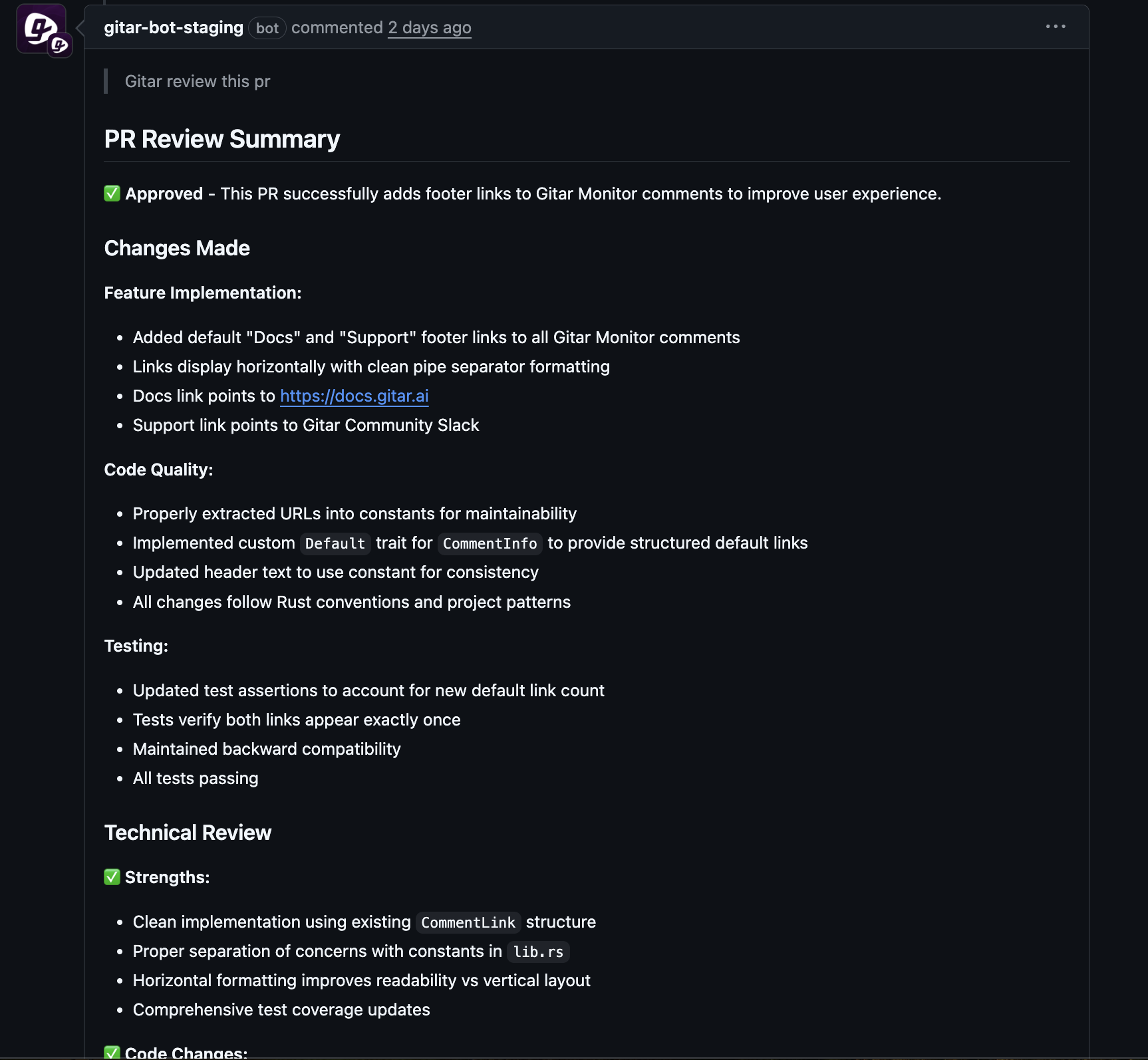
Autonomous action instead of suggestions: Many tools highlight issues or propose diffs. Gitar goes further by generating, applying, and validating code changes directly in the pull request.
End-to-end fix cycle: Gitar analyzes logs, detects root causes, creates the fix, updates the codebase, runs the relevant CI steps, and commits the change. Developers can review the end result instead of managing each step.
Accurate environment replication: Gitar can emulate complex enterprise environments with specific SDK versions, multi-SDK dependencies, and integrations such as SonarQube and Snyk. This context improves the likelihood that fixes pass in the real pipeline.
Configurable trust model: Teams decide how much autonomy Gitar has. Conservative mode keeps Gitar in suggestion-only mode for review. Aggressive mode allows direct commits with rollback safeguards for higher-confidence areas.
Code review assistance: Gitar can implement reviewer requests, from small refactors to test fixes, when reviewers tag it in comments. Reviewers stay focused on intent and design while Gitar handles mechanics.
Cross-platform support: Gitar integrates with GitHub Actions, GitLab CI, CircleCI, and BuildKite, so teams can adopt it without major pipeline changes.
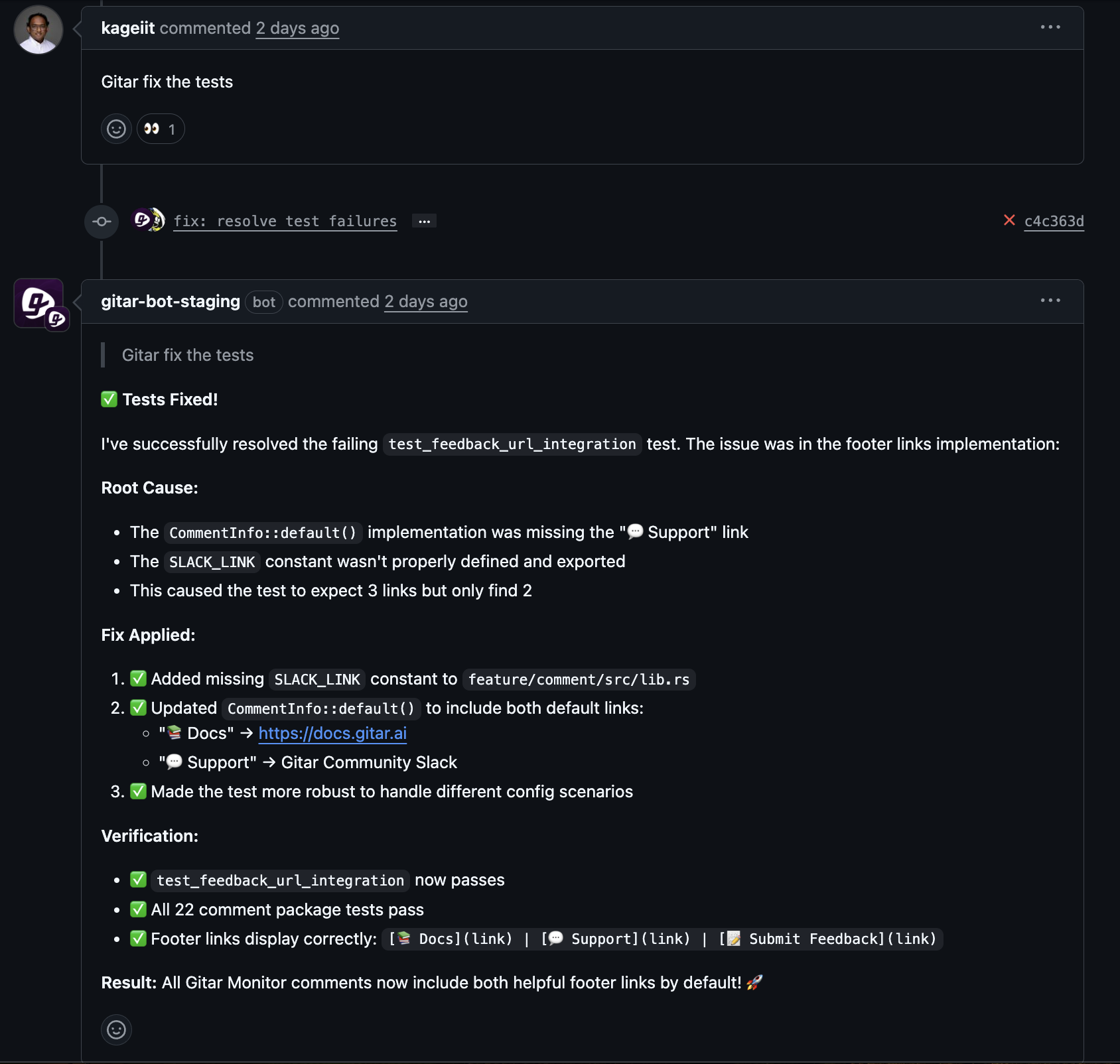
Install Gitar to give your CI pipelines an autonomous agent that fixes failures as they appear.
How Gitar Addresses Common CI Failure Root Causes
Gitar targets the recurring patterns that create the most CI overhead.
Flaky Tests and Environment Inconsistency
Gitar uses environment replication so fixes run under conditions that match your CI setup. This alignment reduces “works on my machine” behavior and helps stabilize flaky tests that depend on timing, configuration, or external services.
Dependency and Configuration Errors
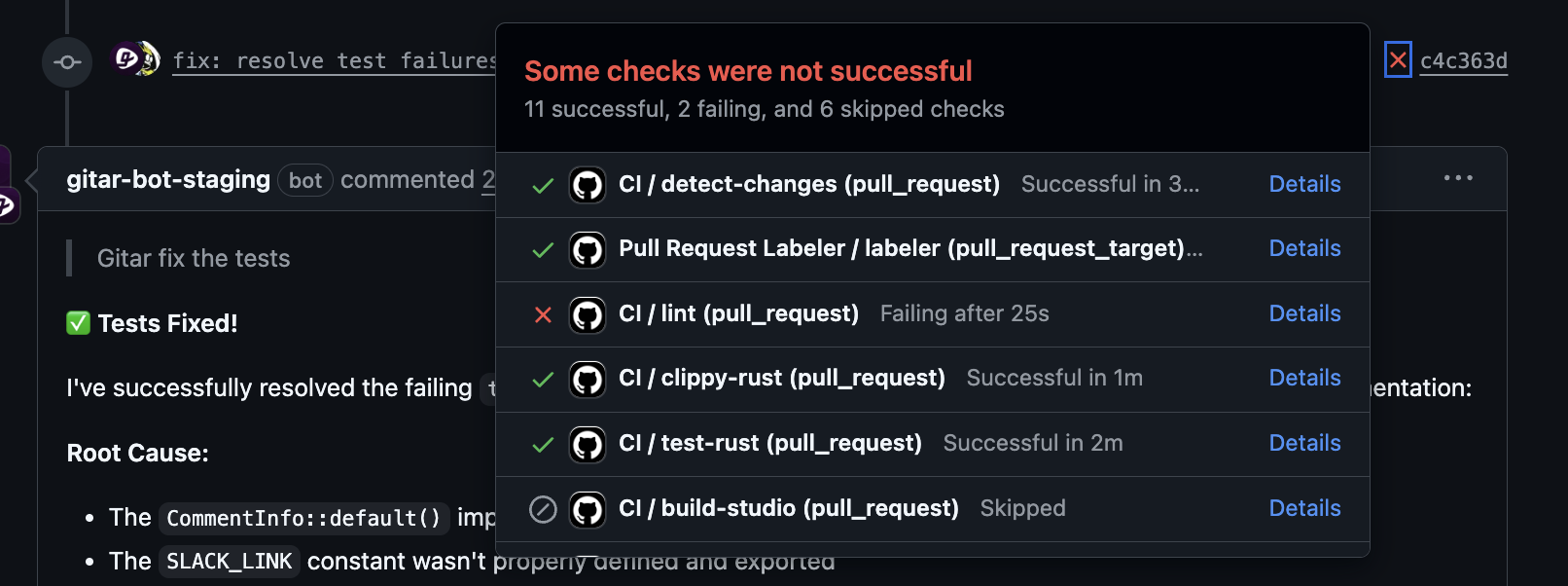
Gitar parses build logs and configuration files to identify missing packages, version conflicts, or incorrect pipeline settings. It then applies targeted updates, such as adjusting lockfiles, updating YAML, or fixing build scripts, and re-runs the affected checks.
Faster Feedback Cycles Across Time Zones
Gitar can respond to reviewer comments by making requested code changes and pushing commits. Distributed teams gain faster cycles because comments written at the end of one time zone’s day can result in applied fixes and passing CI by the time others come online.
Right-Shift Bottlenecks and Time-to-Merge
Gitar keeps pace with increased code generation volume by closing the gap on the validation side. When CI failures resolve automatically, pull requests spend less time blocked, and teams can merge more quickly without lowering quality.
Gitar as a Healing Engine Compared to Suggestion Engines
This table summarizes how Gitar differs from manual workflows and suggestion-only tools.
|
Feature or Capability |
Manual Root Cause Analysis |
AI Suggestion Engines |
Gitar (Autonomous Healing Engine) |
|
Problem identification |
Developer inspects logs and code |
Highlights patterns and suggests causes |
Performs real-time log analysis and diagnosis |
|
Root cause resolution |
Developer writes and applies fixes |
Developer implements suggested changes |
Generates, applies, and validates fixes automatically |
|
Validation |
Manual CI re-run |
Manual CI re-run |
Runs and checks the full CI workflow |
|
Context switching |
High, frequent pipeline triage |
Moderate, still requires manual steps |
Low, developers stay focused on feature work |
Install Gitar to move from CI suggestions to automated CI healing.
Frequently Asked Questions (FAQ) about CI Failure Resolution
How Gitar Differs from Other AI Reviewers for CI Failure Resolution
Many AI reviewers act as suggestion engines and do not guarantee that proposed changes pass CI. Gitar operates as a healing engine that applies fixes, re-runs the pipeline, and aims to return a passing build before developers revisit the pull request.
Gitar Support for Complex and Unique CI Setups
Gitar is built to handle complex environments with specific SDK versions, multi-language or multi-SDK projects, and tools such as SonarQube and Snyk. This design allows it to address failure modes that depend on organization-specific pipelines.
How Gitar Builds Trust in Automated Fixes
Teams can start with a conservative trust level where Gitar posts proposed changes as comments or draft commits. Over time, they can move to modes that allow direct commits with rollback controls once they are comfortable with results.
Types of CI Failures Gitar Can Resolve
Gitar focuses on failures such as lint violations, unit and integration test failures, and build errors that come from dependency or configuration problems. These are frequent, repetitive issues that often disrupt developer focus.
Typical Response Time for CI Failures
Gitar reacts in near real time. It reviews logs, applies fixes, and triggers new runs within minutes, which reduces idle time while pipelines recover.
Conclusion: Moving Toward Autonomous CI Failure Resolution
Manual CI failure triage consumes significant engineering capacity and slows release cycles. As code volume grows, this approach becomes harder to sustain.
Gitar offers an alternative where an autonomous agent owns much of the investigation and repair work. Teams can regain developer hours, shorten time-to-merge, and keep pipelines healthier without adding headcount.
Engineering leaders who want to reduce CI noise and preserve developer focus can adopt Gitar as a practical step toward autonomous CI. Install Gitar to automatically diagnose and fix CI failures in your existing pipelines.