
Written by: Ali-Reza Adl-Tabatabai, Founder and CEO, Gitar
Key Takeaways
- Manual merge conflict resolution and CI failure triage create frequent context switches that slow development and reduce focus time.
- Common CI issues such as lint errors, flaky tests, and minor dependency problems are predictable and suitable for automated resolution.
- Autonomous CI fixing tools that replicate the full build environment can validate changes before commit and reduce repeated CI runs.
- Distributed teams benefit when code review feedback and common merge blockers are handled automatically between working hours in different time zones.
- Teams can reduce downtime from merge conflicts and CI failures by adopting autonomous fixes with Gitar as an AI assistant that analyzes, fixes, and commits changes directly to pull requests.
Manual Merge Conflict Management Slows Teams Down
Merge conflicts and CI failures interrupt focused work and create avoidable delays. A typical cycle starts when a developer pushes a pull request and the build fails because of a missing dependency, a flaky unit test, or a linter issue. The developer must read logs, reopen the local environment, make a small change, push again, and wait for CI to finish.
Each interruption carries a cognitive cost. Developers can lose up to 23 minutes refocusing after each interruption, so a simple fix can expand into an extended loss of productive time. These disruptions break flow state and make complex work harder.
Distributed teams feel this even more. A developer on the US West Coast may depend on review from a teammate in Bangalore. Small issues can stretch a review cycle across several days as comments and follow-up fixes move across time zones. Tools that only suggest fixes still require manual edits, so the delay continues.
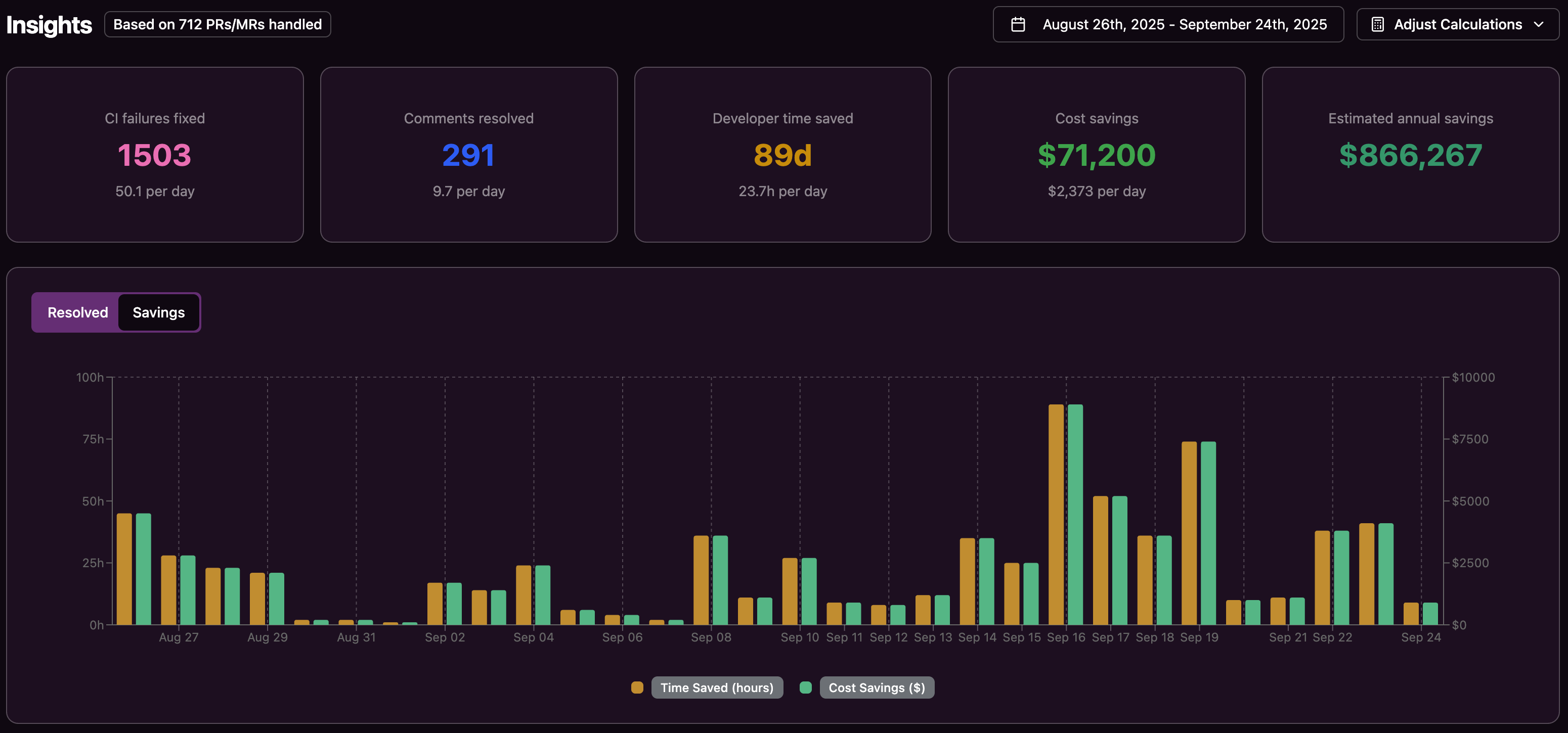
The financial impact is significant. Developers waste approximately 30% of their time on maintenance tasks, including CI failures and review cycles. For a 20-person engineering team, this can approach seven developer-years of time each year that do not go into new features.
Autonomous CI Fixes With Gitar Reduce Merge Conflict Overhead
Gitar turns merge conflict and CI failure handling into an autonomous workflow. The platform acts as a CI healing engine that not only suggests fixes but also applies, validates, and commits them.
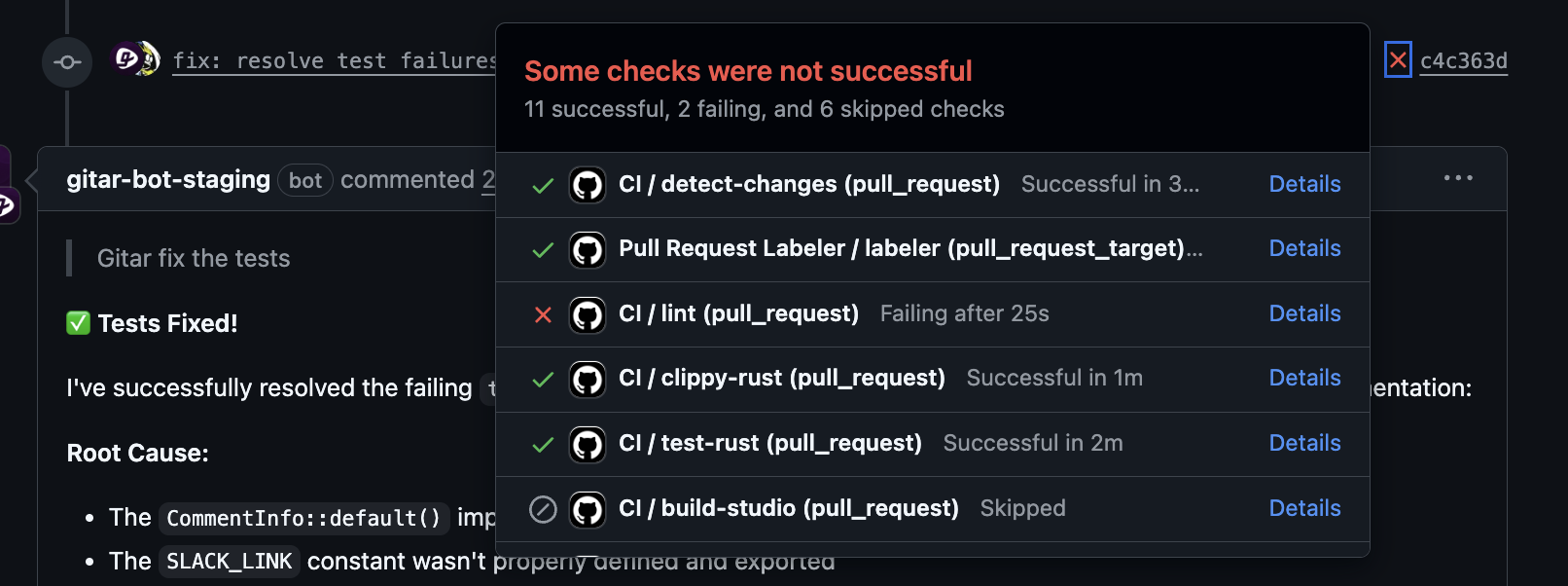
When a CI check fails, Gitar reads the logs, identifies the likely root cause, proposes a code change, runs checks in a replicated environment, and commits the fix back to the pull request branch after validation. This approach creates a self-healing CI experience that reduces manual intervention for routine issues.
Gitar replicates the full build environment so that fixes reflect real conditions. This includes language runtimes, SDK versions, container images, and tools such as SonarQube or Snyk. By testing proposed changes in this context before commit, the system reduces repeated cycles of fix, push, and fail.
Teams can control how much automation they use. Gitar supports modes that range from suggestion-only, where developers approve each change, to auto-commit, where the system resolves well-understood failures without human review. This flexibility allows teams to build trust over time and keep control over higher-risk changes.
Reducing Context Switching From Merge Conflicts
Gitar focuses on issues that commonly block merges and waste time. The system can automatically resolve problems such as:
- Formatting and lint violations that do not match project rules
- Simple test failures, including snapshot updates and straightforward assertion fixes
- Basic dependency and build script issues
- Minor integration conflicts in shared files
Developers stay focused on their current tasks while Gitar updates pull requests in the background. When they next open the PR, the build often passes and the system has added a clear commit message that explains the change.
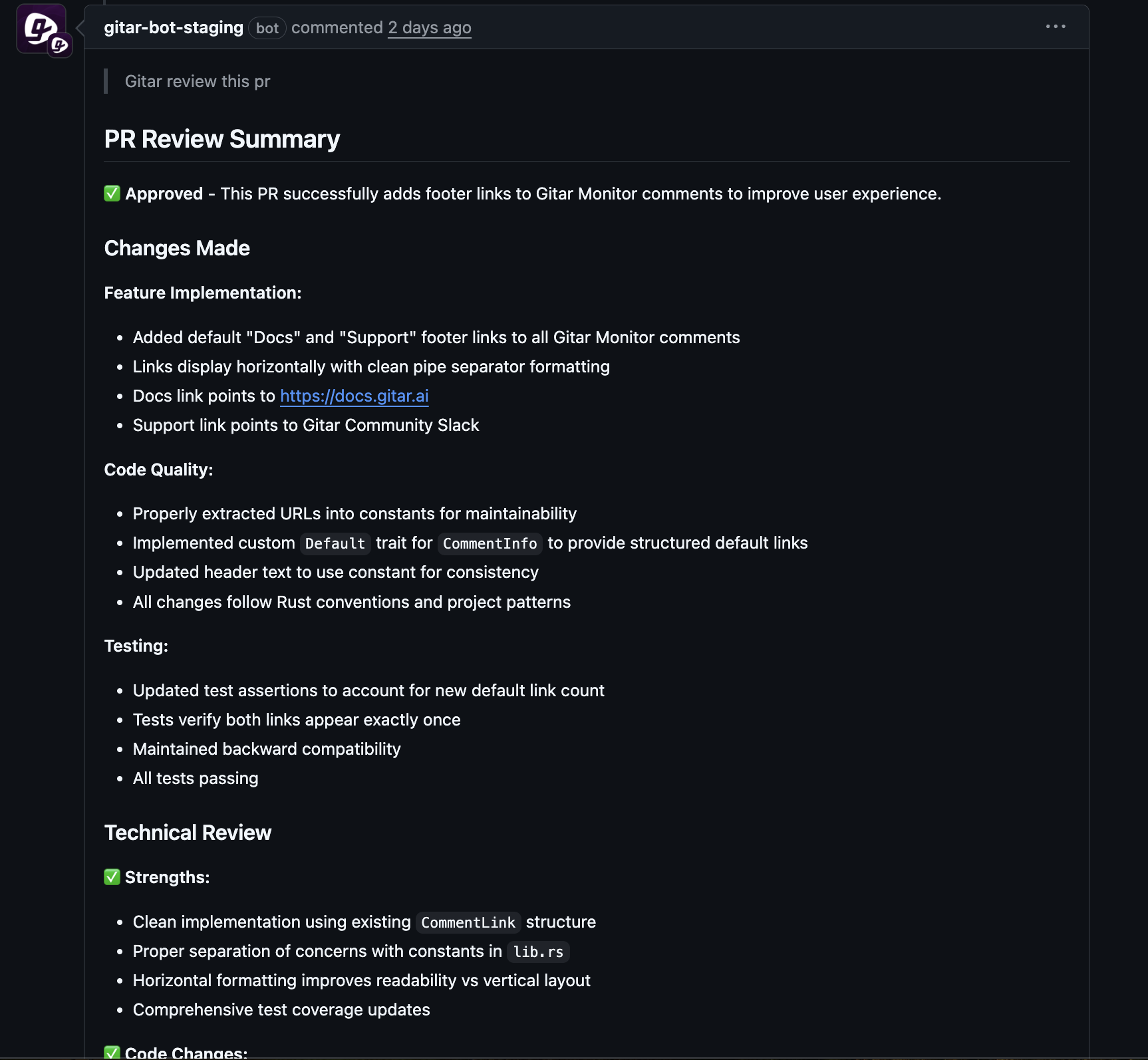
Gitar also supports review-driven changes. Reviewers can leave comments such as requests to adjust error handling or simplify a function. The system implements the requested edits, runs tests in the replicated environment, and commits the result.
Distributed teams benefit from this model. A reviewer in one time zone can request changes near the end of the day. Gitar applies the changes and verifies them so that the original author sees an updated, passing pull request at the start of the next workday.
How Gitar Compares With Other Merge Conflict Strategies
Different approaches to merge conflict management carry different tradeoffs. The comparison below highlights where autonomous CI fixes change the workflow.
|
Feature |
Gitar (Autonomous CI Fixes) |
Manual Merge Resolution |
AI Code Reviewers |
On-Demand AI Fixers |
|
Fix application |
Applies and commits validated fixes |
Developers implement all fixes |
Provides suggestions only |
Requires manual prompts and review |
|
Environment context |
Uses full CI and runtime replication |
Relies on local setup |
Focuses on code snippets |
Depends on prompt detail |
|
CI validation |
Runs checks before commit in a replica |
Often needs repeated CI runs |
No automated validation |
Validation managed by developers |
|
Developer interruption |
Low, background operation |
High, frequent context switches |
Requires manual follow-through |
Requires manual triggering |
Autonomous CI fixes combine implementation, validation, and environment awareness. Developers stay informed through commit messages and audit trails, while routine issues resolve with less hands-on effort.
Teams that want to reduce merge-related downtime can evaluate this approach in their own stack by installing Gitar and enabling autonomous CI fixes on selected repositories.
Frequently Asked Questions About Merge Conflict Management With Gitar
How does Gitar handle complex conflicts that need human judgment?
Gitar separates routine, deterministic issues from changes that may need review. The platform can automatically fix lint problems, straightforward test failures, and minor dependency issues. For more complex conflicts, teams can configure Gitar to propose patches without auto-commit. Developers then review the suggested diff and approve or adjust it. All changes include clear commit messages and can be reverted through normal version control tools.
Does Gitar integrate with common CI/CD pipelines and repositories?
Gitar integrates with major version control and CI platforms. The system supports GitHub and GitLab repositories and works with CI services such as GitHub Actions, GitLab CI, CircleCI, Buildkite, and Jenkins. It can operate with many common languages and frameworks, including Python, Go, JavaScript, TypeScript, Java, and Rust, and it supports containerized builds with Docker. Teams connect Gitar to their repositories and configure behavior through a web dashboard.
Is Gitar useful for both small teams and large enterprises?
Teams of all sizes experience productivity loss from merge conflicts and CI failures. For smaller teams, a single developer dealing with repeated CI breakages can represent a large share of engineering capacity. For larger organizations, even small percentage gains compound across many engineers. Gitar scales from a few repositories to large monorepos and multi-team setups, and automation levels can be tuned per project.
How does Gitar address trust and safety when changing code?
Gitar provides several controls that help teams adopt automation safely. Suggestion-only modes keep developers in the loop for any change, while auto-commit modes can be limited to specific types of failures or selected repositories. Every change is tied to a clear explanation and full CI validation in a replicated environment. Standard rollback options in Git remain available so teams can revert any commit if needed.
What types of CI failures and merge blockers can Gitar resolve?
Gitar focuses on issues that occur frequently and follow predictable patterns. Typical examples include style and formatting violations, outdated snapshots, minor test assertion updates, missing or misconfigured dependencies, and simple conflicts in shared files. The system can also implement direct review feedback, such as renaming functions, adjusting error handling, or updating documentation. As it runs on more of a codebase, it can address a wider range of recurring issues.
Conclusion: Moving Toward Autonomous Merge Conflict Management in 2026
Manual merge conflict resolution and CI failure handling consume a significant share of engineering time. Context switching, repeated CI runs, and cross-time-zone delays reduce focus and slow delivery.
Autonomous CI fixes with Gitar offer a way to offload routine problems to an AI system that understands the build environment, proposes and applies changes, and validates them before commit. Teams gain more uninterrupted development time and shorten feedback loops across locations.
Engineering leaders who want to reduce maintenance overhead and improve flow can start with a controlled rollout, then expand coverage as trust grows. To see how this works in practice, set up Gitar on a repository and enable autonomous CI fixes for common merge blockers.