
Key Takeaways
- Manual CI troubleshooting and slow review cycles create recurring delays, context switching, and hidden costs for engineering teams.
- Pre-merge CI failures, flaky tests, and long build times significantly reduce developer productivity and extend time-to-merge.
- Autonomous CI healing shifts work from manual log reading and patching to automated analysis, fixing, and validation of failed builds.
- Enterprises gain measurable ROI by reducing time spent on CI failures, cutting retry costs, and shortening release cycles.
- Teams can use Gitar to automatically fix failed builds and apply code review feedback directly in their existing workflows.
The Problem: Manual CI Fixes Drain Engineering Time
Failed CI builds interrupt focused work and slow projects. A pull request that turns red forces developers back into logs, test runs, and configuration checks instead of feature work.
Pre-merge CI checks fail more often than post-merge checks and create heavy bottlenecks through job failures, long waits, and time-consuming debugging. Industry estimates suggest developers can spend up to 30% of their time on CI and review issues.
The context switching tax is a key issue. A developer moves to a new task, then must return to fix a lint error or flaky test. What should be a quick correction expands into extended recovery time as they rebuild mental context. Flaky tests, intermittent failures, configuration problems, and dependency issues all increase the frequency of these interruptions.
CI Failures Slow Releases Across the Organization
Pipeline failures affect more than individual contributors. Delayed merges can stall dependent work, release branches, and customer-facing timelines. Higher code volume from AI-assisted coding amplifies the issue, since more changes mean more chances for CI to fail.
Long build times and delayed feedback loops reduce productivity and increase operational costs. Each retry consumes compute resources and further delays validation.
Manual CI/CD Remediation Hides Significant Costs
Time spent fixing pipelines adds up quickly. A 20-developer team that spends one hour per day on CI and review friction can lose roughly $1M in annual productivity, assuming 5,000 hours at a fully loaded cost of $200 per hour.
Unstable environments magnify this loss. Inconsistencies between development, staging, and production increase test flakiness and failed deployments, which adds more remediation work. At the same time, supply chain and pipeline vulnerabilities from insecure dependencies or missing scans introduce security and compliance risk on top of the pure productivity impact.
The Solution: Autonomous CI Healing With Gitar
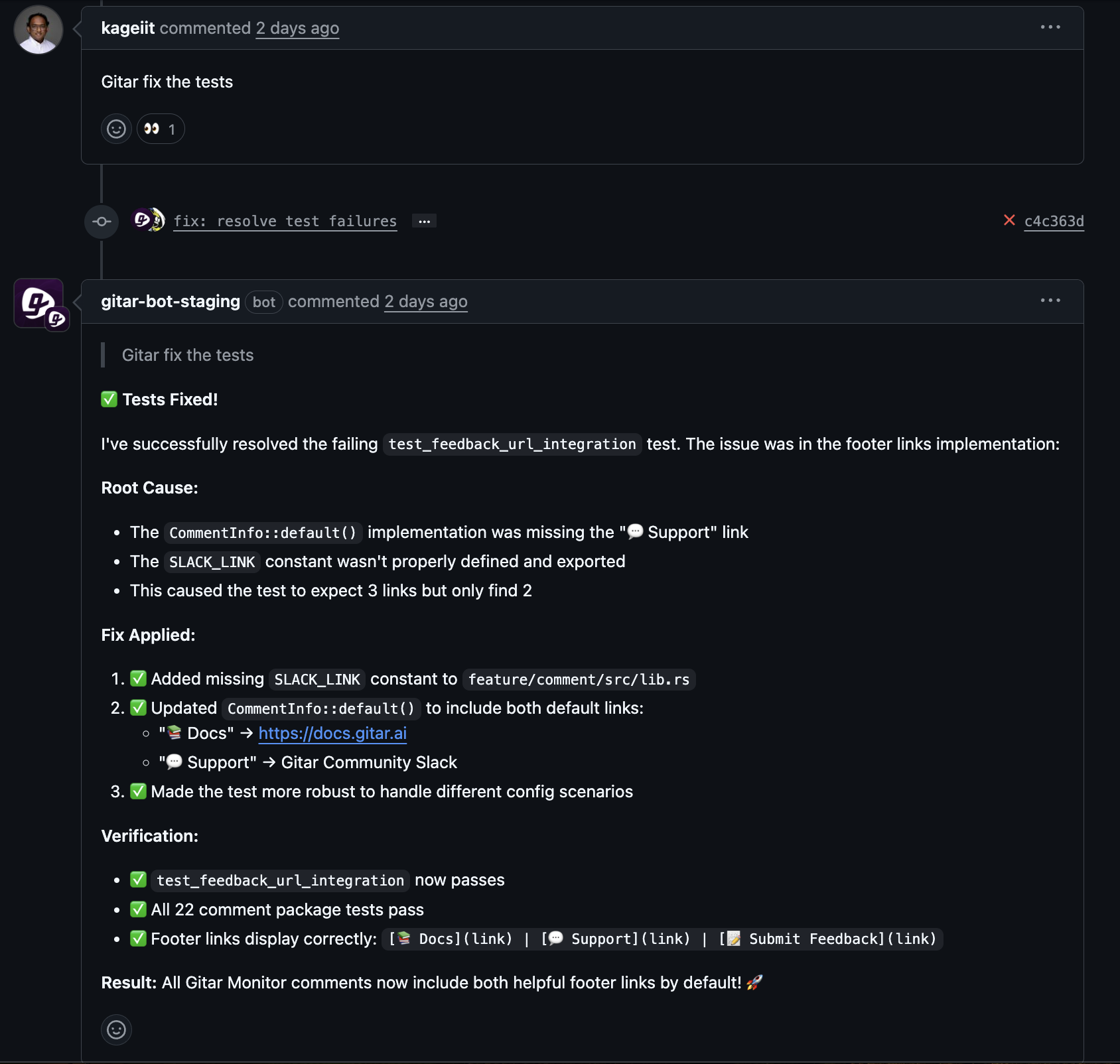
Gitar shifts CI remediation from suggestions to autonomous action. Its agent analyzes failures, generates patches, applies them, and verifies that CI passes, so routine red builds become green builds without manual work.
Key Capabilities That Improve CI/CD Workflows
- Autonomous CI fixer: When checks fail, Gitar examines logs, identifies the root cause, creates code changes, and commits fixes to the pull request branch. This covers lint issues, test failures, and build errors.
- Code review implementation assistant: Reviewers leave comments with clear instructions, and Gitar applies the requested updates with an explanation of the changes. This reduces the delay between feedback and implementation, especially for distributed teams.
- Full environment replication: Gitar emulates complex enterprise workflows, including specific JDK versions, multiple SDKs, and tools such as SonarQube or Snyk, so fixes are validated in conditions that match the real pipeline.
- Configurable trust model: Teams can start in suggestion mode, where developers approve changes, then move to auto-commit mode with rollback options as confidence increases.
- Broad CI support: Gitar connects with GitHub Actions, GitLab CI, CircleCI, BuildKite, and other major systems, so teams can adopt it without changing their core platforms.
Install Gitar to start reducing manual CI toil and shortening the path from commit to merge.

Gitar in Action: Regaining Flow and Speed
Reducing Context Switching From Red Builds
Teams use Gitar to clear many CI failures before developers return to the pull request. The agent detects failing checks, applies a fix, and re-runs validation. Developers stay in a stable flow of feature work instead of rotating between tickets and pipelines.
Shortening Code Review Cycles
Distributed teams often face one- or two-day delays while reviewers and authors work in different time zones. With Gitar, reviewers can leave actionable comments and let the agent implement the requested changes. The next time the author checks the pull request, updates are already in place and CI has rerun.
Improving CI Economics and ROI
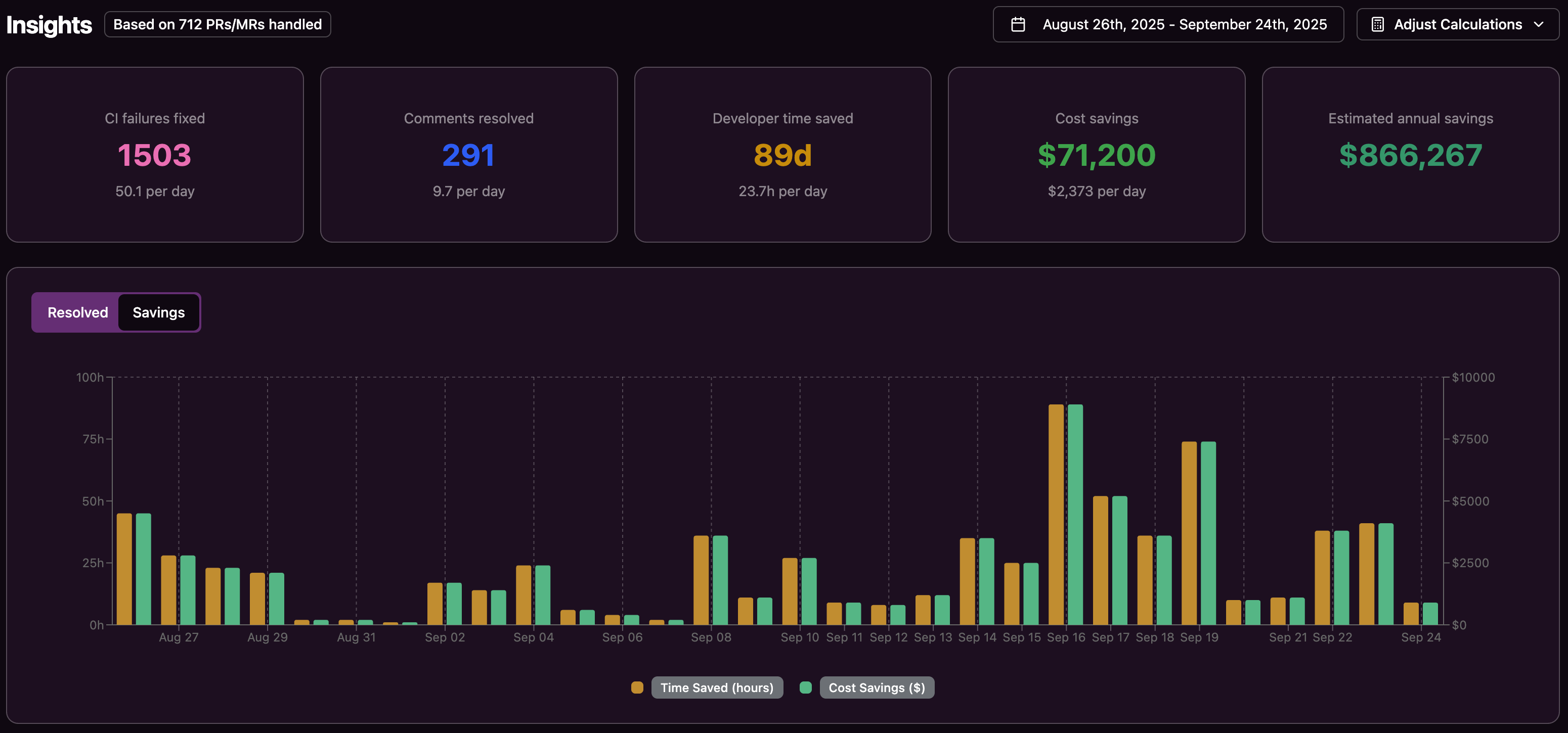
Autonomous healing reduces two major costs at once: developer time spent on debugging and infrastructure time spent on repeated CI runs. Even if only half of failures are fixed automatically, a 20-person team can recover hundreds of thousands of dollars in productivity value, along with faster delivery and lower burnout risk.
How Gitar Differs From Traditional Approaches
Teams often rely on a mix of manual work and suggestion tools. Gitar adds a third option by closing the loop from detection to verified fix.
|
Feature / Approach |
Manual Fixing |
AI Code Reviewers |
Gitar (Autonomous CI Healing) |
|
Problem identification |
Manual log analysis |
Suggests likely cause |
Detects and analyzes failure |
|
Fix generation |
Developer writes patch |
Proposes patch |
Creates patch |
|
Fix application |
Manual commit |
Developer must apply |
Commits change to branch |
|
Validation |
Manual rerun |
Developer must rerun |
Re-runs CI and checks result |
This end-to-end automation is the core difference. Suggestion tools stop at advice, while Gitar carries the change through to a passing pipeline.
Frequently Asked Questions About Autonomous CI Healing
How Gitar Handles Complex Enterprise CI Environments
Gitar mirrors real CI conditions, including specific language versions, build tools, and security scanners. The agent uses this context when generating fixes, which reduces trial-and-error and helps maintain compliance with existing policies.
How Gitar Reduces Context Switching From CI Failures
When a check fails, Gitar analyzes the failure, crafts a solution, applies it, and triggers validation. Developers often return to a pull request and see a green build where a red one would previously have required manual attention.
Safety and Control When Allowing Auto-Commits
Gitar provides several control options. Teams can start with suggestion-only mode, move to auto-commit on low-risk changes, and expand from there. Every change is documented, auditable, and reversible, and fixes are validated in the full CI workflow before they are treated as complete.
Integrating Gitar Into Existing Tools
Gitar connects through GitHub Apps or GitLab equivalents and works with common CI platforms such as GitHub Actions, GitLab CI, CircleCI, and BuildKite. Setup generally involves authorizing the app, selecting repositories, and choosing trust levels in a web dashboard.
Conclusion: Move CI Fixes From Manual Work to Autonomous Healing
Manual CI remediation made sense when pipelines were simpler and commit volume was lower. In 2026, higher code throughput, complex dependencies, and strict security expectations make automated healing a practical requirement.
Gitar does more than highlight issues. It analyzes failures, applies fixes, and validates pipelines so developers can focus on delivering features instead of repairing builds. Teams that adopt autonomous CI healing recover productivity, reduce operational costs, and shorten release cycles.
Install Gitar to reduce time spent on red builds and keep your CI pipelines healthy by default.