
Written by: Ali-Reza Adl-Tabatabai, Founder and CEO, Gitar
Key Takeaways
- Traditional CI/CD and code review workflows create costly delays through context switching, failed builds, and backlogged pull requests.
- Autonomous AI agents reduce this friction by detecting CI failures, generating fixes, and validating changes in the real pipeline before developers switch tasks.
- Gitar extends automation into code review by implementing reviewer feedback, which shortens review cycles for distributed teams.
- A phased rollout with clear guardrails, change management, and ROI tracking helps teams adopt autonomous agents with confidence.
- Teams can cut CI toil and ship more reliable software by installing Gitar as an autonomous fixer for failing tests and review comments: get started with Gitar.
Why Traditional CI/CD and Code Review Are Failing Modern Engineering Teams
Many teams now lose a significant share of development time to CI and review overhead. Developers can spend up to 30% of their time on CI failures and review cycles, which turns each failed build into an expensive interruption instead of a quick correction.
AI coding assistants generate code quickly, yet they also increase right-shift pressure on pipelines. More generated code means more pull requests, more tests, and more chances for CI to fail, so the main constraint has moved from authoring code to getting it through quality and compliance checks.
Distributed teams feel this friction even more. Time zone gaps stretch simple review exchanges across days, and the cognitive overhead of context switching turns a brief fix into a longer loss of focus. For a 20-person team, even one hour per day spent on CI and review issues can represent hundreds of thousands of dollars in lost productive time each year.
Install Gitar to cut CI rework and keep developers focused on high-value work.
Autonomous AI in CI/CD: The Fundamentals
Autonomous AI in CI/CD introduces agents that not only detect failures but also repair them. These agents watch commits, builds, and tests, then diagnose and fix issues so developers see green builds instead of red ones.
Self-healing CI pipelines emerge when the agent acts on failures. The agent inspects logs, identifies root causes, proposes code or configuration changes, validates them in the full CI environment, and updates the pull request branch so the original author can continue their current task.
Effective agents replicate the real environment, including SDK versions, dependencies, and scanners such as SonarQube or Snyk. This depth avoids fixes that compile locally but fail in CI. The same approach applies to code review, where agents can implement reviewer comments and push updated commits without waiting for the original developer.
Gitar: Your Autonomous AI Agent for Self-Healing CI and Automated Code Review
Gitar moves beyond suggestion-only tools by applying and validating fixes directly in your pipelines. Instead of presenting a list of recommendations, it takes responsibility for resolving many common failures and review comments end to end.
Key Capabilities of Gitar
End-to-end autonomous fixing is a core capability. When a CI job fails because of lint errors, unit test breaks, snapshot drift, or dependency issues, Gitar reads the logs, edits the code or configuration, reruns the relevant checks, and commits the fix back to the pull request branch.
Full enterprise environment replication allows Gitar to work reliably in complex organizations. The system mirrors multi-SDK builds, specific JDK versions, security checks, and custom workflows that often break simpler tools, which reduces the risk of fixes that work in isolation but fail in the shared pipeline.
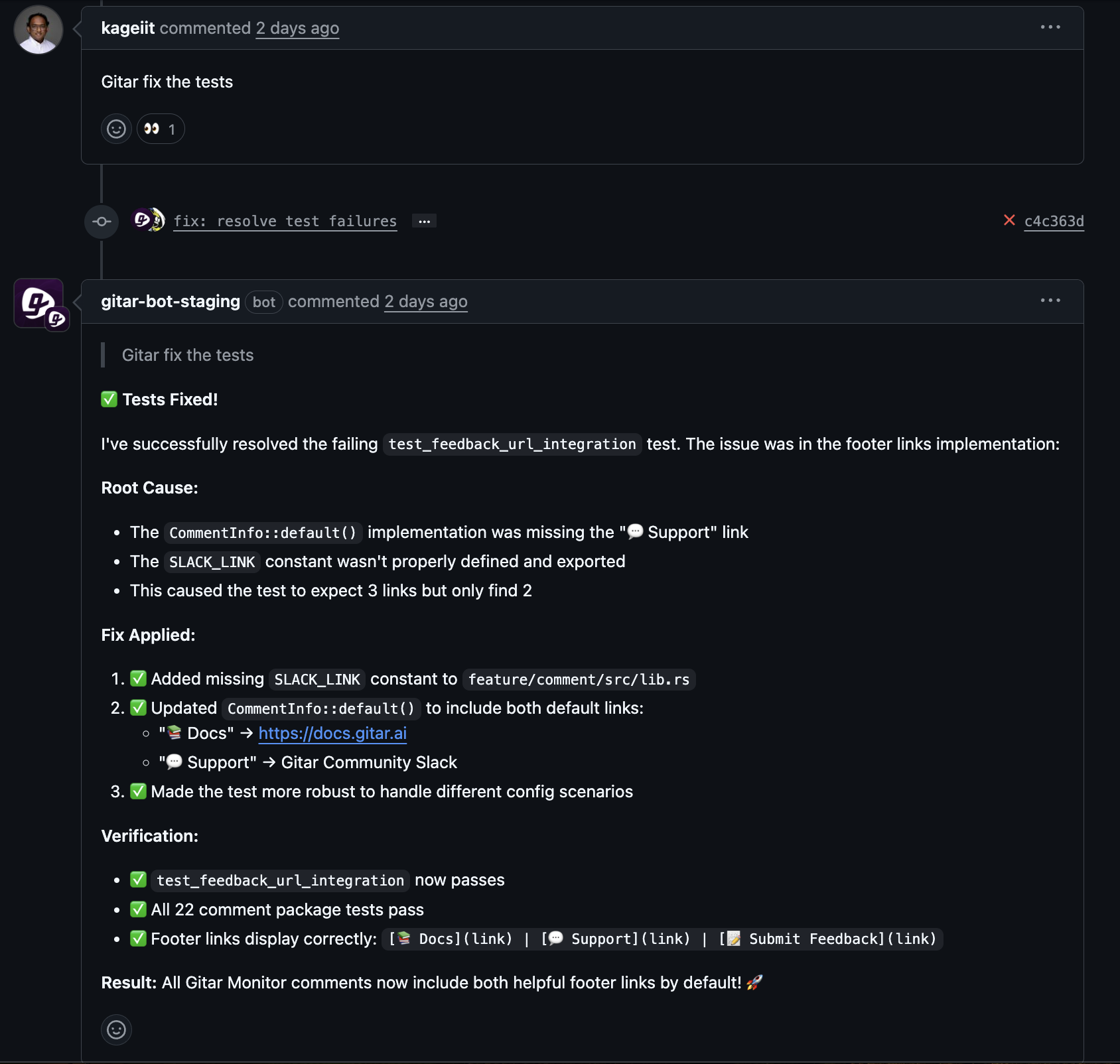
The intelligent code review assistant streamlines review feedback. Reviewers can leave targeted comments, such as requests to remove a feature or adjust logic, and Gitar implements the change, updates the pull request, and explains what changed.
Gitar’s configurable trust model keeps teams in control. Conservative mode posts fixes as suggestions that require explicit approval, which helps teams build trust, while aggressive mode commits directly after CI validation, with audit trails and rollback options available.
Cross-platform support lets organizations plug Gitar into GitHub Actions, GitLab CI, CircleCI, Buildkite, and other systems without rebuilding their infrastructure.
Add Gitar to your repositories to turn CI failures into auto-resolved events.
Strategic Implementation: Integrating Autonomous AI Agents into Your Engineering Workflow
Phased Rollout Strategy with Gitar
Phase 1 centers on installation and initial guardrails. Teams authorize Gitar as a GitHub or GitLab app on selected repositories, connect existing CI systems, and start in suggestion-only mode so every change remains reviewable.
Phase 2 focuses on building confidence through real fixes. After the first failed lint or test run, Gitar proposes a concrete patch, the developer reviews and accepts it, and the pull request updates without extra context switching. Repeated small wins encourage teams to expand coverage and enable more automation for well-understood failure types.
Phase 3 introduces advanced collaboration patterns. Senior engineers and reviewers can describe higher-level refactors or cleanups in comments, and Gitar performs the edits, which helps distributed teams move pull requests forward while colleagues in other time zones are offline.
Strategic Considerations and ROI
The build-versus-buy decision for autonomous agents has significant hidden costs. An internal system must combine AI expertise, CI/CD integration, and long-term maintenance across many evolving tools, and organizations often underestimate the sustained effort required to operate AI systems effectively.
Effective change management explains how Gitar fits into existing review practices and emphasizes that it handles routine fixes while humans decide on design and architecture. Clear rollback procedures and gradual expansion of permissions help teams adopt automation without sacrificing safety or ownership.
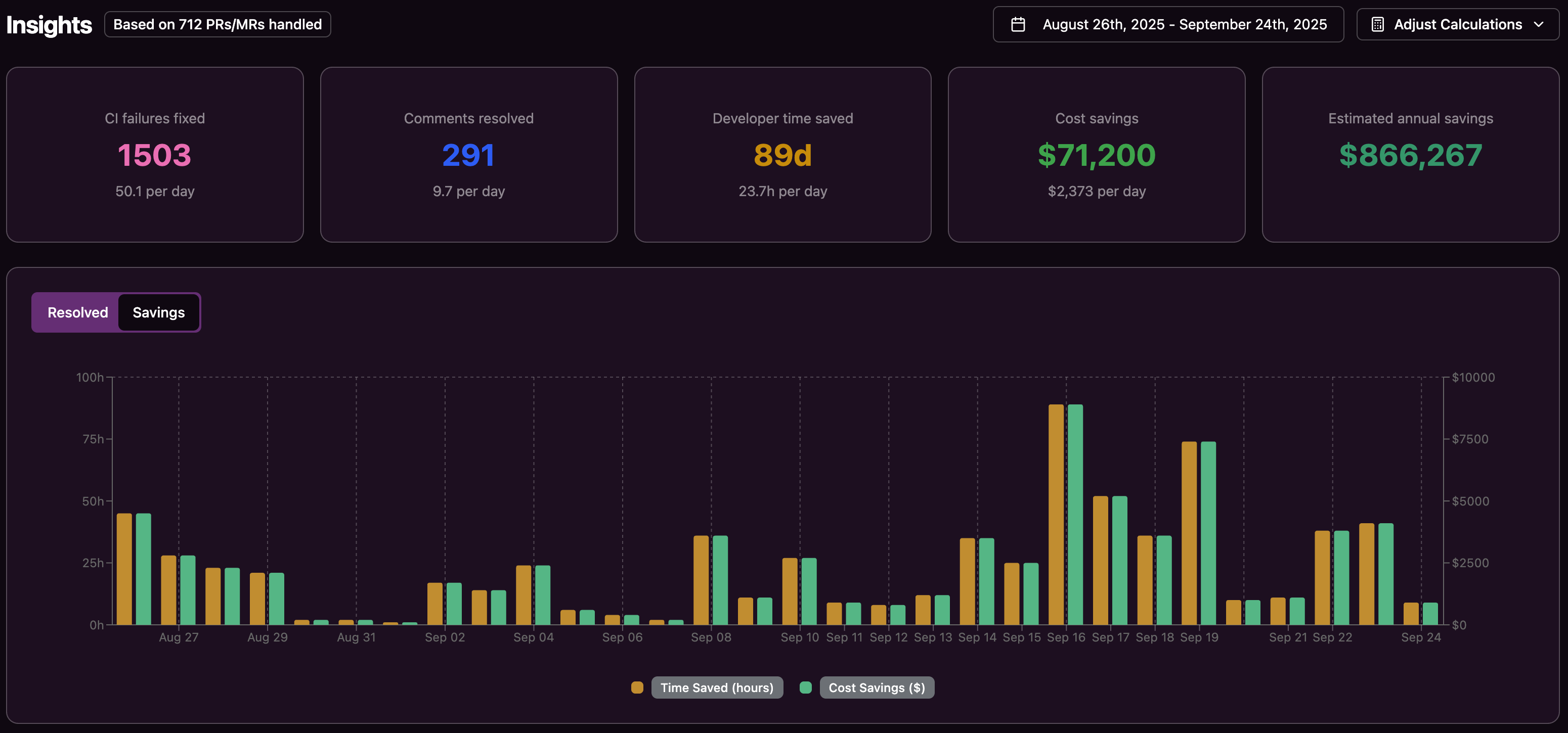
ROI modeling usually starts with time saved on CI fixes and review rework. A 20-developer team that spends an hour per day on these tasks can easily lose thousands of hours per year. Even partial automation with Gitar can recover a large share of that time while improving release predictability.
Competitive Landscape: Why Gitar Leads the AI-Autonomous Development Operations
From Suggestion Engine to Healing Engine
Gitar distinguishes itself by acting rather than only advising. Traditional tools highlight problems and offer snippets, while Gitar applies fixes, validates them, and updates pull requests so developers spend less energy on mechanical repair work.
Gitar vs. The Alternatives: A Comparison
|
Feature / Category |
Gitar (Autonomous AI Agent) |
AI Code Reviewers |
Manual Work |
|
Approach |
Autonomous fixing |
Suggestions and analysis |
Manual debugging |
|
Actionability |
Applies and validates fixes |
Provides recommendations |
Developer implements |
|
CI Integration |
Full environment replication |
Limited CI context |
Manual CI reruns |
|
Automation Level |
End-to-end |
Partial, human-dependent |
None |
Addressing Common Objections to Autonomous AI Agents
Teams that already use AI reviewers often still rely on humans to apply and verify changes. Gitar closes this gap by applying fixes and confirming they pass the real pipeline, which turns many routine failures into silent, automated corrections.
Concerns about complex environments align with Gitar’s design focus. The system understands specific dependencies, SDK versions, and tools such as SonarQube and Snyk, and its permissions model lets teams start with suggestion-only workflows before moving to direct commits.
Use Gitar to remove CI and review bottlenecks from your delivery pipeline.
Conclusion: Accelerate Your Release Cycles with Autonomous AI
Modern development velocity depends as much on validation and integration as it does on writing code. As AI-assisted coding increases output, CI pipelines and review queues become the main constraint, which makes autonomous agents a practical requirement rather than a distant concept.
Gitar helps engineering and platform teams reduce operational overhead while keeping human judgment at the center of design decisions. Teams that adopt autonomous CI and review support can ship features faster, reduce rework, and scale development without linearly increasing costs.
Improve your CI/CD process and free developers from repetitive fixes by installing Gitar in your repositories.
Frequently Asked Questions (FAQ) about Autonomous CI/CD and Code Review
How does Gitar handle complex, enterprise-grade CI environments with multi-SDK builds and third-party tools?
Gitar mirrors your CI environment, including multi-SDK setups, specific JDK versions, and tools such as SonarQube, Snyk, and custom scanners. The agent runs fixes through this mirrored pipeline before committing changes, which improves reliability in environments where simple, editor-only suggestions often fail.
What is the difference between Gitar’s “Conservative” and “Aggressive” modes for automated fixes?
Conservative mode proposes fixes as suggestions that require explicit approval, so developers decide what to merge while still saving the effort of writing the patch. Aggressive mode commits validated fixes directly to pull requests, with rollback options and audit trails, and many teams enable it selectively for common, low-risk failures.
Can Gitar address code review comments that require refactoring or significant code changes, not just simple fixes?
Gitar can interpret structured review comments and carry out larger edits, such as refactors, feature removals, or logic adjustments. This behavior keeps review discussions moving even when the original author is offline, especially for distributed teams.
How does Gitar ensure the trust and safety of automatically generated code changes within our codebase?
Gitar validates each change against the full CI workflow before commit, records detailed audit logs, and respects existing branch protection and review rules. Teams control how autonomous the system can be, from suggestion-only mode to direct commits with clear rollback paths.
How does Gitar integrate with our existing development workflow and tools?
Gitar connects to GitHub and GitLab repositories and works with major CI systems, including GitHub Actions, GitLab CI, CircleCI, and Buildkite. Installation involves authorizing the app, picking repositories, and configuring policies, after which Gitar interacts through pull request comments and commits without requiring changes to your existing branching or review process.