
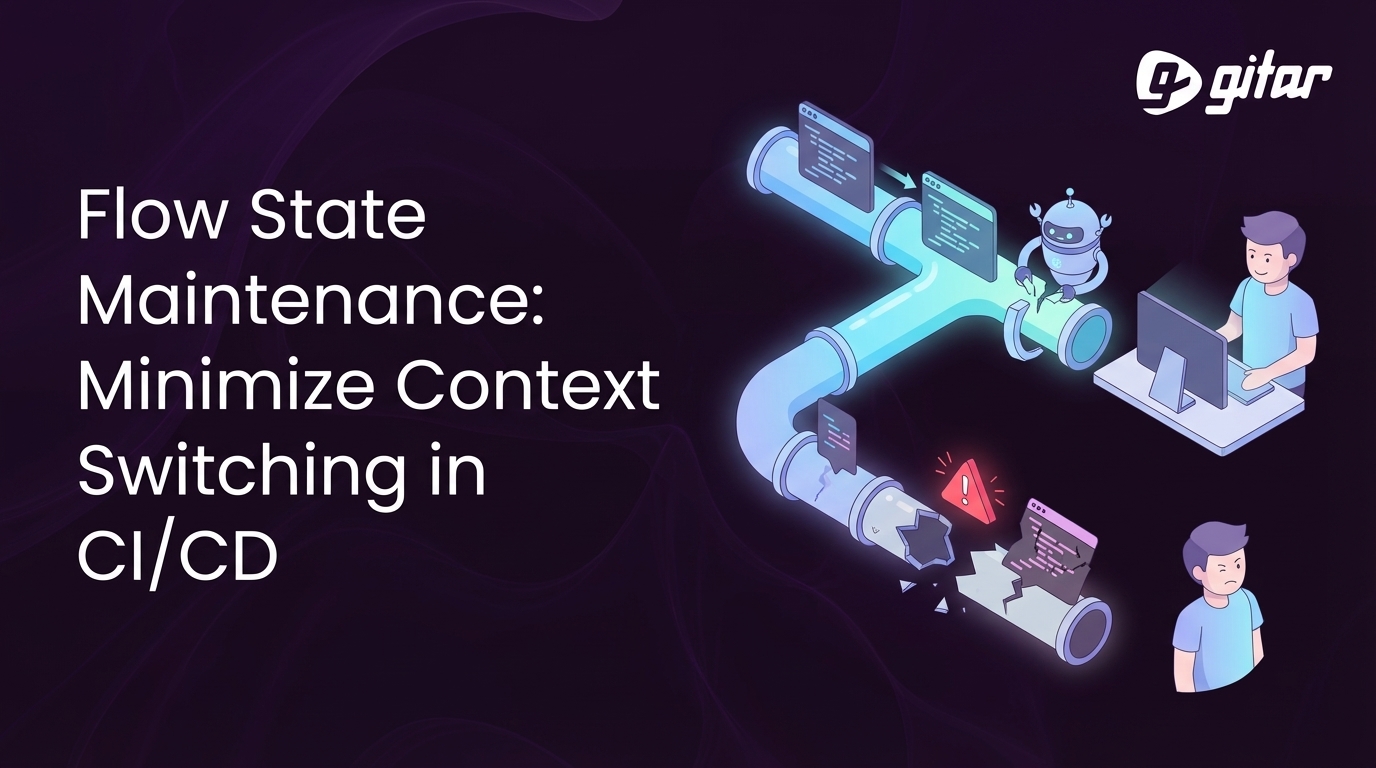
Key Takeaways
- Context switching significantly harms developer focus, and regaining full concentration takes more than 23 minutes after a single interruption.
- CI/CD failures and slow review cycles drive frequent task switching, which contributes to 20–80% productivity loss and measurable code quality degradation.
- Autonomous CI tools can resolve many CI failures and review comments without manual intervention, which helps preserve flow state and reduces error-prone, fragmented work.
- Engineering leaders benefit from a gradual rollout of autonomous CI, clear metrics, and a trust-based adoption model to ensure sustainable productivity gains.
- Teams can use Gitar to automatically fix CI failures and act on review comments, reducing interruptions and supporting uninterrupted development.
The Hidden Cost: Context Switching and Its Impact on Developer Flow State
Context switching is the cognitive cost of rapidly moving between tasks. In software teams this often comes from failing CI builds, urgent bugs, and pending review feedback.
Developers require an average of 23 minutes and 15 seconds to regain focus after one interruption. Repeated disruptions lead to higher error rates and lower code quality, and at scale they delay releases and reduce effective capacity by 20–80%.
Attention residue theory explains that thoughts about incomplete work persist while people attempt new tasks. For developers, unresolved CI failures or open review comments linger in working memory, which increases mental fatigue and reduces performance on subsequent work.
Why Traditional CI/CD and Code Review Disrupt Flow
Modern CI/CD pipelines catch issues early but often interrupt developers at inopportune times. A typical failure forces a shift away from current work into log reading, local reproduction, small fixes, and repeated pushes.
Manual code reviews create similar friction. Distributed teams, time zone gaps, and asynchronous comments extend review loops and fragment focus. Daily losses of 45 to 90 minutes of usable output per developer are common, and teams juggling several projects may lose up to 80% of their energy to switching overhead.
Developers adapt to this environment by favoring short, low-value tasks that fit between interruptions instead of deep, complex work that would deliver greater impact.
Gitar: Autonomous CI Fixes That Protect Developer Flow
Gitar focuses on the main sources of disruption in modern workflows, which are failing CI pipelines and review feedback. When a pull request fails CI or receives comments, Gitar listens, analyzes the issue, proposes a change, and can update the branch automatically once configured to do so.
The system handles lint errors, test failures, and many build issues, and it can apply fixes that address reviewer requests. Developers stay focused on their current task while Gitar manages the feedback loop in the background.
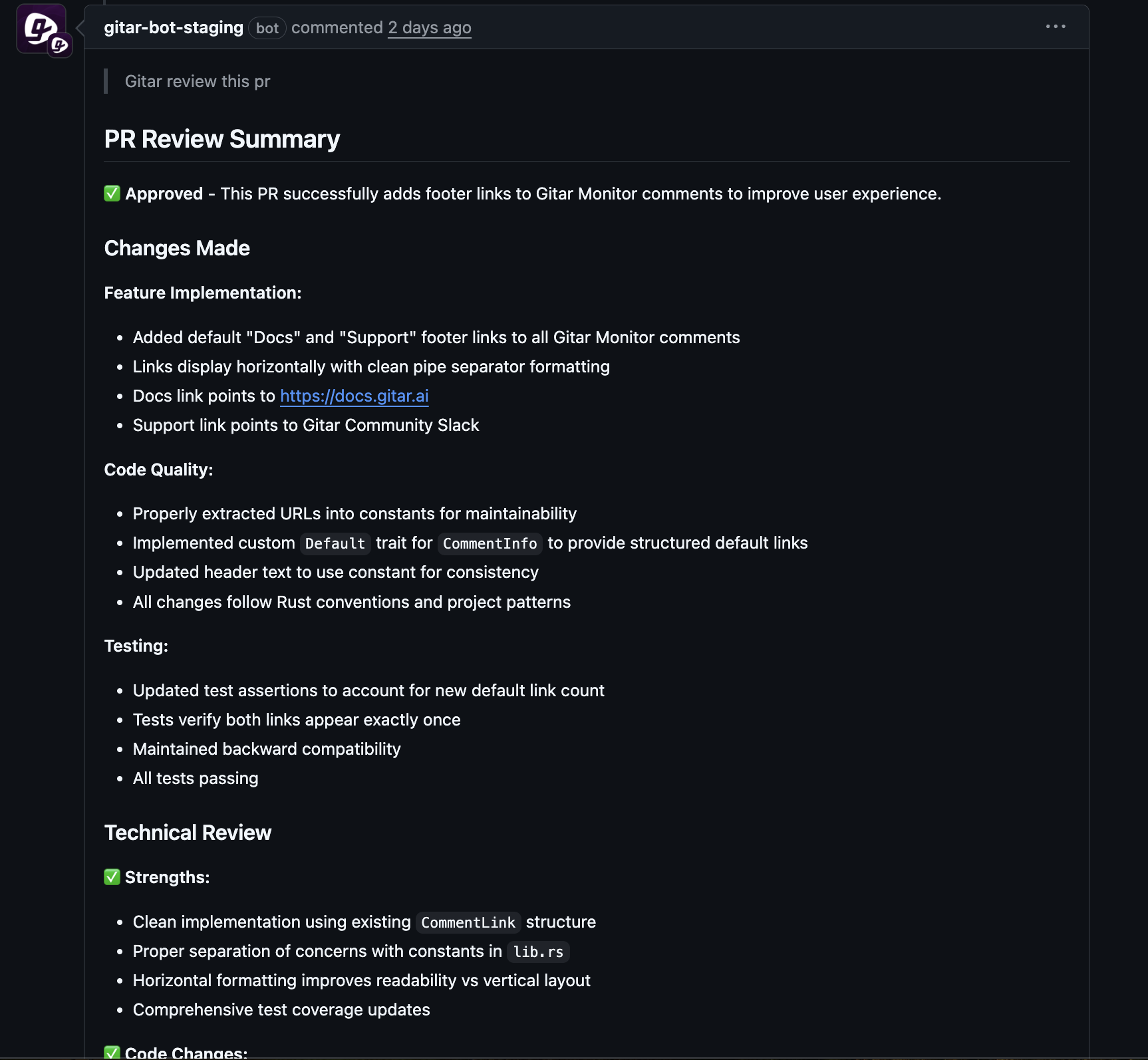
Key capabilities that reduce context switching
- End-to-end autonomous fixing that not only suggests changes but can commit them and validate against CI workflows.
- Full environment replication that mirrors enterprise stacks, including SDKs, dependencies, and external tools, which helps avoid environment-specific regressions.
- Intelligent handling of review feedback so Gitar can interpret reviewer comments and update code accordingly.
- A configurable trust model that lets teams start in suggestion-only mode and gradually move to auto-commit as confidence grows.
- Support for platforms like GitHub Actions, GitLab CI, CircleCI, and Buildkite, so teams can adopt Gitar without restructuring existing pipelines.
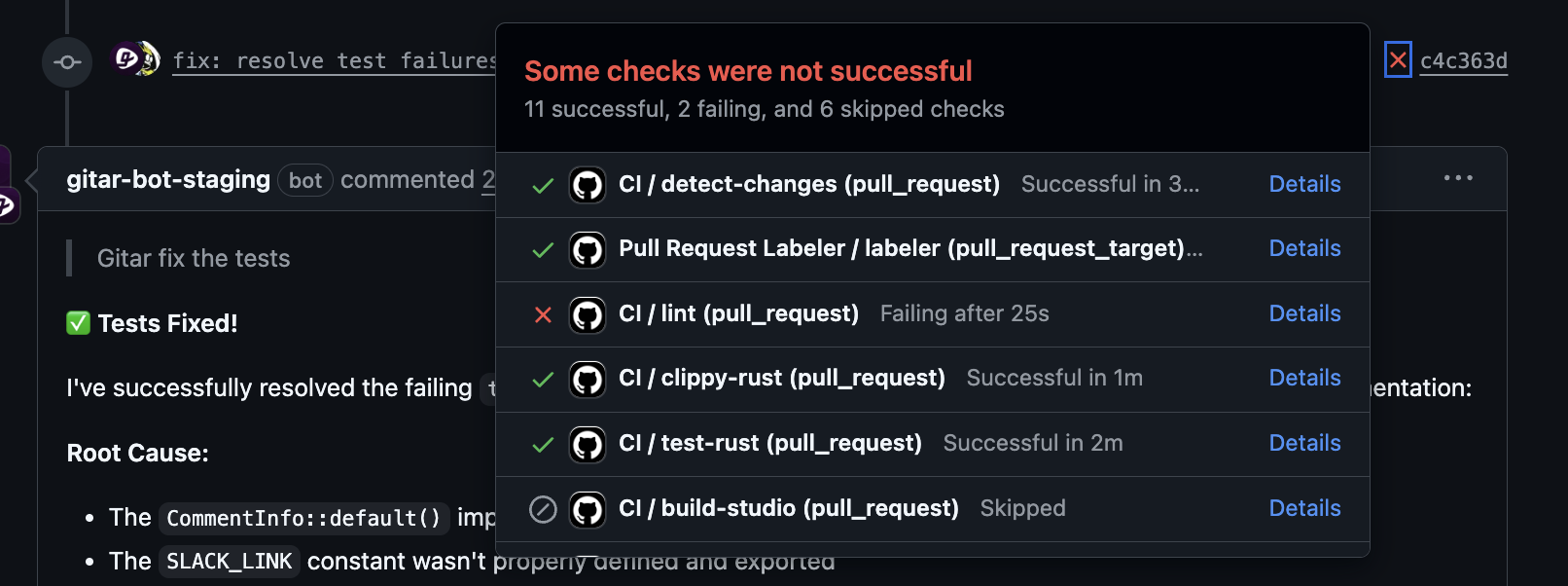
Install Gitar to reduce CI interruptions and support your team’s flow state.
Rolling Out Autonomous CI While Maintaining Trust
Successful adoption of autonomous CI is both a technical and organizational change. Teams benefit from a structured rollout that respects developer autonomy and measures clear outcomes.
Build confidence and measure impact
- Start in low-risk modes, such as suggestions or draft pull requests, then move to auto-commits for specific categories of issues like linting.
- Track metrics such as deployment frequency, lead time, CI failure resolution time, code review turnaround, and developer satisfaction.
- Monitor how often developers need to revisit work due to CI or review changes, and aim to reduce both interruption count and duration.
- Use these metrics to validate that autonomous fixes lower attention residue and free time for deep work.
Avoid common pitfalls
- Do not focus only on minutes saved. Consider the broader effect of 20–80% productivity loss from attention residue and cognitive load.
- Avoid forcing full automation from day one. Align the trust model with team comfort and introduce higher levels of autonomy gradually.
- Define KPIs for flow, including deployment cadence, failure recovery time, and developer sentiment around interruptions.
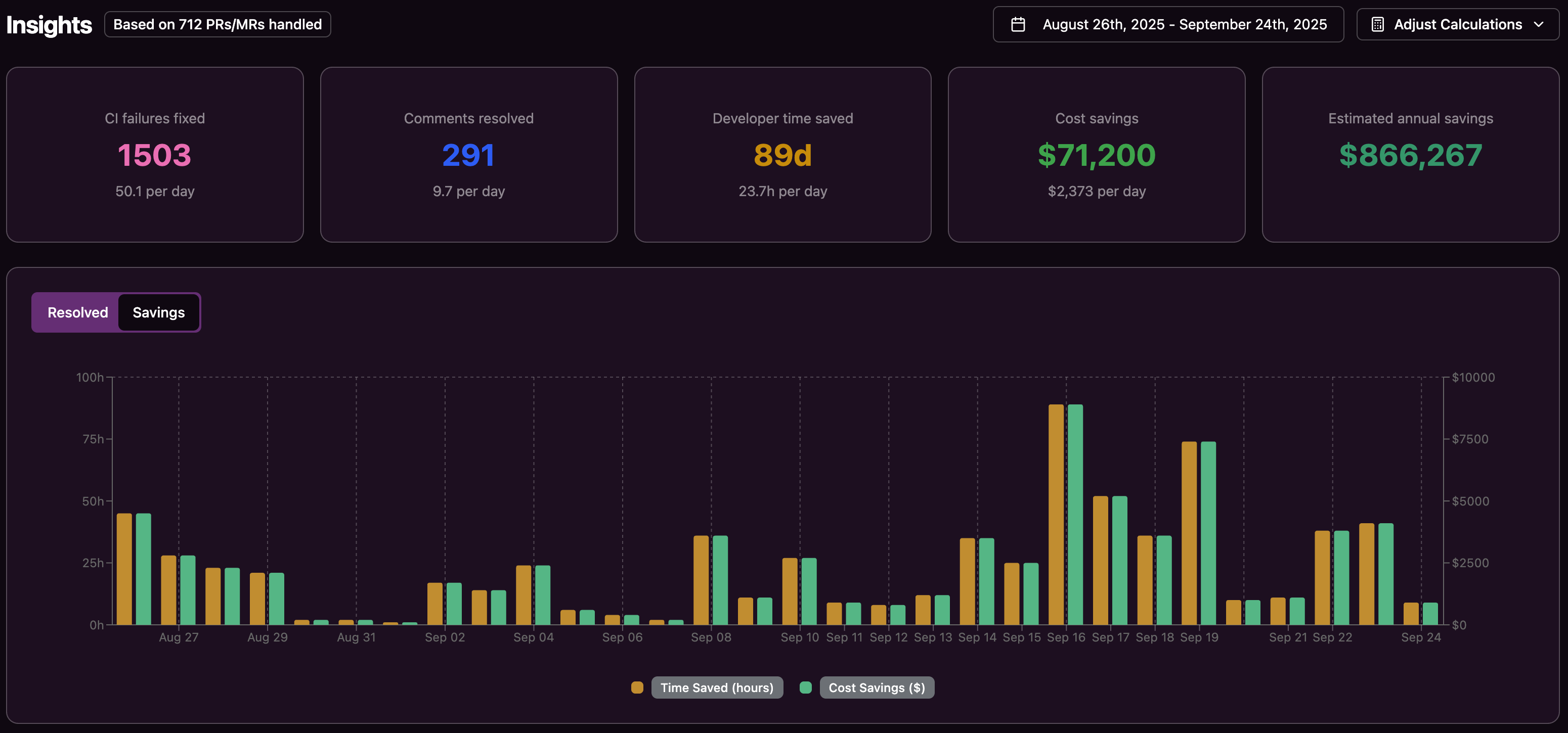
Gitar vs. The Status Quo: Impact on Flow State
This comparison highlights how different approaches affect context switching and flow.
|
Feature |
Manual workflow |
AI code reviewers |
Gitar autonomous CI |
|
Impact on flow state |
Frequent, disruptive context switching. |
Some reduction in effort, but many actions remain manual. |
Fewer interruptions by resolving many issues autonomously. |
|
Fix application |
Developers detect, debug, code, and re-push. |
Tools may suggest or apply limited fixes. |
Applies and validates fixes against CI workflows. |
|
CI validation |
Manual reruns. |
Often requires developer-triggered CI. |
Reruns CI after applying fixes when configured. |
|
Environment awareness |
Depends on individual developer knowledge. |
Varies by tool. |
Replicates enterprise CI environments for context-aware fixes. |
Is Your Organization Ready for Autonomous CI?
Assessing readiness helps ensure that Gitar supports, rather than disrupts, your existing practices.
Key assessment areas
- Context switching burden: Estimate time lost to CI failures and review loops. For a 20-person team, even one hour per day tied to these tasks can represent close to one million dollars in annual productivity loss.
- Team mindset and trust: Evaluate whether developers are open to AI assistance. Start with Gitar in suggestion-driven modes to demonstrate value while preserving control.
- CI/CD maturity: Confirm that pipelines are stable and observable, so Gitar can plug into clear workflows and policies.
- Stakeholder alignment: Align engineering leadership, managers, and contributors on goals such as fewer interruptions, faster feedback, and higher-quality releases.
Request a Gitar demo to evaluate autonomous CI in your own environment.
Frequently Asked Questions
Q1: How much productivity does context switching typically cost an engineering team?
A1: Developers often lose more than 23 minutes regaining focus after each interruption, and many teams see 45 to 90 minutes of usable time lost per developer per day. For groups handling several projects, up to 80% of energy can go into switching overhead. Gitar reduces this by resolving frequent CI and review interruptions automatically.
Q2: Can Gitar work with complex enterprise CI/CD environments and security tools?
A2: Gitar supports replication of complex pipelines, including specific JDK versions, multiple SDKs, and integrations with tools such as SonarQube or Snyk. Fixes run in an environment that closely mirrors your CI, which makes them safer to apply automatically once the team is comfortable.
Q3: How can we measure the ROI of adopting Gitar?
A3: Useful indicators include deployment frequency, CI failure resolution time, time to merge, and developer satisfaction. For a 20-developer team losing about one hour per person each day to CI and review churn, the productivity impact can approach one million dollars annually. If Gitar cuts that loss by half, the savings and morale improvements are substantial.
Conclusion: Support Flow State With Self-Healing CI
Flow state is a valuable but fragile asset for engineering teams. CI failures and drawn-out reviews create repeated context switches that slow delivery, increase errors, and erode morale.
Gitar introduces a practical form of self-healing CI by autonomously fixing many failures and acting on review feedback. Developers spend less time revisiting old work and more time on meaningful problems.
Install Gitar to help fix broken builds and support shipping software faster.