
Key Takeaways
- Manual intervention in CI/CD pipelines creates delays, context switching, and burnout, even in highly automated DevOps environments.
- Autonomous self-healing CI reduces time spent on broken builds and review rework by analyzing, fixing, and re-running pipelines without human input.
- Gitar uses an agent-based architecture that replicates real CI environments, applies changes, and validates them across major CI platforms.
- Engineering leaders can phase Gitar in gradually, measure ROI in hours and dollars saved, and support distributed teams across time zones.
- Teams can start reducing CI toil immediately by installing Gitar at https://gitar.ai/fix and enabling autonomous fixes on selected repositories.
Why Autonomous Self-Healing CI Is Essential for Modern DevOps
Modern CI/CD automates builds, tests, and deployments, yet still depends on human involvement to move code from commit to production. Many pipelines still need manual checks, approvals, and fixes before releases complete.
This dependence on manual work slows delivery, increases costs, and interrupts developer focus. AI-assisted coding tools now generate more code than ever, which increases the number of builds, failures, and review cycles. Each failure adds more human touchpoints and more time spent away from feature work.
Many teams follow CI/CD best practices but still rely on reactive monitoring and manual feedback loops. Automated steps provide faster feedback but still pause for human decisions at key stages. Developers get pulled back into old branches to debug failing builds and respond to comments instead of working on new tasks.
Install Gitar to start converting these manual CI steps into autonomous fixes.
The Hidden Costs of Manual Interventions in CI/CD Pipelines
Manual fixes in CI pipelines drain developer productivity through constant context switching. A single failed build can force a developer to stop current work, parse logs, patch code, and wait for another run. That cycle often turns short fixes into long interruptions and can consume a large share of the workday.
Operational processes add more friction. CI pipelines often include approval gates and manual validation stages before production. Teams frequently configure manual approval workflows that pause pipelines until people respond. These pauses stack across services, teams, and time zones.
This work also affects morale. Developers who spend large parts of the day on repetitive CI debugging and minor review changes report lower satisfaction and higher burnout. For global teams, time zone differences extend review loops even more, so simple comments can add days of delay.
Introducing Gitar: An Autonomous Self-Healing CI Solution
Gitar reduces CI toil by acting as an autonomous AI agent that fixes failing pipelines and applies review feedback directly in pull requests. The tool focuses on full resolution rather than suggestions, so builds return to a passing state without human intervention.
Key capabilities include:
- End-to-end fixing that analyzes failures, updates code, and re-runs CI until builds pass.
- Full environment replication for enterprise setups, including specific language versions, multiple SDKs, and tools such as SonarQube and Snyk.
- A configurable trust model that ranges from suggestion-only mode to automatic commits, so teams can adopt at their own pace.
- Intelligent code review support that applies review comments and reduces time zone delays for distributed teams.
- Support for major CI platforms such as GitHub Actions, GitLab CI, CircleCI, and Buildkite.

See how Gitar can fit into your existing pull request workflow.
How Gitar Delivers Autonomous CI Fixes
Gitar uses an agent-based architecture that tracks activity across users, jobs, and pipelines in real time. The system coordinates parallel stages, asynchronous events, and shared state so fixes remain consistent with the live CI environment.
Persistent context allows Gitar to reason about failures over time rather than treating each run as an isolated event. This approach keeps the agent aware of prior runs, configuration changes, and environment details.
When a CI check fails, Gitar follows a clear, automated flow:
- Analyze failure logs to identify the root cause.
- Propose specific code or configuration changes using the full CI context.
- Apply the changes to the pull request branch.
- Re-run the complete CI workflow to validate the fix.
- Commit the updates with an explanation of what changed and why.
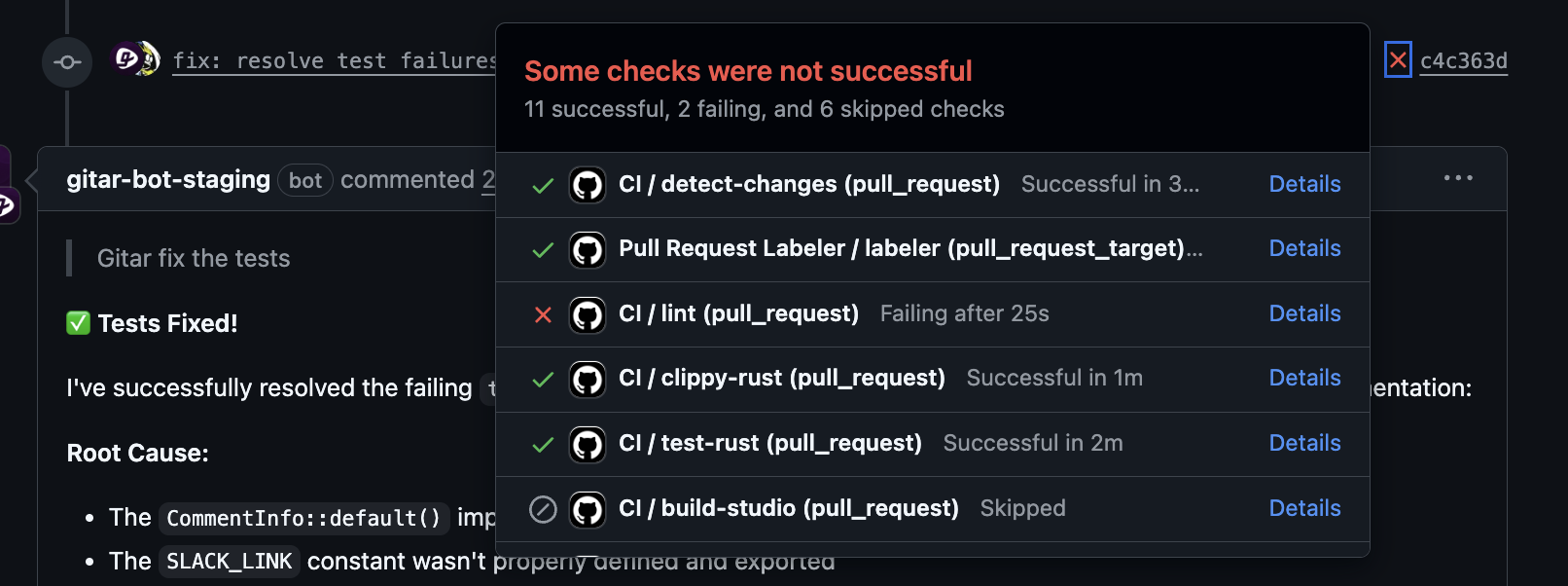
This process runs without using customer CI capacity for the investigation itself, which reduces both human time and infrastructure usage.
Strategic Implementation: Adding Gitar to Your DevOps Workflow
A phased rollout helps teams build confidence and understand impact before enabling fully autonomous fixes.
Phase 1 focuses on installation and initial configuration. Teams authorize Gitar as a GitHub App on selected repositories, connect existing CI systems, and start in suggestion-only mode. Early use centers on low-risk fixes such as lint corrections and straightforward test repairs.
Phase 2 centers on trust building. Teams review Gitar’s suggestions, approve them with one click, and monitor build outcomes. As reliability becomes clear, teams can enable automatic commits for defined scenarios, which reduces context switching and speeds up merges.
Phase 3 expands usage to advanced workflows. Reviewers can leave structured instructions in comments, and Gitar implements the requested changes. Distributed teams benefit from this pattern because work continues overnight, and developers return to already-updated pull requests.
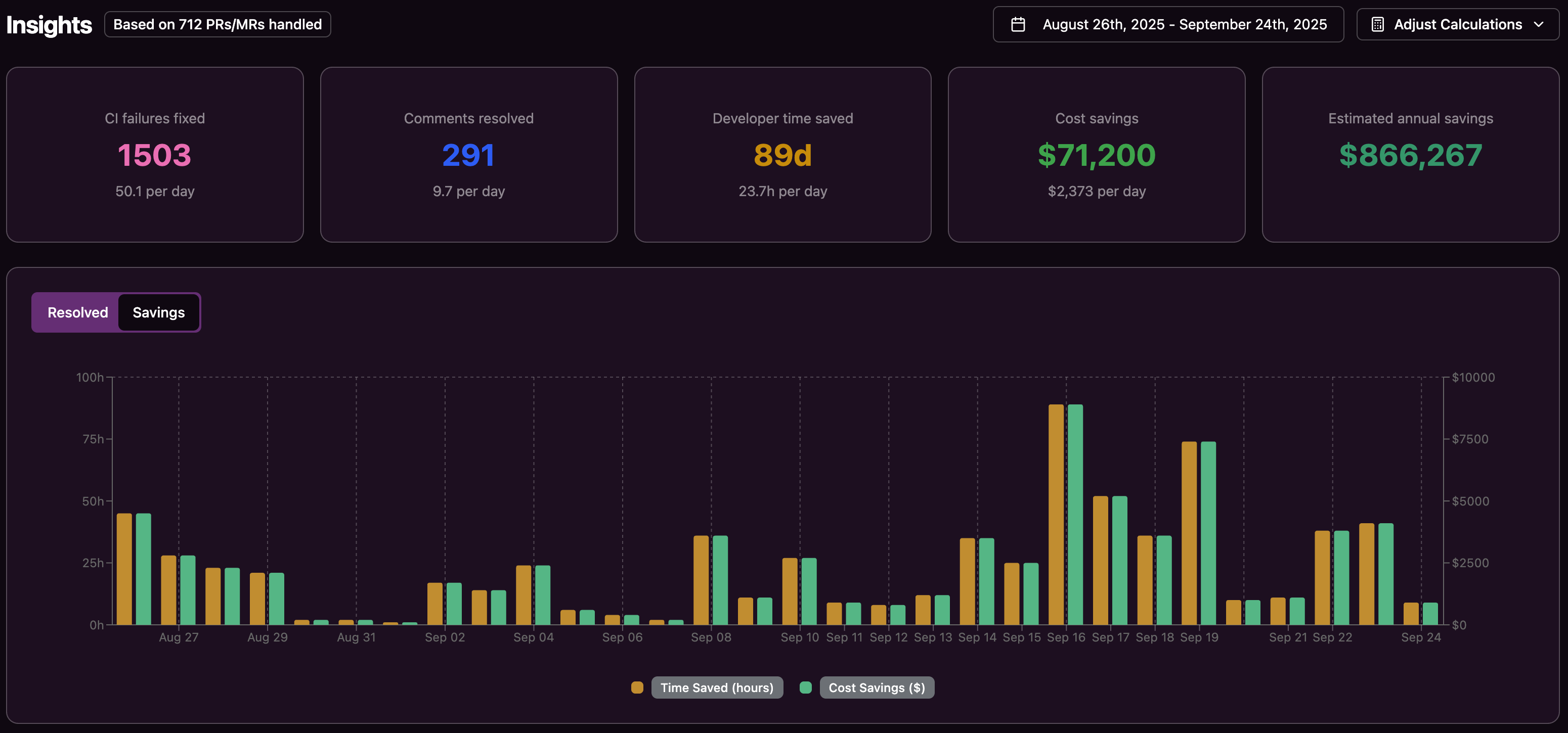
Engineering leaders can quantify impact with simple estimates. A team of 20 developers that spends an hour per day on CI failures and review rework loses about 5,000 hours per year. At a loaded cost of $200 per hour, that effort equals roughly $1 million in productivity. Cutting even half of that time through autonomous healing provides a meaningful return.
Autonomous vs. Current Approaches to CI Healing
Most tools in the CI ecosystem stop at suggestions. Gitar instead operates as a healing engine that drives problems to completion by applying and validating fixes.
|
Approach |
Level of automation |
Intervention required |
Validation method |
|
Manual work |
None |
Full investigation and fixes |
Developer testing |
|
AI code reviewers |
Suggestions only |
Implementation and validation |
Manual commit and CI run |
|
Gitar |
Complete fix cycle |
Configurable, from review to full auto-commit |
Full CI validation |
Manual Work in the Status Quo
Manual CI healing requires developers to stop feature work, dig through logs, change code, and push commits until builds pass. That effort reduces throughput and disrupts flow on every failure.
AI Code Reviewers and On-Demand Fixers
Code review tools and one-off AI fixers provide helpful suggestions but still rely on developers to apply and verify changes. Some also consume customer CI resources for each attempt. These tools improve insight but do not remove the manual “last mile.”
Autonomous Healing With Gitar
Gitar manages the full loop from diagnosis to passing build, without manual triggering. The system replicates the CI environment, tests its own fixes, and reports back with clear explanations. Teams decide when to approve, constrain, or fully automate these changes.
Install Gitar to move from suggestion-only tooling to autonomous CI healing.
Key Answers About Autonomous Self-Healing CI
Trust with engineering teams for automated fixes
Gitar uses configurable aggression levels so teams can start cautiously. Initial modes keep fixes in suggested form for human approval. Over time, teams can enable automatic commits for specific file types, repositories, or failure classes once they are comfortable with the results.
Support for complex CI setups
Gitar is designed for complex enterprise environments. The system mirrors language versions, SDKs, security scanners such as SonarQube and Snyk, and custom build tools. That depth of context helps it produce changes that align with real-world deployment constraints.
Difference from AI code review tools and LLM integrations
Gitar focuses on autonomous healing rather than recommendation. Traditional AI reviewers propose changes that developers still need to implement and test. Gitar instead applies fixes, runs the full CI workflow, and returns a passing build or further diagnostics.
Security and compliance in enterprise environments
Gitar respects existing access controls and approval workflows, and it supports on-premise deployment where needed. Audit logs record actions the system takes, and Gitar works alongside current security scanning tools to stay within established controls.
Conclusion: Regain Time by Automating CI Healing
Autonomous self-healing CI allows engineering teams to reduce manual work on broken builds and review follow-ups, so more time goes into shipping features. Gitar helps teams move from reactive debugging to a model where CI issues resolve in the background and builds stay green with less human effort.
Organizations that adopt this approach can improve developer experience, shorten delivery cycles, and reduce operational costs tied to CI toil.
Start using Gitar to automate CI fixes and reclaim engineering time.