
Key Takeaways
- Autonomous self-healing CI pipelines use AI to detect, diagnose, and fix CI failures so teams spend less time on manual debugging and more time on feature work.
- Most engineering teams lose hundreds of hours each year to CI and code review issues, which creates delays, higher costs, and lower developer morale.
- Effective self-healing systems need an agent architecture that manages real-time events, complex environments, and concurrent workflows across multiple teams.
- A phased rollout that starts with suggestions, then moves to auto-commits, helps teams build trust in autonomous CI while keeping control and visibility.
- Teams can adopt this model today with Gitar, an autonomous CI agent that fixes broken builds and code review feedback automatically: Install Gitar and start reducing CI toil.
Why Autonomous Self-Healing CI Matters Now
Growing engineering teams face a clear productivity problem. Developers often spend up to 30% of their time on CI and code review issues instead of building features. For a 20-person team, this time loss can reach about $1M per year in reduced productivity.
AI coding tools like GitHub Copilot generate code faster, but they also create more pull requests, test runs, and failures. The main constraint has shifted from writing code to validating and merging it. Many teams now face a persistent right-shift bottleneck in CI.
Teams that want to reduce manual troubleshooting can add an autonomous CI agent that fixes failures directly in their existing pipelines. Install Gitar to automatically repair broken builds and keep work moving.
What Is an Autonomous Self-Healing CI Pipeline?
An autonomous self-healing CI pipeline uses AI to detect, analyze, and resolve CI/CD issues without requiring manual intervention. Instead of waiting for a developer to inspect logs, propose a change, and rerun checks, the system handles that loop automatically.
Gitar follows this model as a CI agent that fixes CI failures and addresses code review feedback with configurable automation. The agent applies code changes, validates them in your CI workflows, and commits successful fixes back to the branch so developers see green checks instead of red failures.

How Autonomous Remediation Works in Practice
Effective CI agents rely on architecture built for live, changing environments. They must handle force pushes during runs, new comments on pull requests while jobs are executing, and ongoing updates that change the context in real time.
These agents coordinate concurrent operations, asynchronous events that can arrive out of order, and wave-based execution where multiple job stages run in parallel but share state. Gitar uses its own agent harness, context and state management system, and memory layer to track these details and respond to CI events as they happen.
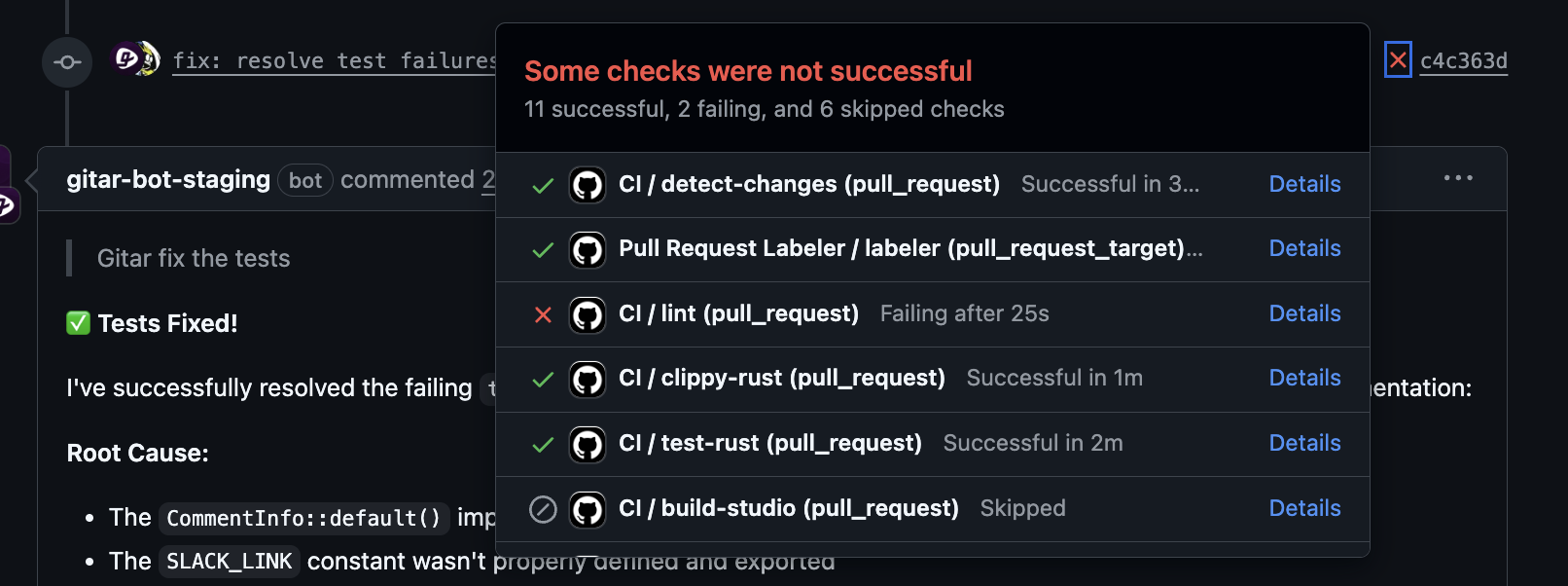
When a CI check fails, Gitar inspects logs, identifies the likely root cause, drafts a code change, and applies a fix for issues such as linting errors or failing tests. The agent then commits the fix to the pull request branch and reruns CI, so developers receive an updated, passing build.
Environment awareness is critical for reliable fixes. Gitar emulates complex workflows that include specific JDK versions, multiple SDKs, and tools such as SonarQube or Snyk. This replication helps ensure that proposed fixes match the organization’s real infrastructure instead of relying on generic assumptions.
Strategic Benefits and ROI for Engineering Leaders
Autonomous self-healing CI directly affects both delivery speed and cost. A team with 20 developers that spends one hour per person each workday on CI and code review issues loses about 5,000 hours per year. At a loaded cost of $200 per hour, that is roughly $1M in productivity loss.
If an autonomous CI agent cuts that burden in half, the team can reclaim about $500K in value annually. Teams also see indirect benefits: fewer context switches, less firefighting, and improved developer satisfaction because engineers spend more time on design and feature development.
How Autonomous CI Compares to Other Approaches
|
Feature Category |
Traditional CI/CD (Manual) |
AI Suggestion Tools |
Gitar (Autonomous Self-Healing) |
|
Problem Resolution |
Manual debug and fix |
Suggests fixes, manual implementation |
Automatically applies, validates, and commits fixes |
|
CI Validation |
Manual re-runs |
Limited validation, developer remains responsible |
Runs full CI workflows and keeps builds green |
|
Context Switching |
High |
Moderate |
Low, with minimal interruptions |
|
Time Savings |
None |
Modest |
Significant, often up to hours per developer per day |
Teams that adopt autonomous remediation can move from reactive triage to a more predictable, automated development flow. Install Gitar to reduce manual CI work and improve delivery speed.
How to Implement Self-Healing CI in Your Organization
Successful adoption usually follows a phased path. Teams start with conservative automation to build trust, then expand coverage and autonomy as they see consistent, reliable results.
Phase 1: Installation and Initial Trust
Teams begin by authorizing Gitar as a GitHub App on selected repositories. The web dashboard lets organizations choose conservative, suggestion-only mode, where Gitar proposes fixes that developers review and apply.
During this phase, teams connect Gitar to existing CI systems such as CircleCI, GitHub Actions, GitLab CI, or BuildKite. Repository-level rules and configuration prompts describe project-specific workflows and policies so the agent can reason about context before changing code.
Phase 2: Expanding Confidence Through Real Pull Requests
The clearest proof often appears on the first real pull request. When a developer opens a PR, Gitar adds a comment that acts as a live status thread. If a linting job fails, Gitar replies within minutes with a suggested patch. The developer can accept it with a click and continue working without leaving the current context.
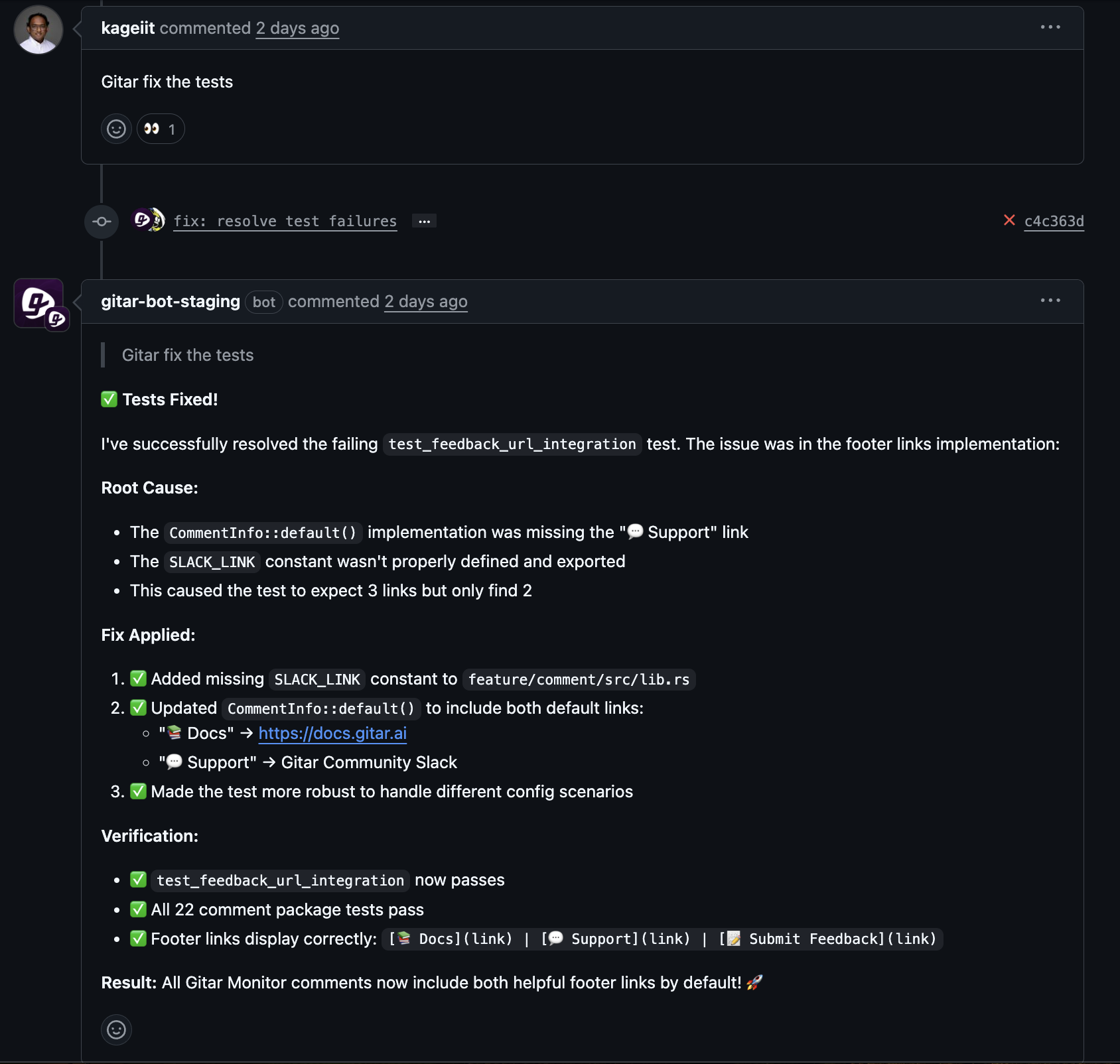
As teams see reliable fixes across style issues, small refactors, and test failures, they can enable auto-commit mode on selected repositories. In this mode, Gitar commits changes directly while keeping rollback options in place so teams maintain control.
Phase 3: Advanced Workflows and Distributed Teams
Once basic fixes are trusted, teams can use Gitar for richer interactions. A senior engineer can leave a review comment such as “@gitar refactor this function to use a map instead of a for-loop” and Gitar applies the refactor, updates tests if needed, and runs CI.
Distributed teams benefit from this model. Reviewers in one time zone can leave comments at the end of their day, and Gitar executes the requested updates and CI runs overnight. Developers in another region return to ready-to-review changes instead of open issues.
Common Pitfalls to Avoid With Autonomous CI
Even strong engineering organizations see challenges when they first introduce autonomous remediation. Awareness of typical missteps helps teams plan a smoother rollout.
Skipping the Trust-Building Stage
Moving directly to aggressive auto-commit mode can create resistance. Most teams benefit from a staged approach that starts with suggestions, then limited auto-commits on low-risk repositories, and finally broader automation once results are proven.
Overlooking Enterprise Complexity
Generic AI tools often struggle with enterprise setups that use custom SDK versions, multiple languages, and layered security checks. Gitar addresses this by mirroring enterprise workflows so its fixes align with how builds actually run.
Stopping at Suggestions Instead of Automated Solutions
Suggestion-only tools still require developers to apply and validate every change. Gitar takes the next step by applying fixes, running CI, and updating the pull request so the team receives a working result instead of just advice.
Underinvesting in Integration
Fragmented tools reduce the value of automation. Gitar connects version control platforms such as GitHub and GitLab with CI providers like CircleCI and BuildKite to form a single, coordinated workflow.
Frequently Asked Questions (FAQ) About Self-Healing CI Pipelines
How can AI handle complex, enterprise-grade CI pipelines?
Gitar’s agent architecture manages concurrent jobs, asynchronous events, and wave-based execution. It replicates enterprise details such as JDK versions, SDK dependencies, and security or quality scans so fixes are tailored to the real environment and more likely to pass CI.
How is Gitar different from AI code reviewers?
Many AI code reviewers propose changes but do not run CI or update branches. Gitar operates as a healing engine that applies fixes, triggers CI, and commits successful changes so teams receive passing builds instead of manual to-do lists.
What if my team is cautious about automated fixes?
Gitar supports conservative and aggressive modes. Teams can begin with suggestion-only behavior, then move to auto-commits on specific repositories once they are comfortable with the quality of fixes, while keeping visibility and rollback controls.
How does self-healing CI help distributed teams?
Distributed teams can rely on Gitar to act on review comments between time zones. Reviewers leave feedback, Gitar implements updates and runs CI, and developers in other regions return to pull requests that are ready for final review or merge.
How does autonomous CI handle the extra code from AI coding assistants?
AI coding assistants increase code volume and, in many cases, the number of CI failures. Gitar absorbs much of this additional validation work by diagnosing failures and applying fixes automatically, so teams can reap the benefits of faster coding without a proportional increase in CI overhead.
Conclusion: Make CI a Strength Instead of a Bottleneck
Autonomous self-healing CI helps engineering teams ship reliably without constant firefighting. By automating failure analysis and remediation, tools like Gitar reduce manual toil, shorten feedback loops, and free developers to focus on design and feature work.
Organizations that adopt this approach gain faster, more predictable delivery and a better developer experience. Install Gitar to add autonomous self-healing to your CI pipelines and keep your builds moving forward.