
Key Takeaways
- Manual CI troubleshooting and frequent context switching create significant productivity loss and erode developer focus.
- Automated pre-merge checks act as a quality gate, helping teams handle the growing volume of AI-assisted code while keeping standards high.
- Self-healing CI and “healing engines” reduce interruptions by detecting, fixing, and validating issues without manual intervention.
- Phased rollout, clear success metrics, and trust-building settings help organizations adopt automation safely in complex enterprise environments.
- Gitar provides autonomous CI fixing and review assistance, helping teams implement automated pre-merge checks quickly; get started at gitar.ai/fix.
Why Automated Pre-Merge Checks Now Matter for Code Quality and Flow
Developer interruptions and the “CI/CD gauntlet”
Many developers push a pull request with confidence, then see a wall of failed checks. A missing dependency, a flaky test, or a linter rule turns into a loop of reading logs, switching back to the editor, fixing, repushing, and waiting for CI again. This cycle breaks concentration and stretches a simple fix into a long interruption.
Most teams still work in a “fire and forget” pattern. Developers open a PR, start a new task, then get pulled back by failing checks or review comments. Each interruption forces a context switch, which adds cognitive overhead and reduces deep work. Across a 20-person team, this hidden tax can reach hundreds of thousands of dollars per year in lost productivity.
More generated code, more pressure on validation
Tools like GitHub Copilot have shifted the bottleneck from writing code to reviewing and validating it. More code means more PRs, tests, and potential failures. Quality checks before merge now act as the main control point for maintaining standards without slowing delivery.
Distributed teams feel this pressure more. A PR from the US that needs feedback from India can stretch across several days because each round of changes waits on time zones. AI tools that only suggest changes still require manual edits and re-runs, so delays remain.
From Manual Reviews to Self-Healing CI
Shift-left, in-PR, and shift-right working together
Effective quality strategies cover the full lifecycle. Local tests and linters catch issues early. Automated checks in the pull request act as the last gate before merge. Production monitoring and error tracking provide feedback after release.
Automated pre-merge checks sit at the center of this system. These checks verify style, tests, security, and performance signals before code reaches the main branch, which reduces rework and incidents later.
Healing engines vs. suggestion engines
Many tools act as suggestion engines. They highlight problems or propose patches, but developers still need to apply changes, push branches, and wait to see if builds pass. This pattern keeps interruptions in place.
Healing engines work differently. These systems identify issues, generate fixes, apply them to the branch, and validate the result in CI. Developers see a passing PR instead of a failing one and do not need to leave their current task to handle small breakages.
How Gitar Enables Self-Healing CI and Automated Pre-Merge Checks
Gitar focuses on turning CI and review feedback into automated, end-to-end fixes instead of new to-do items for developers. It detects failures, applies changes, and re-runs checks so teams spend less time on mechanical troubleshooting.
Key capabilities that reduce interruptions
End-to-end fixing: Gitar inspects failing checks, analyzes logs, proposes a code change, and pushes commits back to the PR branch. It handles lint issues, unit and integration test failures, build errors, and dependency conflicts.
Full environment replication: Gitar reproduces complex enterprise CI setups, including specific JDK versions, multiple SDKs, third-party scanners, and snapshot tests. This context helps ensure that fixes match real pipelines rather than idealized environments.
Configurable trust model: Gitar supports conservative and aggressive modes. In conservative mode, it posts suggested changes that developers can review and accept with one click. In aggressive mode, it commits directly, while still providing clear diffs and allowing rollback.
Intelligent review assistance: Reviewers can mention Gitar in PR comments to request an initial AI review or to implement specific feedback, such as refactors or minor fixes. This assistance shortens review cycles, especially when reviewers and authors work in different time zones.

Get started with Gitar to add self-healing checks to your existing GitHub or GitLab workflows.
Strategic Choices When Adding Automated Pre-Merge Checks
Build vs. buy for CI automation
Leaders often choose between building internal automation or adopting a dedicated platform. Custom solutions must manage concurrent jobs, asynchronous events, and complex orchestration across CI providers. They also require ongoing maintenance and staffing.
Specialized tools such as Gitar connect to GitHub, GitLab, and major CI systems with minimal setup. This approach keeps teams focused on product work while relying on a platform that evolves with new languages, frameworks, and CI providers.
Enterprise integration and scale
Large organizations need automation that works across many repositories, teams, and workflows. Gitar is designed to operate on multiple concurrent PRs, handle complex dependency graphs, and respect existing security, compliance, and approval rules.
Measuring ROI and team impact
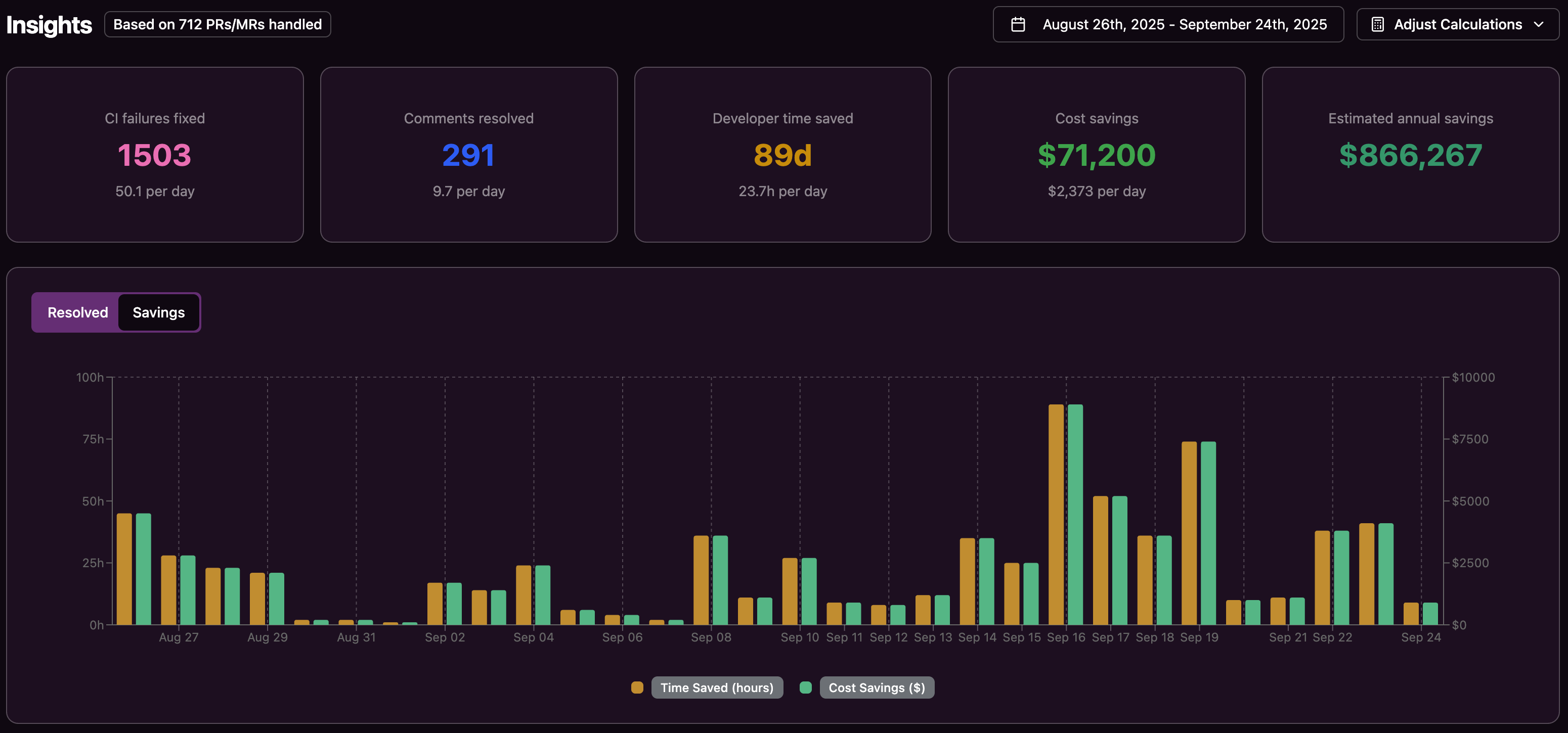
Clear metrics help show the value of automated pre-merge checks. Common indicators include build success rate, time from PR open to merge, and the number of post-release issues linked to missed checks.
For a 20-developer team, even one hour per day spent on CI and review friction can translate into roughly $1M in annual productivity cost. Cutting that by half with automation yields savings in the hundreds of thousands of dollars, alongside higher developer satisfaction.
Implementation Guide: Rolling Out Automated Checks with Gitar
Phase 1: Install and build initial trust
Teams typically start by installing Gitar as a GitHub App on a limited set of repositories. The web dashboard helps configure conservative suggestion-only mode, which lets developers review and accept changes without giving up control.
Pilot projects should reflect common workflows but not be tied to critical deadlines. This step-by-step rollout builds familiarity before automation touches high-risk code paths.
Phase 2: Scale automation after the “aha” moment
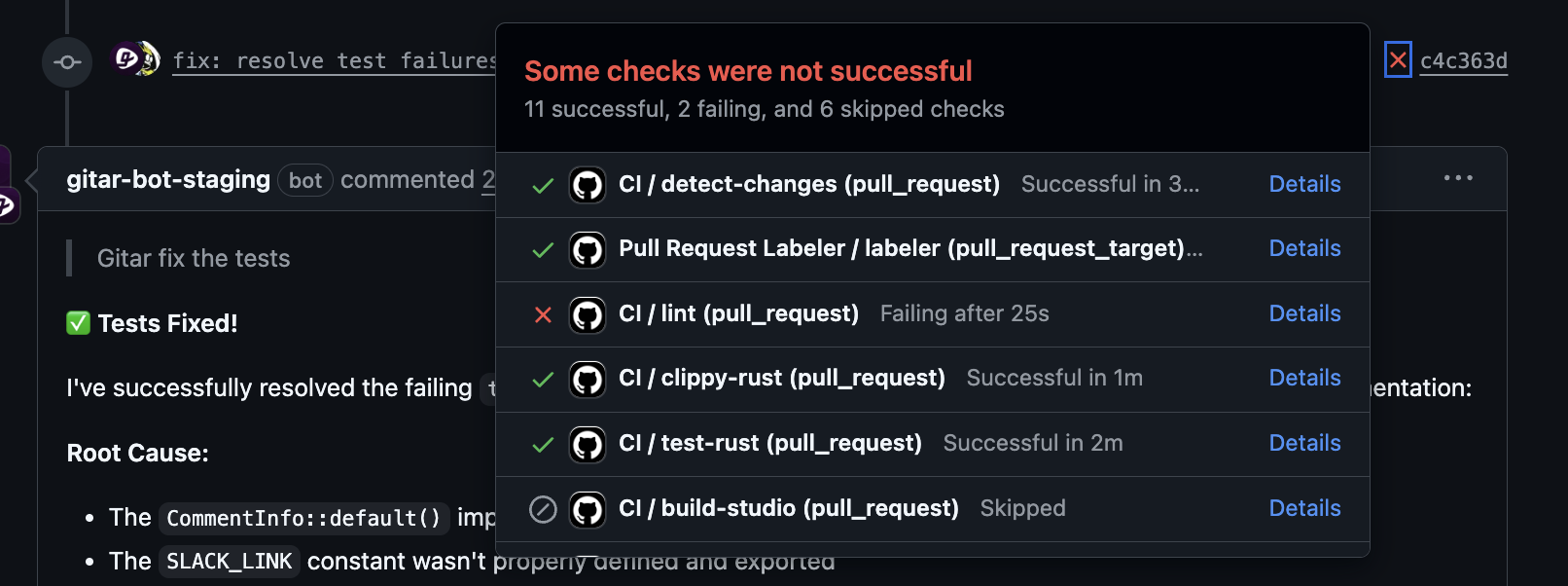
Adoption grows once developers experience a failed lint or test check getting fixed automatically, with an updated PR ready for review. After enough successful small fixes, teams often enable more aggressive modes where Gitar commits changes directly.
Phase 3: Use advanced workflows for reviews and refactors
Mature setups rely on Gitar for more than basic fixes. Senior engineers can leave targeted instructions in comments, such as refactoring a method or applying a pattern, and Gitar implements the change and updates the PR.
Distributed teams benefit when reviewers leave feedback at the end of their day and wake up to updated branches that already address their comments.
Try Gitar on a pilot repository to see automated pre-merge checks in action.
Healing Engines vs. Suggestion Engines: Impact on Developer Time
Healing engines change workflows by resolving issues end to end instead of only recommending changes. The table below summarizes key differences.
|
Feature |
Gitar (Healing Engine) |
AI Code Reviewers |
On-Demand AI Fixers |
|
Autonomous CI fixing |
Applies, validates, and commits fixes |
Provides suggestions only |
Requires manual trigger and follow-up |
|
Implements review comments |
Updates code directly from comments |
Suggests edits but does not apply them |
Limited context for broader changes |
|
Environment awareness |
Replicates complex enterprise workflows |
Little or no CI environment context |
Basic environment support |
|
Cross-platform CI support |
Supports GitHub, GitLab, CircleCI, Buildkite |
Focuses primarily on Git providers |
Often GitHub-only |
Common Pitfalls When Adding Automated Pre-Merge Checks
Ignoring cognitive load and burnout
Tracking only visible time spent on CI issues underestimates the cost. Each interruption forces developers to reload context, which can double actual time lost compared with the minutes shown in logs.
Skipping trust-building steps
Enabling fully autonomous changes on day one can create pushback. A phased approach, starting with suggestions and moving to auto-commits after proven success, improves adoption and confidence.
Using tools without enterprise context
Solutions that cannot mirror real CI environments may miss issues or introduce new ones. Enterprise teams need support for language mixes, custom scanners, compliance checks, and organization-specific rules.
Not measuring impact
Lack of baseline metrics makes it hard to demonstrate value. Tracking build success rates, mean time to merge, and incident rates before and after automation provides a clear picture of impact.
Frequently Asked Questions About Gitar and Automated Pre-Merge Checks
Q: We already use AI reviewers; why do we need Gitar?
A: AI reviewers highlight issues and draft changes, but they still rely on developers to apply edits and re-run CI. Gitar acts as a healing engine that applies, validates, and commits fixes so developers see more passing builds and fewer interruptions.
Q: How does Gitar handle our complex CI setup?
A: Gitar models your CI environment, including language versions, SDKs, third-party tools, and multi-job workflows. It maintains context across runs so that fixes it applies match real conditions in your pipelines.
Q: How can we measure the ROI of using Gitar?
A: Teams typically compare time-to-merge, failure rates, and time spent on CI issues before and after rollout. Many organizations see large reductions in time lost to repeated failures and review back-and-forth, alongside improved developer satisfaction scores.
Conclusion: Make Pre-Merge Checks Work for Developers, Not Against Them
Modern development demands reliable automation at the pull request stage. Automated pre-merge checks and self-healing CI reduce the drag of failed builds, repeated fixes, and review delays while keeping quality high.
Gitar helps teams shift from reactive debugging to proactive, automated quality assurance. With thoughtful rollout, clear metrics, and a trust-first configuration, engineering leaders can regain significant developer time and reduce frustration across the team.