

Written by: Ali-Reza Adl-Tabatabai, Founder and CEO, Gitar
Key Takeaways on Qodo PR-Agent vs Healing Engines
- Qodo PR-Agent delivers industry-leading bug detection with a 60.1% F1 score, outperforming the next-best solution by 9 points in benchmarks.
- The multi-agent architecture catches cross-repository bugs and security issues that many single-model tools miss.
- Key limitations include suggestion-only fixes that require manual implementation and noisy inline comments that clutter pull requests.
- Pricing starts at $30-38 per user monthly for the Teams tier, and ROI often drops once you factor in ongoing manual work.
- Teams that want to close this manual implementation gap should evaluate autonomous fix platforms and try Gitar’s 14-day trial to compare the difference.
Why Developers Praise Qodo PR-Agent’s Detection Power
Developer feedback consistently highlights Qodo’s strength in finding bugs that other tools miss. The platform’s multi-agent architecture delivers measurable gains in identifying critical issues across complex codebases.
- Industry-leading detection accuracy: Qodo 2.0 achieved the highest F1 score among evaluated solutions, with a 9-point lead over the next-best competitor on comprehensive benchmarks.
- Multi-repository awareness: Qodo 2.0 understands dependencies across multiple repositories and flags integration bugs that other tools miss.
- Comprehensive issue coverage: Benchmarks span 100 PRs with 580 injected issues across logical errors, edge cases, race conditions, resource leaks, and error handling.
- Enterprise-scale impact: A Fortune 100 retailer reports higher code quality and faster developer velocity after rolling out Qodo.
Recent GitHub community feedback reinforces these strengths. One senior developer shared, “Caught security vulnerabilities that Copilot completely missed in our authentication flow.” A team lead added, “The multi-repo context actually works, and it flagged breaking changes across our microservices that would have caused production issues.”
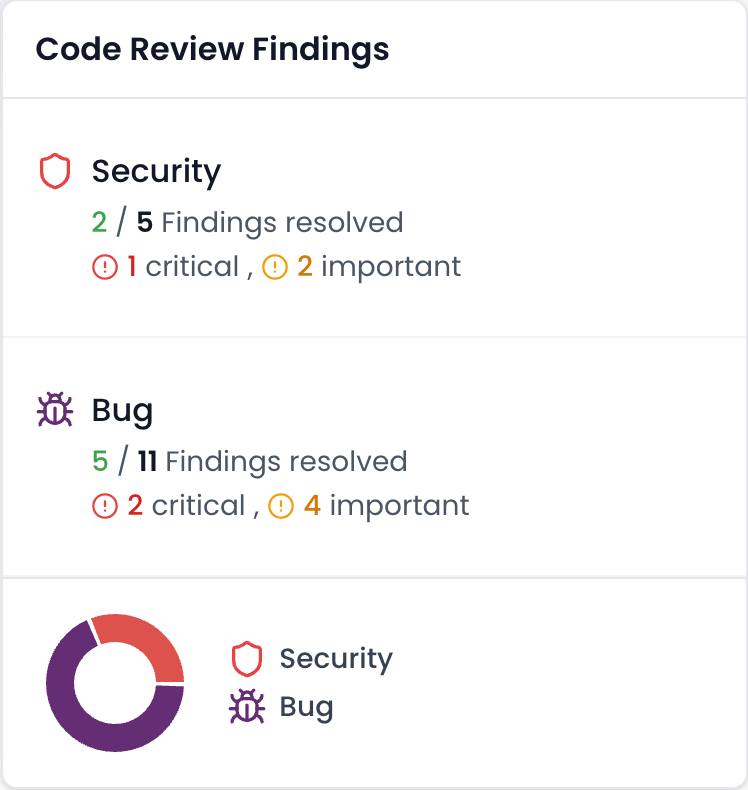
The platform’s specialized agents for different issue categories further sharpen detection. Qodo’s multi-agent harness dispatches focused agents for logical errors, best-practice violations, edge cases, and cross-file dependencies. This structure produces more targeted and accurate findings than generalist approaches that rely on a single model.
Qodo PR-Agent Limitations & Common Developer Complaints
While Qodo’s detection capabilities stand out in benchmarks, real-world usage reveals friction points that reduce the value of those findings. Despite detection strengths, developer experiences reveal consistent workflow issues. The following table groups these limitations by category and shows how each one creates tangible friction during daily reviews:
| Limitation Category | Specific Issues | Developer Impact |
|---|---|---|
| Implementation Gap | Suggestions only, no auto-fixes | Manual work remains after review |
| Comment Management | Multiple inline comments per PR | Notification spam, cognitive overload |
| Platform Support | Advanced features supported on GitHub, GitLab, and Bitbucket | Multi-platform support available |
Real developer feedback from 2026 forums echoes these themes. One Reddit user wrote, “Too many inline comments make PRs unreadable. We’re paying $30/dev for noise.” A GitHub discussion thread added, “Still doing manual fixes after every suggestion, so where is the automation?”
The confidence gap also remains large. Qodo’s 2025 State of AI Code Quality report shows that 88.2% of developers have low confidence in shipping AI-generated code without human review. This finding signals persistent trust issues even when detection quality looks strong on paper.
Context handling creates another constraint. In the same 2025 survey, 65% of developers using AI for refactoring said the assistant misses relevant context. This result suggests that even sophisticated multi-agent systems still struggle to maintain a complete understanding of large, evolving codebases.
Qodo Pricing, Credits & How to Judge ROI
Qodo’s pricing structure targets enterprise teams but often raises questions about value once you factor in the manual implementation gap discussed earlier. The table below highlights how each tier increases detection capabilities while keeping fix implementation manual across the board:
| Tier | Monthly Cost | Credits/Features | Value Proposition |
|---|---|---|---|
| Developer | $0 | 30 PRs, 75 credits | Limited evaluation |
| Teams | $30-38 per user | 2,500 credits, unlimited PRs | Suggestions require manual fixes |
| Enterprise | Custom, contact sales | SSO, analytics, on-premise | Advanced detection, manual implementation |
The credit system adds another layer of complexity to cost planning. Premium models like Claude Opus consume 4-5 credits per request, so the Teams plan’s 2,500 credits support roughly 500-625 premium requests monthly per user.
To evaluate ROI, start by calculating time spent on manual implementation after receiving suggestions, because this hidden cost never appears on pricing pages. This calculation becomes critical as PR review time has increased 91% due to AI-generated code floods, which means teams already face heavier review loads. Against this backdrop, you need to decide whether suggestion-only tools actually reduce workload or simply add another layer of manual effort when your team still owns every fix.
2026 Benchmarks & Real-World Qodo Use Cases
Recent 2026 benchmark data gives you concrete metrics for evaluating Qodo’s detection performance. Qodo 2.0 achieved the highest recall of 56.7% on a 2026 benchmark that evaluated AI code review tools on full pull requests, which shows strong issue identification compared to competing platforms.
Real-world usage, however, exposes gaps in practical automation. Teams report success with PR summaries and security scanning but frustration with the manual implementation gap discussed above. One enterprise developer summarized the experience: “Great at finding the needle in the haystack, but we still have to pull it out ourselves.”
The platform performs well in specific contexts. Small teams value comprehensive summaries, and larger organizations benefit from cross-repository analysis. Teams using AI code review tools can cut time spent on finding defects while improving detection rates, yet most of that time savings stays on the identification side rather than on actual resolution.
Qodo vs Gitar: Suggestion Engines vs Healing Engines
When you compare Qodo with alternatives, focus on how deeply each platform automates the path from detection to resolution. The key distinction lies between suggestion engines that point out problems and healing engines that implement fixes and validate them.
| Capability | Qodo PR-Agent | Gitar |
|---|---|---|
| PR Summaries | Yes | Yes (14-day trial) |
| Bug Detection | Industry-leading (see benchmarks above) | Yes (14-day trial) |
| Auto-Apply Fixes | No | Yes |
| CI Failure Auto-Fix | No | Yes |
| Single Clean Comment | No | Yes |
| Full Team Trial | Limited free tier | 14-day complete access |
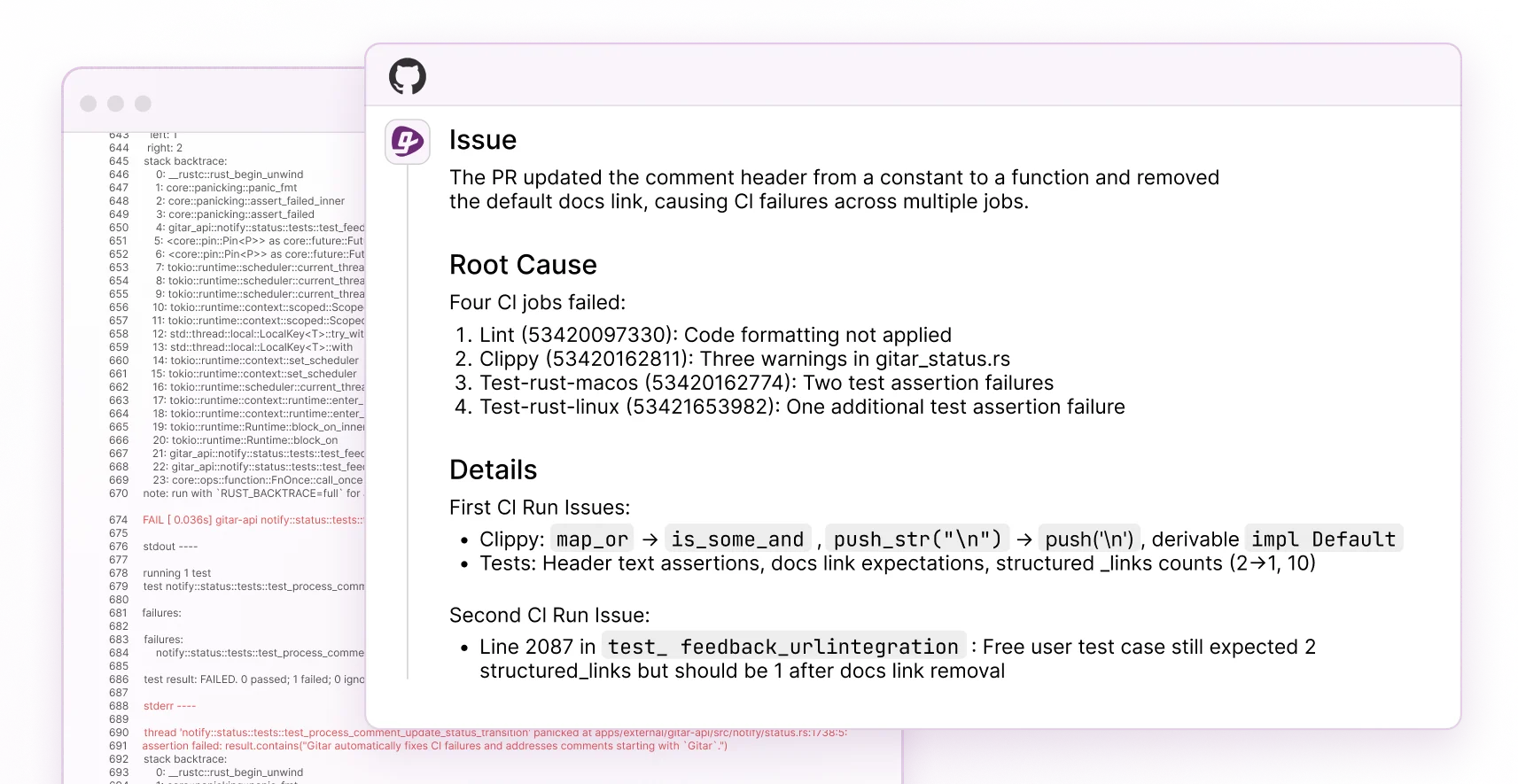
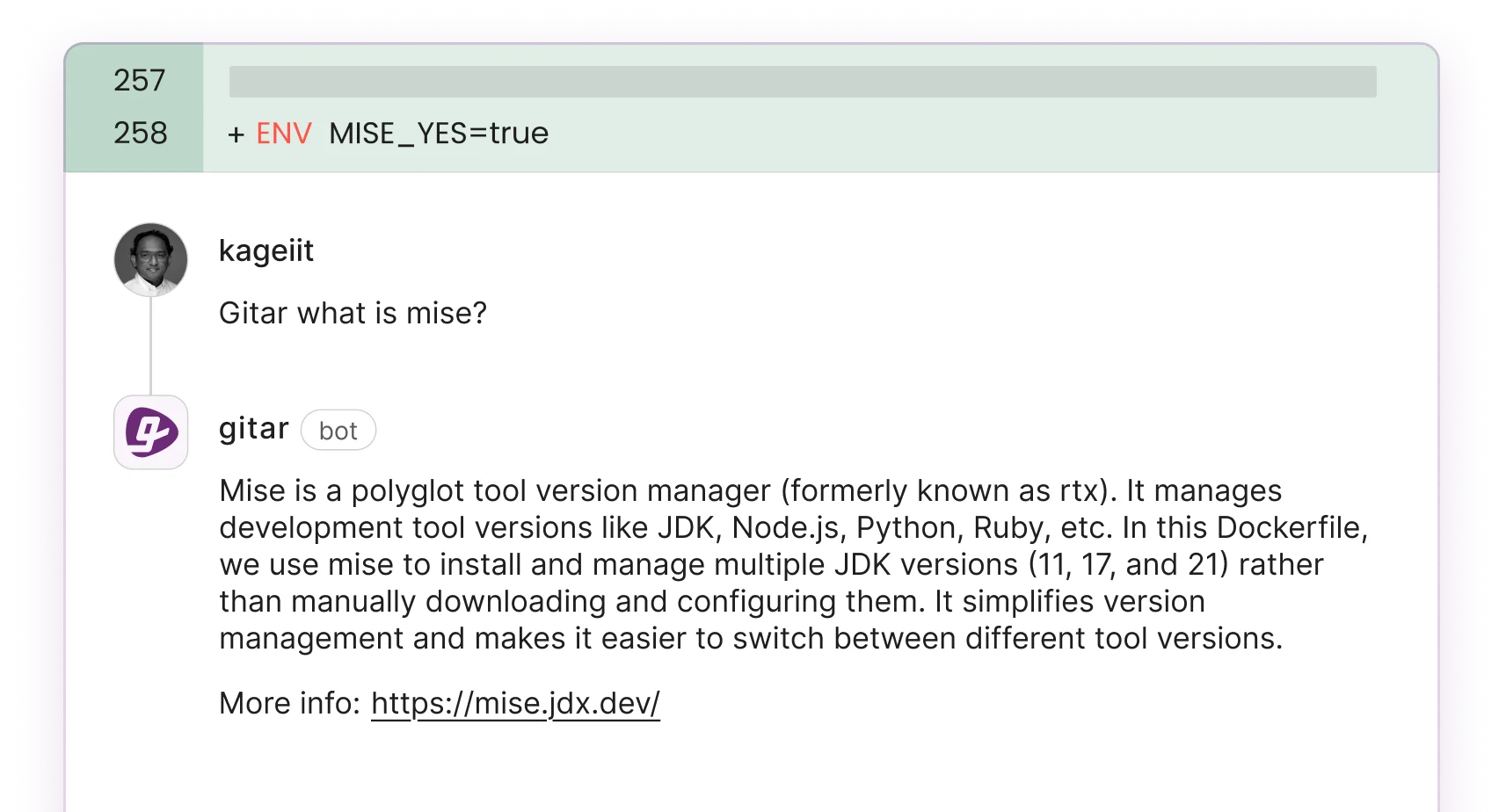
Gitar’s healing engine represents the next step beyond suggestion-only platforms. Qodo focuses on identifying issues, while Gitar automatically applies fixes, validates them against CI, and ships only green builds. Gitar also consolidates all findings into a single updating comment, which removes the notification overload that many teams experience with scattered inline suggestions.
To evaluate platforms, run side-by-side tests that measure autonomous capabilities. Suggestion engines keep manual work in your backlog, while healing engines remove that work from your queue. Start your 14-day trial to experience the difference between suggestions and actual fixes.
Decision Framework for Choosing Qodo or Gitar
Base your code review platform choice on automation depth rather than detection metrics alone. Qodo delivers strong bug identification but remains locked in a suggestion-only model, while healing engines focus on implementing fixes for you.
Start by identifying your team’s primary need. Detection-focused teams that mainly want to uncover more issues will benefit from Qodo’s advanced multi-agent system that excels at finding problems. However, if your main goal is reducing manual work instead of just surfacing more defects, automation-focused teams should prioritize Gitar’s healing engine, which removes implementation work entirely.
Next, factor in total cost. Cost-conscious teams must weigh the $30-38 per user monthly for suggestion-only workflows against the time savings from comprehensive automation, because the cheaper subscription can still cost more in developer hours. Finally, enterprise teams should examine whether suggestion workflows can scale as codebases and headcount grow, or whether autonomous fix implementation becomes necessary to keep review throughput under control.
The core decision centers on whether you pay for issue identification or for issue resolution. Qodo focuses on identification, while autonomous platforms like Gitar deliver end-to-end resolution. Install Gitar now, automatically fix broken builds, and start shipping higher quality software faster.
Frequently Asked Questions
What are the main limitations of Qodo PR-Agent that developers report?
Developers consistently report three primary limitations: suggestion-only fixes that require manual implementation, excessive inline comments that create notification spam, and platform restrictions with advanced features concentrated on GitHub. The core issue is that Qodo identifies problems but leaves the actual fixing work to developers, which creates a persistent gap between detection and resolution and reduces productivity despite strong bug-finding capabilities.
How much does Qodo cost and what’s included in each tier?
Qodo uses a tiered model with a Developer tier at $0 that provides 30 PRs and 75 credits monthly, a Teams tier at $30-38 per user monthly with 2,500 credits and unlimited PRs, and Enterprise pricing around $45 per user monthly with SSO and on-premise options. The credit system means premium AI models consume 4-5 credits per request, so the Teams tier supports roughly 500-625 premium requests monthly per user.
What are the best alternatives to Qodo for automated code review?
The key distinction is between suggestion engines like Qodo and healing engines like Gitar that implement fixes for you. Qodo delivers strong bug detection but still requires manual implementation of every suggestion. Gitar provides autonomous fix implementation, CI failure resolution, and consolidated feedback in a single comment instead of scattered inline notes. Teams should evaluate tools based on whether they primarily need issue identification or complete issue resolution.
How accurate is Qodo’s bug detection compared to other AI code review tools?
Qodo 2.0 demonstrates industry-leading detection accuracy, achieving a 60.1% F1 score with a 9-point lead over the next-best competitor in comprehensive benchmarks. The platform’s multi-agent architecture and cross-repository awareness help it catch integration bugs and security vulnerabilities that other tools miss. However, high detection accuracy does not automatically translate into productivity gains when developers still handle manual implementation for every suggested fix.
Is Qodo worth the cost for development teams?
Qodo’s value depends on your automation requirements and available developer capacity. At $30-38 per user monthly, it provides strong bug detection and PR summaries, and some enterprise customers report meaningful hour savings on reviews. Teams still need to factor in the ongoing manual work required to implement suggestions, which can erode ROI. If your primary goal is issue identification and your team can absorb manual fixes, Qodo can deliver solid value. If you need autonomous resolution that removes manual work from your backlog, platforms with auto-fix capabilities often provide better long-term value even with higher upfront pricing.