
Written by: Ali-Reza Adl-Tabatabai, Founder and CEO, Gitar
Key Takeaways for AI Auto-Fix Tools on GitHub
- Most developers now rely on AI coding assistants daily, yet 66% spend extra time fixing “almost right” AI code, which creates a new productivity bottleneck.
- Leading AI tools for GitHub auto-fixes include Gitar for validated CI fixes, GitHub Copilot Autofix for security, Aider for CLI commits, SWE-agent for issue-to-PR automation, and several others with different trial options.
- Gitar stands out with a 14-day Team Plan trial that delivers CI-validated auto-fixes, green build guarantees, and support for GitHub Actions, GitLab CI, CircleCI, and Buildkite.
- Teams should compare tools on auto-fix depth, GitHub integration, CI support, validation accuracy, and noise reduction. Gitar is the only option in this list that provides fully validated commits across supported CI systems.
- Teams that want green PRs without manual CI debugging can start a Gitar trial today and let automatic CI healing handle failing checks.
How To Evaluate AI Auto-Fix Tools for GitHub
Teams should evaluate AI tools that offer a free trial by focusing on a clear set of capabilities. Key dimensions include auto-fix depth, GitHub integration quality, CI pipeline support, validation accuracy, and noise reduction, such as a single dashboard comment instead of scattered notification spam. Extra features like custom rules and analytics help larger teams align fixes with internal standards.
This evaluation framework separates tools that only suggest changes from tools that deliver working, validated solutions. Refer to Gitar's release notes, public GitHub repositories, and 2026 benchmarks such as Devin's 70% resolution rate and Graphite's 55% fix rate to compare real-world performance.
Overview of 7 Top AI Auto-Fix Tools in 2026
Seven tools currently lead the market for automatically fixing code issues on GitHub. Gitar offers a healing engine with validated CI auto-fixes during its trial period. GitHub Copilot Autofix focuses on security vulnerability fixes. Aider provides CLI-based git edits and commits. SWE-agent automates issue-to-PR workflows. autofix.ci handles trivial PR fixes. CodeRabbit's free tier offers suggestions with one-click apply, and OpenHands supports autonomous agent PRs.
These tools span a spectrum from suggestion-only workflows to fully validated commits that run through your CI. Start a 14-day Gitar Team Plan trial to see validated auto-fixes that keep builds green.
Tool-by-Tool Breakdown and Use Cases
1. Gitar: Healing Engine for CI-Validated Auto-Fixes
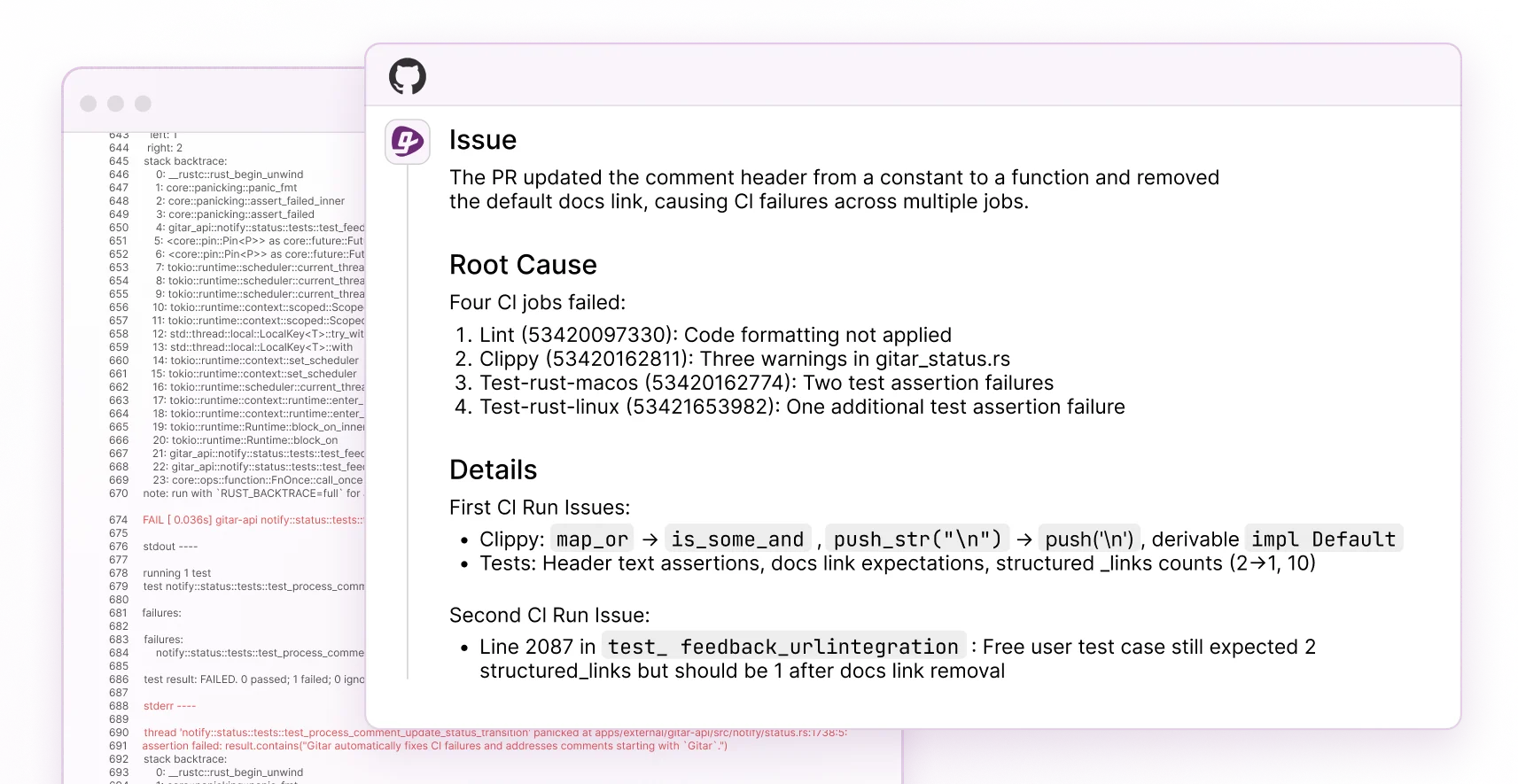
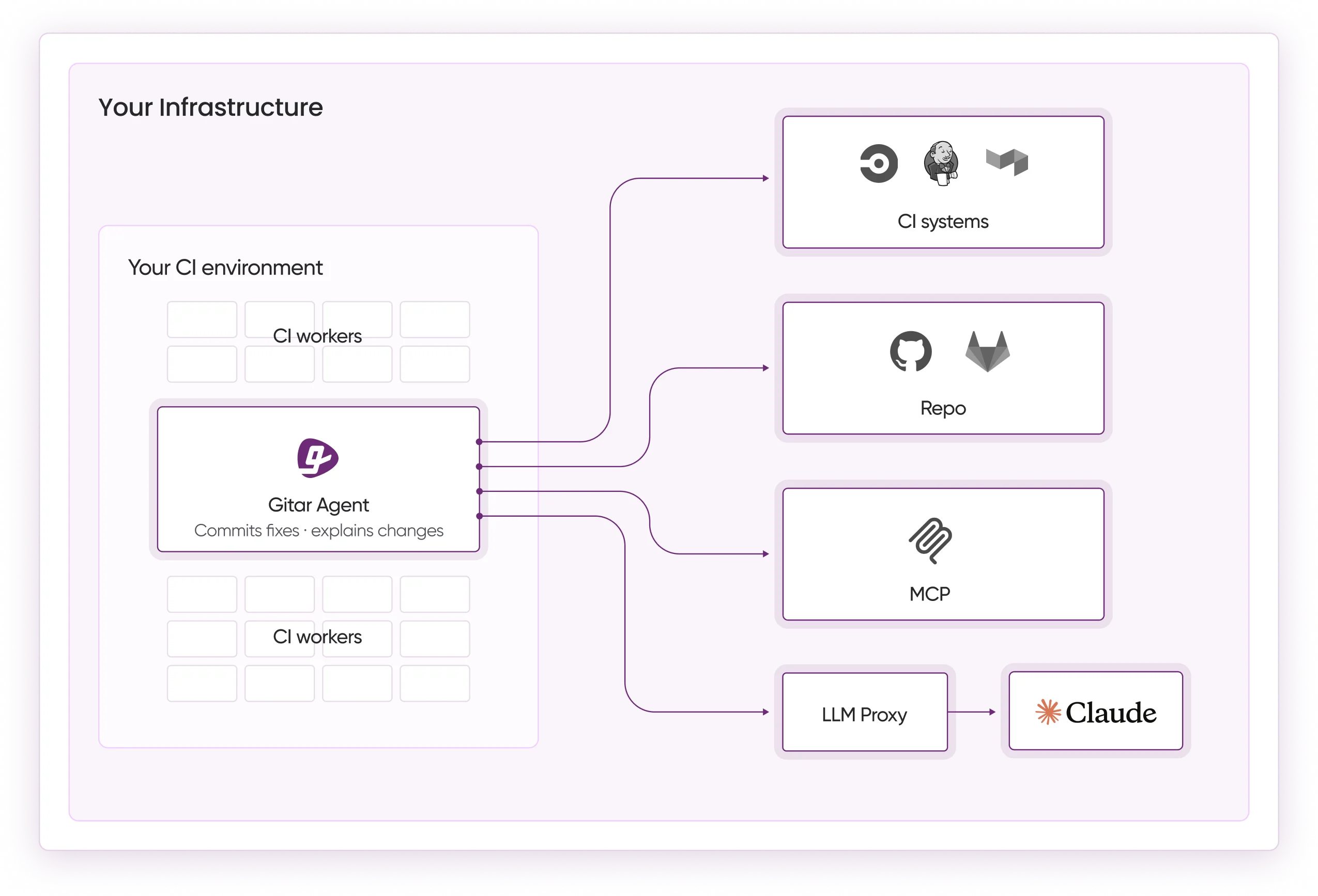
Gitar acts as an AI-powered healing engine that automatically fixes code issues on GitHub and validates them through your CI. During its trial period, Gitar runs inside your existing pipelines and treats CI as the source of truth for whether a fix works.
Unlike suggestion engines, Gitar's CI agent maintains full context from pull request creation to merge, keeps CI green, finds root causes of failures, applies fixes, and verifies results inside the team's own CI environment. The platform offers a comprehensive 14-day trial of the Team Plan with no seat limits. Setup involves installing the Gitar GitHub App, which immediately starts posting a single dashboard comment on PRs.
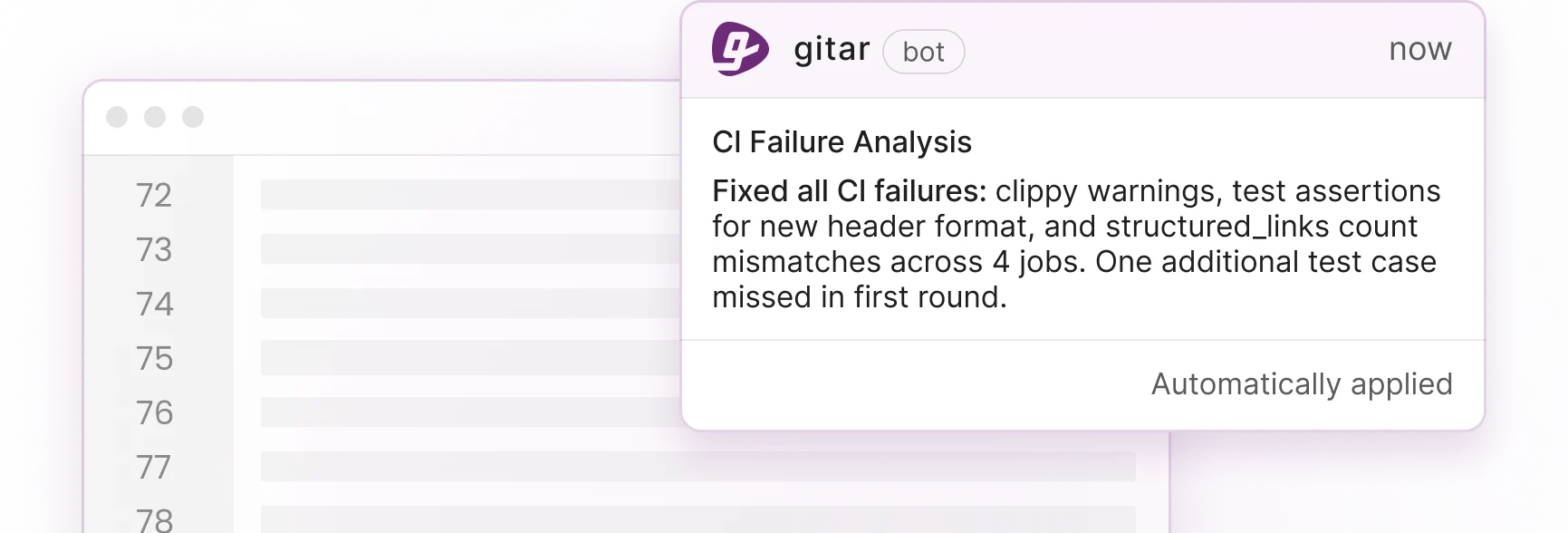
Gitar added CI failure analysis on October 2, 2025, so the agent now analyzes failures automatically and surfaces insights in the dashboard comment, updating as new commits arrive. Key features include automatic CI failure detection and fixing, validated commits that guarantee green builds, a single consolidated comment, natural language repository rules, and integrations with Jira, Slack, and Linear.
Gitar supports GitHub Actions, GitLab CI, CircleCI, and Buildkite, and the trial covers unlimited public and private repositories.
2. GitHub Copilot Autofix: Security-Focused Fixes
GitHub Copilot Autofix targets security vulnerabilities detected in your codebase. It connects directly to GitHub's security scanning and can generate fixes for common vulnerability patterns without leaving the GitHub interface.
The Copilot free tier includes Agent Mode with autonomous multi-step coding using models such as GPT-4.1, Claude Opus 3.5, Gemini 2.0 Flash, and Grok Code Fast 1, limited to 50 chat requests and 2,000 completions per month. Setup requires enabling GitHub Advanced Security and Copilot access. The free tier covers basic security autofix workflows, while broader CI failure handling typically requires paid plans.
3. Aider: Command-Line Git Automation
Aider.chat is a free open-source command-line AI coding assistant with built-in Git integration. It supports local open-weight frontier models like Qwen3-Coder and Devstral through Ollama and focuses on precise code edits.
Aider analyzes repository context, applies requested changes, and commits results with descriptive messages. Setup involves installing via pip and configuring API keys for your chosen models. The tool supports multiple languages and can perform complex refactors, but it does not integrate directly with GitHub-specific CI workflows.
4. SWE-agent: From GitHub Issue to Pull Request
SWE-agent specializes in turning GitHub issues into complete pull requests automatically. The agent reads issue descriptions, inspects the codebase, implements a solution, and opens a PR with working code.
Setup requires granting repository access and configuring model credentials. SWE-agent works well for autonomous bug fixing and test-driven development on structured benchmarks such as SWE-bench. It struggles with CI failures and code review feedback, so it fits best for well-defined issues with clear acceptance criteria.
5. autofix.ci: Lightweight Pull Request Fixes
autofix.ci focuses on simple automated fixes for common PR issues such as formatting, linting, and basic code quality problems. The GitHub App runs on new PRs and commits fixes for trivial issues automatically.
Setup involves installing the autofix.ci GitHub App and choosing which fix types to enable. The tool works well for straightforward problems but does not address complex CI failures or deep architectural issues. The service offers core functionality at no cost for public repositories.
6. CodeRabbit Free Tier: Suggestions with One-Click Apply
CodeRabbit has connected over 1 million repositories and processed more than 5 million pull requests, offering a free tier with basic PR summaries and suggestions. It delivers line-by-line comments, PR summaries with architectural diagrams, and one-click commits for simple fixes, plus a “Fix with AI” option for more complex changes.
The free tier includes limited monthly reviews and focuses on suggestion quality. CodeRabbit reports 46% bug detection accuracy across its user base as of 2026, which highlights its strength in surfacing issues rather than providing CI-validated auto-fixes.
7. OpenHands: Autonomous Agent Pull Requests
OpenCode, an open-source AI coding agent, integrates with GitHub Actions for automated workflows on issues and pull requests. It supports Anthropic, OpenAI, Google Gemini, AWS Bedrock, Groq, and local models via Ollama, so teams can choose their preferred model provider.
OpenHands excels at complex, multi-file changes and agent-based workflows. It requires more setup and configuration than simpler tools, so it suits teams that already invest in custom automation and are comfortable managing autonomous agents.
AI Auto-Fix Comparison for 2026
| Tool | Auto-Commit | CI Auto-Fix | Free Duration | Green Build Guarantee |
|---|---|---|---|---|
| Gitar | Validated | Yes | 14-day full trial | Yes |
| GitHub Copilot Autofix | Limited | Security only | 50 requests/month | No |
| Aider | Yes | No | Unlimited (OSS) | No |
| SWE-agent | Yes | No | Unlimited (OSS) | No |
| autofix.ci | Yes | Basic only | Unlimited (public) | No |
| CodeRabbit | One-click | No | Limited monthly | No |
| OpenHands | Yes | No | Unlimited (OSS) | No |
Teams that prioritize CI reliability and validated fixes gain the most from Gitar's comprehensive trial. Solo developers often prefer open-source options like Aider for basic git automation, while security-focused teams should weigh GitHub Copilot Autofix for vulnerability management.
Key Considerations and Tradeoffs for Different Teams
Different team types emphasize different parts of this evaluation framework. Solo developers care most about trial length, setup complexity, and local model support. Larger teams focus on scalability, workflow integration, and how well the tool fits existing review and CI practices. DevOps teams pay close attention to CI pipeline compatibility and validation accuracy.
The main tradeoff centers on trust versus automation depth. Suggestion-only tools require manual validation but give reviewers full control over every change. Auto-commit tools like Gitar resolve issues faster but depend on trust in AI-generated fixes that pass CI.
METR's 2025 study reported a 19% net slowdown for experienced developers using AI tools, driven partly by reviewer burden and context switching. This finding shows why teams need automation that reduces manual overhead instead of adding more review work.
Cost analysis should include the hidden expense of manual fix implementation. Teams that spend significant developer time on CI failures and review feedback often find that validated auto-fix solutions cost less overall than suggestion tools that still require manual debugging. Let Gitar's healing engine handle CI failures during a risk-free trial instead of paying engineers to debug them by hand.
Frequently Asked Questions
What is the best AI tool for automatically fixing GitHub CI failures?
Gitar currently provides the most complete solution for automatically fixing GitHub CI failures during its trial period. It analyzes CI failure logs, generates validated fixes, and commits working solutions that guarantee green builds. The platform supports GitHub Actions, GitLab CI, CircleCI, and Buildkite with real-time failure detection and automatic resolution.
Which AI tools actually commit code fixes instead of only suggesting them?
Several tools can commit fixes automatically, including Gitar with CI validation, Aider with command-line git integration, SWE-agent for issue-to-PR automation, autofix.ci for basic fixes, and OpenHands for autonomous PRs. Only Gitar validates fixes against CI pipelines before committing, which helps ensure that changes resolve the underlying issues rather than introducing new problems.
How should teams evaluate AI auto-fix tools for GitHub?
Teams should assess auto-fix depth, GitHub integration quality, CI pipeline support, validation accuracy, noise reduction, and features such as custom rules. Effective evaluation includes testing on real repository issues, measuring time saved, and comparing the manual effort required after suggestions with the effort required when using automatic fixes.
What is the difference between Gitar and suggestion-only tools like CodeRabbit?
Gitar operates as a healing engine that detects, fixes, and validates code issues with guaranteed green builds. CodeRabbit functions as a suggestion engine that identifies problems and leaves comments for developers to implement manually. Gitar maintains full CI context and commits working solutions, while CodeRabbit focuses on analysis and recommendations that still require manual testing.
How long do trial periods last for AI code-fixing tools?
Trial lengths vary widely. Gitar provides a comprehensive 14-day trial of the full Team Plan with no seat limits. GitHub Copilot offers 50 requests per month on its free tier. Open-source tools such as Aider and SWE-agent allow unlimited usage. CodeRabbit's free tier includes limited monthly reviews, and autofix.ci offers unlimited basic fixes for public repositories.
Can AI tools automatically fix security vulnerabilities in GitHub repositories?
Several tools address security issues automatically. GitHub Copilot Autofix focuses on vulnerabilities detected by GitHub's scanning tools. Gitar's analysis can include security-related issues and validated fixes during its trial period. Security fixes still require careful validation, so tools with CI integration and verification provide more reliable coverage for production environments.
Conclusion and Next Steps for Your Team
The shift from code generation to code validation now defines the next stage of developer productivity. Teams should match tools to their goals, whether they need validated auto-fixes for CI reliability, high-quality suggestions for code review, or deep integration for workflow automation.
The most effective approach starts with hands-on testing of top auto-fix solutions on real repository issues. Measure time savings, accuracy, and developer satisfaction to identify which tool fits your workflow best.