
Written by: Ali-Reza Adl-Tabatabai, Founder and CEO, Gitar
Key Takeaways
- AI-generated code has increased PR review times by 91%, and autonomous tools like Gitar cut this backlog by auto-fixing issues.
- Gitar leads as the top Meegle alternative with CI failure analysis, automatic commits, and guaranteed green builds instead of suggestions only.
- Alternatives such as Greptile and CodeRabbit provide useful insights but still require manual fixes, which keeps review work high.
- Gitar offers zero-setup GitHub integration, a 14-day Team Plan trial, and strong ROI through lower CI costs and higher developer productivity.
- Teams move from suggestion engines to true healing engines with Gitar’s 14-day trial, accelerating delivery while improving software quality.
How To Rank AI Code Review Tools for 2026
Evaluation criteria prioritize autonomous capabilities over suggestion engines. Assess auto-fix depth, including CI failure analysis and automatic commits. Review platform integrations spanning GitHub, GitLab, CircleCI, and Buildkite. Pricing and ROI metrics, contextual memory systems, noise reduction through consolidated feedback, and scalability for mid-size teams all factor into rankings.
Sources can include Gitar documentation, independent benchmarks, and verified customer testimonials. Rankings reflect autonomous capabilities and measurable velocity improvements. Based on these criteria, here are the top seven alternatives that teams should evaluate next.
7 Best Meegle Alternatives for Autonomous AI Code Review in 2026
1. Gitar: Autonomous Healing Engine for CI and PRs
Gitar operates as a true healing engine that automatically fixes code instead of only suggesting changes. The platform maintains full context from PR creation to merge. It works continuously to keep CI green by finding root causes, implementing fixes, and verifying results within your team’s CI environment.
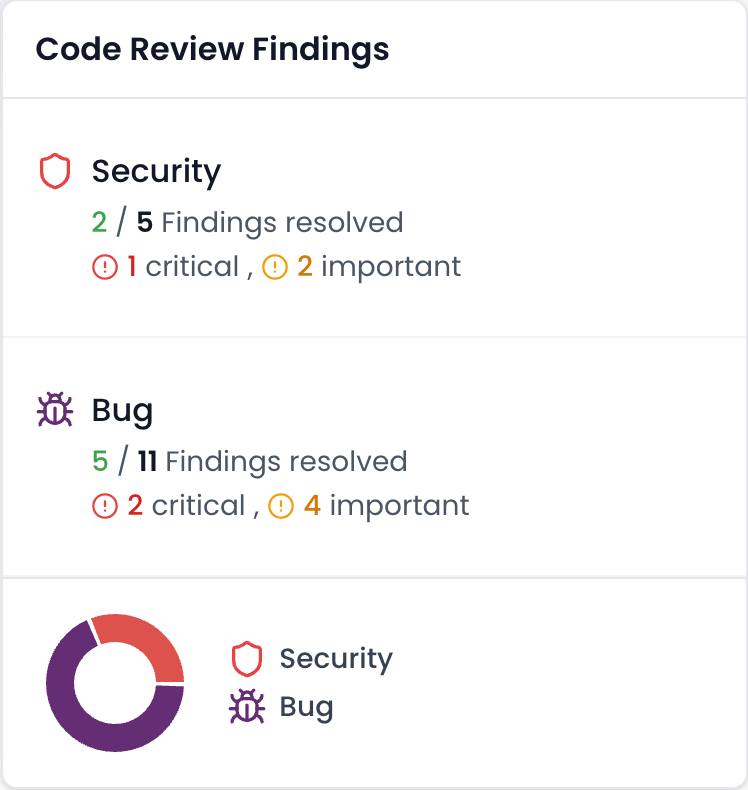
Gitar’s autonomous capabilities center on its CI healing engine, which analyzes failures and auto-fixes them with build guarantees. To reduce noise during this process, it uses a single updating dashboard comment that replaces scattered notification spam. Teams customize this automation through natural language repository rules that encode workflow policies. Comprehensive analytics help identify recurring CI patterns and bottlenecks. All of this runs through native integrations with GitHub, GitLab, CircleCI, Buildkite, Jira, and Slack.
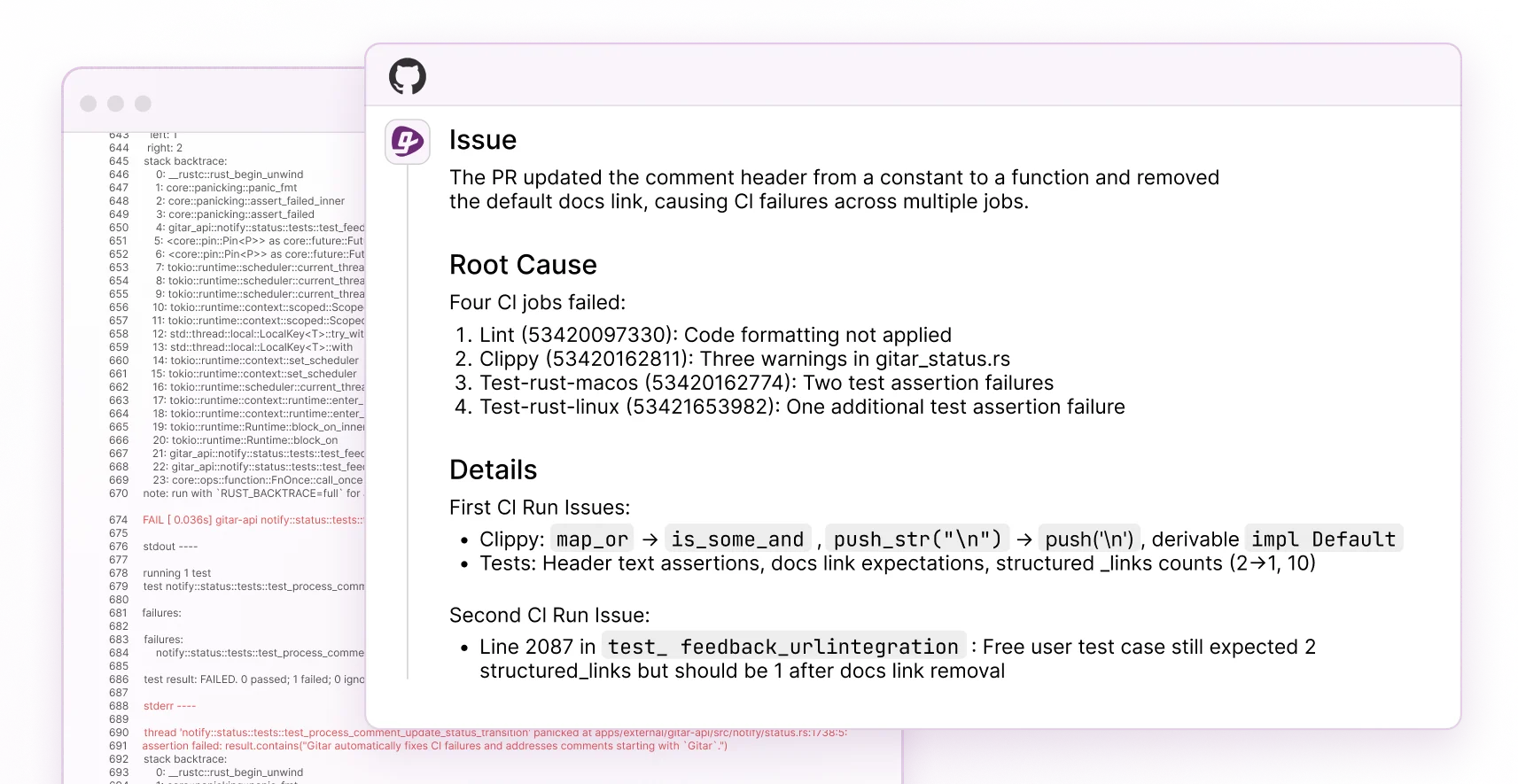
The zero-setup GitHub App offers configurable modes that range from suggestion-only to full automation. Teams receive a 14-day trial of the complete Team Plan with unlimited users and repositories. ROI metrics show dramatic productivity gains for 20-developer teams through eliminated manual fixes and reduced CI reruns, with detailed calculations provided in the decision framework below.
Gitar charges for outcomes instead of comments. Competing tools often charge $15 to $30 per seat for suggestions that still require manual work. Gitar proves value through actual code fixes and guaranteed green builds. Start your 14-day trial and experience autonomous code review automation in your own pipelines.
2. Greptile: Semantic Codebase Context Without Auto-Fix
Greptile builds semantic knowledge graphs of entire codebases to provide architectural context during reviews. At $30 per developer monthly, it offers multi-hop reasoning across repositories and complex projects. However, Greptile remains suggestion-only with the highest false positive rate in independent evaluations. It lacks CI auto-fix capabilities that separate healing engines from comment generators.
3. CodeRabbit: High-Volume Suggestions Without CI Validation
CodeRabbit processes over 13 million PRs across 2 million repositories at $12 to $24 per developer monthly. The platform achieves 46% bug detection accuracy with GitHub and GitLab support. It still provides suggestions only, without autonomous fix implementation or CI validation. Teams frequently report notification fatigue from scattered inline comments across diffs.
Gitar breaks the suggestion trap and delivers autonomous fixes that ship.
4. Tembo: Agentic Sandboxes Without Full CI Healing
Tembo runs agentic sandboxes that generate merge-ready PRs with architectural reasoning. These capabilities move beyond basic suggestions and help with larger refactors. The platform still lacks comprehensive CI failure analysis and guaranteed build validation. That gap keeps Tembo short of the healing engine category.
5. Augment: Large-Context Reasoning With Manual Implementation
Augment provides a 200k-token Context Engine suited for large monorepos with cross-repository understanding. The platform excels at architectural reasoning and long-range dependencies. It still requires manual implementation of suggested changes because it does not offer autonomous CI healing capabilities.
6. Bito: Limited Automation Without Full Commit Control
Bito combines suggestions with limited automation features at undisclosed pricing. The platform lacks comprehensive validation and commit capabilities that define autonomous review. As a result, it functions as an enhanced suggestion engine rather than a full healing solution.
7. Swimm: Documentation-Focused Reviews Without Auto-Fix
Swimm focuses on documentation-driven code reviews with contextual insights. This approach supports knowledge sharing and onboarding. It still provides no autonomous fix implementation or CI failure resolution, so teams must handle all changes manually.
Autonomy Matrix: Gitar vs Meegle Alternatives
|
Feature |
Gitar |
Top Alternatives |
Notes |
|
PR Summaries |
Yes (Trial) |
Yes |
Standard across platforms |
|
Inline Suggestions |
Yes (Trial) |
Yes |
Basic review capability |
|
Auto-Apply Fixes |
Yes (Trial) |
No |
Gitar implements changes |
|
CI Auto-Fix & Guarantee |
Yes (Trial) |
Partial/No |
Healing vs suggestion engine |
|
Platform Integrations |
Full (Trial) |
Limited |
GitHub, GitLab, CI systems |
|
Pricing Model |
14-day trial |
$15-30/seat |
Prove value before payment |
|
Noise Management |
Single comment |
Noisy |
Consolidated vs scattered |
Choosing the Right AI Code Review Tool for Your Team
Different roles feel the limits of suggestion engines in distinct ways. Engineering managers need velocity improvements, not more suggestions to implement manually. DevOps teams face higher CI costs from failed builds and reruns. Individual developers carry the daily burden through constant context switching and notification fatigue. These pain points share a common cause: tools that identify problems but do not resolve them.
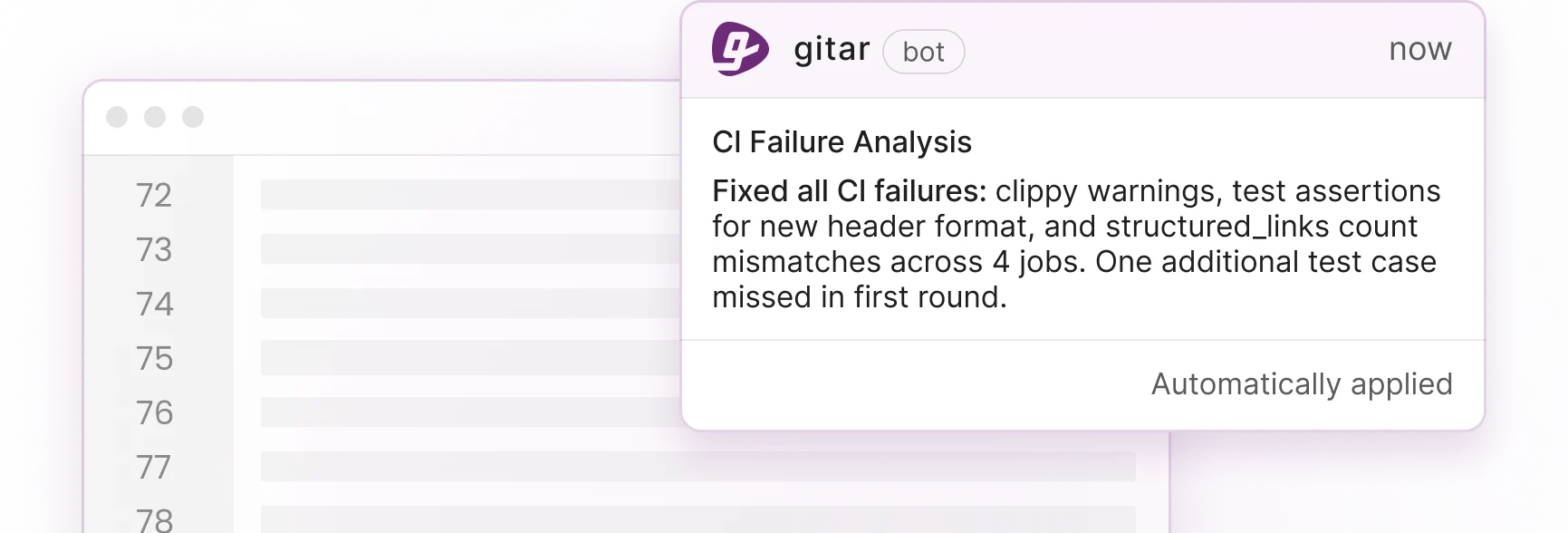
The core tradeoff separates suggestion engines from healing engines. Traditional tools charge premium prices for comments that still require manual work. As independent analysis shows, AI tools can reduce routine coding tasks by 46% and shorten review cycles by 35% when they move beyond detection to implementation. Teams unlock those gains only when tools actually implement fixes rather than just suggest them.
ROI calculations for 20-developer teams show dramatic differences. Before autonomous review, teams spend 1 hour daily per developer on CI and review issues, which costs $1 million annually. After implementing healing engines, this drops to 15 minutes daily, reducing costs to $250,000 and saving $750,000 in productivity gains.
Common objections about trusting automated commits fade when tools provide configurable aggression levels and safe rollout paths. Trial periods let teams validate behavior on real workloads before enabling full automation. Complex CI environments actually favor autonomous solutions that understand full build context instead of relying on diff-only analysis.
FAQs on Autonomous AI Code Review Automation
What is the best AI code review tool in 2026?
Gitar leads autonomous AI code review by fixing code rather than only suggesting changes. The platform automatically resolves CI failures, implements review feedback, and guarantees green builds through its healing engine architecture. Unlike suggestion-only tools, Gitar validates fixes against your actual CI environment and commits working solutions.
How do CodeRabbit and Greptile compare to autonomous alternatives?
CodeRabbit and Greptile represent a previous generation of suggestion engines that analyze code and leave comments requiring manual implementation. These tools help identify issues but still create additional work for developers. Autonomous platforms such as Gitar remove the suggestion trap by implementing fixes directly, validating them against CI, and guaranteeing working solutions.
Can ChatGPT or Claude replace dedicated code review tools?
General-purpose LLMs lack integration with CI systems and cannot validate fixes against actual build environments. They also require manual copy-paste workflows that slow teams down. Dedicated autonomous review platforms provide end-to-end automation from analysis to implementation with full development tool integration.
Which tools actually auto-fix CI failures?
Most AI code review tools only suggest fixes for CI failures. Gitar automatically analyzes failure logs, generates context-aware fixes, validates them against your CI environment, and commits working solutions. This healing engine approach removes the manual work that suggestion engines still require.
Do autonomous code review tools offer trial periods?
Gitar provides a comprehensive 14-day trial of the complete Team Plan with unlimited users and repositories. This trial lets teams experience autonomous fixing capabilities and measure velocity improvements before committing to paid plans. Many suggestion-only tools offer limited trials that do not demonstrate full automation value.
What integrations do autonomous review platforms support?
Leading autonomous platforms integrate with GitHub, GitLab, CircleCI, Buildkite, Jira, Slack, and Linear. Gitar provides native apps and webhooks for seamless workflow integration. Suggestion engines often support only basic version control platforms and lack deeper CI connectivity.
Fix Your PR Bottleneck with Autonomous Review
Autonomous AI code review marks the next step beyond suggestion engines that charge premium prices for manual work. Gitar leads 2026 automation capabilities with healing engine technology that fixes code, validates changes, and guarantees green builds. Teams can stop paying for suggestions and start benefiting from autonomous fixes that ship faster and safer. Install Gitar now, automatically fix broken builds, and start shipping higher quality software faster.