
Written by: Ali-Reza Adl-Tabatabai, Founder and CEO, Gitar
Key Takeaways
- AI coding assistants increase coding speed by 40%, yet PR review times have risen 91% because of larger PRs and AI-generated issues.
- Gitar leads this space with auto-fix capabilities for CI failures, lint errors, and test breaks, while most competitors only suggest changes.
- Codeium and Tabnine deliver strong code completions with 37–40% acceptance rates but do not connect to CI or apply fixes automatically.
- Open-source tools like Qodo PR-Agent and TabbyML support self-hosting and customization but demand complex setup and GPU resources.
- Teams reach higher productivity and green builds faster with Gitar’s 14-day Team Plan trial with no seat limits.
How We Evaluated AI Code Review and Coding Assistants
Our 2026 evaluation focused on auto-fix capabilities for CI failures, integration depth with GitHub, GitLab, and CircleCI, notification handling, and measurable productivity gains. We prioritized tools that deliver real automation instead of suggestion-only workflows. Acceptance rates came from LocalAimaster’s 1,000-hour benchmark testing and validation from production deployments. Testing showed 75% more AI-related issues in PRs, which makes reliable auto-fix capabilities a requirement for modern teams.
Top 10 AI Code Review and Coding Assistant Platforms in 2026
#1 Gitar – The Healing Engine
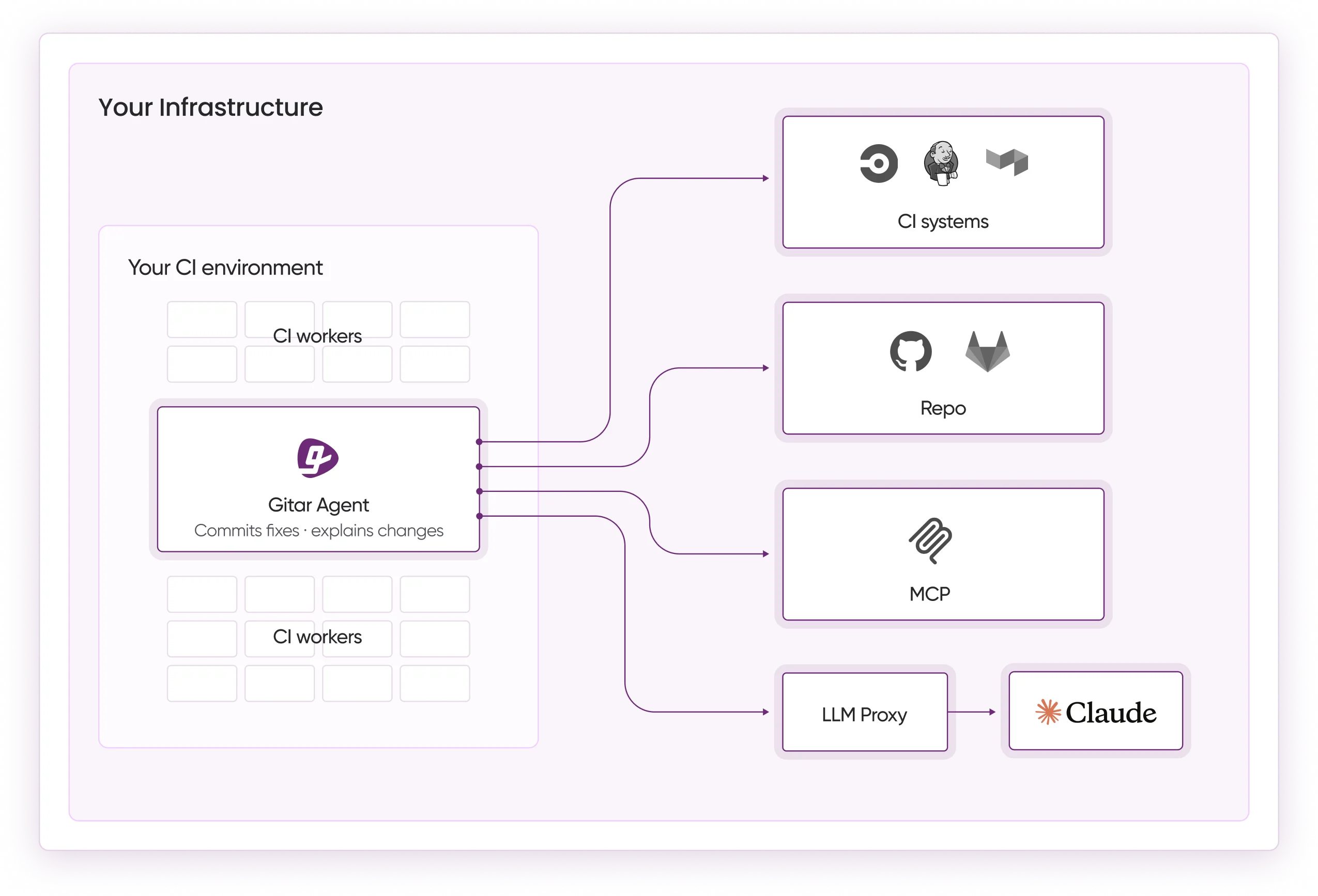
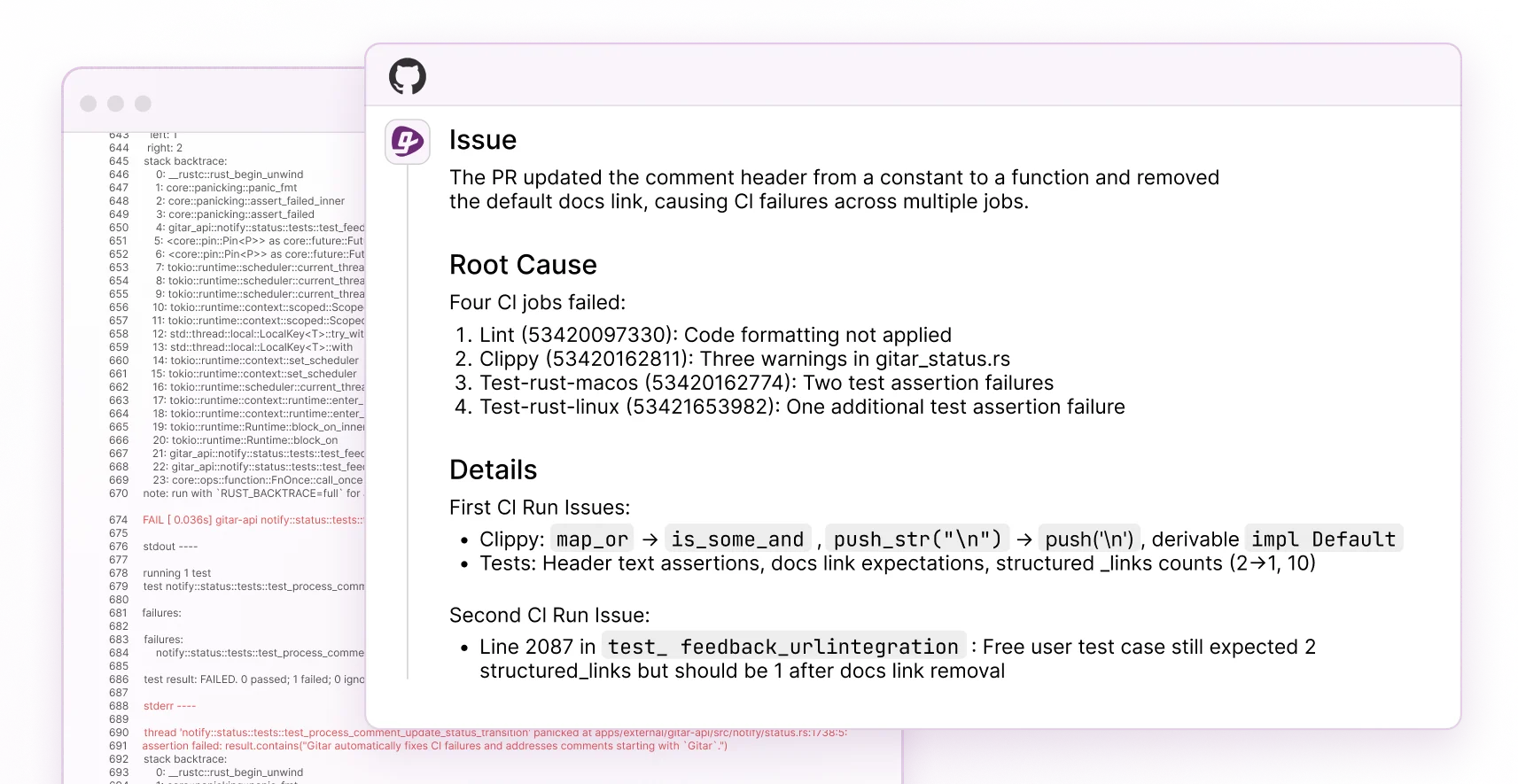
Gitar fixes code directly instead of only suggesting improvements. When CI fails because of lint errors, test failures, or build breaks, Gitar analyzes failures and posts a dashboard comment that updates as it works. The platform generates validated fixes, commits them, and drives pipelines back to green builds. Unlike competitors that charge $15–30 per developer for suggestions, Gitar offers the 14-day Team Plan trial mentioned above with full auto-fix capabilities included. A single dashboard comment consolidates findings, and guardrails filter noise and duplicate outputs. The Gitar docs outline integration steps. Gitar suits teams that want autonomous review and clear ROI from automated CI healing.
#2 Codeium – Unlimited Completions
While Gitar focuses on fixing code after it is written, the next group of tools helps developers write code faster from the start. Codeium reached a 37.25% autocomplete acceptance rate across Python, JavaScript or TypeScript, Java, and Go in 2026 benchmarks. Its individual plan offers unlimited completions, AI chat, and commands across 70+ languages with support for VS Code, JetBrains, Vim, and Jupyter. Codeium excels at code generation but does not provide CI auto-fix features or review automation. It works best for individual developers who value unlimited completions more than integrated review workflows.
#3 Tabnine – Privacy-Focused Assistance
Tabnine’s Starter tier achieved 39.5% autocomplete acceptance across major languages. The platform delivers context-aware suggestions for most popular languages and IDEs and can train bespoke models on specific codebases. Strong privacy controls and on-premises deployment options support security-sensitive teams. Review features remain suggestion-based, so teams still apply fixes manually.
#4 Amazon CodeWhisperer – AWS-Optimized
Amazon Q Developer’s limited tier scored 39% autocomplete acceptance, with Python reaching 42% for AWS-focused tasks. It offers unlimited completions, 50 agentic requests, automated security scans, and deep AWS integrations for IAM policies, CloudFormation templates, and Lambda functions. National Australia Bank reported a 50% code acceptance rate. CodeWhisperer fits teams that build heavily on AWS and want cloud-native development support more than advanced review automation.
#5 Qodo PR-Agent – Open Source Flexibility
PR-Agent has 10,500 GitHub stars, supports GitHub and GitLab, and can run self-hosted with Ollama for data control. It automates PR descriptions, reviews, and suggestions without per-seat pricing. However, deployment needs GPU infrastructure and more configuration than non-AI tools. Qodo PR-Agent suits teams with strong internal DevOps skills that want customizable, self-hosted review suggestions.
#6 TabbyML Tabby – Self-Hosted Assistant
Tabby holds 33,000 GitHub stars and integrates with GitHub and GitLab, with documented SSO options. The self-hosted platform focuses on local models for code assistance and basic reviews. Teams gain full data control but must treat review features as secondary to completion. Setup requires significant engineering effort, so Tabby works best for organizations that prioritize data sovereignty over plug-and-play automation.
#7 DeepSource – Static Analysis Focus
DeepSource delivers automated code quality checks with GitHub integration, catching bugs, security issues, and performance problems. The platform enforces coding standards effectively but does not resolve CI failures automatically. It fits teams that want traditional static analysis with some AI support instead of full auto-fix workflows.
#8 Gemini Code Assist – Google Cloud Integration
Gemini Code Assist provides completions and chat in VS Code, JetBrains, and Cloud Shell with tight integration for Firebase, Google Cloud Platform, and Cloud Run. It supports Google ecosystem development well, yet review capabilities stay basic compared to specialized review platforms. Gemini Code Assist suits teams that primarily ship on Google Cloud.
#9 Aider – Git-Integrated CLI
Aider has more than 42,000 GitHub stars and tracks every AI edit as a committed change with descriptive messages. The command-line tool integrates directly with Git and supports local models through Ollama. It works well for individual developers who prefer terminal workflows but lacks collaboration features and CI integration for larger teams.
#10 Continue.dev – Open Source Extension
Continue.dev supports local models via Ollama or LM Studio and more than 200 cloud models through API keys, avoiding vendor lock-in and usage limits for local setups. The VS Code and JetBrains extension offers high flexibility but needs careful configuration for strong results. It suits developers who enjoy tuning models and workflows more than teams that want ready-made automation. Try Gitar’s auto-fix engine and see how it handles your failing builds.
AI Code Review and Coding Assistants Compared 2026
The comparison below highlights the core gap between tools that only suggest code and platforms that fix failures. Gitar is the only option in this set that applies auto-fixes for both CI failures and reviews while integrating directly with major CI providers.
|
Tool |
Tier Limits |
Auto-Fix CI/Reviews? |
Integrations |
|
Gitar |
14-day Full Team Plan |
Yes/Yes |
GitHub/GitLab/CircleCI/Buildkite |
|
Codeium |
Unlimited completions |
No/No |
VS Code/JetBrains/Vim |
|
Tabnine |
Basic completions |
No/No |
Most IDEs |
|
CodeWhisperer |
Unlimited completions |
No/Limited |
AWS/VS Code/JetBrains |
Key Considerations When Choosing AI Code Review Tools
The move from suggestion engines to auto-fix platforms reflects the limits of suggestion-only tools. Context window limits create noise and confusion on large diffs over 1,000 lines, which feeds a broader trust problem. Only 33% of developers fully trust AI-generated code, and 66% of assistants produce code that is almost correct but still wrong. These issues complicate reviews and slow teams down. Platforms that deliver real fixes with CI validation reduce this uncertainty and keep pipelines stable. Notification handling also matters. Gitar’s single dashboard comment avoids PR spam that many tools create with dozens of inline comments. See how Gitar removes CI failures with validated auto-fixes.
Frequently Asked Questions
What is the leading AI code review tool in 2026?
Gitar leads the market because it fixes code instead of only suggesting edits. Competitors such as CodeRabbit and Greptile charge per developer for suggestion-only tools, while Gitar provides a 14-day Team Plan trial for the whole team with no seat limits. The platform resolves CI failures, applies review feedback, and drives pipelines back to green through its healing engine. The Gitar docs describe architecture and deployment options in detail.
Which AI coding assistants support auto-fix features?
Most assistants still focus on suggestions and leave implementation to developers. Gitar stands out with validated auto-fixes for CI failures, lint errors, and test failures. GitHub Copilot offers Copilot Autofix for code scanning on public repositories, which covers a narrower set of issues. Open-source tools like PR-Agent generate suggestions but lack reliable infrastructure for safe automatic application of fixes.
How do Codeium, Tabnine, and Gitar differ?
Codeium and Tabnine specialize in code completion with unlimited usage on their tiers and benchmark acceptance rates around 37–39%. Both operate as suggestion engines without CI integration or auto-fix support. Gitar targets the review and CI bottleneck directly and provides autonomous fixes that these tools do not offer. Teams that want productivity gains beyond faster typing see stronger ROI from Gitar’s healing engine.
Can I test AI code review tools before purchase?
Most vendors provide limited trials or basic tiers. Gitar offers a 14-day trial of its full Team Plan, which includes auto-fix capabilities, custom rules, and all integrations for the entire team with no seat limits. This window lets teams measure impact on sprint velocity and build stability before committing budget.
Are AI code review tools safe for enterprise CI pipelines?
Security posture varies widely. Open-source tools such as PR-Agent allow full data control through self-hosting but demand significant internal resources. Gitar supports enterprise deployments where agents run inside your CI pipeline and maintains SOC 2 Type II and ISO 27001 certifications. This approach keeps code within your infrastructure while still enabling autonomous fixes.
Conclusion and Next Steps for Your Team
The shift from suggestion engines to auto-fix platforms marks a major change in developer tooling. Traditional tools still create notification overload and require manual follow-through, while Gitar shows how autonomous code healing can cut maintenance work. Third Wave AI tools focus on reducing maintenance effort, not just running tests faster. Start with Gitar’s 14-day trial of the Team Plan to compare suggestions against real solutions in your own CI. Install Gitar and let it recover failing builds while your team ships higher quality software faster.