
Written by: Ali-Reza Adl-Tabatabai, Founder and CEO, Gitar
Key Takeaways for 2026 Code Review Budgets
- AI coding assistants have increased pull requests by 29% YoY, causing 91% longer review times and about $1M annual losses for 20-100 dev teams.
- Most tools like CodeRabbit ($12-30/user), Greptile ($30/user), and Graphite ($40/user) only suggest changes, so teams still handle manual fixes.
- Gitar provides auto-fixes, CI integration, and SOC 2 compliance, delivering $500K-$750K annual savings compared with suggestion-only engines.
- For 30-dev teams, competitors cost $360-$1,200 monthly without auto-fix, while Gitar’s 14-day trial is free with unlimited access.
- Teams can escape manual review toil by trying Gitar’s free Team Plan trial and validating auto-fix ROI in their own workflows.
How We Compared Code Review Automation Pricing Tiers
Our analysis evaluates pricing tiers based on team size scalability (free, starter, pro, enterprise), feature depth (summaries, suggestions, auto-fixes, CI integration), and ROI metrics for 20-100 developer teams. We examined 2026 vendor pricing from official websites, product documentation, and enterprise feedback. Key criteria include per-user costs, setup complexity, security compliance, and whether tools actually fix code or only suggest changes.
Our baseline assumes teams lose 1 hour daily per developer to CI failures and review cycles without automation. The comparison table below synthesizes these findings and shows how monthly costs and auto-fix capabilities differ for a typical 30-developer team. For more details on Gitar’s features, see the Gitar documentation.
Gitar Pricing: Auto-Fix Platform With Measurable ROI
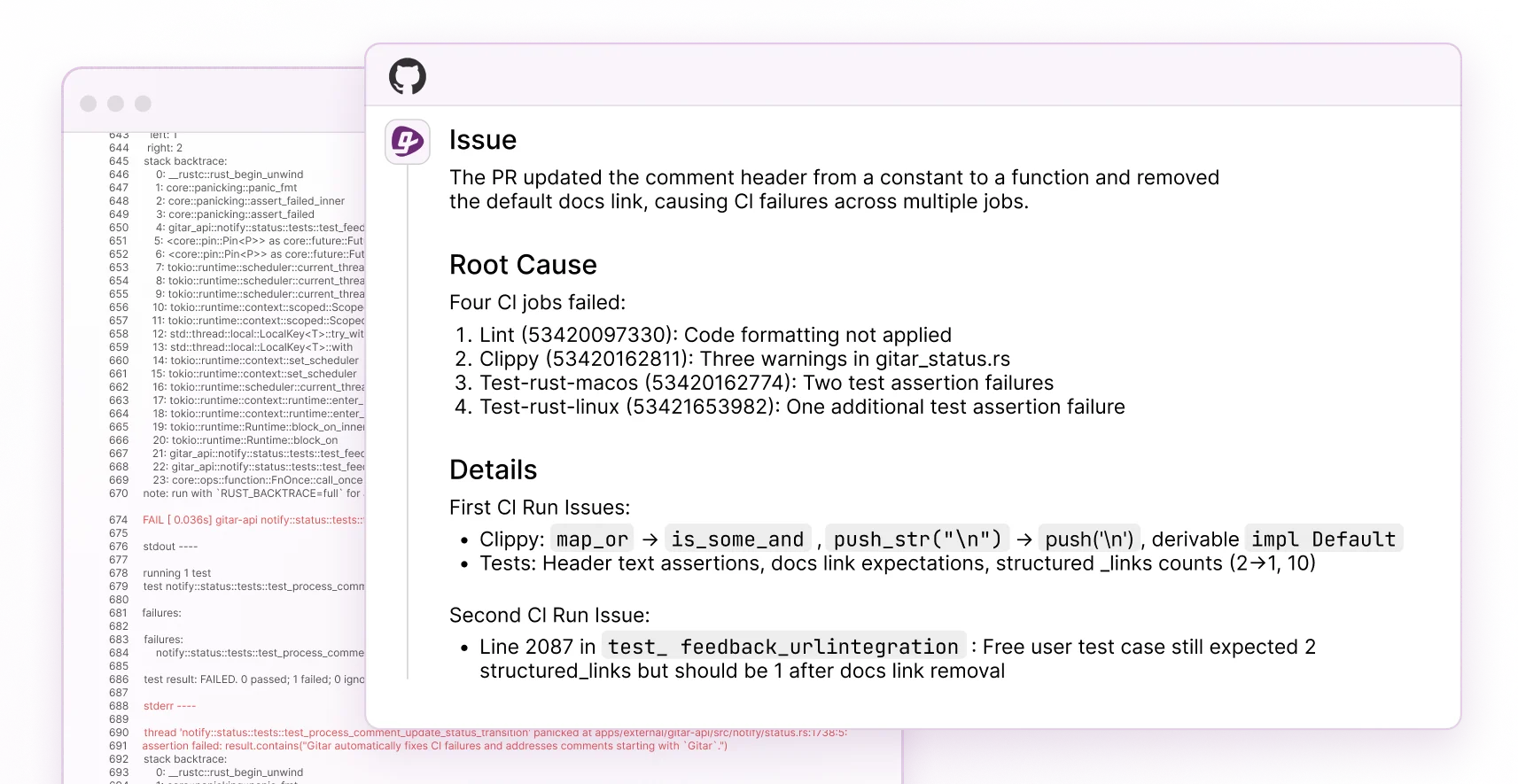
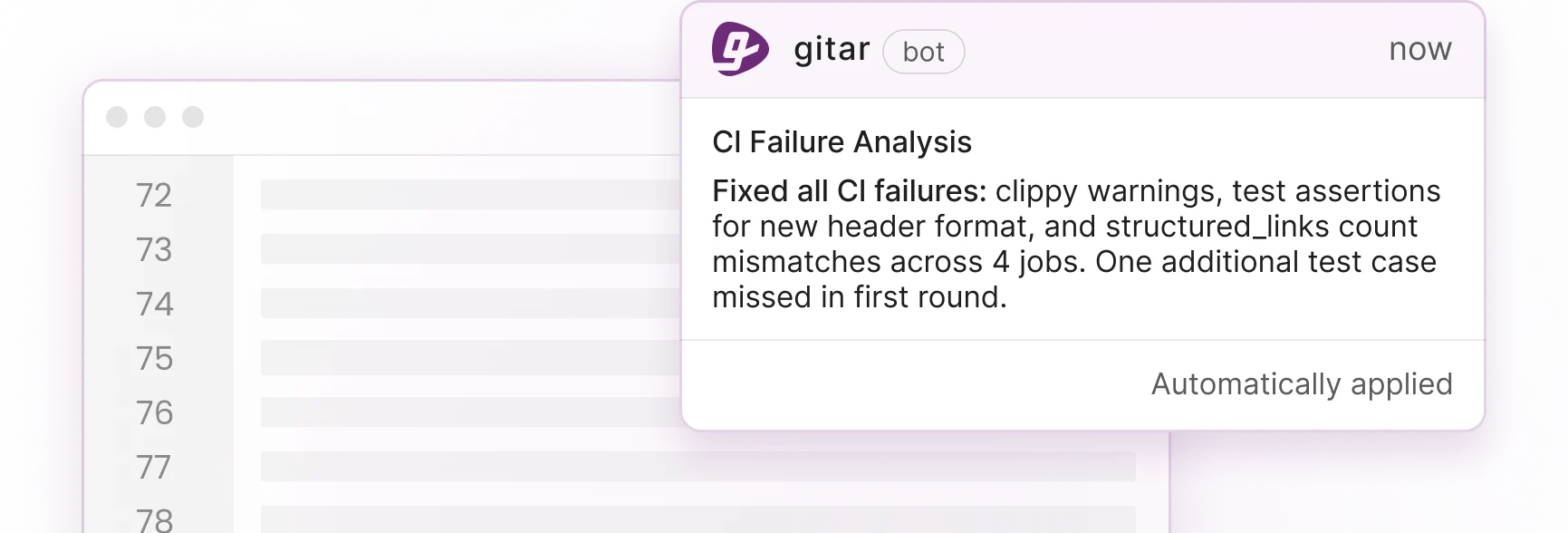
Gitar leads this comparison as the only platform in this group that delivers autonomous code fixes instead of suggestions alone. The AI platform resolves CI failures, implements review feedback, and targets consistently green builds through its “healing engine” architecture. Gitar introduced per-seat licensing for Team-tier organizations on March 2, 2026, and offers a 14-day free trial of its Team Plan with full access and no seat limits during the trial. The Gitar documentation lists full pricing and feature details.
The Team Plan trial includes full PR analysis, security scanning, bug detection, and performance review, matching the diagnostic depth of leading competitors. Its auto-fix engine then applies those findings, which removes the manual work that suggestion-only tools leave behind. This workflow extends across CI platforms such as GitHub Actions, GitLab, CircleCI, and Buildkite, and connects with Jira, Slack, and Linear so teams can test ROI inside their existing environment. The single-comment interface reduces notification noise, while hierarchical memory preserves context across related PRs.
For 20-100 developer teams dealing with AI-generated PR volume, Gitar’s auto-fix approach can save roughly $750,000 annually compared with manual suggestion workflows. Explore the 14-day Team Plan trial and see autonomous code review in your own repos.
CodeRabbit vs Gitar Pricing for 2026
CodeRabbit offers paid plans starting at $12 per user per month, with higher tiers around $30 per user for team features. The platform runs comprehensive PR analysis using more than 40 code analyzers but delivers results as suggestions that engineers must implement manually.
CodeRabbit’s Free Lite plan costs $0 and supports public repositories with basic summaries only. For a 30-developer team, CodeRabbit costs about $360-$900 monthly depending on tier, and reviews often generate notification clutter across PR timelines. Teams then spend extra hours applying suggested fixes, which erodes productivity gains from AI code generation.
CodeRabbit excels at detailed analysis depth, yet the suggestion-only model creates expensive manual overhead. Mid-sized teams with high PR volumes often find the per-user pricing difficult to justify without auto-fix driven ROI, especially when compared with the 30-developer baseline summarized in the table below.
Greptile vs Gitar Pricing for Context-Rich Reviews
Greptile’s 2026 pricing is approximately $30 per user per month for cloud deployment, placing it at the premium end of suggestion engines. The platform builds knowledge graphs for deep codebase context, tracing dependencies and surfacing potential breaking changes across repositories.
For a 30-developer team, Greptile costs about $900 monthly, which is the highest per-user rate among the major platforms in this comparison. Its contextual analysis surpasses many competitors, yet the output still arrives as suggestions that require manual implementation. Greptile offers 50% off for startups, while enterprise teams face heavier setup complexity and compute requirements that constrain scale.
Greptile fits complex, multi-repository environments that need deep architectural insight. The premium pricing without auto-fix capabilities, however, makes ROI harder to achieve for teams that prioritize immediate productivity gains over long-form analysis.
Augment Code Pricing for Security-Focused Teams
Augment Code offers tiers starting at $20 per month for Indie and Pro features, with Teams plans at $40 per user monthly that include PR summaries, security analysis, and code quality insights. The platform emphasizes SOC 2 Type II compliance for enterprise security requirements but does not implement fixes autonomously.
The tool provides static analysis and vulnerability detection aligned with common security frameworks, which suits compliance-heavy industries. The suggestion-only model, however, forces security teams to apply recommended fixes manually, creating bottlenecks in high-velocity development environments.
For teams that prioritize security compliance ahead of development speed, Augment Code delivers strong analysis capabilities. The manual implementation overhead still limits its effectiveness in AI-accelerated workflows, especially when compared with auto-fix platforms.
Graphite Pricing for Stacked PR Workflows
Graphite’s Team plan costs $40 per user per month and adds unlimited AI reviews, review customizations, automations, and merge queue capabilities. The platform integrates AI reviews with stacked PR workflows and reports sub-90-second review times with low negative feedback rates.
While Augment Code centers on security compliance, Graphite focuses on workflow efficiency for stacked development patterns. It handles hundreds of weekly PRs and flags security issues during review, yet its $40 per user pricing sits at the top of mainstream tools. The absence of CI auto-fix capabilities means teams still perform manual implementation.
For teams already committed to Graphite’s stacked PR methodology, the AI review layer adds value, but premium pricing without autonomous fixes restricts broader rollout. Compare Gitar’s auto-fix capabilities against Graphite’s $40/user suggestion model with a free 14-day trial.
Code Review Automation Pricing Comparison for 30-Developer Teams
The table below highlights monthly costs and key differentiators for a 30-developer team across major platforms. Gitar’s 14-day free trial includes full auto-fix capabilities, while competitors charge premium rates for suggestion-only features.
|
Tool |
Monthly Cost (30 devs) |
Auto-Fix |
Key Limitation |
|
Gitar |
$0 (14-day trial) |
Yes |
Trial period |
|
CodeRabbit |
$720 |
No |
Suggestion-only |
|
Greptile |
$900 |
No |
Manual implementation |
|
Graphite |
$1,200 |
No |
Premium pricing |
The hidden cost of suggestion engines becomes clear at scale. A 30-developer team that spends 1 hour daily on manual fix implementation incurs about $1 million annually in lost productivity. Gitar’s auto-fix approach removes most of this overhead and can deliver roughly 30x ROI after teams move beyond the free trial.
Pricing Impact for 20-50 Developer Teams
Mid-sized engineering teams experience the sharpest productivity penalties from the AI-driven PR surge. Jellyfish’s analysis found that high-AI adoption companies merged more pull requests overall, with 9.5% classified as bug fixes compared with 7.5% at low-adoption companies. This higher bug-fix rate compounds review overhead.
For a 20-developer team, suggestion engines cost about $480-$800 monthly, while teams lose roughly $667,000 annually to manual implementation cycles. DX’s Q4 2025 impact report shows daily AI users merge about 60% more pull requests than light users, which further amplifies the review bottleneck.
Gitar’s auto-fix platform reduces manual overhead from 1 hour to 15 minutes daily per developer. These savings, which align with the earlier $500K-$750K range, come from reclaiming that time for 20-person teams. The ROI calculation favors autonomous platforms over suggestion engines by roughly 25:1.
Enterprise Code Review Pricing and Total Cost of Ownership
Enterprise teams require SOC 2 compliance, on-premises deployment options, and custom security controls. Most platforms offer enterprise tiers with custom pricing, yet few deliver autonomous fix capabilities at scale. CodeAnt AI holds SOC 2 Type 2 and HIPAA certifications, and Greptile offers on-premises deployment with custom pricing.
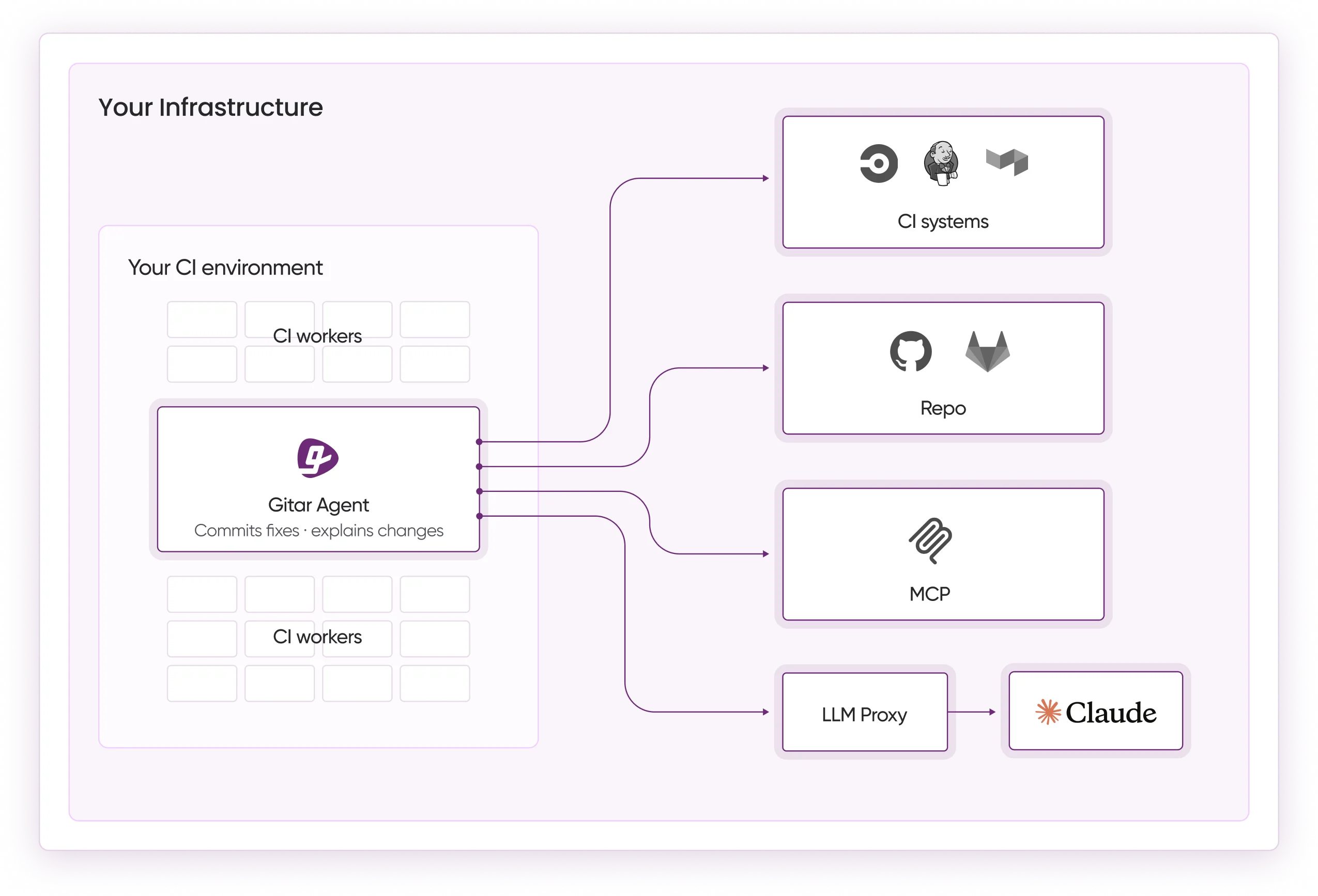
Enterprise deployments often involve 6-13 week implementation timelines and infrastructure requirements such as minimum 8GB VRAM GPUs for self-hosted setups. Gitar’s enterprise tier runs agents inside customer CI pipelines, which maintains data sovereignty while still providing full auto-fix capabilities.
Total cost of ownership for enterprise code review automation includes licensing, infrastructure, maintenance, and training. Post-deployment lifecycle work can account for about 65% of total AI system costs over a 3-5 year horizon, so selecting a platform with autonomous fixes becomes critical for long-term ROI.
Key Factors When Choosing Code Review Automation Tiers
Engineering leaders need to weigh more than per-user pricing. CodeRabbit’s December 2025 report found that AI-coauthored pull requests contain about 1.7 times more issues than human-only pull requests, which raises the bar for analysis quality beyond basic suggestion engines.
Security teams focus on compliance certifications and audit trails, while developers care about reducing notification noise and context switching. DevOps teams look for CI integration depth and infrastructure compatibility. Gitar addresses these groups through SOC 2 compliance, a single-comment interface, and multi-CI platform support with a 30-second installation path.
The core decision centers on auto-fix versus suggestion-only capabilities. Teams that pay $15-$30 per user for tools that still require manual implementation absorb heavy productivity losses compared with autonomous platforms. Start shipping higher quality software faster by validating auto-fix ROI in your own pipelines.
Choose Gitar for Proven Auto-Fix ROI
The 2026 code review automation landscape favors platforms that deliver autonomous fixes instead of expensive suggestion engines. Gitar’s 14-day free Team Plan trial gives engineering teams a low-friction way to capture immediate productivity gains from AI-accelerated development. While competitors charge premium rates that preserve manual overhead, Gitar proves ROI through real code fixes and consistently green builds.
Install Gitar to automatically repair broken builds and help your team ship higher quality software on a faster cadence.
Code Review Automation Pricing FAQs
What code review automation tools offer free tiers in 2026?
Gitar provides a comprehensive free tier through its 14-day Team Plan trial, which includes unlimited seats, repositories, and full auto-fix capabilities. CodeRabbit offers a limited Free Lite plan for public repositories only, and most other competitors require payment before unlocking meaningful features. Gitar’s trial model lets teams measure real ROI before making a financial commitment.
How does Gitar vs CodeRabbit pricing compare for teams?
CodeRabbit’s paid plans start at $12 per user monthly, which places a 30-developer team in the $360-$900 monthly range depending on tier, without auto-fix capabilities. Gitar offers a 14-day free Team Plan trial with full access and no seat limits, including auto-fix functionality. Teams can then validate savings against the earlier $750,000 annual manual overhead estimate.
How should teams measure ROI from code review automation?
Teams can calculate ROI by tracking time saved on manual fix implementation, reduced context switching, and faster PR merge cycles. Many teams lose about 1 hour daily per developer to CI failures and review loops. Auto-fix platforms like Gitar often cut this to about 15 minutes, which can save hundreds of thousands of dollars annually for 30-developer teams. Deployment frequency and incident reduction serve as additional metrics.
Which CI systems integrate with code review automation tools?
Gitar supports GitHub Actions, GitLab CI, CircleCI, Buildkite, and Bitrise with native integrations. Many competitors focus mainly on GitHub, which limits multi-platform teams. Enterprise deployments also benefit from agents that run within customer CI pipelines for security compliance, which Gitar provides through its enterprise tier with controlled access to configs, secrets, and caches.
Are auto-fix code review tools secure for enterprise use?
Modern auto-fix platforms include configurable security controls and often start in suggestion mode so teams can build trust before enabling autonomous commits. Gitar maintains SOC 2 Type II compliance and supports enterprise deployment within customer infrastructure. Teams can tune fix aggression levels and restrict auto-commits to specific failure types, such as lint errors, while requiring approval for logic changes.