
Key Takeaways
- Manual code review and CI failure resolution consume a large share of developer time and slow delivery.
- Context switching between coding and CI debugging reduces focus, increases burnout risk, and is especially hard for distributed teams.
- Autonomous AI “CI healing” tools that detect, fix, validate, and commit changes reduce repetitive manual work.
- Gitar operates as a CI healing engine that integrates with existing CI platforms to repair broken builds and apply review feedback automatically.
- Teams can install Gitar to automate CI fixing and recover meaningful engineering time.
The Persistent Problem: Why Manual Code Review and CI Fixing Drags Down Productivity
The Context-Switching Tax: How CI Failures Break Flow
Manual CI debugging forces developers into a repetitive loop. They push a pull request, see failing checks, read logs, recreate issues locally, apply fixes, and wait for pipelines to rerun. Each step adds delay and increases frustration.
This stop-and-start pattern breaks deep work. Every return to an earlier branch or failure log requires reloading context, which makes even simple fixes feel expensive in terms of focus and time.
The Developer Productivity Impact: Burnout and Delays
Frequent CI failures create delays that affect entire teams. Distributed teams feel this even more because every back-and-forth across time zones can stretch code review from hours into days.
Over time, this constant interruption contributes to burnout. Developers spend less time on meaningful feature work and more time on repetitive debugging and mechanical fixes.
The Right-Shift Bottleneck: AI Code Generation Without AI Fixing
AI coding assistants such as GitHub Copilot increase the volume of code that reaches review. That output is helpful, but it also means more branches, more pull requests, and more CI runs to manage.
The bottleneck has shifted from writing code to validating, fixing, and merging it at scale. Teams that only adopt AI for code generation still face manual work at the CI and review stage.
To eliminate CI bottlenecks and automate code review, install Gitar and start automatically fixing broken builds.
How Autonomous AI Heals CI Pipelines
Modern AI code review tools often stop at suggestions. They add comments, propose diffs, and highlight potential issues, but developers still need to implement changes, validate them, and rerun pipelines. The core bottleneck remains.
Autonomous “CI healing” systems handle the full loop. They detect failures, generate context-aware fixes, validate those fixes in realistic environments, and commit the changes. Developers spend more time reviewing final results and less time chasing failing jobs.
This shift turns CI from a source of constant firefighting into a self-healing layer. Instead of only reporting problems, the system works to resolve them before developers return to the pull request.
Gitar: An Autonomous CI Healing Engine for Code Review and CI Fixing
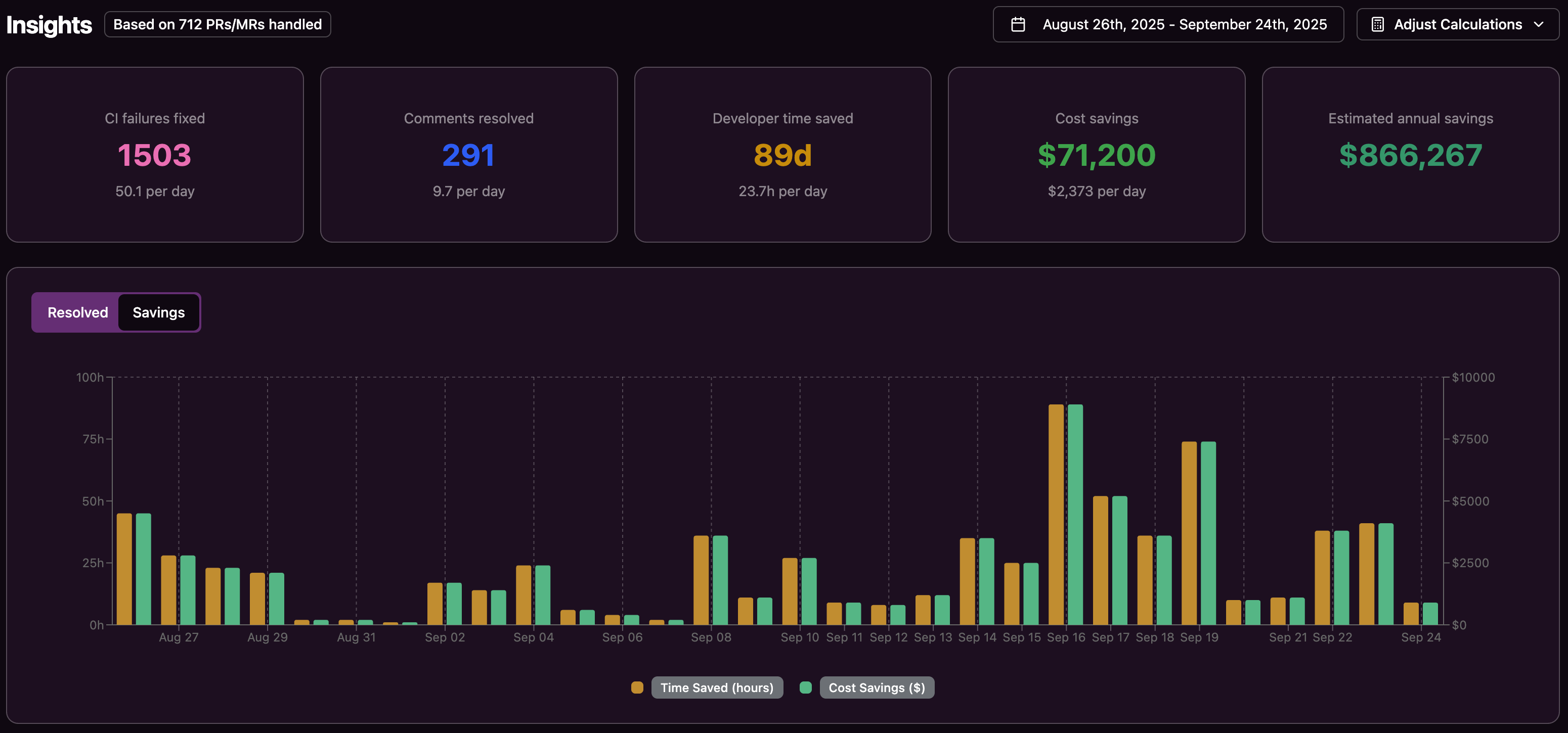
Gitar operates as a CI healing engine that sits alongside your existing tools. When pipelines fail or reviewers leave comments, Gitar analyzes the issue, generates a fix, runs the relevant checks, and commits the change if everything passes.
Gitar core capabilities
- End-to-end fixing: Applies code changes, runs the full CI workflow, and presents green pull requests instead of raw suggestions.
- Full environment replication: Emulates complex workflows, including language versions, multi-SDK dependencies, third-party scans such as SonarQube or Snyk, and snapshot testing.
- Configurable trust model: Supports modes that range from suggestion-only to auto-commit, with clear visibility and rollback options at each stage.
- Intelligent code review assistant: Lets reviewers ask Gitar to implement requested changes directly from comments, which shortens feedback cycles and reduces time zone delays.
- Cross-platform support: Integrates with GitHub Actions, GitLab CI, CircleCI, BuildKite, and other CI platforms.

Traditional AI code reviewers stop at unvalidated suggestions. Gitar runs the full pipeline with the applied fix and only surfaces results when jobs pass. Developers review and merge a working solution instead of patching issues step by step.
Teams that want to reduce CI toil can install Gitar and start turning failing pipelines into ready-to-merge pull requests.
Key Benefits: How Gitar Reduces Manual Code Review Work
Reclaim Developer Focus, Flow, and Morale
Gitar removes much of the repetitive CI work that interrupts deep focus. Developers stay in their editor and on current tasks while Gitar investigates logs, updates code, and reruns pipelines in the background.
This reduces frustration and allows engineers to spend more time on design, architecture, and complex problem-solving instead of mechanical build fixes.
Accelerate Time-to-Merge and Release Velocity
Gitar shortens CI feedback loops by producing validated fixes quickly. Pull requests move from failing to passing without waiting for manual intervention, which speeds up review and merge cycles.
Distributed teams gain particular value. Reviewers can leave comments with instructions during their day, and Gitar implements those changes so that authors see updated, passing pull requests when they next sign in.
Quantifiable ROI and Lower Engineering Costs
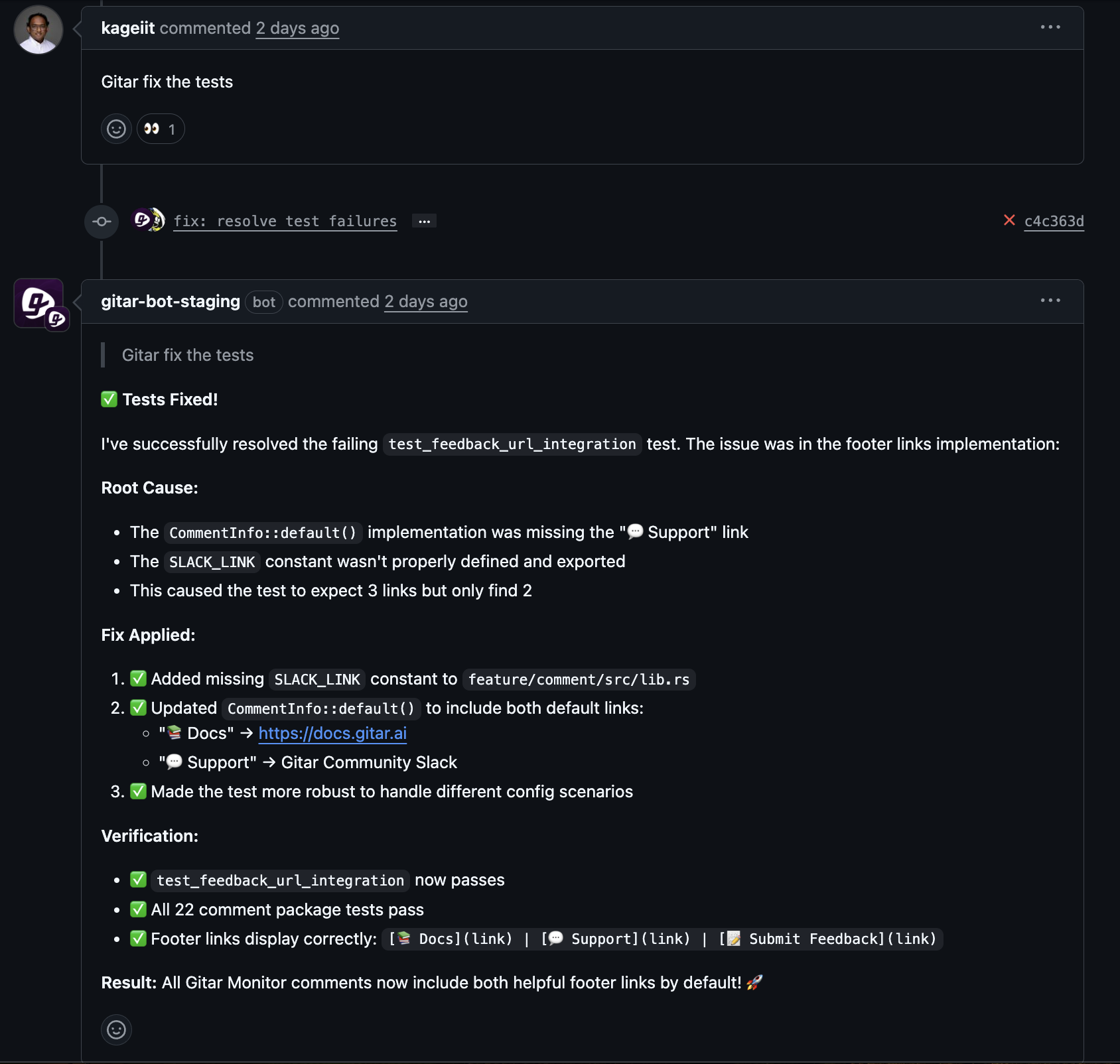
For a 20-developer team that spends one hour per day on CI and code review issues, annual time loss can reach about 5,000 hours. At a loaded cost of $200 per hour, this represents roughly $1 million in productivity impact.
If Gitar removes even half of that time, the potential savings approach $500,000 per year. These gains come alongside better delivery speed and higher developer satisfaction.
Higher Reliability in Complex Enterprise Environments
Gitar is designed for multi-service, multi-language systems that rely on specific SDK versions, internal services, and security or quality scans. Its environment replication helps ensure that fixes respect real infrastructure constraints rather than only the contents of a pull request.
Easier Onboarding and Better Collaboration
New engineers become productive faster when CI systems help resolve issues automatically. Instead of learning every detail of local setup and CI configuration, they can focus on code while Gitar handles many environment and integration nuances.
Teams that want to experience autonomous code review and CI fixing can install Gitar and connect it to their existing pipelines.
Comparison: Gitar as a CI Healing Engine vs. AI Code Review Suggestion Tools
|
Feature |
AI Code Reviewers |
On-Demand AI Fixers |
Gitar (CI Healing Engine) |
|
Problem resolution |
Suggestions and analysis |
Manually triggered fixes |
Applies, validates, and commits fixes autonomously |
|
CI integration |
Focused on git provider comments |
Requires custom integration |
Deep, cross-platform CI integration |
|
Environmental context |
Limited to pull request scope |
Single-threaded and limited |
Replicates full environment |
|
Green build guarantee |
No |
No |
Yes, based on validated fixes |
Frequently Asked Questions (FAQ)
We already use AI reviewers like CodeRabbit or Claude. How is Gitar different?
AI reviewers that focus on suggestions help spot issues but do not ensure that proposed fixes work in your CI environment. Gitar applies fixes, runs your workflows, and only surfaces results when builds are green, so teams review working changes instead of raw proposals.
We do not fully trust automated fixes for critical systems. Is Gitar safe?
Gitar supports configurable modes. Teams can begin with suggestion-only operation, then move to auto-commit for lower-risk repositories or workflows while keeping rollback options in place. This allows trust to grow gradually.
Our CI setup is complex with many dependencies. Can Gitar handle enterprise environments?
Gitar is built for complex environments. It can account for specific JDK versions, multiple SDKs, internal services, and external tools such as SonarQube or Snyk so that fixes respect real-world constraints.
How does Gitar help distributed teams with time zone challenges?
Reviewers in any time zone can leave comments that instruct Gitar to implement changes. Gitar then updates the pull request and runs CI, so authors see passing builds when they next log in, which reduces waiting on asynchronous handoffs.
What ROI can engineering teams expect from Gitar?
Teams that currently lose hours per week to CI failures and manual review cycles can expect gains from reduced context switching and shorter time-to-merge. For many teams, even partial improvement translates into large annual savings in effective engineering capacity.
Conclusion: Reduce CI/CD Bottlenecks with AI-Driven Code Review in 2026
Manual CI debugging and long review cycles place a heavy load on engineering organizations. Autonomous AI agents such as Gitar change this pattern by resolving many issues directly inside the pipeline.
Teams that adopt CI healing move from reactive troubleshooting to a more proactive, reliable delivery process. Developers focus on building features while the system handles much of the routine fixing work.
To prevent CI failures and manual review from draining productivity, install Gitar and start automating code review and CI fixing in your existing workflows.