
Manual debugging in CI pipelines slows developers, creating delays and added costs. This article dives into how Gitar, an AI-powered tool for autonomous CI fixes, addresses this issue. You’ll see how Gitar acts as a healing engine, detecting and resolving CI failures while handling code review feedback, ultimately saving significant time on manual debugging tasks.
Why Manual Debugging Hurts CI Pipelines
Manual debugging costs developers time and focus, pulling them away from creating valuable features. Let’s unpack the specific challenges it creates in CI pipelines and the impact on productivity.
Disrupting Developer Focus with Constant Interruptions
Picture this: you push a pull request, confident in your work, only to see a failed build from a missing dependency or a minor style error. Now, you’re stuck decoding logs, switching back to your local setup, making a fix, committing, pushing, and waiting for the pipeline to rerun.
This process eats up more than just a few minutes. Developers often spend up to 30% of their day on CI and code review issues, roughly an hour daily, debugging instead of building. That constant back-and-forth kills momentum, turning a quick fix into a major productivity hit.
For distributed teams, the problem grows. A developer in one time zone might push a PR needing review from a teammate halfway across the world. A simple exchange can stretch from hours to days. Many AI tools only suggest fixes, leaving the manual work to you, adding more delays.
Typical CI Failures That Demand Manual Fixes
CI pipelines face recurring issues that pull developers into manual debugging. Common failures stem from weak tests, missing quality checks, environment misconfigurations, or skipped static analysis. Here’s a breakdown of frequent culprits:
- Linting and Formatting Errors: Minor style issues that could be auto-fixed but instead need manual edits and new commits, triggering extra CI runs.
- Test Failures: Broken unit or integration tests and snapshot mismatches that force you to dig into root causes and tweak code or fixtures.
- Build Configuration Issues: Missing dependencies or version conflicts that work locally but fail in CI due to setup differences.
- Environment-Specific Problems: Code behaving differently across dev, staging, or production due to configuration or dependency variations.
Without strong automated testing or analysis tools, developers end up sifting through complex logs and recreating issues locally, making debugging even more time-consuming.
Financial Losses from Debugging Inefficiencies
The impact of manual debugging ripples beyond engineering teams, hitting organizations with real costs. A 20-developer team can lose about $1 million yearly in productivity from time spent on CI issues and debugging.
Break it down: 20 developers spending one hour daily on these tasks equals 5,000 hours a year. At $200 per hour for a software engineer, that’s a direct $1 million loss for one team. Add to that other hidden costs:
- Delayed Releases: Debugging pulls focus from feature work, slowing projects and letting competitors get ahead.
- Developer Frustration: Repetitive tasks and interruptions lead to burnout, increasing turnover and hiring expenses.
- Missed Opportunities: Time spent debugging is time not spent on innovation or tackling technical debt.
- Customer Dissatisfaction: Late releases or quality issues from debugging delays can harm trust and loyalty.
For growing companies, where engineering speed ties directly to success, manual debugging becomes a bottleneck that hampers scaling and market response.
How Autonomous AI Fixes Solve Debugging Challenges
Autonomous AI fixes mark a shift from reactive debugging to proactive pipeline healing. Unlike traditional methods needing human input at every step, these systems detect, analyze, and resolve CI failures without disrupting developers.
What Autonomous AI Fixes Bring to the Table
These tools don’t just point out errors, they handle the entire fix process. When a CI pipeline fails, an autonomous AI system examines the issue, finds the root cause, applies a solution, and confirms it works, all without developer involvement.
This matters because frequent CI failures from redundant builds or misused resources often lead to excessive manual debugging. Autonomous fixes tackle these systematically, learning patterns to prevent repeat issues. Key strengths include:
- Complete Context: Understanding the error, codebase, and CI setup fully.
- Full Resolution: Handling everything from spotting issues to validating fixes.
- Adaptive Learning: Improving over time with each fix.
- Tool Integration: Fitting into existing workflows without major changes.
This turns CI failures into background tasks, letting developers focus on creative, high-impact work.
Autonomous Fixes vs. Suggestion-Only Tools
Many AI tools suggest fixes but stop there, leaving implementation to developers. Autonomous systems like Gitar go further, completing the fix cycle without manual steps. Here’s the difference:
- Suggestion Tools: Identify issues and propose changes, but you often need to review, apply, test, and validate them yourself, which still takes focus and time.
- Autonomous Systems: Handle everything, from applying fixes to confirming they work in your CI setup, presenting a resolved state without pulling you away.
The impact on focus is clear. Suggestion tools may notify you of issues, requiring mental effort to process them. Autonomous fixes run silently, letting you see resolved problems only when you check your PR, keeping your workflow uninterrupted.
Handling Complex Pipeline and Environment Issues
Modern setups often face debugging challenges from complex configurations. Configuration errors frequently cause CI/CD failures, needing extensive manual fixes when environments aren’t aligned. Autonomous AI excels here by addressing:
- Microservice Setups: Recognizing patterns across multiple services and applying consistent fixes to avoid widespread failures.
- Environment Differences: Adapting fixes for dev, staging, or production specifics, avoiding local-to-CI mismatches.
- Platform Variations: Working across CI tools like GitHub Actions or CircleCI with tailored solutions.
- Dependency Conflicts: Resolving version issues or missing packages by analyzing compatibility needs.
By automating these scenarios, autonomous AI prevents small issues from escalating into long debugging sessions or deep infrastructure dives.
Install Gitar now to fix broken builds automatically and ship better software faster
Meet Gitar: Your CI Pipeline Healing Engine
Gitar moves beyond AI assistance to fully autonomous development operations, eliminating the last manual hurdles in software delivery. Unlike tools that only suggest fixes, Gitar detects, resolves, and validates CI failures and code feedback on its own.
When a pull request faces a CI failure or gets review comments, Gitar steps in. It analyzes the issue, creates the needed fix, and updates the request, turning a disruptive, hours-long manual task into a seamless, automated process.

Key Ways Gitar Cuts Debugging Time
Gitar offers practical features to minimize manual debugging. Here’s how it helps:
- Complete Fix Process: Gitar applies fixes and validates them across full CI workflows, ensuring pull requests pass before you even notice an issue.
- Environment Accuracy: It mirrors complex setups, including specific JDK versions, multi-SDK dependencies, and third-party tools like SonarQube, so fixes work in your real environment.
- Adjustable Automation: Start with a mode where fixes need a quick approval, then move to full automation with rollback options as trust builds.
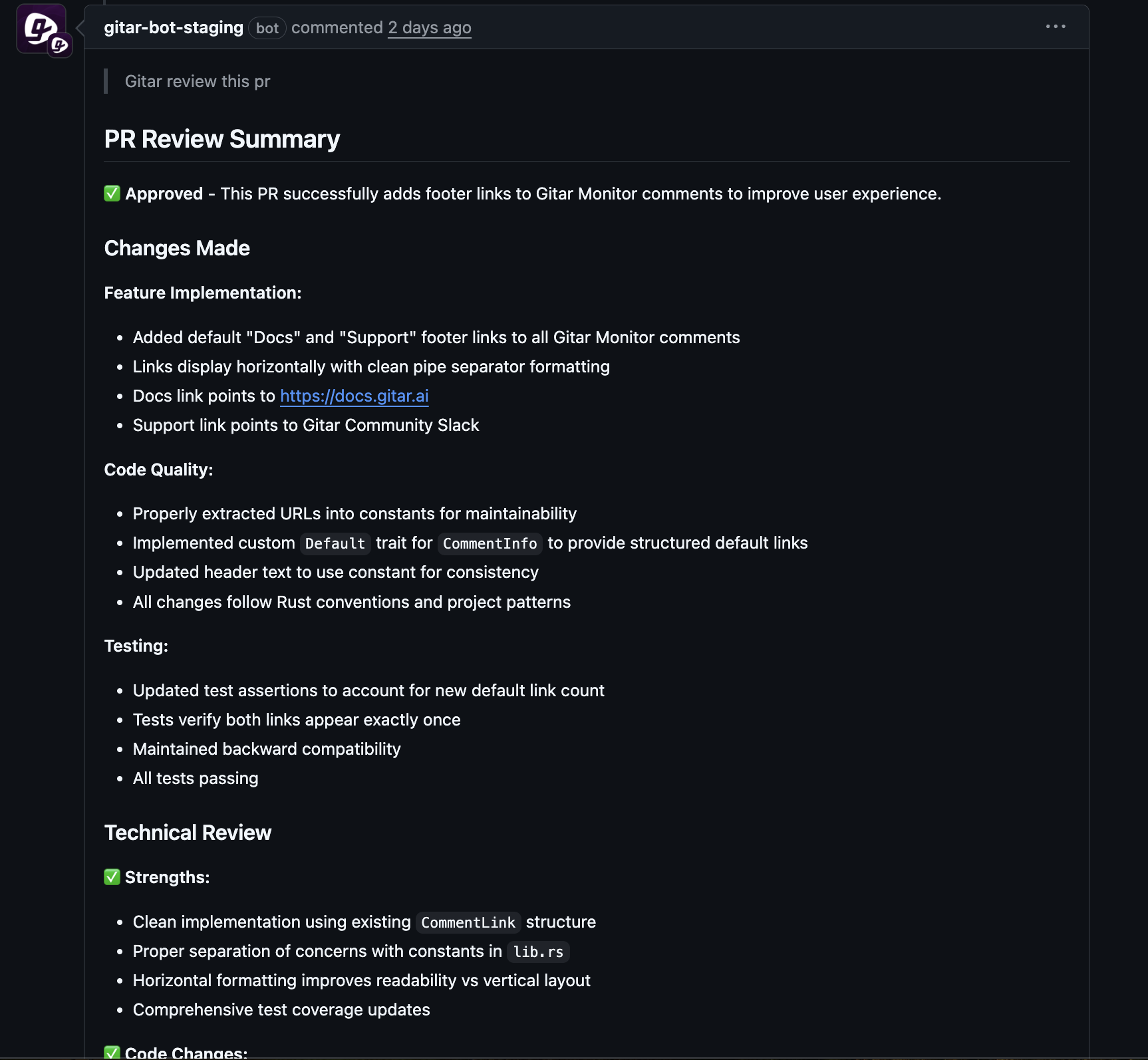
- Smart Code Review: Reviewers can instruct Gitar to make changes like removing features from a PR. Gitar acts on it and explains the updates.
- Platform Flexibility: Works with GitHub Actions, GitLab CI, CircleCI, and more, fitting any team’s tools.
- Time Zone Efficiency: Fixes feedback across time zones instantly, so a comment left in India is resolved before a US developer starts their day.
- Clear Updates: Posts status updates on PRs, showing actions taken, from fixing failures to addressing comments, with minimal workflow changes.
Gitar automates fixes for common issues like linting errors, test failures, snapshot updates, and build problems from dependency conflicts.
Real Ways Gitar Saves Debugging Time
Gitar’s biggest value lies in keeping developers focused and speeding up processes. Let’s explore how it achieves this in daily workflows.
Preserving Focus by Removing Interruptions
Gitar’s strongest impact is maintaining your focus. It fixes CI issues automatically, so you stay on task instead of jumping between problems.
Without Gitar, a failed CI run means stopping your work, investigating logs, recalling your code, fixing locally, committing, and waiting for validation, often repeating if the fix fails. With Gitar, you just check your PR later and find it green, ready to merge, with no disruption.
Teams often notice the difference right away. Push a PR with a small error, keep working, and later see Gitar has fixed it and explained the change. No lost time, just continuous productivity.
Speeding Up Reviews for Global Teams
Code reviews slow down when feedback loops take too long, especially across time zones. Gitar fixes feedback instantly, cutting delays and boosting team efficiency.
In a typical setup, a PR goes through multiple rounds: submit, get feedback, make changes, resubmit, and repeat, often adding a day per cycle for global teams. With Gitar, a reviewer leaves a note, Gitar applies the change immediately, and the reviewer confirms, slashing wait times.
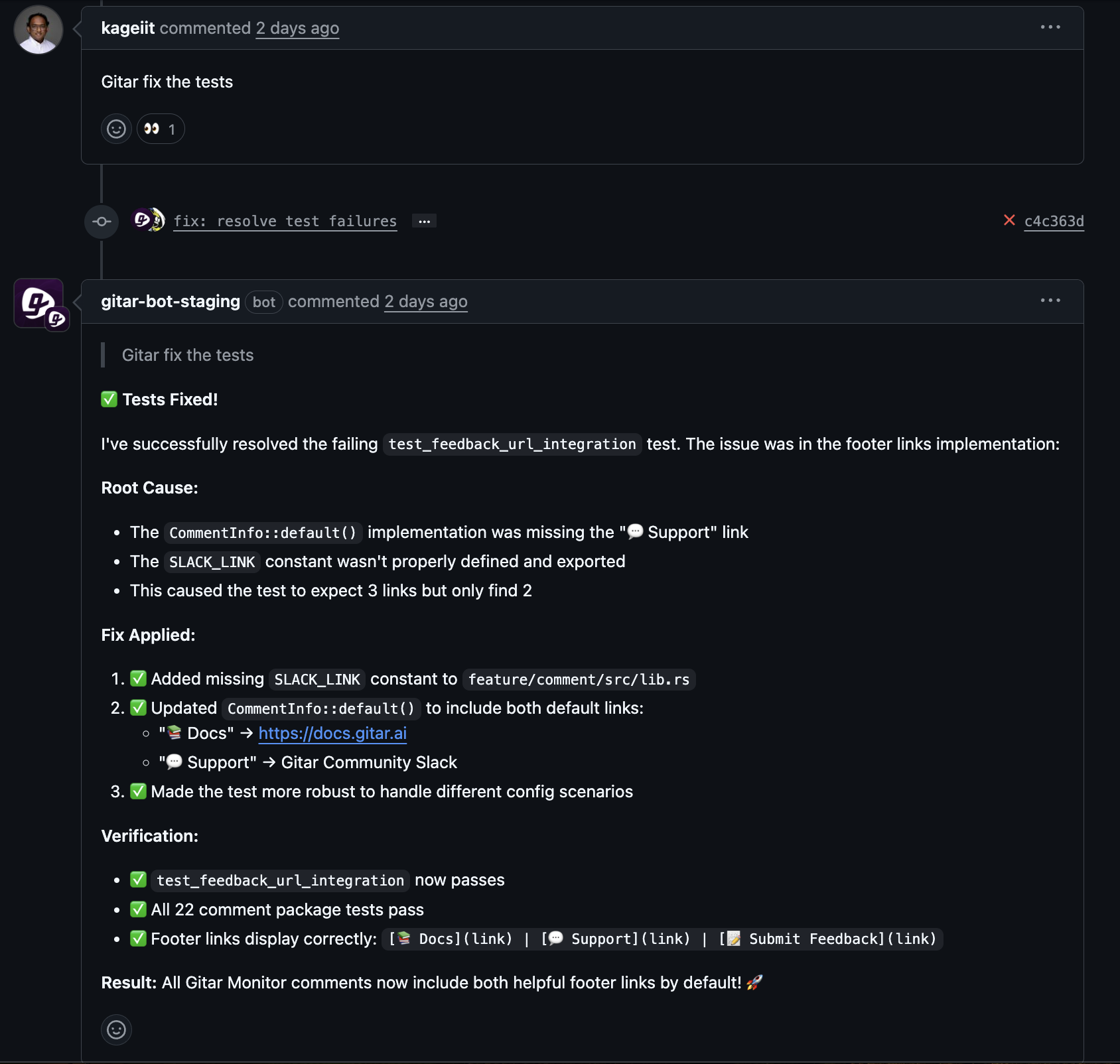
For example, a comment like “remove this unrelated feature” gets acted on by Gitar right away, with a clear update on what changed, no waiting for the developer to respond.
Keeping CI Pipelines Reliable and Green
Reliable pipelines boost productivity and morale. Strong CI/CD setups aim to catch errors early and speed up feedback. Gitar goes further by not just spotting issues but fixing them automatically.
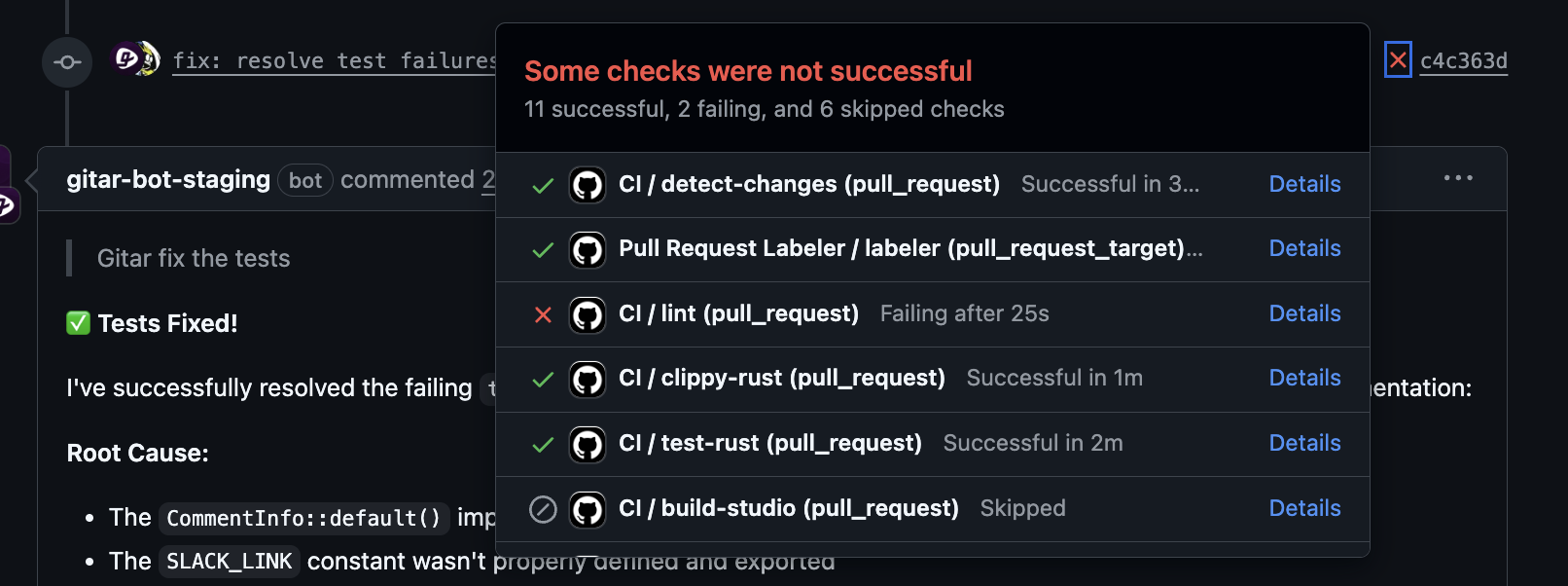
It resolves linting errors, test failures, or build issues instantly, preventing small problems from growing. By matching your CI environment, fixes work across contexts, avoiding the “works locally, fails in CI” headache. The result? Consistent green builds and less stress around code pushes.
Easing Onboarding for New Developers
Onboarding new engineers takes time, especially with complex CI setups. Gitar lifts this burden, helping new hires contribute faster, even with imperfect environments.
Normally, new developers struggle with environment setups, learning CI systems, and fear of breaking builds, delaying their impact. Gitar changes this by:
- Allowing Mistakes: Push code with setup flaws, and Gitar fixes CI issues automatically.
- Learning by Watching: See how Gitar resolves common problems, picking up best practices without manual fixes.
- Building Confidence: Knowing errors get fixed encourages frequent pushes, speeding up learning.
- Reducing Mentor Time: Senior staff focus on guidance, not debugging help.
Install Gitar now to fix broken builds automatically and ship better software faster
Gitar Compared to Manual Debugging and Suggestion Tools
Gitar stands out when compared to traditional debugging and suggestion-based AI tools. Here’s how it stacks up in reducing manual debugging time:
|
Feature/Benefit |
Manual Debugging |
AI Suggestion Tools |
Gitar (Autonomous Fixes) |
|
Issue Resolution |
Full manual effort for investigation and fixes |
Often needs manual steps to apply or test suggestions |
Automatic application and validation of fixes |
|
Developer Interruptions |
High, with frequent stops for CI issues |
Moderate, as action may still be needed |
Minimal, with fixes done in the background |
|
Pipeline Reliability |
Reactive, fixing after delays occur |
Mixed, depending on tool automation |
Proactive, preventing issues from recurring |
|
Time to Merge PRs |
Slow, with repeated debug cycles |
Faster than manual but may need steps |
Quick, with instant issue resolution |
Manual debugging reacts after issues disrupt work, creating the highest interruption cost. Suggestion tools help by pointing out fixes but often still need your effort. Gitar’s full automation handles everything, letting you find resolved PRs without breaking focus.
Common Questions About Gitar
How Does Gitar Differ from Other AI Review Tools?
Many AI review tools point out issues or suggest fixes but often leave the application and testing to developers. Gitar, on the other hand, acts as a complete healing engine. It not only identifies problems but applies fixes, tests them in your CI environment, and ensures builds pass, all without your input.
This saves real time. Instead of switching tasks to handle suggestions, you find issues already fixed when checking your PR. Gitar also mirrors complex setups, ensuring fixes match your unique environment, unlike tools that might only work in simpler cases.
How Does Gitar Build Trust with Automated Fixes?
Gitar offers a flexible trust model to ease teams into automation. Start with a conservative mode where fixes are suggestions needing one click to approve, showing exactly what changes will happen. As you see consistent results, switch to a mode where Gitar commits fixes directly, with rollback options if needed.
Transparency helps too. Every fix comes with a PR comment explaining the issue, solution, and validation, so you understand the logic. Gitar tests fixes in your full CI setup first, ensuring they work before applying them, reducing risks of new issues.
Can Gitar Handle Complex CI Environments?
Gitar shines in complex setups where generic AI tools fall short. It replicates your full CI environment, including specific versions of tools like JDK or Node.js, custom build rules, third-party scans like Snyk, and multi-service dependencies.
This means fixes fit your exact standards, not just generic ones. The complexity that slows manual debugging, like custom setups or integrations, is what Gitar automates, applying expertise without developer effort.
Install Gitar now to fix broken builds automatically and ship better software faster
Wrap-Up: Save Developer Time with Gitar’s Autonomous Fixes
Manual debugging drains developer time that could go to building features or innovating. Following current CI/CD practices with feedback at each step cuts down manual debugging needs, yet many teams still face interruptions and slow fixes.
Gitar changes this with autonomous fixes, turning a tedious manual process into an automated background task. It resolves issues from start to finish, letting developers stay focused and speeding up delivery. Benefits include better productivity, quicker releases, improved morale by cutting frustrating tasks, and faster onboarding for new hires.
For leaders, the numbers add up. Using effective tools and practices is key to saving debugging time and boosting reliability. A 20-developer team losing an hour daily to CI issues costs $1 million yearly. Gitar recovers much of that time, enhancing satisfaction too.
As software moves toward AI-driven operations, adopting tools like Gitar offers a clear edge with faster cycles and better resource use. Its flexible trust model lets teams start slow and scale automation as confidence grows.
Ready to save time on debugging and speed up development? See Gitar in action at Request a Demo.