
Key Takeaways
- Software supply chain attacks continue to rise, and CI/CD pipelines remain a high-value target for attackers.
- Most organizations still lack full visibility across their software supply chain, which creates exploitable gaps.
- Autonomous CI fixes help resolve lint errors, test failures, and build issues early in the pipeline, reducing manual work and risk.
- Automated remediation with validation supports consistent, reliable builds while preserving developer focus and velocity.
- Teams can adopt Gitar for autonomous CI fixes to cut down CI noise, reduce failures, and keep pipelines moving. Get started with Gitar.
The Problem: Why Insecure CI/CD Pipelines Create a High-Stakes Threat Landscape
The security landscape has reached a critical point. Software supply chain attacks more than doubled globally in 2025, with over 70% of organizations experiencing at least one incident. Roughly 22% of those attacks targeted CI/CD pipelines and build environments, turning them into primary entry points for attackers.
The financial impact is significant. Global losses from software supply chain attacks were projected to reach $60 billion by the end of 2025. For engineering leaders, pipeline security now ties directly to business continuity, product delivery, customer trust, and compliance.
Reactive security strategies cannot keep up. More than 21,500 CVEs were reported in the first half of 2025 alone, an 18% increase from 2024 and tracking toward 50,000+ for the full year. Over 130 new CVEs per day place constant pressure on already stretched security teams, making manual triage and remediation unsustainable.
Visibility gaps amplify this risk. Fewer than half of enterprises monitor more than half of their extended software supply chain. In 2026, this limited monitoring, combined with fast-growing vulnerability volume, creates ideal conditions for pipeline compromises.
Strengthen your CI/CD pipeline with autonomous fixes from Gitar.
How Autonomous CI Fixes Enhance Your Development Pipeline
Autonomous CI fixes turn pipeline security and reliability from a manual chore into an automated workflow. These systems do more than surface problems. They identify CI failures, generate fixes, validate them, and keep developers unblocked.
Fixing Issues Early in the CI Process
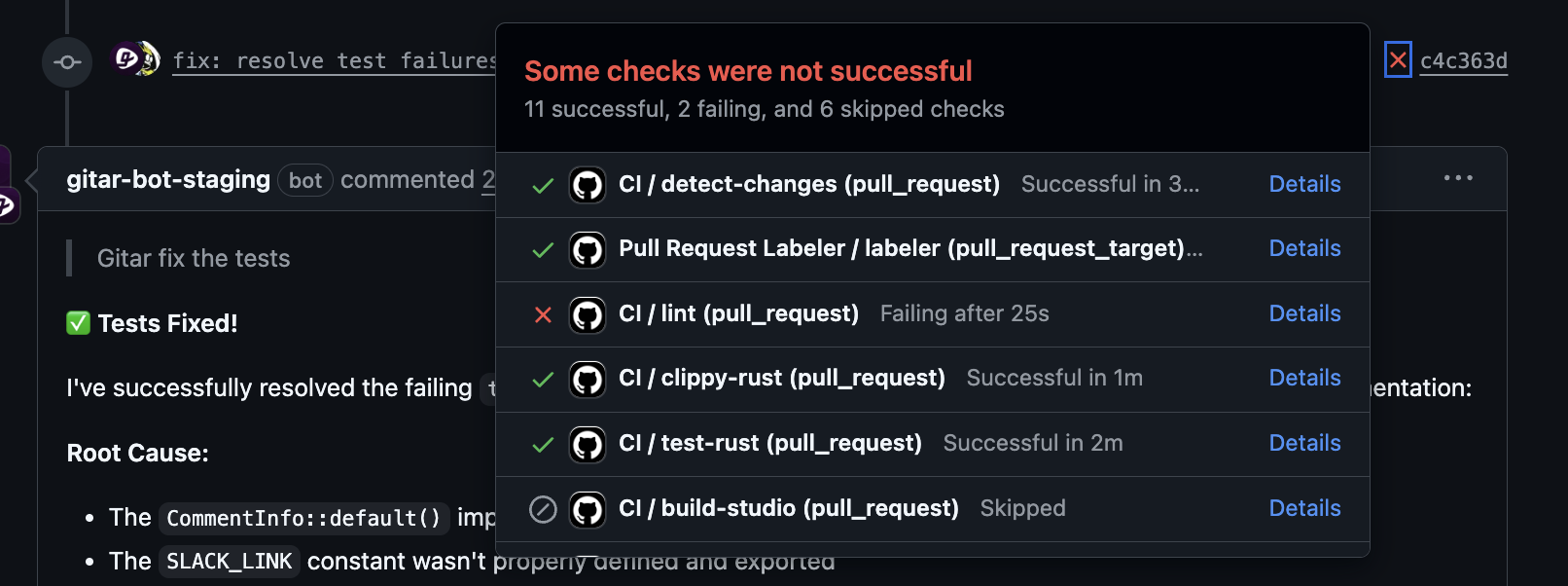
Early resolution keeps risk and delays low. Autonomous CI systems detect issues such as linting errors, failing tests, dependency conflicts, and build configuration problems as soon as they appear in the pipeline. When a CI check fails, the system analyzes the logs, proposes a fix, applies it, and reruns the relevant jobs.
This approach keeps problems from stacking up near release time. Teams spend less time revisiting old pull requests, and pipelines move forward with fewer manual interventions.
Improving Consistency and Reducing Human Error
Manual fixes often introduce inconsistency and new errors, especially under time pressure. Autonomous CI fixes rely on repeatable workflows. The system replicates your CI environment, including SDK versions, dependencies, and tools, then validates changes against that environment before surfacing a green build.
This workflow reduces configuration drift, supports consistent standards across teams, and lowers the odds of regression from rushed fixes.
Supporting Faster Merges and Higher Developer Velocity
High-performing teams protect developer focus. Autonomous CI remediation handles routine breakages in the background. When a pull request triggers failing checks, the system generates and validates fixes, then updates the branch so developers can merge without context switching.
This model keeps work moving, prevents long queues of red builds, and reduces the back-and-forth that typically slows down code reviews and releases.
Autonomous Fixes vs. Traditional Tools: Key Pipeline Differences
|
Feature |
Autonomous CI Fixes |
Traditional Tools |
Manual Processes |
|
Remediation capability |
Generate, apply, and validate fixes automatically |
Identify issues and suggest potential fixes |
Developers investigate and fix issues by hand |
|
Impact on developer velocity |
Minimal context switching and fewer blocked pull requests |
Developers must stop work to apply the suggestions |
Frequent interruptions and high coordination overhead |
|
Environmental awareness |
Replicates the full CI environment for validation |
Often limited to static or partial context |
Relies on manual environment setup and judgment |
|
Risk of human error |
Lower risk through consistent, validated workflows |
Present whenever suggestions are implemented manually |
High risk from rushed or inconsistent fixes |
Explore how autonomous CI fixes compare by installing Gitar.
Gitar: Autonomous CI Fixes for Secure, Efficient Pipelines
Gitar focuses on closing the gap between detection and remediation in CI/CD pipelines. The platform keeps developers moving while it handles routine CI failures, code review feedback, and environment-specific issues.
Key capabilities include:
- Full environment replication: Gitar mirrors your CI environment, including SDK versions, third-party tools, and configuration, so generated fixes run in the same conditions your pipeline uses.
- AI-driven remediation: The system generates code changes, applies them to branches, and runs your CI checks to confirm that builds return to green.
- Configurable trust levels: Teams can start in suggestion mode and require human approval, then move to more automated operation as confidence grows.
- End-to-end fixing: Gitar updates code, configuration, and tests as needed, validates results against your CI workflows, and surfaces ready-to-merge pull requests.
- Cross-platform support: The platform works with GitHub Actions, GitLab CI, CircleCI, BuildKite, and other common CI systems.
Enhance CI/CD efficiency and reliability with Gitar.
Frequently Asked Questions on Autonomous CI Fixes
How does Gitar handle complex CI issues that still need human judgment?
Gitar uses a configurable trust model. Teams can run it in a conservative mode where it suggests fixes for complex issues but requires developer approval before changes are merged. For nuanced problems, Gitar provides context, proposed changes, and reasoning, which speeds up code review rather than bypassing it. This approach keeps humans in control of critical decisions while offloading repetitive work.
Can Gitar work with third-party tools and custom scripts in our pipeline?
Gitar integrates with complex enterprise CI environments. The system replicates workflows that include multiple SDK versions, internal tools, third-party services, and custom scripts. Fixes are generated with that context in mind and must pass your existing checks and gates, so the platform extends your current toolchain instead of replacing it.
How does Gitar avoid introducing new issues with automated changes?
Gitar validates every change through your full CI pipeline. After generating a fix, it commits the change to the branch and runs your tests, linters, security checks, and other jobs. Only builds that pass all configured checks are surfaced as successful. This validation process reduces the risk of regressions and gives teams confidence in automated remediation.
What happens if a proposed fix conflicts with internal policies or workflow rules?
Gitar runs fixes through the same policies and workflow steps that apply to any change in your CI/CD setup. If a fix fails a policy check or violates a rule, the pipeline blocks the change. Gitar then adjusts the fix when possible or flags the issue for human review. This process ensures that automation stays aligned with your security and compliance standards.
How does Gitar stay consistent across environments and deployment stages?
Gitar maintains awareness of environment-specific settings, including configuration for staging and production. When generating fixes, it uses the context available from your CI workflows and environment definitions, so changes that work in CI are more likely to behave correctly downstream. This consistency reduces surprises between development, staging, and production.
Conclusion: Moving CI/CD Security and Reliability Forward with Gitar
CI/CD pipelines in 2026 face growing pressure from supply chain attacks, rising vulnerability volume, and complex toolchains. Manual, reactive approaches struggle to keep pace and often slow down delivery.
Autonomous CI fixes offer a practical path forward by resolving common failures early, validating changes in real environments, and preserving developer focus. Gitar delivers this capability in a way that respects existing workflows and policies while reducing repetitive remediation work.
Start using Gitar to reduce CI failures, improve security, and keep your pipeline moving.