
Failing CI/CD pipelines and lengthy code review cycles in GitLab often slow down developers and delay projects. Many engineering teams face this issue daily: a merge request fails, and hours are lost to debugging logs, switching tasks, and waiting for pipelines to rerun. This process can take up a significant portion of a developer’s day, impacting overall productivity.
This article explores how AI-driven tools like Gitar bring a self-healing approach to GitLab CI/CD workflows. You’ll see how Gitar tackles common challenges for developers and team leads by offering quick, reliable fixes, making your GitLab setup more efficient and reducing delays from broken builds.
Why Broken CI/CD Pipelines in GitLab Hurt Productivity
Time Lost to Manual Debugging
Debugging CI failures manually eats up valuable time. Developers often spend hours combing through logs and configuration files to fix issues like syntax errors or failed tests, which delays deadlines and adds frustration. These tasks require significant effort and often lead to missed project milestones.
The challenge grows when errors involve long stack traces across multiple components. Identifying the root cause becomes complex, especially with interconnected systems. This repetitive process pulls focus from coding and slows down team progress.
For a team of 20 developers, just one hour daily on CI issues adds up to 5,000 hours yearly. At an average cost, this equals around $1 million in lost productivity, time that could go toward building features or tackling technical debt.
Disruption from Context Switching
CI failures don’t just waste time fixing issues, they also disrupt a developer’s focus. After submitting a merge request and moving to another task, a failure notification forces a switch back to debugging. Studies show it can take over 20 minutes to refocus after such interruptions, turning a quick fix into a major productivity loss.
In GitLab setups with complex pipelines, this disruption is even worse. A developer working on a new feature might need to pause to address a minor linting error or test issue, losing momentum. This constant shifting of focus creates a hidden cost that builds up daily.
Unlike planned interruptions, CI failures strike unexpectedly. This randomness prevents developers from grouping similar tasks, keeping them in a state of low-level stress that affects deep, innovative work.
Delays in Merging Code and Project Timelines
CI failures cause delays that ripple beyond single merge requests. AI tools can diagnose and fix pipeline issues much faster than manual methods, speeding up resolution and reducing interruptions. Manual debugging, by contrast, slows everything down.
The issue is worse in GitLab setups with sequential pipelines. These systems run all tests in order, creating long wait times and blocking releases when even one job fails. A single error can hold up an entire feature launch.
Debugging in these setups becomes tougher as engineers must pinpoint specific failures and their downstream effects. This often leads teams to batch changes into larger commits, which goes against efficient development practices and further slows progress.
Delays in merging code directly impact feature releases and market timing. For companies with tight schedules or customer-driven goals, these setbacks can affect revenue and competitive standing.
Challenges with Complex Environments
Enterprise GitLab setups often face issues that standard tools can’t handle. A common problem is mismatched build environments, where differences in tool versions between local and CI setups cause unexpected failures. This is frequent in large teams using varied SDKs and integrations.
Adding security tools like SonarQube or Snyk complicates matters further. Fixes that work locally might fail in CI due to stricter checks. Replicating the CI environment locally is often impractical, leaving developers to guess and test repeatedly.
For distributed teams, slight differences in local setups create inconsistencies. A build passing for one developer might fail for another due to OS or dependency variations, leading to uneven experiences and blame-shifting over failures.
Infrastructure-as-Code scenarios, like managing Kubernetes or Terraform through GitLab CI/CD, add more hurdles. Failures here often need specialized skills, creating delays when the right expertise isn’t immediately available.
Dealing with Flaky Tests and Setup Errors
Flaky tests, which pass or fail without code changes, plague enterprise CI/CD systems, including GitLab. These unpredictable failures undermine trust in the pipeline. Developers may start ignoring results or bypassing quality checks.
These issues often arise from timing problems or external dependencies hard to replicate locally. In GitLab, this could mean integration tests failing on database timeouts or UI tests failing due to JavaScript timing issues.
Shared testing environments add another layer of difficulty. Misconfigurations in these setups frequently cause test and deployment failures. This is costly to debug, especially when multiple teams share resources.
Flaky tests also harm morale. Developers may overlook real issues, thinking failures are just random, which weakens trust in automation and can reduce test coverage over time.
Install Gitar now to automatically fix broken builds and ship software faster.
How Gitar Brings Self-Healing CI to GitLab
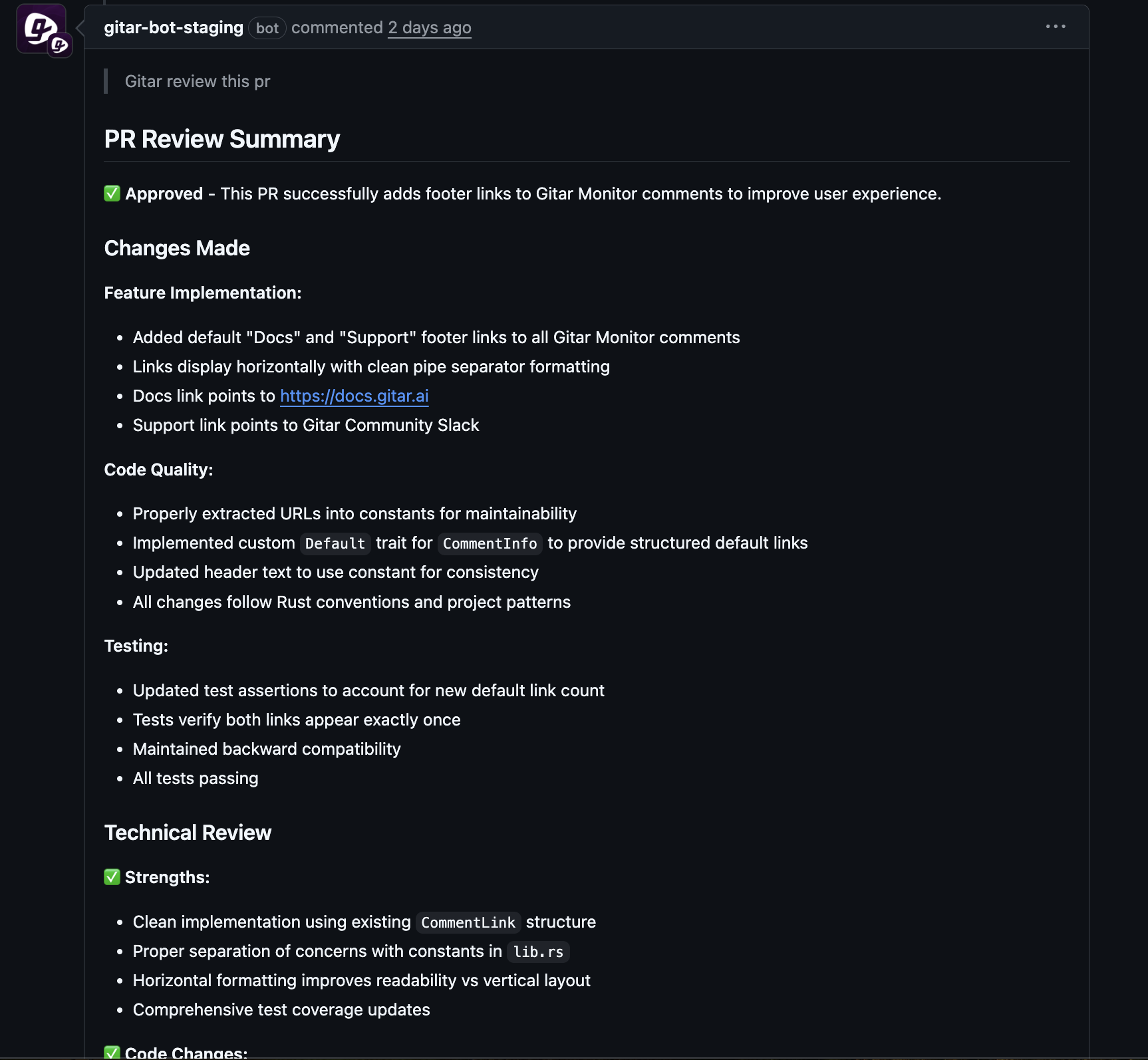
Gitar offers a new way to handle CI/CD issues in GitLab by moving beyond mere suggestions to full automation. Unlike tools that only point out problems, Gitar identifies failures, applies fixes, validates them, and commits changes directly, saving developers from manual tasks.
When a merge request fails or gets feedback, Gitar steps in. It examines logs or comments, finds the root cause, crafts a fix, tests it in the full CI environment, and updates the merge request. This automation turns a slow, hands-on process into a streamlined workflow that keeps builds passing and speeds up development.
Developers benefit right away. They can move to the next task while Gitar handles routine CI issues. Review cycles, often delayed by time zones, shrink as Gitar applies feedback instantly, improving the overall workflow.

What Gitar Can Do for Your Team
Here’s a breakdown of Gitar’s main features that improve GitLab workflows:
- Complete Fix Automation: Gitar doesn’t just suggest fixes for errors like linting. It applies the solution, tests it across the GitLab pipeline, and ensures everything passes before finalizing the merge request, removing the need for manual steps.
- Accurate Environment Matching: Gitar handles complex GitLab setups with specific dependencies and security scans like SonarQube or Snyk, ensuring fixes work in real conditions.
- Smart Review Handling: Gitar interprets review comments and applies requested changes, cutting down delays, especially for teams across different time zones.
- Flexible Trust Settings: Teams can start with ‘Conservative Mode,’ where fixes are suggestions for review, or use ‘Aggressive Mode’ for direct commits with rollback options once trust is built.
- Wide Platform Compatibility: Gitar supports GitLab CI, GitHub Actions, and others, fitting well into varied or transitioning toolsets.
Solving Key GitLab CI/CD Pain Points with Gitar
Cutting Down Manual Debugging Effort
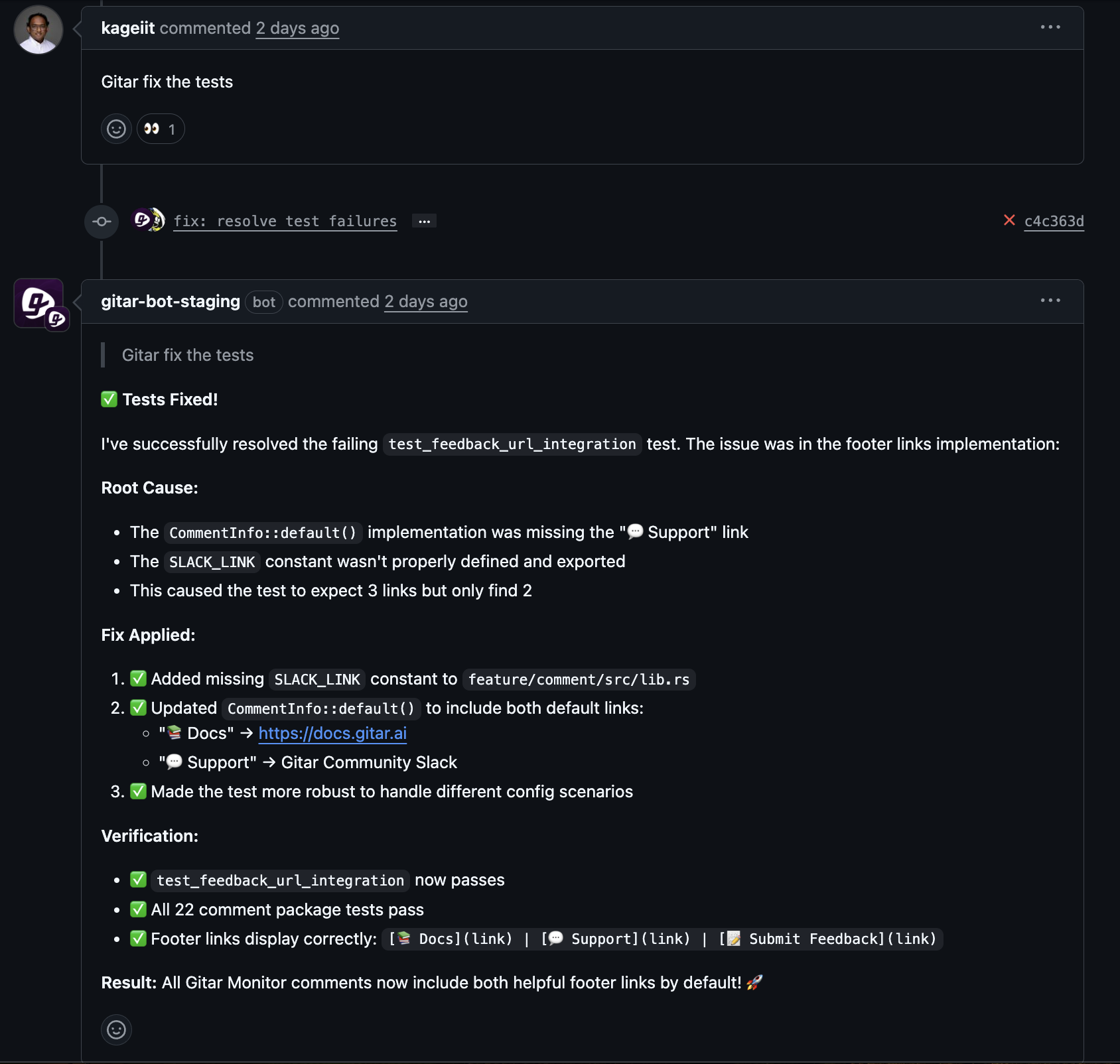
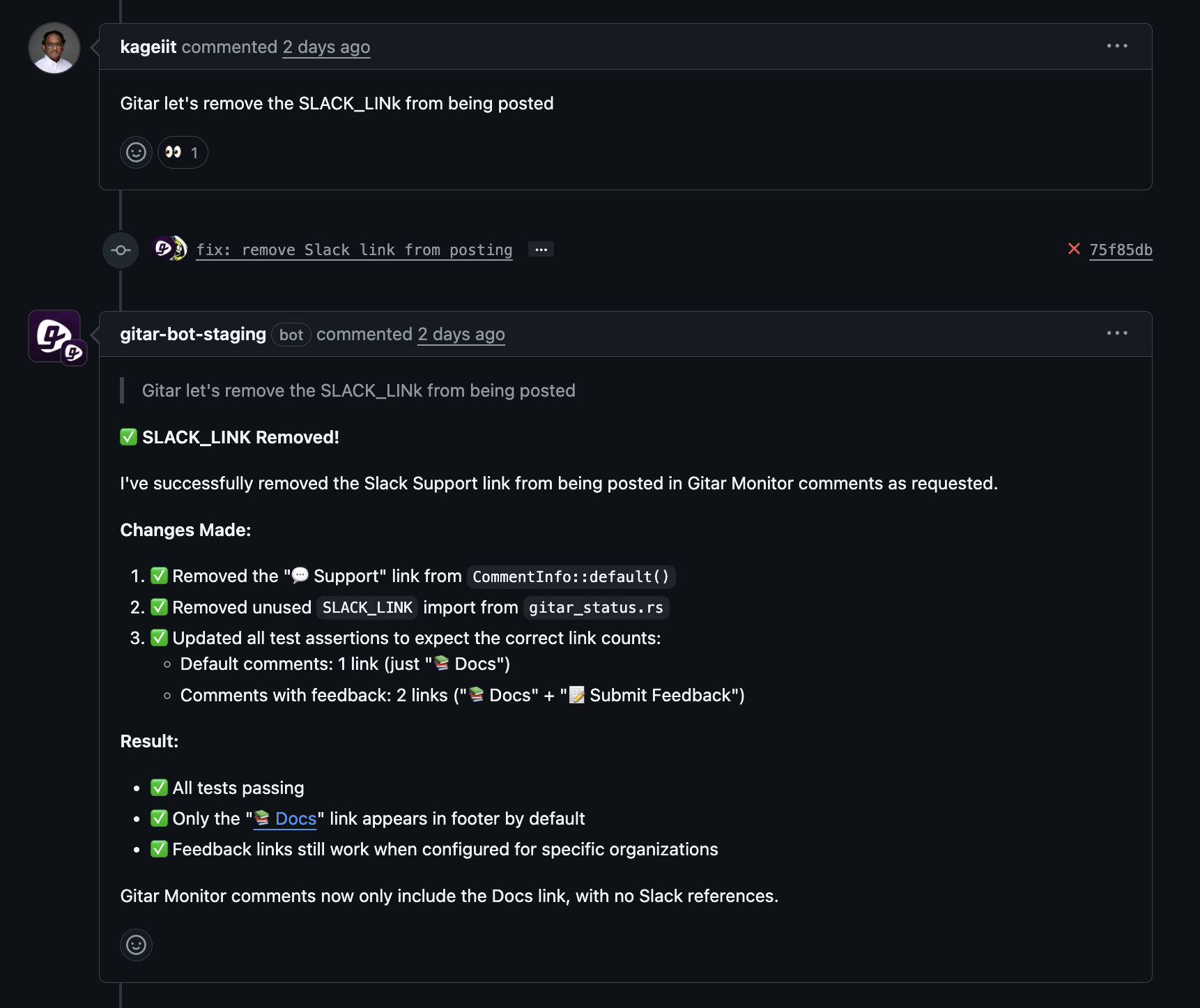
Gitar eliminates the time sink of manual debugging in GitLab by automatically analyzing failures and applying fixes. It quickly identifies issues like syntax errors or test failures from logs, sparing developers from poring over details.
Common issues Gitar resolves include:
- Formatting errors and linting violations, adjusted to match style guides.
- Test issues, such as updating snapshots or fixing assertions.
- Build script problems, like dependency conflicts, corrected in the process.
By automating these fixes, Gitar lets developers stay focused on their primary tasks without constant interruptions from CI issues.
Speeding Up Code Merges
GitLab workflows often slow down due to repeated CI failures and review rounds. Gitar reduces these delays by fixing issues and applying feedback instantly, often before developers notice the problem, keeping projects on track.
This speed is vital as coding tools increase code output. Gitar ensures the added volume doesn’t bog down reviews or CI checks, maintaining steady progress.
Handling Enterprise-Scale Complexity
Enterprise GitLab environments often involve varied languages, SDK versions, and security tools. Gitar adapts to these complexities by mimicking the full build context, ensuring fixes align with production standards and pass quality checks like SonarQube or Snyk scans.
Reducing Flaky Test Frustrations
Flaky tests and setup errors are hard to pin down manually. Gitar uses pattern analysis across pipeline runs to spot systematic issues versus random failures, applying fixes where possible to boost reliability.
Install Gitar now to fix broken builds automatically and ship software faster.
Comparing Gitar to Manual Fixes and Other AI Tools
|
Feature/Aspect |
Manual Debugging |
AI Code Reviewers (e.g., CodeRabbit) |
Gitar (Autonomous AI Agent) |
|
Primary Action |
Detect and fix manually |
Suggest potential fixes and analysis |
Detect, diagnose, and fix autonomously |
|
CI/CD Fixes (GitLab) |
Time-consuming, error-prone |
Offers committable fixes and analysis |
Automated, validated, self-healing |
|
Code Review Feedback |
Manual implementation |
Provides actionable suggestions and fixes |
Implements changes autonomously based on feedback |
|
Context Switching |
High, frequent disruption |
Reduced through integrations and automation |
Minimal to none, maintains developer flow |
|
Environment Awareness |
Depends on developer expertise |
Contextually aware with tailored analysis |
Full GitLab environment replication |
|
End Result |
Potentially fixed, eventually green |
Actionable fixes, developer oversight for green builds |
Validated green builds |
Gitar stands out by fully automating fixes and validating them against GitLab workflows. Manual methods demand constant attention, and other AI tools still require developer involvement for final steps. Gitar takes on the full responsibility, ensuring reliable outcomes.
This difference matters most in enterprise GitLab setups, where context switching costs and environment complexity make manual fixes inefficient. Gitar removes uncertainty by confirming every fix works in the actual pipeline.
Business Benefits: Cost Savings and Efficiency
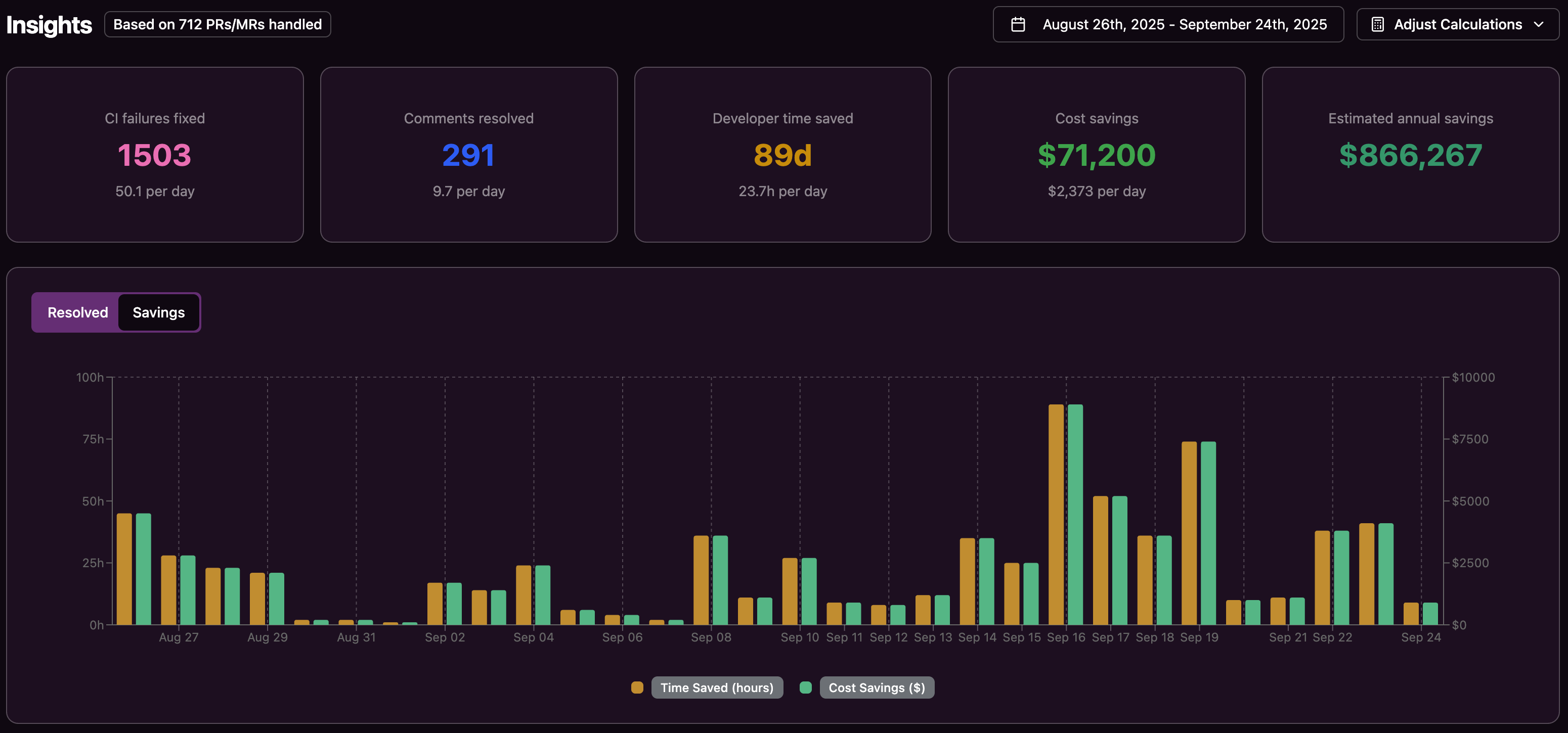
Using Gitar for automated CI fixes offers clear financial benefits. A 20-developer team losing one hour daily to CI and review issues faces around $1 million in annual productivity costs, based on a $200 hourly rate including salary and overhead.
Beyond direct savings, Gitar delivers other advantages:
- Faster Development Cycles: Automating fixes speeds up feature delivery and iteration.
- Better Developer Experience: Reducing tedious tasks can improve team morale and engagement.
- Consistent Code Quality: Automated fixes align with coding standards, maintaining codebase integrity.
Getting Started with Gitar: A Simple Setup Plan
Implementing Gitar follows a three-step process to build trust and deliver value quickly:
First, install Gitar on select GitLab repositories in ‘Conservative Mode.’ Fixes start as suggestions for review, letting teams see results without immediate automation.
Next, as confidence grows from successful fixes, expand Gitar to more repositories. Teams may test higher automation levels on less critical projects.
Finally, move to ‘Aggressive Mode’ for full automation where appropriate. Distributed teams especially gain from faster reviews, unaffected by time zone gaps.
Install Gitar now to fix broken builds automatically and ship software faster.
Common Questions About GitLab CI/CD Automation with Gitar
How does Gitar fit into my current GitLab setup?
Gitar integrates easily as an application in your GitLab repositories. Installation is straightforward, requiring no major changes to existing pipelines or configuration files like .gitlab-ci.yml. It automatically monitors CI runs and reviews, stepping in when needed.
Can Gitar manage complex enterprise GitLab environments?
Yes, Gitar is built for enterprise needs. It replicates full workflows, handling specific SDKs, dependencies, and tools like SonarQube or Snyk, ensuring fixes work in production settings.
What if I’m unsure about automated fixes?
Gitar offers flexibility. Start with ‘Conservative Mode’ to review and approve fixes manually. As trust grows, switch to ‘Aggressive Mode’ for full automation, with rollback options always available.
Does Gitar help with flaky job failures?
Gitar analyzes pipeline patterns to separate random issues from consistent problems, applying fixes to systematic failures and improving reliability over time.
How does Gitar address security and compliance?
Gitar prioritizes security with on-premise deployment options for strict requirements. It respects GitLab permissions and integrates with existing systems, ensuring fixes meet organizational standards.
What CI failures can Gitar fix?
Gitar automates fixes for routine GitLab CI issues like linting errors, formatting problems, test failures such as snapshot updates, and build issues like dependency conflicts, freeing developers for complex challenges.
Looking Ahead: Efficient GitLab CI/CD with Automation
CI/CD failures and long review cycles in GitLab don’t have to stall development. Tools like Gitar shift these burdens to automated, self-healing systems, redefining how teams manage workflows.
Manual debugging consumes too much developer time, an unsustainable cost in today’s fast-paced software world. Companies adopting automated solutions can deliver features quicker and stay competitive.