
Last updated: February 27, 2026
Key Takeaways for GitLab AI Integrations
- AI-generated PRs increase review time by 91% and often break CI pipelines, costing a 20-developer team about $1M per year in manual fixes.
- Three reliable methods connect external AI with GitLab: CI/CD jobs that call APIs, GitLab AI Gateway for self-hosted models, and webhooks for event-driven automation.
- Gitar.ai offers free AI code review with autofix, removing manual work for lint errors, test failures, and build breaks.
- Gitar provides zero-setup GitLab integration, consolidated feedback, and fix validation across GitLab CI, GitHub Actions, and other CI providers.
- Install Gitar today to keep builds green and ship higher quality software faster without building custom API plumbing.
Gitar.ai: Free AI Code Review and Autofix for GitLab Teams
Gitar.ai delivers free AI code review that not only suggests changes but also fixes your code. Competing tools often charge $15-30 per developer for basic comments, while Gitar provides full PR analysis, security scanning, and bug detection at no cost, plus a 14-day free trial for autofix.
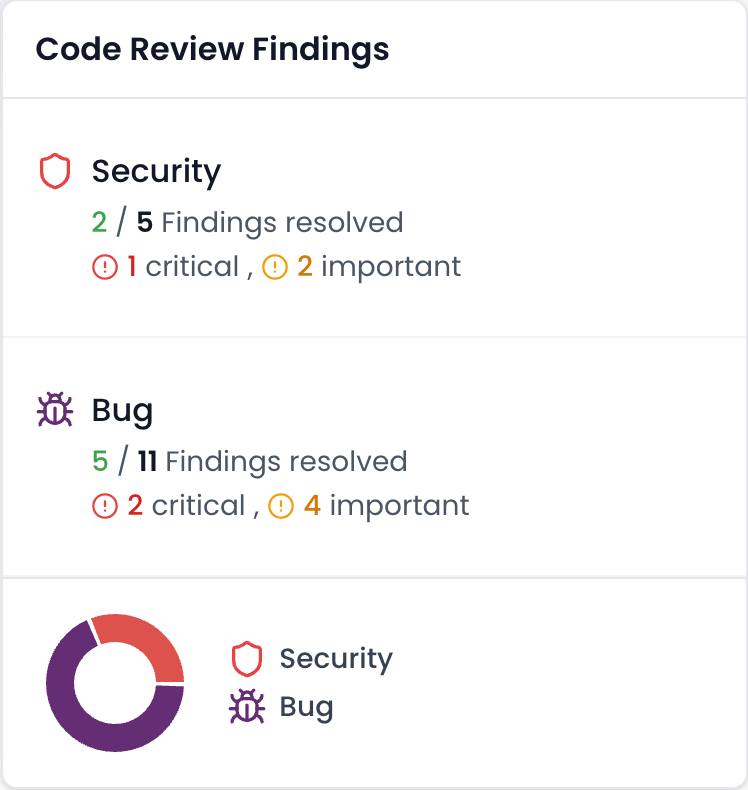
Key capabilities include:
- Automatic CI failure analysis and fixing for lint errors, test failures, and build breaks
- Implementation of review feedback through natural language commands
- Single dashboard comment that consolidates all findings instead of notification spam
- Native GitLab integration with support for GitLab CI, GitHub Actions, CircleCI, and Buildkite
- Validation that fixes work before committing them
- Cross-platform support for unlimited repositories and users
Install Gitar now, automatically fix broken builds, start shipping higher quality software, faster
Solution 1: CI/CD Jobs That Call External AI APIs
Direct CI/CD jobs that call AI APIs give you precise control and work with any AI provider. You define when the job runs and what context the model receives.
Use this step-by-step flow:
- Configure CI/CD Variables: Set secure variables in GitLab project settings for API keys such as OPENAI_API_KEY and ANTHROPIC_API_KEY.
- Create YAML Job Configuration: Define a CI job that runs on merge request events or only when CI fails.
- Implement API Calls: Use curl or Python scripts to send code context and metadata to your chosen AI model.
- Parse and Apply Fixes: Process the AI response and commit fixes back to the branch with a bot user.
- Add Error Handling: Add retry logic, fallbacks, and clear logging for API failures.
Gitar provides seamless GitLab integration through its app installation, so you avoid custom YAML, API keys, and manual error handling.
Gitar-Powered CI Workflow in GitLab
Gitar’s GitLab integration manages CI failure analysis and fix validation for you. After installation, it monitors pipelines, detects failures, generates targeted fixes, and validates them in your environment before committing.
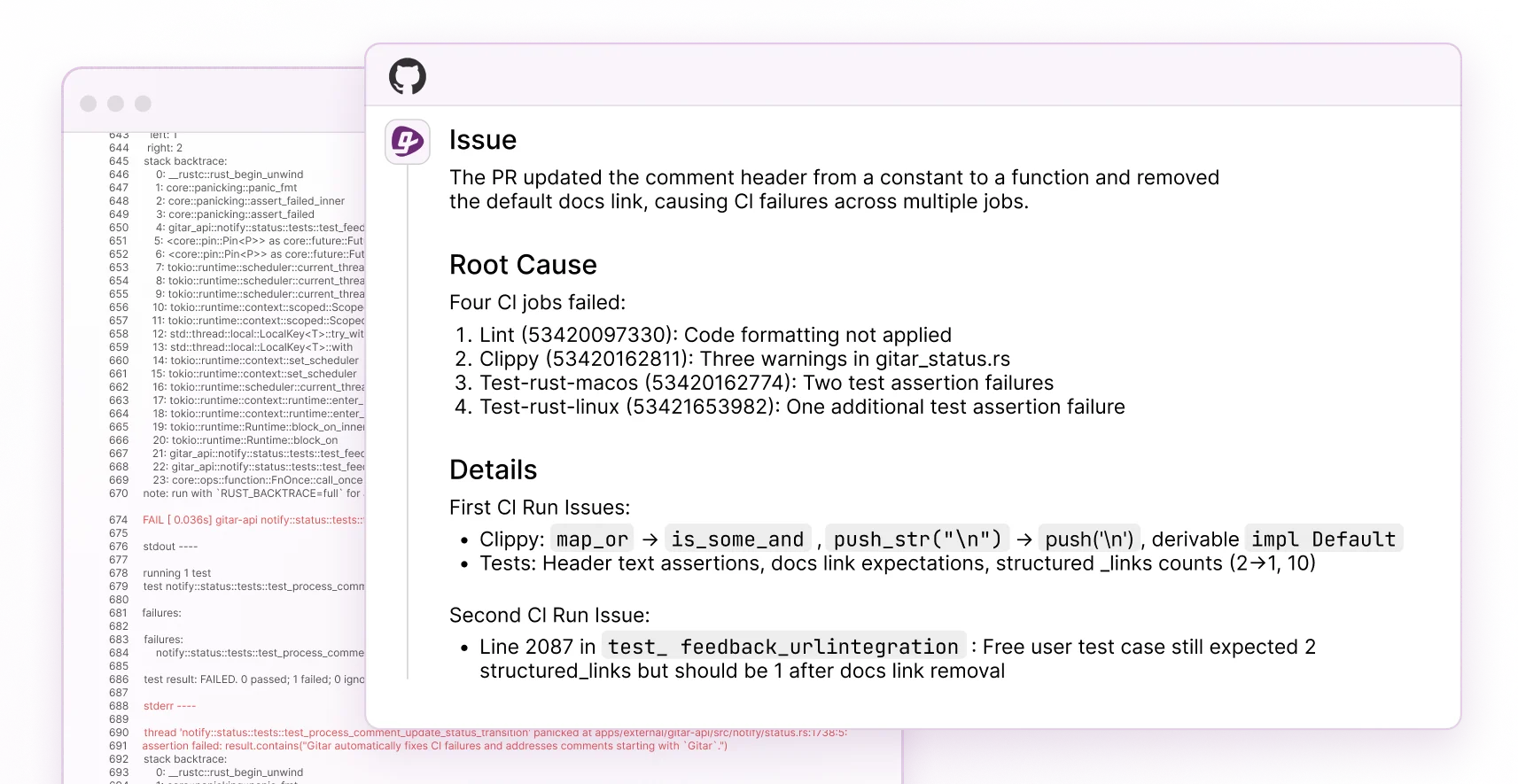
See the Gitar documentation for GitLab setup details.
|
API Provider |
Endpoint |
Gitar Advantage |
|
OpenAI GPT-4 |
api.openai.com/v1/chat/completions |
Requires custom integration |
|
Anthropic Claude |
api.anthropic.com/v1/messages |
Available pre-built integrations |
|
Gitar |
App installation |
Zero-setup GitLab integration with autofix |
GitLab CI covers job configuration, and Gitar’s docs explain the one-click integration.
Solution 2: GitLab AI Gateway for Self-Hosted and External Models
GitLab AI Gateway centralizes access to external AI models behind a single endpoint. Teams route all AI traffic through this gateway while keeping strict control over security and compliance.
This pattern works well for organizations that run models on-premises or in private clouds.
Implementation steps:
- Deploy AI Gateway: Run the Docker container or self-hosted instance in your infrastructure.
- Configure Model Proxies: Route external LLM requests through the gateway to OpenAI, Anthropic, or internal models.
- Integrate with MR Pipelines: Connect merge request workflows so AI analysis runs during reviews or on failures.
- Set Up Authentication: Configure secure access tokens and API keys for each provider.
Using Gitar with GitLab AI Gateway
Gitar integrates natively with GitLab through app installation and supports GitLab CI workflows with full autofix. This approach fits enterprise security requirements while avoiding custom glue code.
GitLab Duo External Agents for AI Tools
GitLab Duo external agents connect external AI models such as Anthropic Claude or OpenAI Codex directly to GitLab workflows. Users mention external agents in issues, epics, or merge request comments, for example @ai-codex, which triggers runner jobs that execute AI tools and post results back to GitLab.
Supported providers include Anthropic Claude for code generation and review and OpenAI Codex for GPT-powered code assistance. Configuration uses CI/CD variables such as GITLAB_HOST, AWS_REGION_NAME for Amazon Q, and GOOGLE_API_KEY plus GOOGLE_CLOUD_PROJECT for Google Gemini.
GitLab Duo external agents provide useful AI suggestions, while Gitar focuses on zero-setup autofix that implements and validates fixes, not just comments on them.
Solution 3: Webhooks with External AI Services for Event Automation
GitLab webhooks enable event-driven AI automation that reacts in real time to repository activity. This approach triggers AI analysis and fixes when merge requests change or when CI pipelines fail.
Use this implementation pattern:
- Configure GitLab Webhooks: Create webhook endpoints for merge request and pipeline events.
- Deploy External Handler: Run a service that receives webhook payloads and normalizes them.
- Integrate AI Analysis: Call OpenAI or other AI services from the handler with relevant code context.
- Implement Autonomous Commits: Allow the system to push fixes back to branches with a service account.
Scaling Webhook-Based Automation with Duo Agents
For large installations, experts recommend webhook receivers in GitOps tools that trigger immediate reconciliation on push events. This pattern avoids heavy polling and reduces API rate pressure.
Scale further by relaxing polling to 5-10 minutes as a fallback for missed webhooks and by using separate webhooks for different repository paths.
Gitar Webhook Workflow for Fast Feedback
Gitar’s webhook integration manages event processing and responds quickly to CI failures and merge request updates. The system keeps context across events and posts consolidated feedback through a single dashboard comment.
|
Capability |
Manual API |
Paid Tools |
Gitar (Free) |
|
Auto-apply fixes |
No |
No |
Yes |
|
CI validation |
No |
Limited |
Yes |
|
Consolidated feedback |
No |
No |
Yes |
|
Webhook automation |
Custom |
Basic |
Full |
Install Gitar now, automatically fix broken builds, start shipping higher quality software, faster
Best Practices for Secure, Scalable AI Integrations
Authentication and Secrets Management in GitLab
Secure API integrations depend on careful token and secret handling.
- Use GitLab CI/CD variables for API keys and mark them as masked and protected.
- Use CI_JOB_TOKEN for GitLab API access where possible.
- Rotate tokens regularly for external services and document the schedule.
- Store team-specific settings in project-level variables for easier management.
Scaling for High Volumes of AI-Generated PRs
Rising AI-generated PR volume requires robust scaling patterns.
- Configure retry logic with exponential backoff for API rate limits and transient failures.
- Use natural language rules or labels to prioritize critical fixes over cosmetic changes.
- Run parallel processing for multiple CI failures across services or repositories.
- Set up monitoring and alerting for integration health and error spikes.
Common Integration Errors and Practical Fixes
Most teams encounter a familiar set of integration issues.
- API rate limits: Add queuing, retries, and request batching where possible.
- Authentication failures: Confirm token scopes, expiration dates, and environment variable names.
- Network timeouts: Tune timeout values and add circuit breakers for unstable endpoints.
- Invalid responses: Validate responses and add structured error handling with clear logs.
Gitar removes most of these concerns through its zero-setup integration that manages authentication, rate limiting, and error recovery automatically.
Frequently Asked Questions
How do you connect external AI models with GitLab APIs?
The most effective pattern uses CI/CD variables for API authentication and pipeline jobs that call external AI services. Configure OPENAI_API_KEY as a masked variable, then use a Python script in .gitlab-ci.yml to send code context to the AI model and process responses. Gitar simplifies this by providing a pre-built integration that only requires installing the GitLab app, without custom scripting or API management.
What is the difference between GitLab Copilot-style features and external AI integrations?
GitLab’s native AI features such as GitLab Duo provide agentic workflows, CI/CD chat, root cause analysis, code reviews, test generation, and refactoring across the lifecycle. External AI integrations add specialized capabilities such as autonomous fixing, advanced security scanning, and custom workflow automation. Gitar offers free autofix that implements and validates changes, while many AI tools stop at recommendations that still need manual work.
Can you run self-hosted AI models with GitLab?
Yes. GitLab AI Gateway can proxy requests to self-hosted AI models while meeting security and compliance requirements. You deploy the AI Gateway as a Docker container, configure routing to internal AI services, and connect it to GitLab CI/CD pipelines. This pattern suits organizations with strict data governance rules.
How do you build trust in automated commits from AI integrations?
Start with suggestion mode so AI-generated fixes require manual approval. Gradually enable auto-commit for low-risk failures such as lint or formatting issues. Maintain detailed logging and audit trails for every automated change. Gitar supports configurable automation levels, so teams can increase trust over time while keeping full visibility into all fixes.
What are GitLab Duo external agents and how do they work?
GitLab Duo external agents connect external AI models such as Anthropic Claude or OpenAI directly to GitLab workflows. You mention the agent in comments using @agent-name syntax, which triggers a runner job that calls the AI tool and posts results back to GitLab. Configuration uses CI/CD variables for API keys and authentication credentials for each provider.
Conclusion: Keep GitLab Builds Green with Gitar.ai
External AI models connected to GitLab through APIs shift development from reactive firefighting to proactive healing. Teams replace manual CI fixes and repetitive review changes with autonomous workflows that keep pipelines green and maintain delivery speed.
|
Metric |
Before Gitar |
After Gitar |
|
Time on CI fixes |
1 hour/day/developer |
15 minutes/day/developer |
|
Annual productivity cost |
$1M (20-dev team) |
$250K |
|
Tool costs |
$450-900/month |
$0 (free tier) |
The three proven methods, direct CI/CD API calls, GitLab AI Gateway integration, and webhook-driven automation, all support autonomous CI fixes. Custom integrations, however, demand significant engineering time and ongoing maintenance.
Gitar removes that overhead with a complete platform that manages authentication, error recovery, fix validation, and GitLab integration from day one. Teams at Pinterest scale Gitar across 50+ million lines of code and thousands of daily PRs while meeting production reliability and security standards.
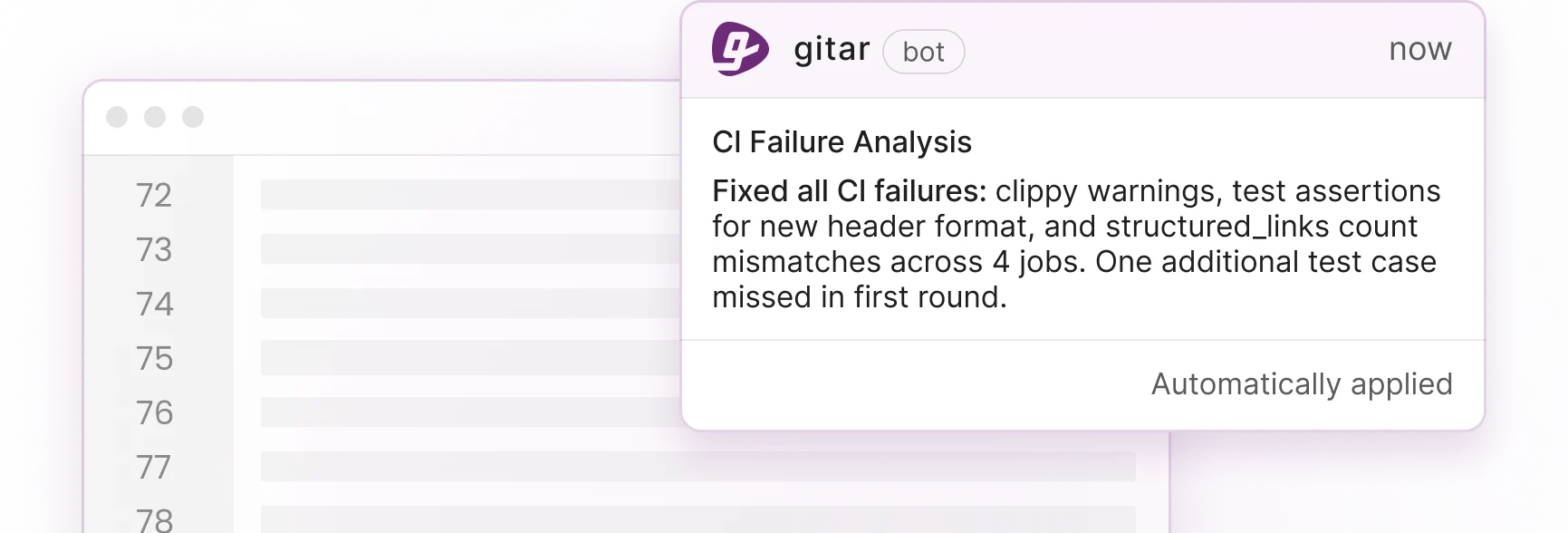
Install Gitar now, automatically fix broken builds, start shipping higher quality software, faster