
Written by: Ali-Reza Adl-Tabatabai, Founder and CEO, Gitar
Key Takeaways for 2026 AI Code Review
- AI code generation increased PR review time by 91% in 2025, so polyglot teams now face slower reviews despite faster coding.
- Gitar ranks #1 by using a healing engine that auto-fixes CI failures across Python, JavaScript, Java, Go, Rust, and additional languages.
- Competitors such as CodeRabbit, SonarQube, and Greptile provide suggestions without guaranteed auto-fixes, so engineers still apply changes manually.
- Key integrations include GitHub, GitLab, CircleCI, and Buildkite, and Gitar stands out with real-time updates that avoid comment spam.
- Teams see stronger ROI with Gitar’s 14-day full Team Plan trial, so start your free trial at Gitar to automate fixes and ship faster.
How We Ranked AI Code Review and Auto-Fix Platforms
Our evaluation criteria focus on real-world deployment for mid to large engineering teams. We prioritized multi-language coverage, native CI/CD integrations such as GitHub Actions, GitLab CI, CircleCI, and Buildkite, and auto-fix capabilities that go beyond simple suggestions. We also weighed setup simplicity, pricing transparency, and enterprise scalability. We saw Gitar documentation for details on CI failure analysis compared to suggestion-only competitors. Testing combined hands-on deployment across polyglot repositories, vendor documentation review, and integration with industry data from GitClear, Index.dev, and Jellyfish platform metrics.
Top 9 Automated Multi-Language Code Review Tools Overview
This list summarizes the leading automated code review tools for 2026 workflows.
- Gitar – Healing engine with auto-fixes for CI and review issues across polyglot stacks
- CodeRabbit – PR suggestions with 40+ linter integrations
- SonarQube – Static analysis and quality gates
- Greptile – Codebase graph analysis with contextual suggestions
- Snyk Code – Security-focused autofix for vulnerabilities
- DeepSource – Diff-focused static analysis scans
- GitHub Copilot Code Review – Native GitHub inline feedback
- Semgrep – Custom rule-based static analysis
- CodeQL – Semantic code analysis for security
#1 Gitar: Healing Engine for Polyglot CI/CD Pipelines
Gitar stands out as the platform that moves beyond suggestions and focuses on guaranteed green builds through automated fixes. It supports Python, Go, JavaScript, TypeScript, Java, Rust, and additional languages with native integrations across GitHub, GitLab, CircleCI, and Buildkite. Gitar’s CI Failure Analysis deduplicates failures across multiple jobs, surfaces root causes without manual log analysis, and maintains real-time updates.
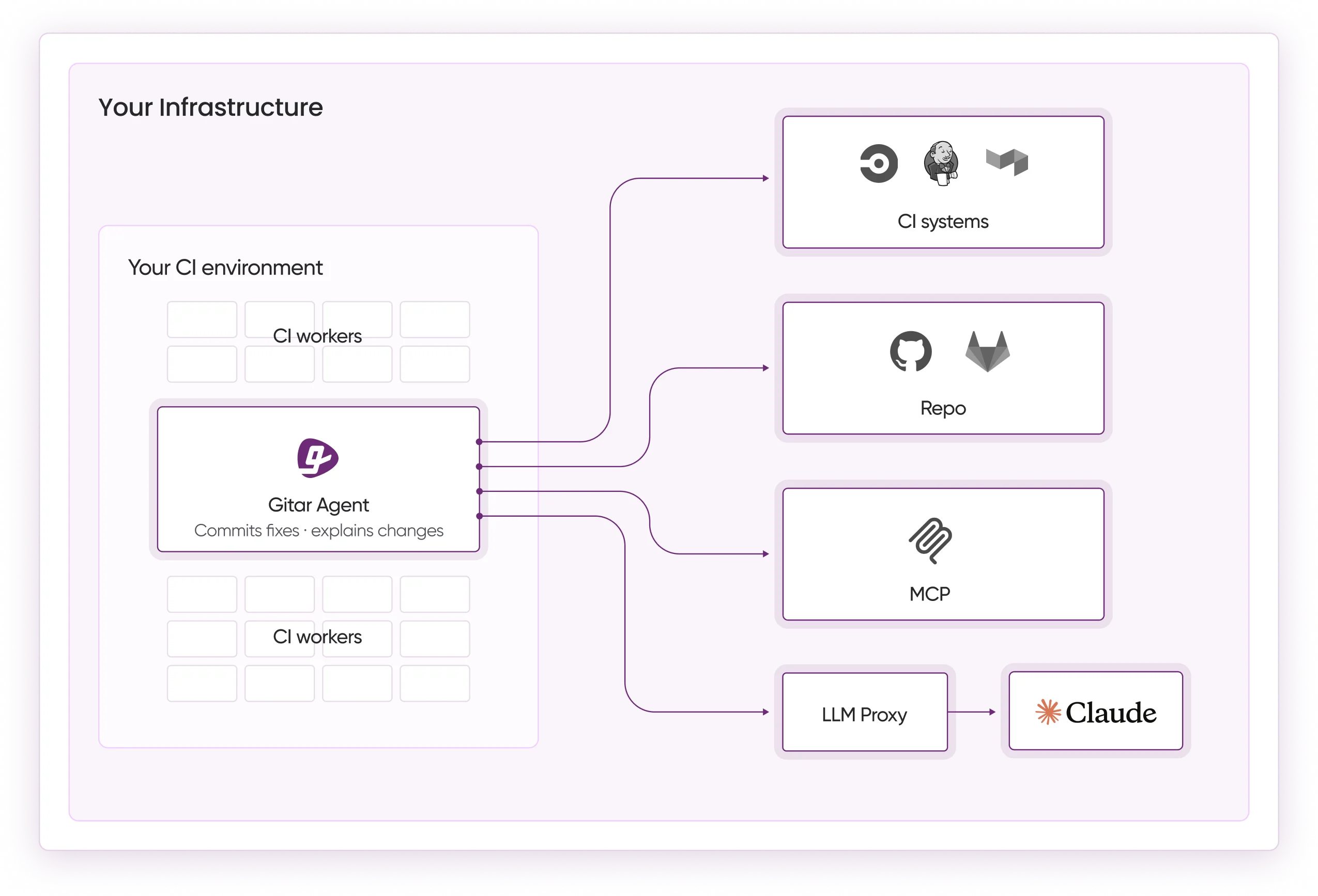
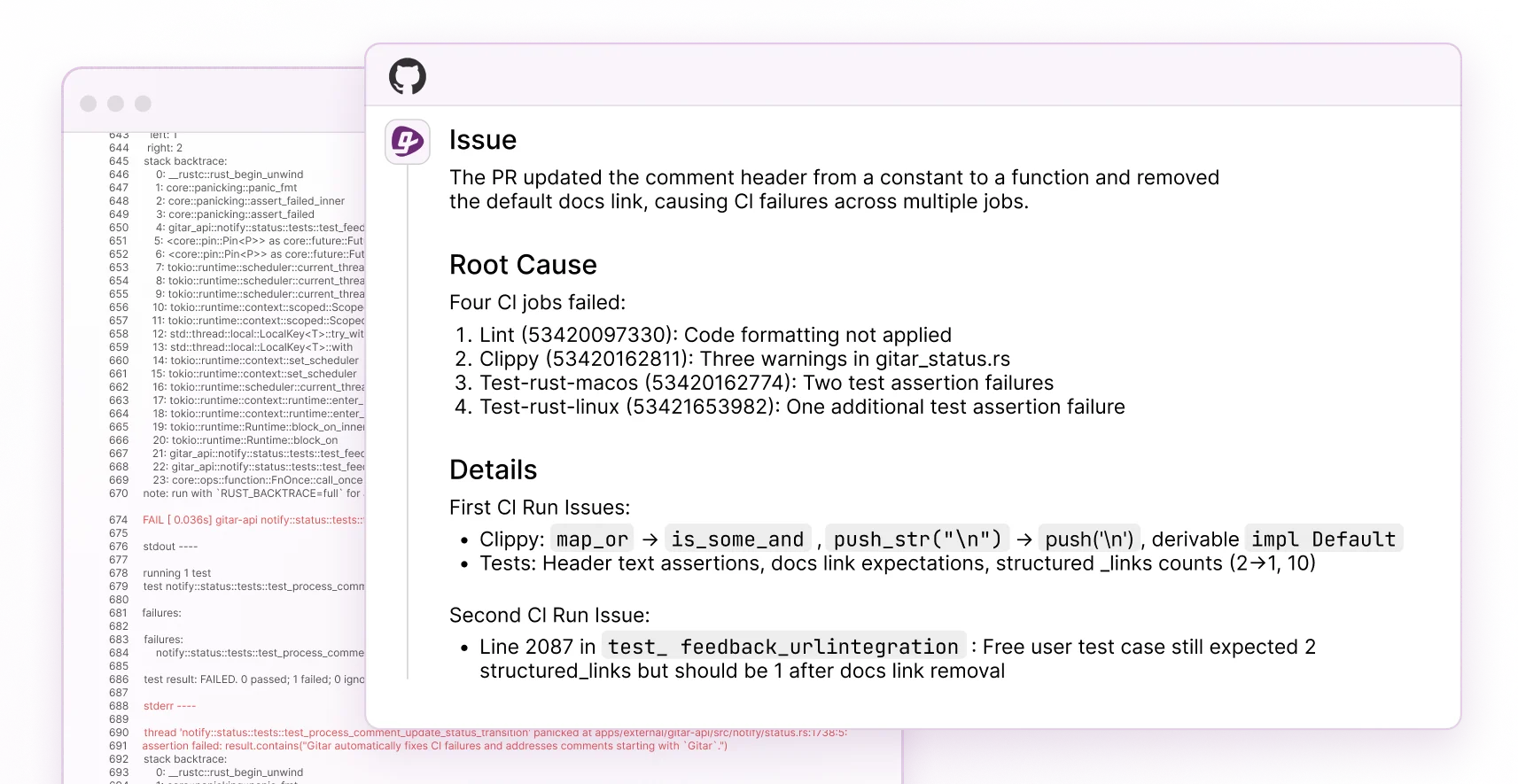
The platform’s healing engine automatically analyzes CI failures to identify root causes, then generates validated fixes based on that analysis, and finally commits those corrections directly to pull requests. This sequence completes the entire remediation cycle without human intervention. Unlike competitors that flood PRs with dozens of inline comments, Gitar consolidates all findings into a single dashboard comment that updates in real time, which removes notification spam while preserving full coverage.
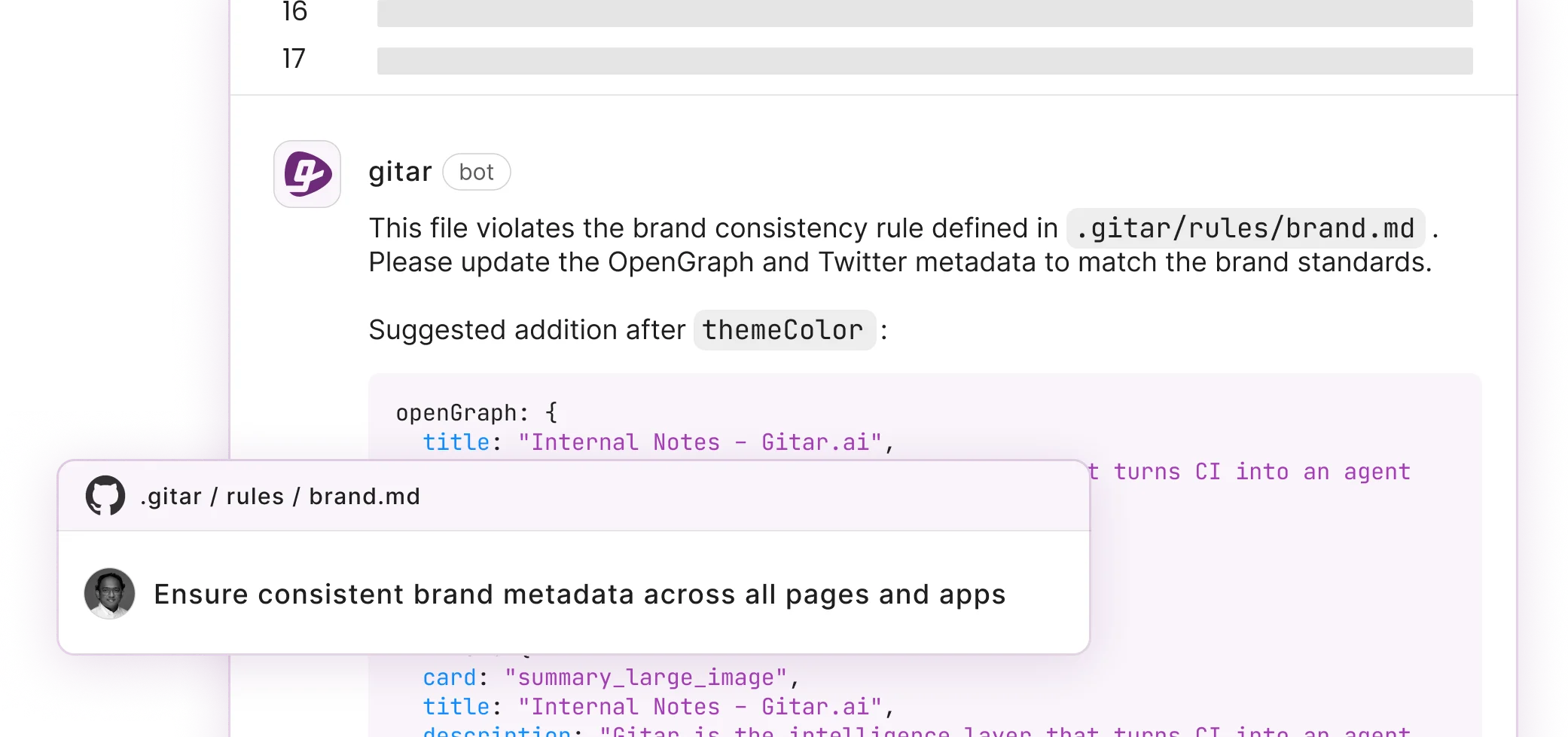
Key differentiators include natural language repository rules that power workflow automation without complex YAML, along with deep Jira and Slack integrations. Teams also receive a 14-day full Team Plan trial with no seat limits. Gitar’s CI agent maintains context from PR creation to merge and works continuously to keep CI green while finding and fixing root causes inside the team’s own CI environment.
For DevOps leads who manage teams of 20 or more developers, Gitar delivers measurable ROI through reduced manual intervention and higher build success rates. This healing engine approach contrasts with suggestion-only tools that still depend on human follow-through. The next four tools show why suggestion models struggle to remove the post‑AI coding bottleneck.
Try Gitar free for automated multi-language code review workflows: Start your 14-day trial.
#2 CodeRabbit vs Gitar for PR Suggestions
CodeRabbit serves more than 2 million repositories with PR suggestions and integrates over 40 linters across GitHub, GitLab, Bitbucket, and Azure DevOps. CodeRabbit reports 46% bug detection accuracy but does not provide auto-fix capabilities, so teams must implement suggested changes manually. At $15 to $30 per developer each month, engineering groups still handle the actual fixing work. The platform also generates extensive inline comments that can clutter PR timelines unless teams tune configuration settings.
#3 SonarQube Alternatives Compared to Gitar
SonarQube Community Edition offers static analysis across more than 30 languages and enforces quality gates that fail builds when code falls below defined standards. The platform integrates with all major CI/CD systems but functions as a traditional rule-based tool without AI-powered contextual understanding or auto-fix capabilities. As a result, SonarQube can miss architectural issues that modern AI-driven platforms detect and remediate.
#4 Greptile: Codebase Graph Analysis and Context
Greptile builds detailed knowledge graphs of entire codebases, indexing functions, dependencies, and historical changes for deep PR analysis. Teams report 4x faster PR merges through Greptile’s impact context analysis, although the platform still operates as a suggestion engine without auto-healing features. Version 3 uses Anthropic Claude Agent SDK for multi-hop investigation, yet engineers must apply the fixes themselves.
#5 Snyk Code: Security-Focused Autofix Coverage
Snyk Code provides AI-powered Static Application Security Testing across more than 19 languages, and Team and Enterprise plans include Autofix for vulnerability remediation. The platform integrates with IDEs, GitHub, and CI pipelines and delivers actionable security fixes. Its scope centers on security rather than full-stack code review, so teams often pair it with broader quality and CI automation tools.
#6 DeepSource: Diff-Focused Static Analysis
DeepSource runs rapid static analysis on pull requests and flags null handling errors, unsafe resource usage, and failing logic paths. The Autofix feature generates single-click suggestions for Python, Go, JavaScript, Ruby, and Java, and integrates into CI/CD workflows. These capabilities still fall short of a full healing engine because teams must manage many fixes and validations manually.
#7 GitHub Copilot Code Review: Native GitHub Experience
GitHub Copilot Code Review reached one million users within months of its April 2025 general availability. The platform offers surface-level PR reviews with change summaries and inline comments and integrates CodeQL and ESLint for security scanning. It remains limited to GitHub environments and lacks the deep architectural analysis and auto-fix capabilities that specialized platforms provide.
#8 Semgrep: Custom Rule Engine for Policy Enforcement
Semgrep supports custom rule-based static analysis with broad language coverage and CI/CD integration. The platform excels at enforcing specific coding standards and security patterns. It still relies on traditional rule matching without AI-powered contextual understanding or automated fixes, so teams must maintain rules and apply changes themselves.
#9 CodeQL: Semantic Security Analysis in GitHub
CodeQL delivers semantic code analysis for security vulnerability detection and integrates into GitHub Advanced Security. The platform adds inline annotations with potential fixes and Copilot Autofix suggestions, yet its primary focus remains security rather than comprehensive code review automation across all quality dimensions.
Ready to move beyond suggestions? Start your free 14-day trial and experience automated fixes firsthand.
Multi-Language Support Matrix for Polyglot Teams
Comprehensive language support remains critical for teams that manage diverse technology stacks. The table below reveals a key pattern: many tools advertise polyglot coverage, yet only Gitar pairs broad language support with guaranteed auto-fix capabilities. Competing platforms still force teams to apply suggested changes manually even when they support multiple languages.
|
Tool |
Polyglot Support |
Auto-Fix CI Fails |
Key Integrations |
|
Gitar |
Yes (Python, Go, JavaScript, TypeScript, Java, Rust, and more) |
Yes |
GitHub/GitLab/CircleCI/Buildkite |
|
CodeRabbit |
Partial |
No |
GitHub/GitLab/Bitbucket/Azure |
|
SonarQube |
Yes |
No |
All CI platforms |
|
Greptile |
Yes |
No |
GitHub/GitLab |
Side-by-Side ROI Comparison for Auto-Fix Tools
ROI analysis shows clear gaps in value delivery between suggestion engines and healing platforms. The savings figures below represent estimated annual productivity gains for a 50-engineer team. These estimates draw from reduced manual fix time, faster PR cycles, and fewer failed builds that require rework.
|
Tool |
Auto-Fix CI Fails |
Multi-Lang Depth |
Pricing/Trial |
ROI Savings |
|
Gitar |
Yes/Guaranteed |
Multiple |
14-day Full |
$750K |
|
CodeRabbit |
Suggestions |
Partial |
$15/dev |
$250K |
|
Greptile |
Suggestions |
Full |
$30/dev |
$200K |
|
Snyk Code |
Security Only |
19+ |
Team Plan |
$150K |
Key Considerations and Tradeoffs for Automated Workflows
Team size and infrastructure complexity shape platform selection in predictable ways. Small teams benefit from Gitar’s comprehensive trial because they can measure velocity improvements without upfront investment, which reduces budget risk. Enterprise organizations face different constraints and often require SOC 2 compliance and self-hosted deployment options before they can even start a trial, so vendor evaluation becomes a longer and more formal process. Organizations with 100% AI coding tool adoption merge 113% more pull requests per engineer with 24% faster median cycle times, but they only reach those gains when automated review workflows keep pace with accelerated coding speed.
Migration from existing tools such as SonarQube or CodeRabbit requires a close look at auto-fix capabilities compared to suggestion-only approaches. Teams that spend $450 to $900 each month on per-seat suggestion tools often find stronger ROI with platforms that guarantee fixes instead of relying on manual implementation.
Install Gitar now to automatically fix broken builds and start shipping higher quality software, faster.
FAQs: Multi-Language Code Review and Auto-Fix
What is the most useful free trial for teams evaluating automated code review tools?
Gitar offers a 14-day full Team Plan trial with no seat limits, which gives teams complete access to auto-fix capabilities, custom rules, and all integrations. This structure lets engineering leaders measure real velocity improvements and ROI before they commit to paid plans. Many competitors restrict features during trials or request payment details upfront, which reduces evaluation quality.
How does CodeRabbit compare to Gitar for automated workflows?
CodeRabbit delivers suggestions and comments across more than 40 linters but still requires manual implementation of fixes. Gitar’s healing engine instead resolves CI failures automatically and applies review feedback directly. CodeRabbit charges $15 to $30 per developer for suggestion-only features, while Gitar focuses on guaranteed green builds through validated auto-fixes during the trial period.
Which tool works best for multi-language GitHub workflows?
Gitar leads in polyglot GitHub workflows with support for more than 30 programming languages and automatic CI failure resolution. Its single dashboard comment approach, described earlier, removes notification spam that often appears with tools like CodeRabbit. The platform also maintains full context across the development lifecycle, while competitors such as GitHub Copilot Code Review provide surface-level analysis without comprehensive auto-fix capabilities.
How do teams measure ROI from automated code review investments?
Successful teams track DORA metrics such as lead time for changes, deployment frequency, and change failure rates alongside developer satisfaction scores. Industry data shows potential savings that reduce annual productivity loss from roughly $1M to about $250K through automated workflows. Elite teams reach time-to-first-review under one hour and complete most PRs in less than six hours.
Can automated tools handle complex CI environments and custom workflows?
Gitar handles complex environments by emulating full CI contexts, including specific SDK versions, multi-dependency builds, and third-party scans. Enterprise deployments run agents inside customer CI pipelines with access to secrets and caches. This approach ensures that generated fixes work in production environments instead of only passing isolated tests.
Conclusion: Why Gitar Leads 2026 Polyglot Auto-Fix Workflows
The 2026 automated code review landscape clearly separates suggestion engines from true healing platforms. Tools such as CodeRabbit and Greptile provide valuable insights at their per-developer pricing tiers, yet they keep the manual bottleneck that AI code generation created. Gitar’s healing engine represents the next stage beyond suggestions by automatically fixing CI failures, applying review feedback, and delivering green builds across polyglot stacks.
For engineering teams struggling with the PR review bottleneck mentioned earlier, the decision becomes straightforward. Teams can continue paying for suggestions that still demand manual work, or they can adopt a platform that removes the post‑AI coding slowdown through automated fixes and end-to-end workflow intelligence.
Start Gitar’s 14-day Team Plan trial: automatically fix CI fails and ship faster.