
Written by: Ali-Reza Adl-Tabatabai, Founder and CEO, Gitar
Key Results You Can Expect
- AI coding tools flood Graphite CI pipelines with PRs, which creates 30-70% compute waste from flaky tests, reruns, and redundant executions.
- Graphite improvements like merge queues, smart skipping, caching, spot instances, and parallel execution deliver 20-40% baseline cost reductions.
- Gitar’s AI agent auto-fixes CI failures, analyzes logs, and keeps builds 99% green, cutting rerun waste to under 10%.
- Teams see 50% or more total CI cost savings and 3-5x developer velocity gains, which equals about $750K annual savings for 20 developers.
- Combine Graphite workflows with Gitar’s healing engine to keep CI green and ship faster. Start your free trial today.
7 Graphite-Specific Steps to Cut CI Costs
These Graphite-focused changes create a 20-40% baseline reduction in CI spend before you add AI auto-fixes.
1. Enable Merge Queues for Batched Testing
Configure Graphite’s merge queue to batch multiple PRs from your stack, which reduces the number of individual CI runs you execute. Once batching is active, define queue rules that skip intermediate commits and only test the final merged state. This setup keeps validation accurate while cutting redundant work. For detailed merge queue configuration steps, see the Gitar documentation.
2. Implement Smart Skip Logic for Stacked PRs
Use Graphite’s CI optimizer to skip redundant runs on intermediate stack commits so you avoid testing every small change. Configure path-based triggers so only affected services run tests when shared dependencies stay the same. This approach keeps coverage high while trimming unnecessary jobs. Learn how to configure path-based triggers in the Gitar documentation.
3. Use Aggressive Dependency Caching
Set up persistent caching for npm, pip, and Docker layers so pipelines reuse previously downloaded and built artifacts. Advanced caching can reduce pipeline time by 40-60% through faster dependency resolution and image reuse. This time reduction translates directly into lower compute costs.
4. Run CI on Spot Instances with Auto-scaling
Move CI workloads to spot instances to capture 30-75% compute savings compared to on-demand pricing. Pair spot instances with auto-scaling groups that respond to Graphite’s variable merge queue load. This combination keeps queues flowing while holding infrastructure spend in check.
5. Split Tests for Parallel Execution
Enable test splitting so suites run across multiple parallel containers instead of a single long job. Parallel execution can cut build times by 50-70%, which is especially valuable for large stacked PR validations. Faster feedback loops also reduce developer idle time while waiting on CI.
6. Migrate CI Workloads to ARM-Based Compute
Shift Linux workloads to AWS Graviton (ARM) instances to reduce compute costs by 20-40%. Most Graphite CI environments run standard Linux stacks that port cleanly to ARM. This change lowers per-minute pricing while keeping performance comparable.
7. Add Infrastructure as Code Cost Checks
Integrate cost checks into your CI/CD pipelines so each deployment includes a projected spend impact. These checks flag high-cost changes before deployment, which prevents surprise bills and encourages engineers to consider cost during implementation.
These seven optimizations deliver significant infrastructure savings, but they only address one side of the cost equation. The other, often larger, cost driver is compute waste from failed builds and reruns, which can consume a large share of your CI budget even with careful infrastructure tuning. Gitar’s CI failure analysis examines failures and surfaces insights directly in a single dashboard comment, which removes the manual debugging that usually triggers expensive reruns. For full implementation details, review the Gitar documentation.
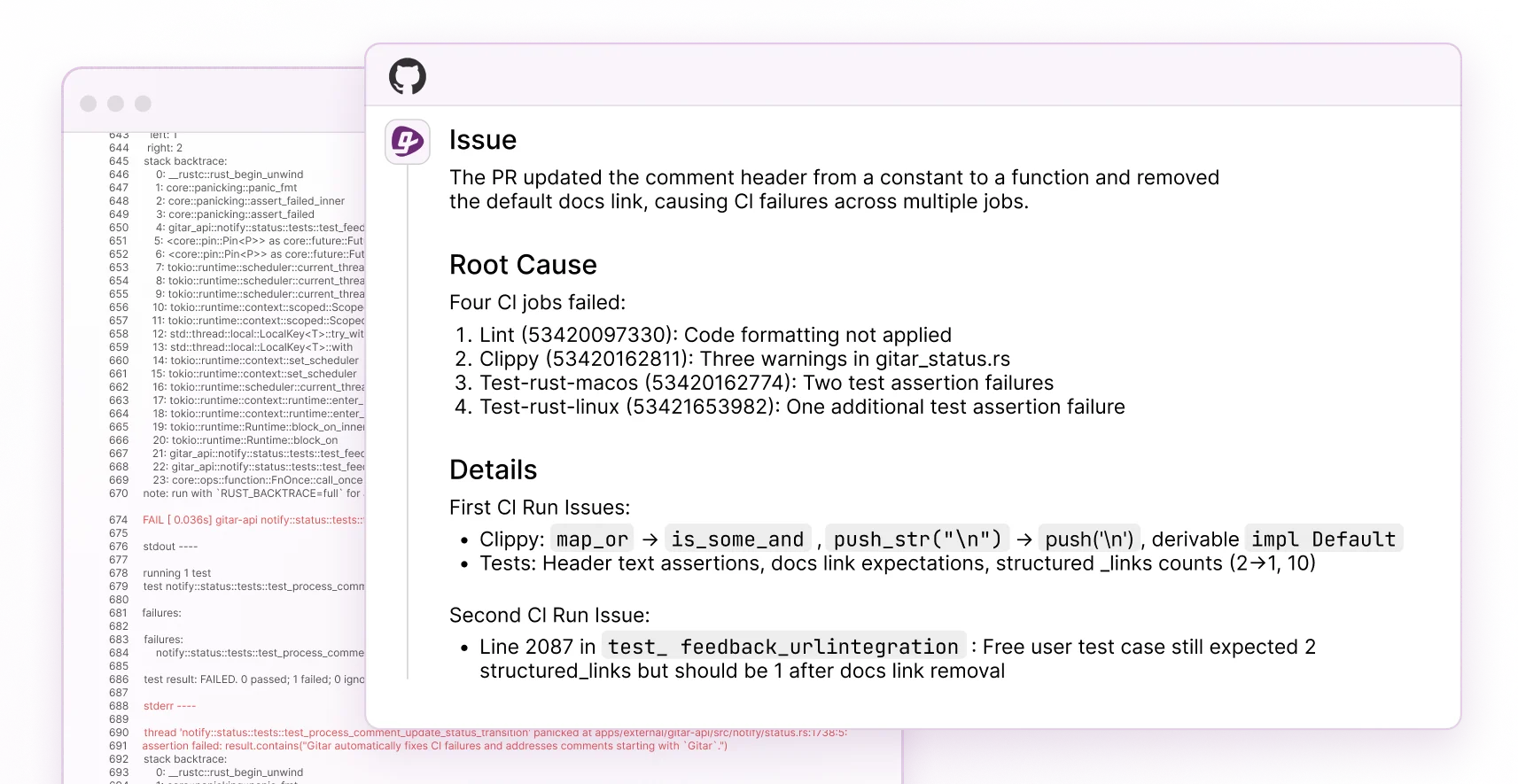
The Hidden 50% Savings: Stop Reruns with AI Auto-Fixes
Gitar’s CI agent keeps full context from the moment a pull request opens until it merges, works in the background to keep CI green, finds root causes of failures, fixes them, and verifies results inside the team’s own CI environment. This healing engine approach reshapes CI economics by eliminating the rerun cycles that consume a large share of compute budgets.
The platform analyzes failure logs and deduplicates failures across multiple jobs or pipelines while surfacing causes without digging through logs. When a lint error, test failure, or build break appears, Gitar generates validated fixes and commits them automatically. This workflow keeps builds green with minimal manual intervention.
|
Metric |
Without Gitar |
With Gitar |
|
Rerun Waste |
30-70% |
<10% (auto-fixes) |
|
Annual Cost (20-dev) |
$1M |
$250K |
|
Build Success Rate |
70-80% |
99% green |
|
Developer Velocity |
Neutral |
+3-5x faster |
The ROI calculation stays simple. A 20-developer team can save about $750K per year through fewer reruns, less context switching, and faster processing. Gitar retries flaky CI jobs automatically, which removes the manual overhead that usually accompanies CI tuning and maintenance.
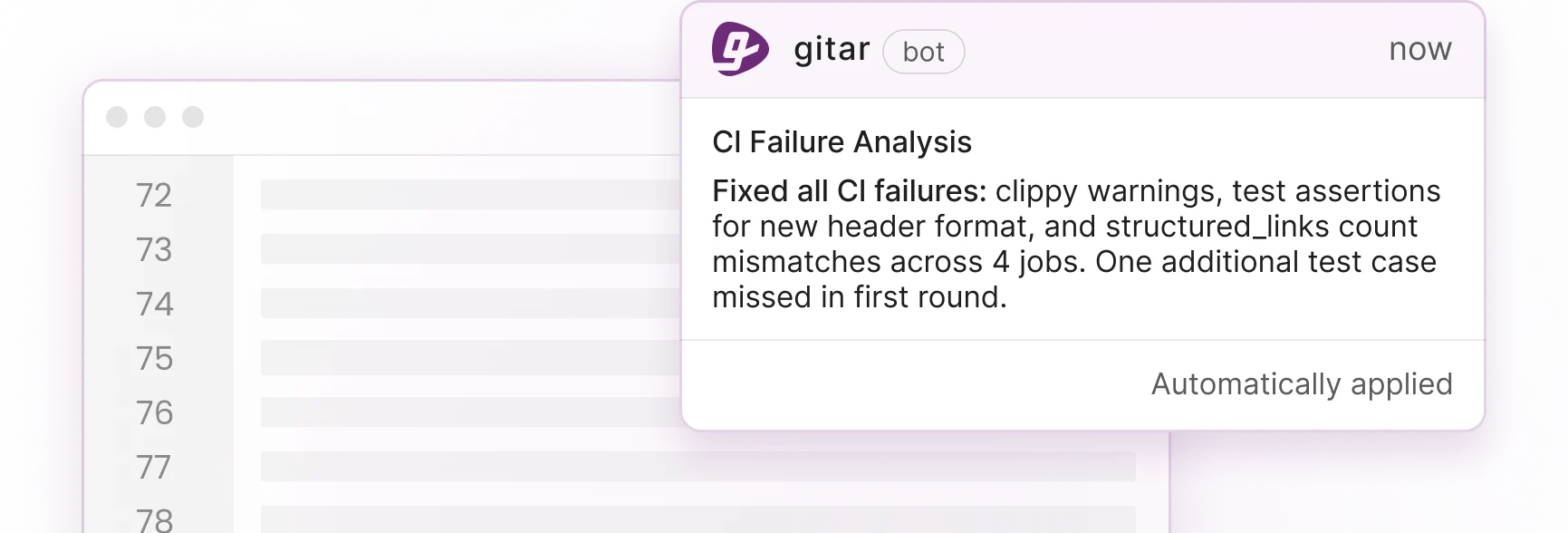
Teams report that Gitar’s single dashboard comment approach reduces notification fatigue while still providing complete failure analysis. As one engineering leader noted, “Gitar summaries are more concise than competitors”, and they deliver actionable insights without the comment spam that clutters many other AI review tools.
Start your free trial of Gitar to auto-fix broken builds and ship higher quality software faster.
Frequently Asked Questions
Does Gitar work with Graphite stacked PRs?
Gitar provides AI code review and CI failure analysis for GitHub and GitLab repositories, which helps automatically fix CI failures and address review feedback. The platform works across major CI systems such as GitHub Actions, GitLab CI, CircleCI, and Buildkite. Current Gitar documentation does not describe a dedicated integration for Graphite stacked PR workflows, so teams typically connect through the underlying Git hosting and CI providers.
How does combining Graphite with Gitar speed up CI pipelines?
Graphite’s merge queues batch PRs for efficient testing, and Gitar’s auto-fixes for CI failures prevent reruns that require debugging. Gitar analyzes and fixes CI issues across supported platforms, which keeps builds green and reduces pipeline friction. Together, these tools shorten feedback loops and reduce time spent waiting on or repairing CI.
What specific pipeline execution time improvements can I expect?
The combination of Graphite’s caching and batching with Gitar’s failure prevention typically delivers 20-70% reductions in total pipeline execution time. These gains include compute time savings from fewer reruns and developer time savings from less manual intervention. Actual improvements depend on your current failure rates, rerun frequency, and test suite size.
How much do Graphite CI failures actually cost?
CI failures in Graphite workflows often account for 30-70% of total compute costs through reruns, manual debugging, and delayed merge queue processing. For a 20-developer team, this pattern translates to roughly $700K each year in productivity losses and infrastructure costs. Gitar’s Healing Engine reduces this waste by automatically fixing CI failures and preventing repeated broken runs.
Can I measure the ROI before committing to Gitar?
Gitar offers a 14-day free trial of the Team Plan with full access to auto-fix capabilities, CI failure analysis, and workflow automation. This trial period lets you measure real improvements in build success rates, reduced reruns, and developer productivity before you commit budget. Most teams see clear, measurable results within the first week.
Conclusion: Cut Graphite CI Costs While Protecting Velocity
Reducing Graphite CI pipeline costs by 50% or more requires two coordinated efforts. First, apply Graphite’s native features to trim baseline spend. Second, prevent failures and reruns with AI-powered auto-fixes. Infrastructure changes like spot instances and caching deliver 20-40% savings, and the larger breakthrough comes from removing rerun cycles that consume much of the CI budget.
Gitar adds an intelligence layer to CI that helps engineering teams ship faster with less friction, which turns CI from a cost center into a competitive advantage. The platform’s healing engine keeps builds green even as AI-generated code dramatically increases PR volume in 2026.
Engineering leaders facing budget pressure and aggressive delivery goals can pair Graphite’s workflow improvements with Gitar’s failure prevention to see measurable ROI within weeks. The 14-day free trial removes financial risk while giving full access to the automation capabilities that are reshaping CI economics.