
Written by: Ali-Reza Adl-Tabatabai, Founder and CEO, Gitar
Key Takeaways
- AI code generation tools like Copilot have increased PR review time by 91%, creating bottlenecks that suggestion-only tools such as CodeRabbit cannot clear.
- Gitar delivers autonomous AI code review that fixes CI failures, applies review feedback, and commits validated code directly to pull requests.
- Alternatives like Qodo, Greptile, and Graphite provide strong analysis but stop at suggestions, so teams still implement every change manually.
- Teams using Gitar report $750K annual savings for 20-developer teams by reducing CI and review time from 1 hour to 15 minutes per developer each day.
- Teams ready to eliminate manual fixes and guarantee green builds can start a 14-day Gitar Team Plan trial and experience autonomous code healing across GitHub, GitLab, and multi-CI environments.
Why Teams Move Beyond CodeRabbit’s Suggestion Engine
CodeRabbit and similar suggestion-only tools create a false sense of automation. While CodeRabbit has processed over 13 million PRs across 2 million repositories, it still requires manual implementation of every suggested fix. Teams pay $24-30 per developer each month for comments that often generate noise without resolution. Independent benchmarks rated CodeRabbit 1/5 for completeness on systemic issues, which exposes the limits of diff-based analysis. The industry now needs healing engines that automatically resolve issues, not suggestion engines that create more work. The following alternatives reflect this shift, and only one delivers true autonomous fixing at scale.
Top 10 CodeRabbit Alternatives for Autonomous AI Code Review 2026
1. Gitar – Autonomous Healing for CI and PRs
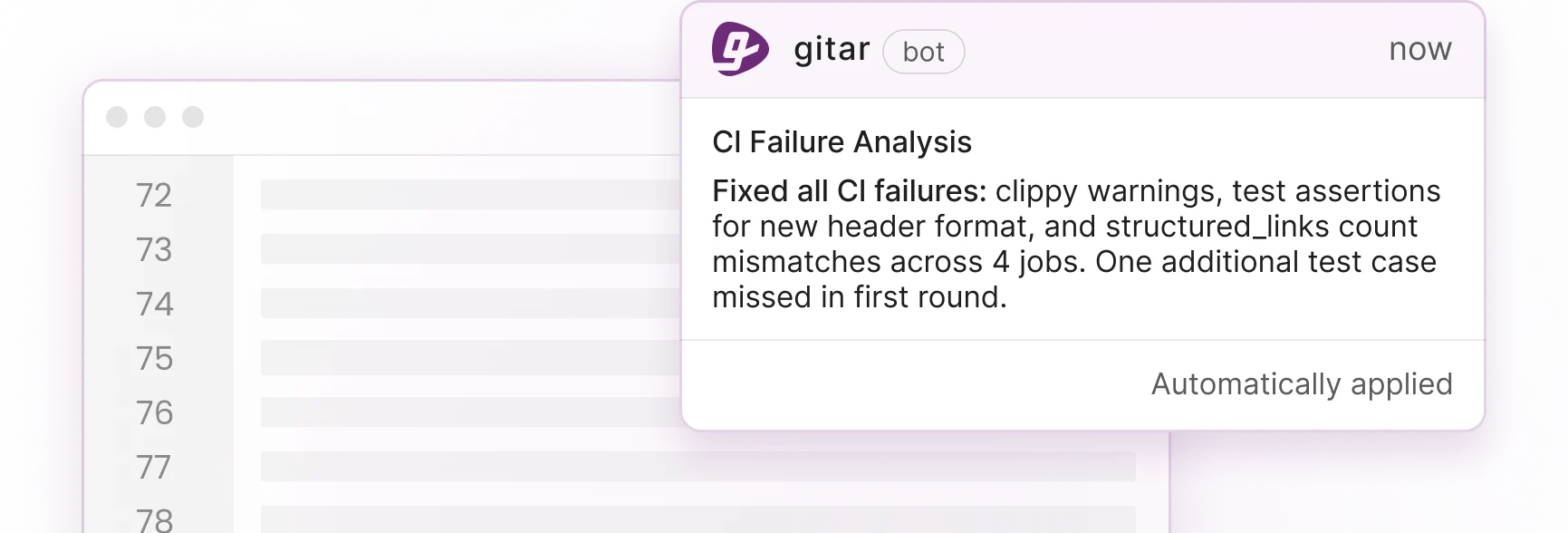
Gitar stands alone as the only platform in this list that automatically resolves CI failures and implements review feedback through validated commits. The healing engine analyzes failure logs, generates fixes with full codebase context, validates solutions against CI, and then commits working code directly to your pull request. See the Gitar documentation for detailed coverage of autonomous fixing capabilities.
Key autonomous features include single-comment consolidation, which eliminates notification spam by grouping feedback into one thread. This consolidation works with natural language repository rules stored in .gitar/rules/*.md files, so teams define standards without complex YAML. These rules extend through deep integrations with Jira, Slack, and Linear, creating end-to-end workflow automation. Gitar supports GitHub Actions, GitLab CI, CircleCI, and Buildkite, and it uses hierarchical codebase memory to learn your team’s patterns across all these environments. Refer to the Gitar documentation for integration guides.
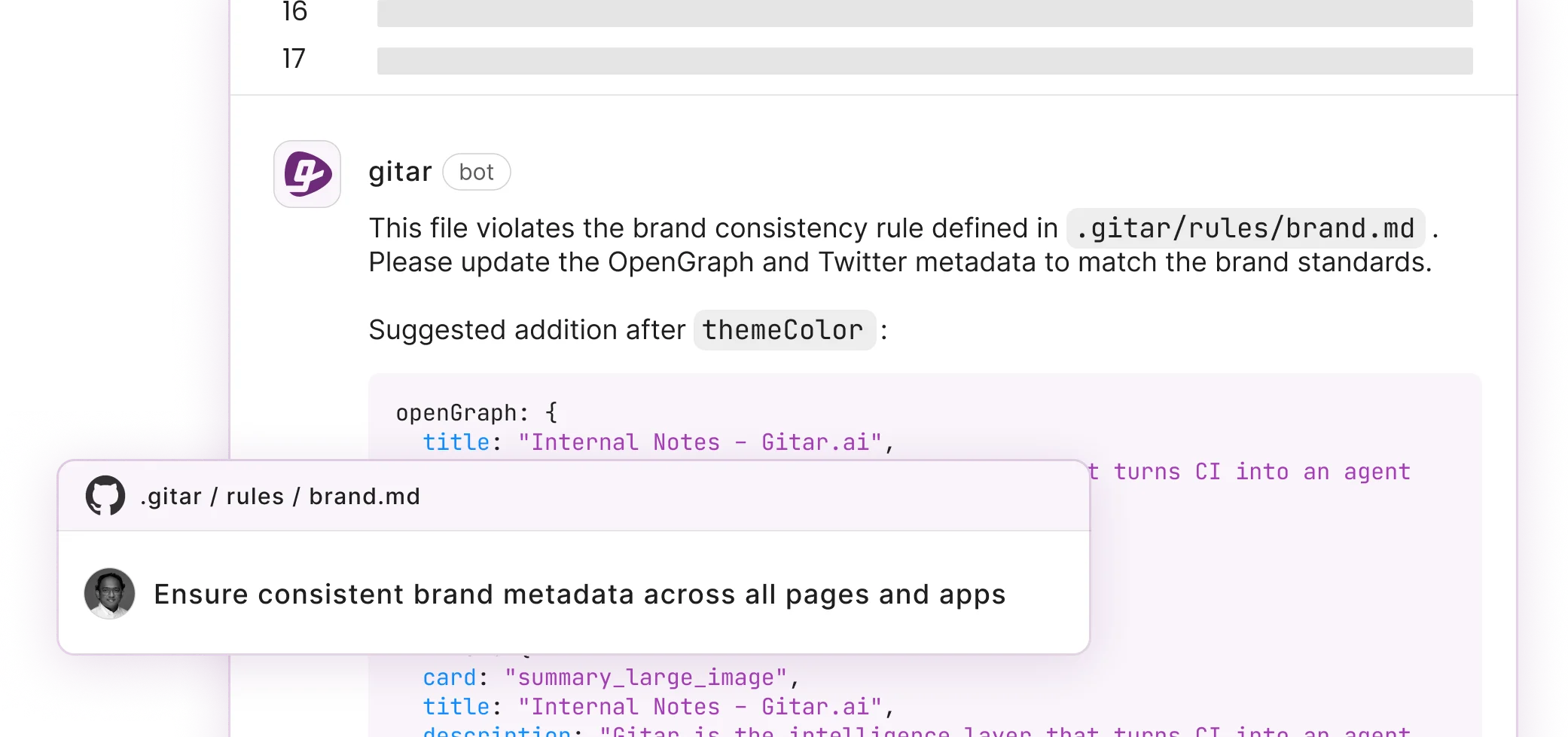
ROI impact: Teams achieve the savings outlined above through consistent daily time reductions across their entire development organization. Gitar offers a comprehensive 14-day free trial of the Team Plan with no seat limits, so teams can validate value through real fixes on live repositories.

Start your 14-day Gitar Team Plan trial to experience autonomous code review that actually fixes issues.
2. Qodo (PR-Agent) – Self-Hosted Security Reviews
Qodo excels in self-hosted environments with AGPL-3.0 licensing and support for Claude Opus 4.6. In November 2025 testing, Qodo completed security reviews in under one minute while scanning entire codebases. The platform focuses on security findings but does not apply fixes, so teams still implement every change manually. GitHub and GitLab integration run through self-hosted runners, which suits organizations with strict data residency requirements.
3. Greptile – Deep Analysis Without Auto-Fix
Greptile provides deep codebase analysis through repository indexing and code graph analysis at $30 per developer each month. Version 3 uses Anthropic Claude Agent SDK for autonomous multi-hop investigation, which uncovers subtle bugs and cross-file issues. The system still stops at suggestions and does not implement fixes, so developers handle remediation. Greptile supports GitHub and GitLab with self-hosted options for enterprises that need tighter control.
4. Cubic – Architecture and Logic Insights
Cubic focuses on architectural patterns and logic flow analysis with medium-depth review capabilities. It supports broad platform integrations, including GitHub, Jira, Linear, and Asana, which helps teams align code structure with project management workflows. Cubic provides structural insights for complex codebases but lacks CI integration and autonomous fixing, so it functions as an advisory layer rather than an execution engine.
5. Aikido – Security-First Vulnerability Detection
Aikido specializes in security vulnerability detection with integration to SAST scanners. The platform performs well at identifying OWASP Top 10 issues and surfacing risky patterns early in the lifecycle. Teams still remediate all findings manually, because Aikido does not offer autonomous fixing or CI failure resolution capabilities.
6. Graphite Agent – Stacked PR Workflow Acceleration
Graphite Agent transforms PR workflows with stacked PR support on GitHub. Shopify reported 33% more PRs merged per developer after adoption, and median merge time dropped from 24 hours to 90 minutes. The platform offers inline CI failure resolution but limits support to GitHub-only environments at $40 per user each month, which narrows its fit for multi-platform teams.
7. BugBot (Cursor) – IDE-Native Issue Resolution
BugBot integrates directly with the Cursor IDE to keep reviews inside the development environment. It resolves over 70% of flagged issues before merge through the “Fix in Cursor” button, which applies changes in the editor. BugBot requires a Cursor Pro subscription at $20 per month and supports GitHub and GitLab, making it ideal for teams already standardized on Cursor.
8. GitHub Copilot Code Review – Native GitHub Suggestions
GitHub Copilot Code Review reached 1 million users within one month of general availability in April 2025. The feature comes bundled at $10-39 per month with Copilot subscriptions and offers diff-based analysis with CodeQL security scanning. Copilot Code Review still focuses on suggestions and does not autonomously implement fixes, so teams treat it as an assistant rather than a healing engine.
9. Open-Source DIY Stacks – Flexible but Costly
Custom integrations using Claude, GPT, or local models provide maximum flexibility for teams willing to build their own pipelines. DX estimates $100K-$500K total investment for small teams with 12-18 month payback periods, which reflects engineering time and maintenance. These stacks usually lack autonomous fixing and CI integration out of the box, so teams must design and maintain that logic themselves.
10. Korbit – Adaptive, Education-Focused Reviews
Korbit provides adaptive code review with team-specific learning capabilities. The platform emphasizes educational feedback and pattern recognition, which helps developers improve skills over time. It does not provide autonomous fixing or multi-CI support, and enterprise adoption remains limited compared to more established alternatives.
Try Gitar’s healing engine to move beyond the educational feedback approach and achieve autonomous resolution. Learn more in the Gitar documentation.
CodeRabbit Alternatives Comparison Table 2026
The following table summarizes critical differences between these platforms, with a focus on autonomous fixing and multi-CI support that distinguish Gitar from suggestion-only tools.
|
Tool |
Auto-Fix/CI Integration |
Platform Support |
Pricing/Trial |
|
Gitar |
Yes/Multi-CI |
GitHub, GitLab, CircleCI, Buildkite |
14-day free trial |
|
CodeRabbit |
No/Limited |
GitHub, GitLab |
$24-30/month |
|
Greptile |
No/None |
GitHub, GitLab |
$30/month |
|
Graphite |
Partial/GitHub Actions |
GitHub only |
$40/month |
Free CodeRabbit Alternatives for GitHub and GitLab Teams
Gitar offers a comprehensive 14-day free trial of the Team Plan with no seat limits, autonomous fixing, and multi-CI support. As noted in Gitar’s description above, this full-access trial contrasts sharply with CodeRabbit’s basic free tier, which only provides PR summaries without fixing capabilities. Open-source options such as PR-Agent require significant infrastructure investment and still lack autonomous resolution features. For GitHub and GitLab environments, Gitar delivers the deepest integration with both platforms plus CircleCI and Buildkite support.
How to Choose an Autonomous Alternative and Address Objections
Engineering managers should prioritize ROI through actual time savings rather than long feature lists, and this focus aligns with what developers experience daily. Developers benefit from reduced context switching when tools automatically resolve issues, because they stay in flow instead of chasing CI failures. DevOps teams value natural language rules over complex YAML configurations, since simpler rules reduce configuration errors that interrupt developers. Common objections include concerns about trusting automated commits, which Gitar addresses with configurable approval modes, and worries about switching costs from existing tools, which the 14-day trial helps resolve before any commitment. Teams typically see 45-minute daily time savings per developer, transforming 1-hour CI and review cycles into 15-minute validations.
Frequently Asked Questions
What is the best free AI code review alternative to CodeRabbit?
Gitar provides the most comprehensive free trial with 14 days of full Team Plan access, including autonomous fixing, multi-CI integration, and unlimited seats. Unlike CodeRabbit’s limited free tier that only offers basic PR summaries, Gitar’s trial includes all healing engine capabilities, natural language rules, and deep workflow integrations. Teams can experience real autonomous code fixing on production workflows instead of testing suggestion-only behavior.
How does CodeRabbit compare to Gitar for autonomous code review?
CodeRabbit operates as a suggestion engine that identifies issues but requires manual implementation of fixes. Gitar functions as a healing engine that automatically resolves CI failures and implements review feedback through validated commits. CodeRabbit charges $24-30 per developer for comments and suggestions, while Gitar provides autonomous fixing, CI integration, and workflow automation. The core difference is that Gitar targets guaranteed green builds, whereas CodeRabbit leaves implementation work with developers.
Which platforms support both GitHub and GitLab integration?
Gitar provides comprehensive support for GitHub, GitLab, CircleCI, and Buildkite with consistent autonomous fixing capabilities across all platforms. CodeRabbit supports multiple platforms but does not offer autonomous fixing on any of them. Greptile offers GitHub and GitLab support but only provides suggestions without implementation. Most alternatives focus on a single primary platform, which makes Gitar unique in delivering autonomous healing across diverse CI environments.
How do you measure ROI from AI code review tools?
ROI measurement focuses on time savings from shorter CI and review cycles, reduced context switching, and removal of manual fix implementation. Teams using autonomous platforms like Gitar achieve the time savings mentioned earlier, which translates to $750K annual productivity gains for a 20-developer team. Suggestion-only tools provide limited time savings because developers still implement every fix, so ROI remains significantly lower even when pricing appears similar.
How easy is migration from CodeRabbit to autonomous alternatives?
Migration to Gitar typically takes about 30 seconds for GitHub App installation or GitLab integration setup. The platform begins providing autonomous fixing immediately without changes to existing workflows. Teams can run Gitar alongside CodeRabbit during evaluation to compare suggestion-only behavior with autonomous fixing on the same repositories. Natural language repository rules remove the need for complex YAML configurations, which makes adoption much easier than traditional CI tool migrations.
Conclusion: Why Autonomous Fixing Now Matters Most
The 2026 landscape clearly favors autonomous AI code review platforms that fix code instead of only commenting on it. Gitar leads this shift with a healing engine that resolves CI failures, implements review feedback, and focuses on delivering consistently green builds. While competitors charge premium prices for commentary and suggestions, Gitar proves value through comprehensive autonomous fixing during a risk-free trial period.
Begin your 14-day trial and see autonomous fixing in action on your own codebase.