
Written by: Ali-Reza Adl-Tabatabai, Founder and CEO, Gitar
Key Takeaways
- 60% of AI projects fail due to fragile CI pipelines. At the same time, 84% of developers use AI coding tools, which shifts the bottleneck from writing code to validating it.
- Common CI failures such as lint errors, flaky tests, and dependency conflicts waste about 1 hour per day per developer on manual debugging.
- Gitar’s healing engine analyzes failures, generates validated fixes, and commits them across GitHub Actions, GitLab, CircleCI, and Buildkite.
- Unlike Qodo’s suggestions, Gitar guarantees green builds with full CI validation, which saves teams $750K per year for a 20-developer group.
- Start your 14-day Team Plan trial with Gitar to automate fixes and ship higher quality software faster.
Why CI Pipelines Break and Manual Fixes Waste Time
Modern CI pipelines break more often as AI-generated code floods development workflows. Data labeling failures from non-expert annotations lead to 30% higher domain errors in AI-generated datasets. These issues cause models to fail on real-world edge cases even when accuracy metrics look strong.
The most common CI failures include:
- Lint errors from inconsistent code formatting and style violations
- Flaky tests that pass locally but fail in CI environments
- Build breaks from dependency conflicts and version mismatches
- Schema validation issues from upstream API changes
- Integration failures between microservices and external systems
Each of these failure types triggers the same costly cycle. Manual debugging consumes about 1 hour per day per developer through constant context switching. Engineers lose momentum while they investigate failures, implement fixes, push commits, and wait for re-validation. Pipeline failures lead to days of emergency debugging, rollback procedures, and retraining cycles. Traditional approaches depend on human intervention at every step, which creates bottlenecks that scale poorly as code velocity increases.
How Gitar’s PR Agent Fixes CI Failures for You
Gitar’s healing engine replaces manual CI failure resolution with autonomous analysis and repair. The process removes repetitive human effort and keeps pipelines moving:
- Install GitHub or GitLab app – Setup takes under 5 minutes.
- Start 14-day trial – Get full Team Plan access with no seat limits.
- Monitor PRs and CI – Track issues through real-time detection across all pipeline stages.
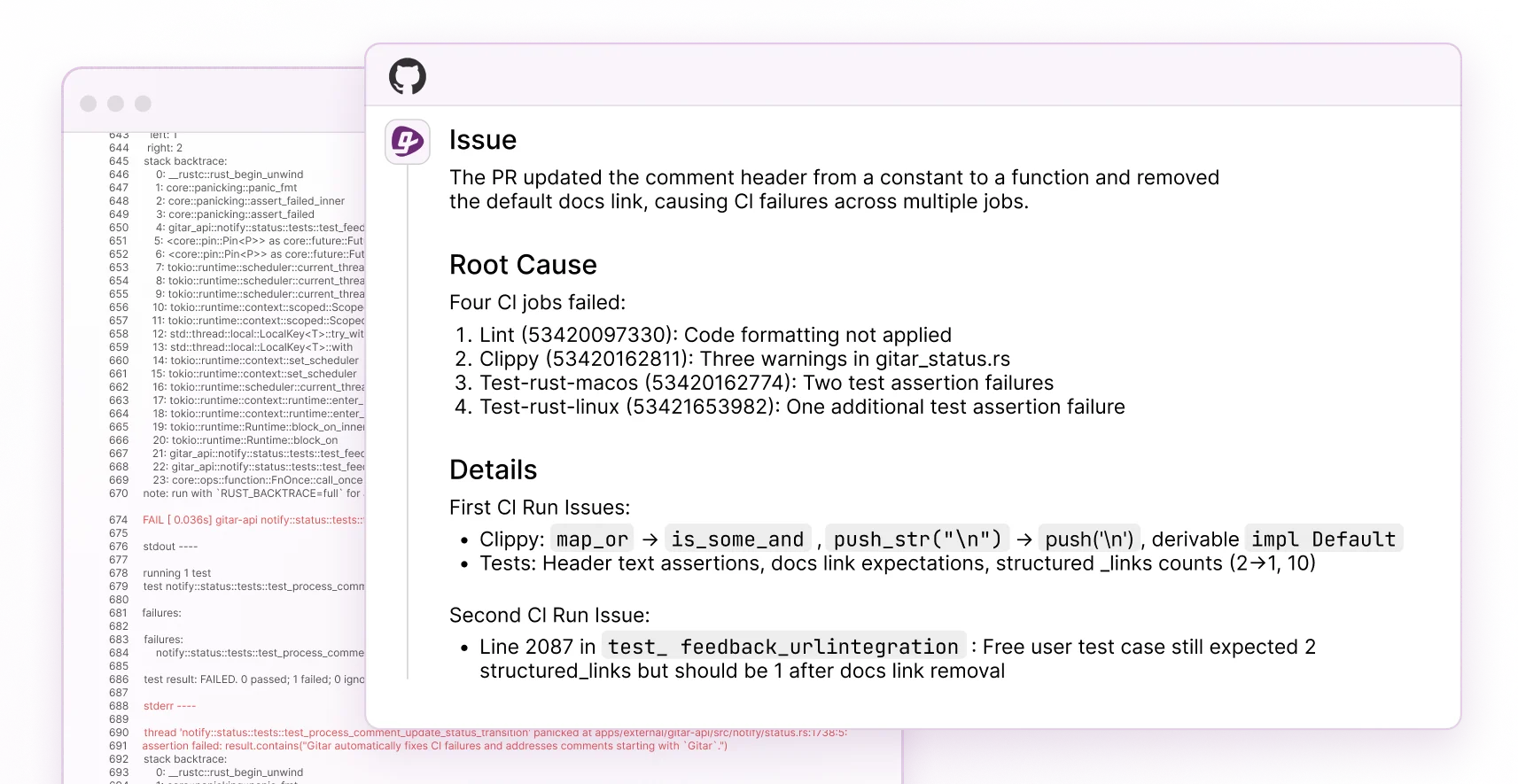
- Detect failures via logs – Run comprehensive analysis of build outputs and error messages.
- Analyze root cause – Use codebase history and Jira integration for contextual understanding.
- Generate and validate fix – Test code solutions against the full CI environment before applying them.
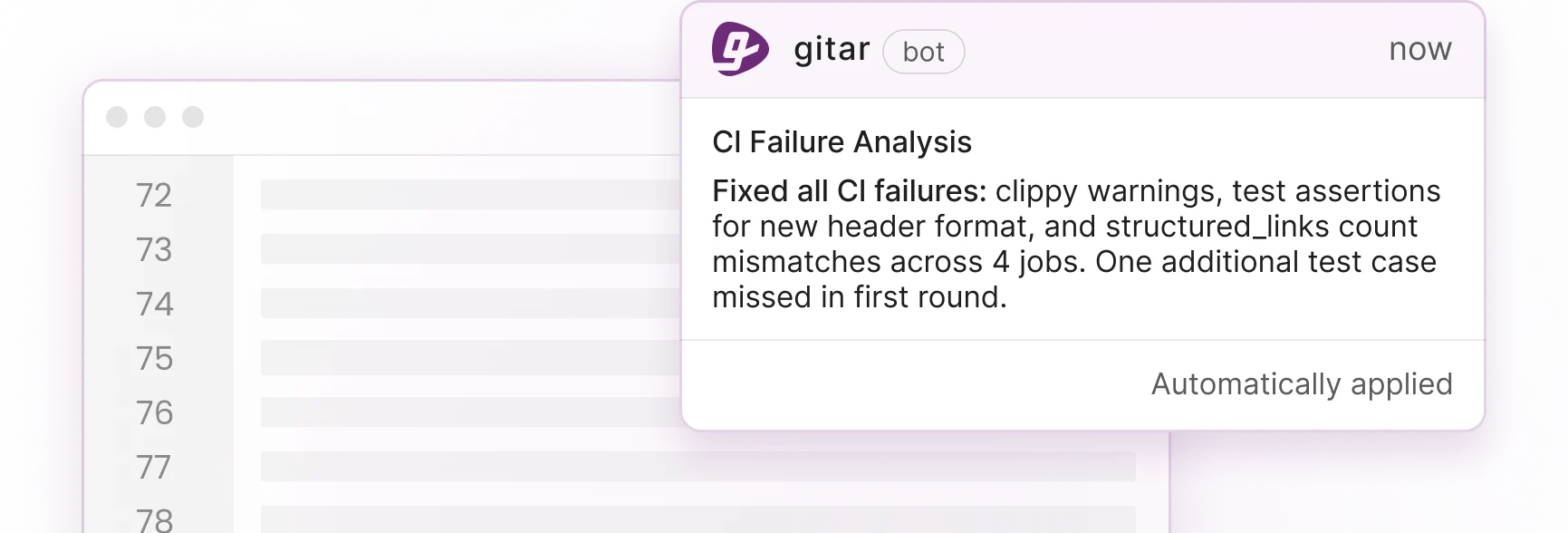
- Auto-commit with single comment – Apply clean implementations while avoiding notification spam.
Example auto-fix comment:
✅ Fixed lint violations in user-service.py – Removed unused imports (lines 15, 23) – Applied consistent formatting to function definitions – Updated docstring format to match project standards Build Status: ✅ All checks passing
The system manages cross-platform complexity and automatically fixes CI failures. Unlike suggestion-based tools, Gitar validates every fix against your actual CI configuration before committing changes.
Gitar vs Qodo: How Gitar Delivers Guaranteed Green Builds
The gap between suggestion engines and healing engines becomes clear when you compare capabilities side by side:
|
Capability |
Qodo |
Gitar |
|
Auto-apply fixes |
IDE-based |
Yes (PR/CI) |
|
CI failure analysis |
CI-integrated |
Full log analysis |
|
Validate against CI |
CI-triggered |
Yes |
|
Green build guarantee |
No |
Yes |
These evaluation criteria highlight Gitar’s deeper automation. For a 20-developer team, manual CI debugging costs about $1M annually in lost productivity. As mentioned earlier, Gitar’s healing engine delivers $750K in annual savings by reducing that $1M cost to $250K through automated root-cause analysis, validated fixes, and cross-platform support.
Real-world scenarios show how this plays out:
- Engineers across timezones – Gitar fixes failures overnight and removes delays from morning standups.
- Engineering leaders – Sprint velocity increases as context switching and firefighting decrease.
- DevOps teams – The system identifies and resolves infrastructure flakiness automatically.
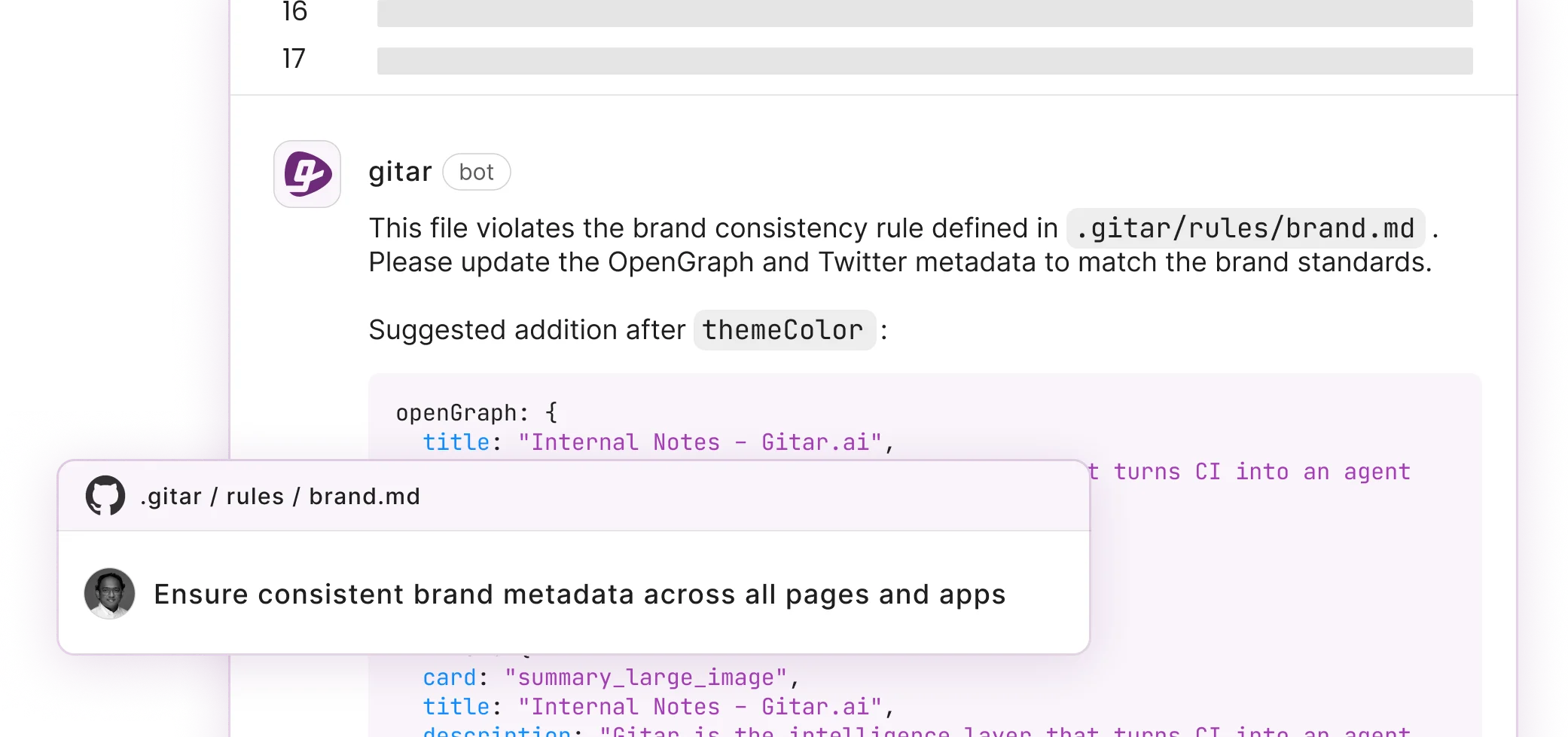
Gitar’s repository rules also support natural language workflow automation:
— title: ‘Security Review’ when: ‘PRs modifying authentication or encryption code’ actions: ‘Assign security team and add security-review label’ —
This approach removes complex YAML configuration while still providing enterprise-grade automation capabilities.
Four Phases to Turn On Instant Auto-Fixes
Phase 1: 5-Minute Installation
Install the Gitar GitHub App or GitLab integration. The system immediately begins monitoring PRs and posting dashboard comments with no extra configuration.
Phase 2: Suggestion Mode
Start with human approval for all fixes to build confidence in the system. As you review Gitar’s analyses and solutions, you see how it resolves lint errors, test failures, and build breaks with validated code changes. This observation period helps your team understand accuracy before moving toward more automation.
Phase 3: Auto-Commit Activation
Enable automatic commits for trusted fix types once you feel comfortable. Configure aggression levels per repository so each codebase gets the right level of automation. The healing engine remembers patterns and improves accuracy over time through its hierarchical memory systems.
Phase 4: Rules and Analytics
Deploy natural language rules to automate workflows such as reviews, labels, and team routing. Use deep analytics for CI failure categorization and systematic pattern recognition. Install Gitar now to automatically fix broken builds and accelerate your release cycle.
Security and control concerns receive direct attention. Gitar offers configurable permissions, emulates your exact CI environment including SDK versions and dependencies, and maintains audit trails for all automated actions. Zero setup effort reduces retry costs, while pattern memory blocks recurring issues before they spread.
Proven ROI and 2026 Productivity Gains
Quantified productivity improvements show clear financial impact:
|
Metric |
Before Gitar |
After Gitar |
|
Time on CI issues |
1 hour/day (the debugging burden discussed earlier) |
15 minutes/day |
|
Team savings (20 devs) |
$1M/year lost |
$750K/year saved |
US productivity increased 2.7% in 2025, nearly doubling the past decade’s average. Gitar’s agentic harness contributes to this improvement by removing manual toil from CI/CD workflows. GitHub Agentic Workflows launched in 2026 to automate complex repository tasks, which validates the broader market shift toward autonomous development tools.
Gitar extends beyond Qodo’s IDE-based automation and delivers guaranteed fixes through validated PR and CI automation. The healing engine does more than identify problems. It solves them. While competitors charge $15–30 per developer for comments that still require manual work, Gitar offers a comprehensive 14-day Team Plan trial so teams can measure real impact. See these productivity gains in your own workflow by starting your 14-day trial today. Review the complete setup guide to plan your rollout.
Frequently Asked Questions
How does Gitar’s auto-fix capability differ from other AI PR agents?
Gitar operates as a healing engine rather than a suggestion engine. Tools like Qodo provide IDE-based automated fixes and PR comments, while Gitar generates fixes directly in PRs, validates them against your actual CI environment, and commits working solutions. The system analyzes failure logs, identifies root causes using full codebase context, and guarantees green builds through validated automation. This approach removes the manual work that other tools still require and turns CI failure resolution into an autonomous background operation.
What types of CI pipeline failures can Gitar automatically resolve?
Gitar covers the full spectrum of common CI failures such as lint errors, flaky tests, build breaks, dependency conflicts, schema validation issues, and integration failures. The system excels at spotting environmental dependencies that cause tests to pass locally but fail in CI, race conditions in concurrent operations, and timing issues in asynchronous code. Gitar’s cross-platform support includes GitHub Actions, GitLab CI, CircleCI, and Buildkite, with the ability to emulate specific SDK versions, multi-dependency builds, and third-party security scans. For enterprise deployments, the agent runs inside your own CI pipeline with access to secrets and caches so fixes work in your exact production environment.
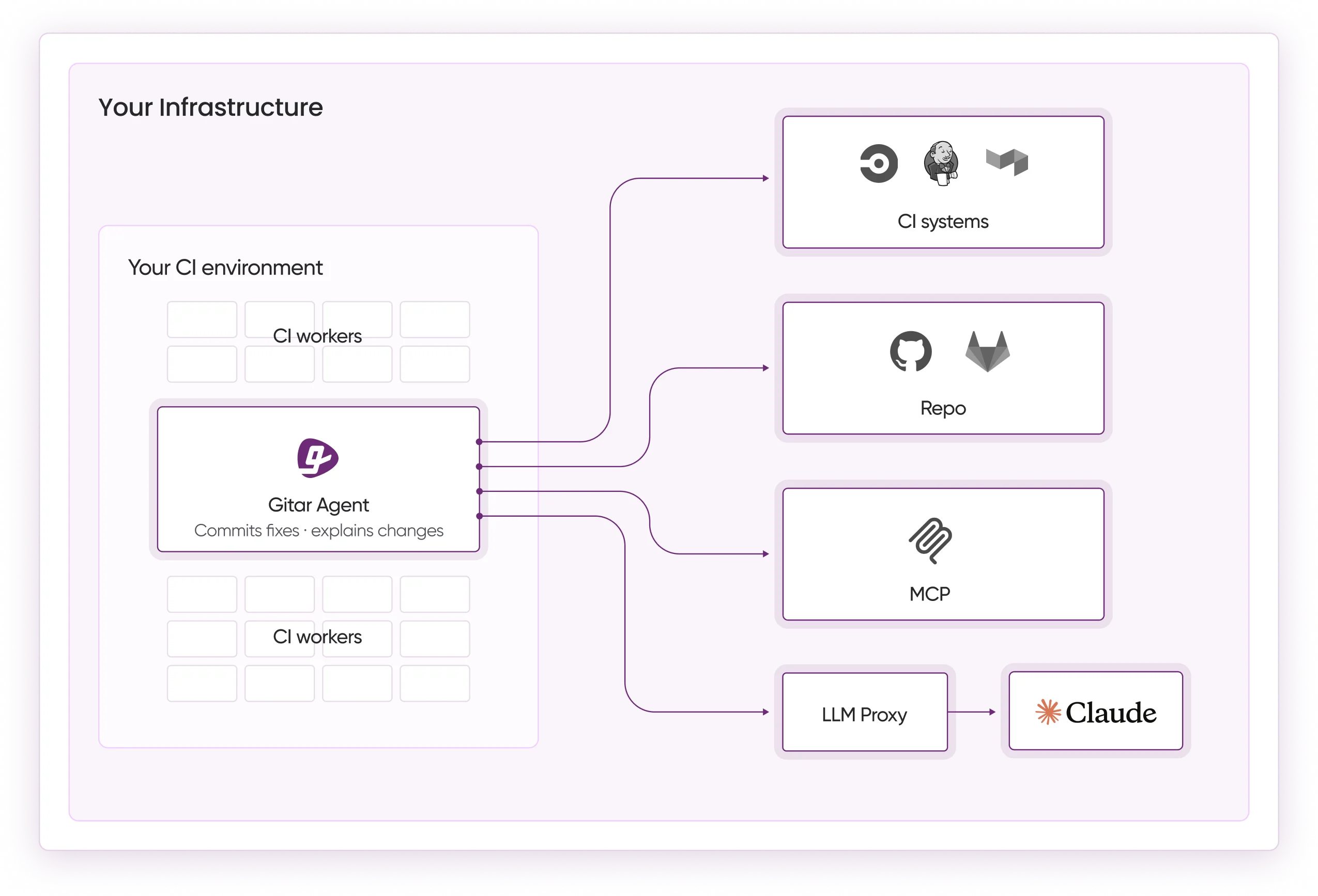
How does the 14-day Team Plan trial work and what’s included?
The 14-day Team Plan trial gives your team full access to Gitar’s healing engine with no seat limits. Your entire organization can experience autonomous CI fixing, PR analysis, and workflow automation. The trial includes auto-fix capabilities for CI failures, comprehensive code review with security scanning, natural language repository rules, deep analytics for CI patterns, and integrations with Jira, Slack, and Linear. You can configure the system to start in suggestion mode for trust building, then enable auto-commit for validated fix types. The trial covers unlimited public and private repositories across all supported platforms so you can see productivity gains before making any financial commitment.
Is Gitar secure for enterprise environments and sensitive codebases?
Gitar delivers enterprise-grade security with multiple deployment options. The Team Plan uses strict permission controls, audit trails for all automated actions, and configurable aggression levels per repository. For maximum protection, the Enterprise Plan deploys the agent within your own CI pipeline so no code leaves your infrastructure while it still has access to configurations, secrets, and caches. The system is SOC 2 Type II and ISO 27001 certified and provides extensive logging and observability for forensic reconstruction. Security architecture treats agent execution as an extension of CI/CD with explicit constraints on permissions, outputs, and network access, following the same trust boundaries as your existing automation tools.
How does Gitar integrate with existing development workflows and tools?
Gitar fits into existing workflows without disrupting established processes. The system connects natively with GitHub, GitLab, Jira, Slack, and Linear, and it pulls product context to understand the business logic behind code changes. Repository rules rely on natural language instead of complex YAML, so any team member can automate workflows such as security reviews, team assignments, and label management. The single dashboard comment approach consolidates findings, CI analysis, and rule evaluations in one location, which reduces notification spam while preserving full visibility. Gitar’s hierarchical memory system learns your team’s patterns over time and becomes more accurate and contextually aware as it processes more PRs and absorbs your specific coding standards and architectural decisions.