
Written by: Ali-Reza Adl-Tabatabai, Founder and CEO, Gitar
Key Takeaways for AI Code Review in 2026
- AI code generation now ships features 3–5 times faster, yet PR review time has jumped 91%, slowing delivery for most teams.
- Open source AI code review platforms like OneDev (65% F-score) and GitLab CE reduce licensing costs but lack auto-fix features and deep CI coverage.
- Gitar’s Healing Engine automatically fixes CI failures, applies reviewer feedback, and keeps builds green across GitHub, GitLab, and other major platforms.
- Production workloads expose gaps in OSS and proprietary suggestion-only tools, which still rely on manual implementation and repeated CI runs.
- Teams save $15–30 per developer monthly with OSS, but discover that Gitar’s 14-day free Team Plan delivers higher ROI through automated fixes and faster releases.
Methodology and Platform Selection
We conducted hands-on benchmarks across more than 50 AI-generated pull requests using established evaluation frameworks. To focus on production-viable platforms, we required at least 1,000 GitHub stars for community validation, recent commit activity for active maintenance, and self-hosting options via Docker or Kubernetes for deployment flexibility. We also required integration support for GitHub Actions and GitLab CI so tests reflected real engineering workflows rather than lab conditions.
Independent benchmarks on real-world codebases measured precision, recall, and F-scores across tools like Augment Code Review (59% F-score), Greptile (45%), and CodeRabbit (39%). These metrics expose meaningful accuracy gaps when compared with platforms designed for continuous production use.
Our ranking evaluates six leading open source platforms: OneDev (14,625 stars), PR-Agent, GitLab Community Edition, Aider, OpenCode, and SonarQube Community Edition. Each platform was tested for bug detection accuracy, review speed, resource footprint, and deployment complexity. The analysis highlights a consistent pattern: suggestion-only tools still leave teams with the implementation bottleneck that Gitar’s autonomous fix engine removes.
Top Open Source AI Code Review Platforms Ranked for 2026
1. OneDev: Lightweight Self-Hosted Git Server With AI Assist
OneDev is a self-hosted Git server with integrated AI-assisted code review features, including code explanation and build failure investigation. It uses fewer resources than GitLab CE and includes integrated CI/CD, symbol search, and Kanban boards. The following comparison shows how OneDev trades low cost and low RAM usage for missing auto-fix capabilities and a more complex setup.
|
Pros |
Cons |
Accuracy/Speed |
Install |
|
Free, low RAM usage |
No auto-fix, complex setup |
65% F-score, 2-5min |
docker-compose up |
OneDev works best for teams managing repositories under 1GB that need basic AI explanations rather than automated remediation.
2. PR-Agent: PR Summaries and Suggestions for GitHub
PR-Agent provides AI-powered pull request analysis and automated summaries. The tool connects to GitHub through webhooks, generates detailed PR descriptions, and flags potential issues for reviewers.
|
Pros |
Cons |
Accuracy/Speed |
Install |
|
Quick setup, good summaries |
Suggestion-only, limited context |
45-60% accuracy, 1-3min |
docker run pr-agent |
3. GitLab Community Edition (Duo AI): Full Dev Platform With AI Suggestions
GitLab CE provides AI-assisted code review via merge request insights and inline suggestions. The platform typically requires 4–12 GB RAM for production deployments but scales to about 500 users.
|
Pros |
Cons |
Accuracy/Speed |
Install |
|
Production-ready, full platform |
High resource usage, no auto-fix |
55% F-score, 3-8min |
Omnibus package |
While GitLab CE delivers a mature DevOps platform, its AI features still stop at suggestions, so developers must implement every change manually. See how Gitar’s autonomous fixes remove this manual work by resolving CI failures and applying reviewer feedback for you.
4. Aider: Terminal-First Refactoring Assistant
Aider stands out as a CLI tool for terminal-driven refactors, editing code through Git-tracked diffs while remaining model-agnostic.
|
Pros |
Cons |
Accuracy/Speed |
Install |
|
CLI-focused, Git integration |
No web UI, manual workflow |
Up to 88% with top models, varies |
pip install aider-chat |
5. OpenCode: Sourcegraph’s Context-Aware OSS Tool
OpenCode by Sourcegraph provides free open source functionality with codebase context and cross-repository work capabilities through an npm installation.
|
Pros |
Cons |
Accuracy/Speed |
Install |
|
Free, cross-repo context |
CLI-focused, limited UI |
Strong performance on complex tasks, 2-4min |
npm install -g opencode |
6. SonarQube Community Edition: Static Analysis With CI Focus
SonarQube CE offers mature static analysis with AI-enhanced quality gates and broad enterprise adoption. It lacks native merge request integration and works best when wired into existing CI/CD pipelines.
|
Pros |
Cons |
Accuracy/Speed |
Install |
|
Mature, enterprise-ready |
No MR integration, complex |
70% static analysis |
Docker + PostgreSQL |
OSS vs. Proprietary Platforms: Where Gitar Gains an Edge
Open source platforms reduce licensing costs, but production environments expose their limits. The table below highlights the key gap: most tools can summarize PRs, yet only Gitar applies fixes and keeps CI pipelines passing without manual effort.
|
Feature |
Top OSS (OneDev) |
Proprietary (CodeRabbit) |
Gitar |
|
PR Summaries |
Yes |
Yes |
Yes |
|
Auto-Apply Fixes |
No |
No |
Yes |
|
CI Auto-Fix/Green Builds |
No |
No |
Yes (unique) |
|
Full Integrations |
Limited |
Partial |
Complete |
While CodeRabbit charges $24/month for codebase-aware reviews and Greptile costs $30/user monthly, neither removes the implementation bottleneck identified earlier. Gitar’s Healing Engine automatically resolves CI failures, applies review feedback, and supports natural language workflow rules, which no open source alternative currently matches. See the Gitar documentation for full details on the Healing Engine.
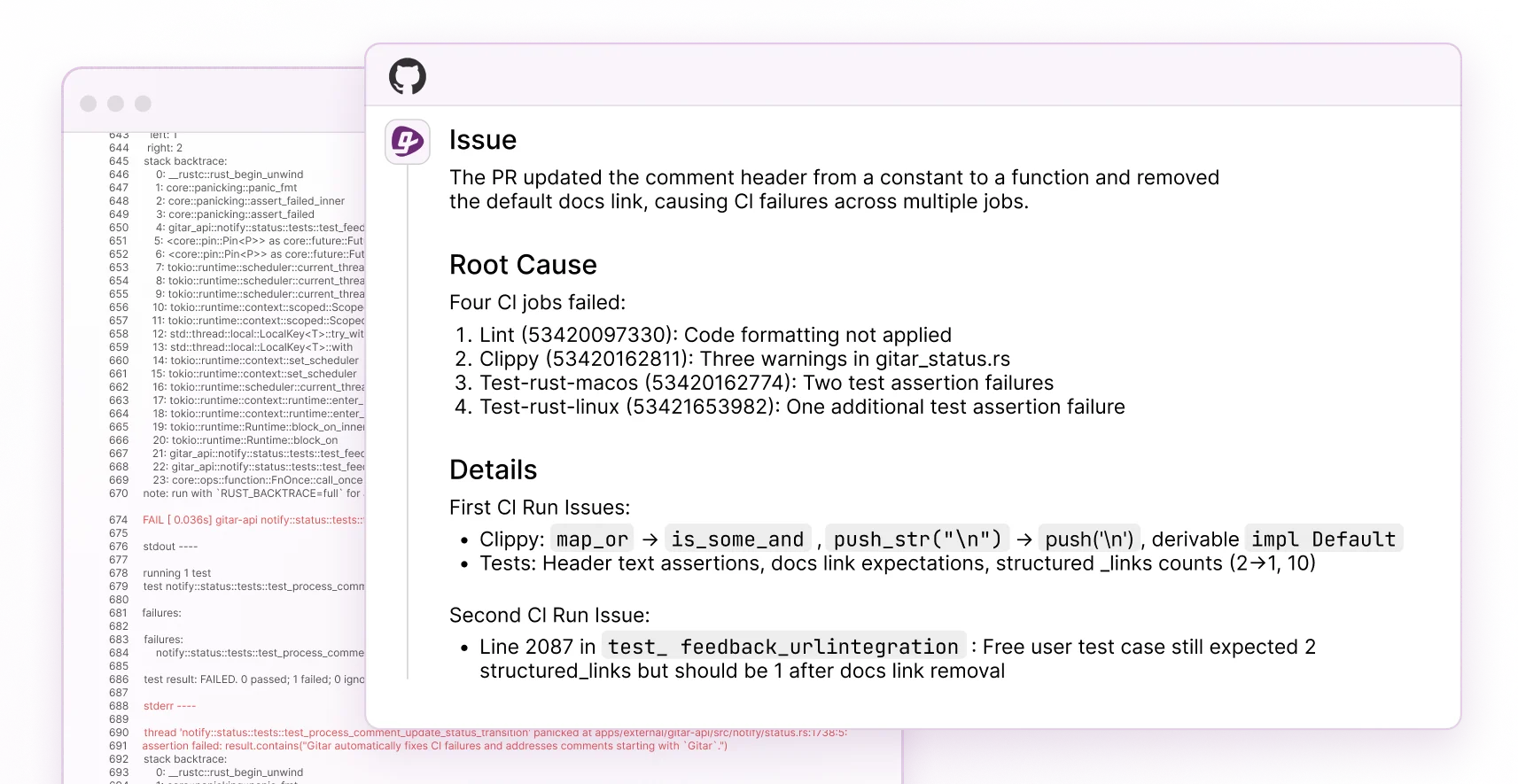
Gitar’s roadmap extends from review into broader development intelligence. Teams gain automated workflows, deep analytics, Jira and Slack integrations, and CI as an agent platform. Comprehensive documentation explains the full feature set available during the 14-day evaluation period.
Test whether autonomous fixes outperform suggestion-only tools in your own codebase and measure the productivity impact of builds that pass on the first try.
Self-Hosting Open Source Review Tools Without Breaking CI
Self-hosting open source AI code review platforms demands careful planning around resource usage and integration complexity. For OneDev, teams clone the repository, configure environment variables for API keys, and run docker run -d –name onedev -p 6610:6610 1dev/server to bring the service online.
Common pitfalls include underestimating model inference costs, allocating too little memory for large repositories, and seeing brittle performance on complex monorepos. Multi-agent system deployments also need YAML configuration for agents, models, and toolsets, which adds operational overhead and more moving parts to maintain.
These configuration challenges compound deeper architectural gaps in many OSS platforms. Most open source tools lack the production-hardened design required for enterprise CI environments. This gap shows up as failures with force pushes mid-run, trouble handling concurrent operations, and difficulty with wave-based execution that shares state across agents. Gitar’s purpose-built agentic harness handles these scenarios reliably because it was designed for production CI complexity from day one.
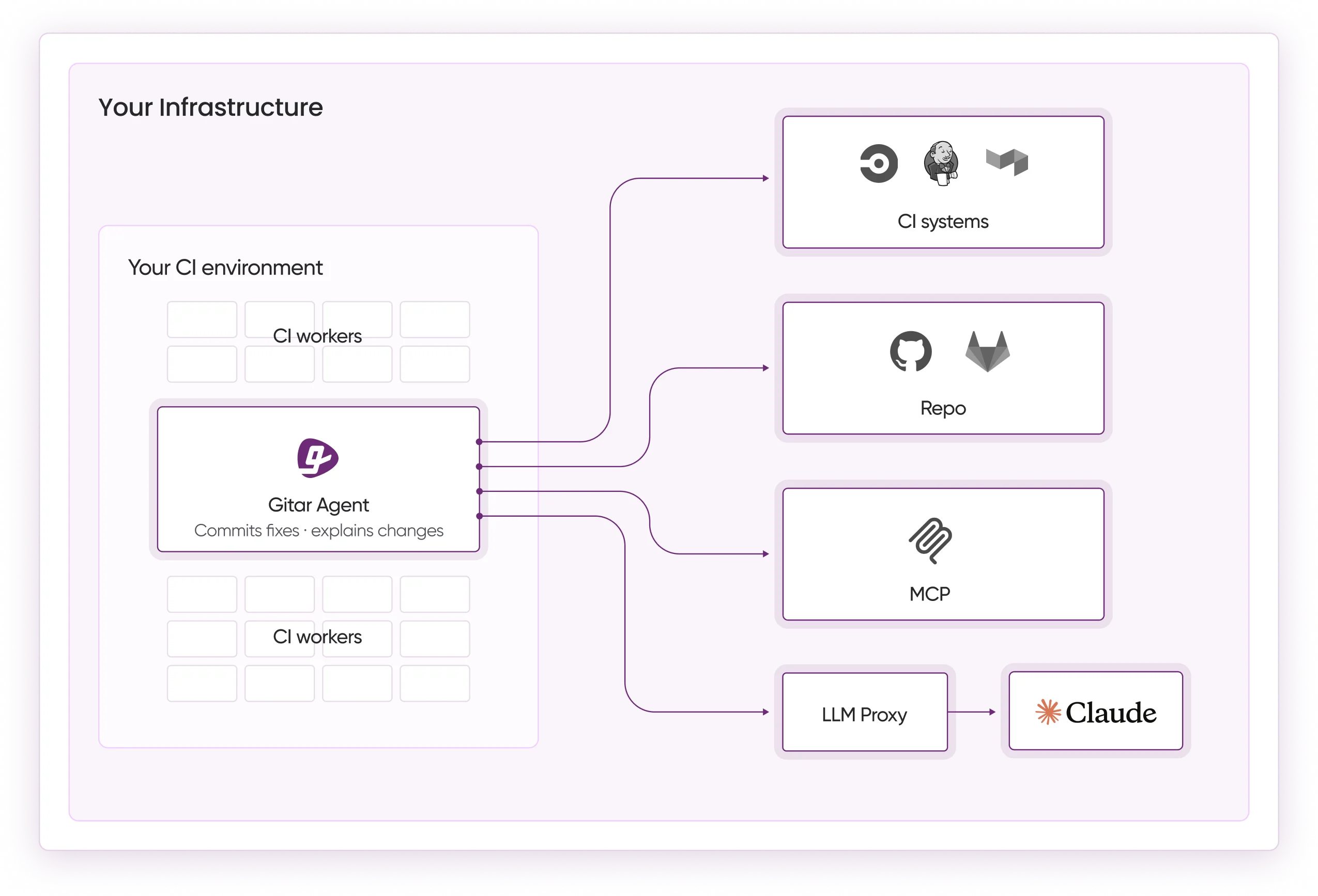
Gitar removes setup friction through a zero-configuration GitHub App installation. Teams gain immediate access to production-ready AI code review and automated fixing without managing containers, YAML, or custom orchestration.
Frequently Asked Questions
Which open source AI code review platform works best with GitHub?
OneDev currently ranks highest for GitHub integration among open source options, with 14,625 stars, active maintenance, and AI-assisted code explanations. It still lacks auto-fix capabilities and forces teams to implement suggested changes by hand. GitLab CE offers robust merge request workflows but needs 4–12 GB RAM for typical deployments. For teams that want automated fixes and consistently passing builds, Gitar’s GitHub App integration goes further by resolving CI failures and applying reviewer feedback automatically.
Are there truly free AI code review tools with no usage limits?
Open source platforms such as OneDev, Aider, and OpenCode provide unlimited usage without subscription fees. Performance constraints appear with larger codebases and complex CI environments, where these tools only suggest changes and still require extensive manual work. Many also lack the hardened architecture needed for high-concurrency pipelines. Gitar’s 14-day Team Plan trial offers full access to automated fixing, custom rules, and complete integrations so teams can measure real productivity gains before choosing a long-term platform.
How does Gitar compare to open source alternatives in terms of ROI?
Open source tools remove license costs but introduce hidden expenses through extra developer time spent implementing suggestions, debugging CI failures, and maintaining custom deployments. Gitar’s Healing Engine saves about 45 minutes per developer each day by fixing code directly instead of only recommending edits. For a 20-developer team, this time reduction translates to roughly $750,000 in annual productivity gains compared to manual suggestion-based workflows. Automatic validation ensures changes work in production, which avoids the trial-and-error cycles common with OSS stacks.
What are the latest 2026 updates and Reddit recommendations for open source AI code review?
GitHub activity shows OneDev maintaining strong development momentum with frequent commits, while Aider continues to gain traction for terminal-driven workflows and tight Git integration. Reddit threads often recommend open source tools for learning, experimentation, and small projects, yet they repeatedly flag missing auto-fix features and fragile CI integration in production. The community consensus favors OSS for early exploration, then migration to production-ready platforms like Gitar when teams need reliable automation and consistent build success.
How do you calculate ROI for AI code review platform investments?
ROI calculations focus on developer time savings and fewer context switches. Traditional workflows require developers to read suggestions, implement changes manually, push commits, and wait for CI validation across multiple cycles per pull request. Gitar cuts this overhead by both implementing and validating fixes automatically. A typical baseline is 1 hour per day per developer spent on CI and review issues at a $150,000 annual salary, which equals $37,500 yearly cost per developer. Gitar reduces this to about 15 minutes daily, saving roughly $28,125 per developer each year and improving sprint velocity for larger teams.
Conclusion: Moving From Suggestions to Automated Code Healing
Open source AI code review platforms provide valuable learning tools and a low-cost entry point, yet production environments increasingly require automated fixing capabilities that Gitar delivers. OneDev, GitLab CE, and similar tools offer suggestions and analysis, but they cannot ensure passing builds or remove the manual implementation bottleneck that slows teams down.
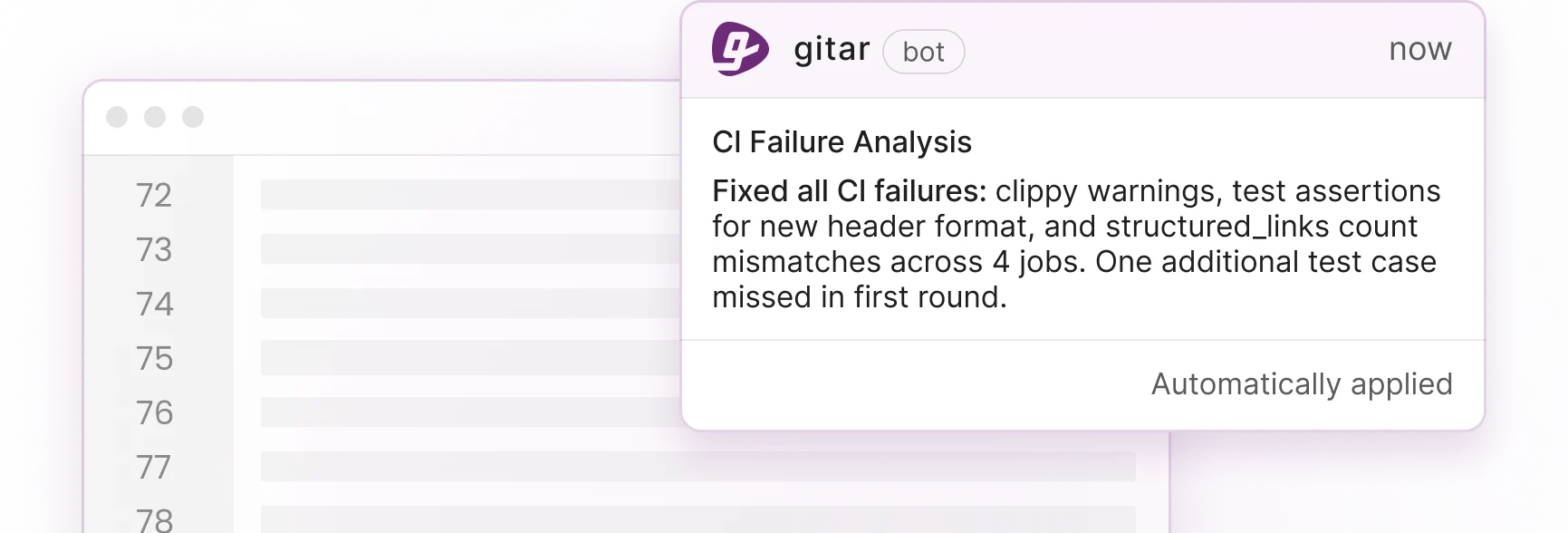
Move beyond suggestion-only tools and see how Gitar’s autonomous code healing fixes broken builds and accelerates your shipping velocity during a 14-day trial.